
2 minute watch (TRAILER), 10 minute read.
In this episode of From Fact to Fiction, I sit down with Special Forces veteran and firearms expert Chris Grall to break down the biggest mistakes writers and filmmakers make—and how to avoid them.
CONTINUE WATCHING Here on Substack or on YouTube.
LISTEN on From Fact To Fiction: Thrilling Book Reviews Podcast (Find most links HERE)
READ the transcript below, lightly edited for length and clarity
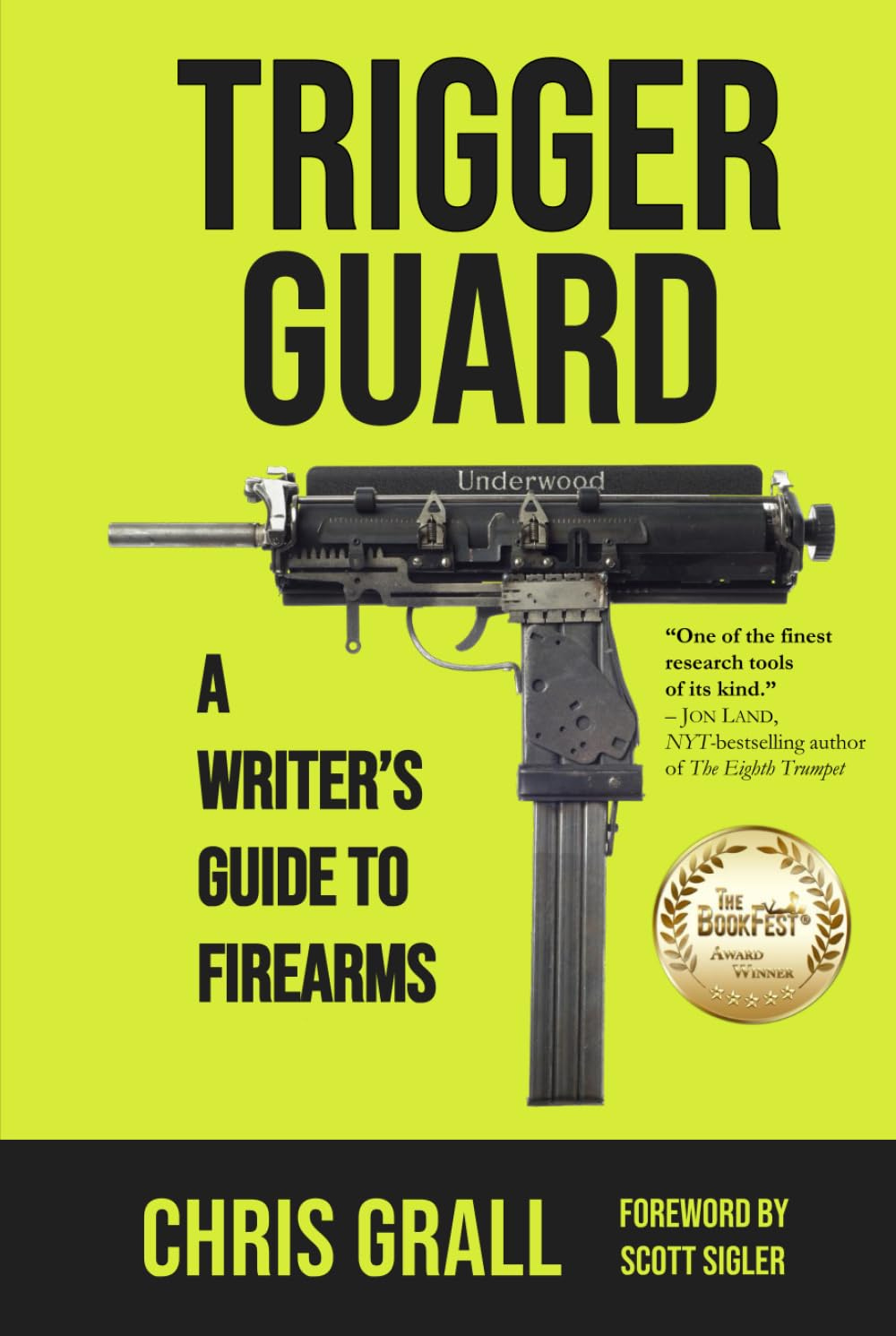
BUY Trigger Guard.
CONTACT Chris: ChrisGrall.com
And, if you are enjoying From Fact To Fiction, please let me know. Add a comment, like this post, or send me a note.
LINDA: So, welcome everybody. Welcome to From Fact to Fiction. I’m Linda Whitaker, your host.
I write speculative and near future thrillers laced with science and technology. I also host this podcast, From Fact to Fiction, where we unpack the truth behind our favorite specialty thrillers.
Think Tom Clancy, John le Carré, Blake Crouch. And while each of these works differ in specialty—from military to political to techno thrillers—each immerses the reader in a new but realistic world.
And the best of these blend fact with fiction so well, it’s hard to tell the difference. You don’t know what is, what could be, and what’s totally impossible. It would take an expert to know.
That’s why each time we meet, I’ll pair up with an expert and we select a new specialty thriller. We’ll not only talk about why we love the book, but unpack the truth behind the fiction.
This week, we’re going to do something totally different. Rather than look into the facts within one book, we’re going to look across thrillers at the facts behind the portrayal of firearms.
We’re going to cover the common errors books and movies make and add a few best practices for writers. We’ll break down some movie clips separating fact from fiction from fantastical.
Our expert to help us today is Chris Grall.
LINDA: Chris is a perfect expert to help us with this. He’s a retired US Special Forces Sergeant. He’s been advising writers on the depiction of firearms since 2007.
He wrote Trigger Guard: A Writer’s Guide to Firearms. And in fact, I met Chris at a writer’s conference where he was advising.
He lives in Lake Barrington, Illinois, with his wife, Mindy, and his puppy, Ricky the Destroyer.
CHRIS: Hello. Thanks for having me.
LINDA: So first, I want to ask you what inspired you to start helping writers doing this kind of quirky thing you do.
CHRIS: Well, it’s a crazy story. Just like everything else good in my life, I backed into it.
I was listening to an audiobook and one of the author’s plot lines was around a bullet type and why he couldn’t use it.
And I just sent him an email. I said, “Hey, you know, they make this thing, right?”
And I sent the email off and I looked over at my wife and I said, “I’ll never hear from that guy.”
Well, two hours later, I get an email and it’s a tirade. It’s a tirade about how it messes everything up for him.
And then he got done with this tirade and he said, “So maybe you can help me on my next one.”
And so I helped him with that one and then the next one. And then I just started, you know, doing this.
LINDA: Let’s get to the facts behind the fiction then.
So as we said, firearms are present in a majority of thrillers, to some extent. And like a doctor watching an operating room or a lawyer reading a courtroom drama, you must get super frustrated with lazy and inaccurate depictions.
CHRIS: Sometimes it will take me right out. Sometimes I won’t even finish a book, and I will finish just about everything that I start. But sometimes it’s just so bad.
There’s some really bad traps for writers out there in the anatomy of different firearms. But basic terminology and basic anatomy of a firearm—you should be able to get that right, even if you speak of guns in the most generic of terms. And if it’s wrong, I’m done.
LINDA: And it’s not just writers. It’s not just books. It’s movies as well, right?
CHRIS: Right. And most movies are pretty good about it. But the biggest offender in movies is the Foley artist—the guy who goes back in and puts the sound effects in.
Which leads to our first Deadly Sin: Clicking on Empty.
CHRIS: So one of my seven deadly sins is when a writer says the gun clicked on empty. Well, it can, but it depends on the firearm. A majority of writers use semi-automatic handguns, which will not click on empty because of the mechanics of the gun itself.
But you’re watching a movie and click, click, click, click, click.
And that mistake propagates into our fiction because, “I saw this really gritty movie that was fantastic in every way, and the gun clicks on empty, so it must be a thing. That’s what I’m going to write.”
And that’s how movies get it wrong in the most subtle way that translates into our fiction.
So, I have a really good video example of clicking on empty if you want to see it.
LINDA: Sure.
CHRIS: All right. This is from the TV show The Punisher, and it is possibly the most egregious clicking on empty there could possibly be.
So we have Frank Castle there. He’s been shot at, and we’re tracking the number of bullets because, you know, in a firefight, you can count how many bullets are shot.
And here we get click, click, click, click, click—five clicks—and the slide is locked back to the rear.
So this is why that won’t work. I have a regular semi-automatic firearm here. You can see the slide is locked back to the rear, as it would be if I shot it until it was empty.
And you can see that the trigger is back. So there is nothing—and I cannot pull the trigger.
Now, if I did have a revolver, it’ll click all day long because that’s how revolvers do. Because the action moves when the trigger is pulled.
So with a revolver, yeah, you can click on empty all day. But with any of the semi-automatics, you can’t.
LINDA: Well, let’s move along with your pet peeves—your seven deadly sins. That was one, clicking on empty. That was number one. What are some others?
CHRIS: Well, basic anatomy for any kind of pistol. And this is a trap because different firearms have different features.
You can look at the description of a firearm—let’s take the Glock, for example.
There we go. You know, here you go, you’ve got a Glock. And if you read the description for Glock, it says it has a trigger safety.
Well, most people associate that with a safety that you can put on and off. And yes, there’s a trigger safety, but in the firearms community, it doesn’t count.
There are manual safeties that you can click on and off, and that’s fine with the firearms community.
But you also have other kinds of safeties, like this grip safety, which is a safety, but it doesn’t count as far as the firearms community is concerned with putting a gun on and off safe.
And then you’ve got the trigger safety, like on that Glock 19 right there. And it’s right there on the trigger, but it doesn’t count as a safety either.
So anatomy is a big one. And you should be able to diagnose and read just the basic facts about what a firearm is and how it operates—or how that particular firearm operates.
So you don’t say he put the Glock on safe, which is just one of the worst cardinal sins ever.
CHRIS: If we’re going down the deadly sins, you’ve got bullet effects.
When you’re hit by a bullet, you’re not going to be picked up and thrown across a room. A 0.5 ounce bullet is never going to lift a 100 pound person and throw them across the room. I mean, that’s just physics.
Not only that, but in order for the bullet to exert that much force on a person, that same amount of force has to be applied to the shooter. So they would fall back because of conservation of momentum. So they would get thrown across the room simply by pulling the trigger.
Having your gunshot victim do any kind of acrobatics is not advised.
CHRIS: Menacing. Menacing’s always a good one.
So menacing would be me operating the gun in such a way as to make you think I really mean business.
So if I’m in a crazy hostage scene, interrogation thing going on here, and I’m holding my gun and I’m mad at Linda and I decide, okay, well, I’m going to prove that I’m mad at Linda by doing that (racking the pistol slide).
Well, if there were bullets in the gun, I would have just ejected a bullet.
And if a bullet didn’t eject, then there was no bullet in the gun in the first place.
So operating the firearm in order to make a point is only going to make the character look dumb.
CHRIS: Now there’s a big thing in some movies, and it bleeds into fiction, where the good guys or the bad guys decide to go hot—weapon off safe—and that’s generally with rifles.
But in Special Forces, we were trained you’re either '“on safe” or you’re “off safe” and actually shooting at somebody. And as soon as you’re done shooting, you go back on safe because you have this big long rifle.
And if you decide to let it hang on your equipment and you’re doing other things, gear grows hands and fingers, and it likes to try to pull that trigger for you.
So if it isn’t “on safe”, it’s not a safe gun. And that’s why professionals go on and off safe when they’re shooting.
CHRIS: And I only have one more deadly sin—and it isn’t really a sin, it’s just more of a pet peeve—and that’s the gun jammed.
LINDA: Right at the moment when the gun’s pointed at you and the person is just about to get it—the gun jams.
CHRIS: If guns jammed as much in real life as they do in fiction, we would all still be using swords.
CHRIS: When a character is using two pistols, it’s just horrible.
I mean, here you go—you’ve got Bruce Willis and Harvey Keitel and Antonio Banderas and Lara Croft and all these people that just love to use two guns at the same time.
But the problem is that it’s really confusing. Not very good to use two guns at the same time.
I’ve tried it because I’ve done a lot of training with police, and we’d fight each other with simmunitions. And I thought, you know what? Today I’m going to go with two guns. I’m going to see what it’s like.
I have a lefty and a righty.
And what I found was I fought with one hand and then I’d fight with the other hand. But then you run out of ammo.
And you can see from this clip that it’s very difficult to load a gun with a gun in your other hand. So just don’t do that. Just don’t.
CHRIS: But as far as best practices go, always pick a common firearm.
You know, you could pick the Glock 19 here and you could say, “Oh, it’s a Glock,” and you never really have to explain that very much because everybody knows what a Glock is.
You could say, “Oh, he’s got his Colt Peacemaker.” Okay—yeah, Colt Peacemaker, single action, cowboy gun—got it.
Or you could say he pulled out his harmonica gun.
Which one are you going to look up? Which one are you going to just glaze over and continue with the story? And which is going to make a person stop and go, “What is that?”
And that’s exactly what you don’t want, especially in a tense scene.
And then the other thing to do is keep your interactions with the firearm simple.
You know, keep it the most basic that you can—load, unload, aim, fire, holster, safe, if it’s equipped with a safety.
If you just keep it to those simple interactions, you’re not going to run into anybody’s pet peeves or biases or training ideas.
LINDA: I had two other examples—two things I wanted to pull out from your book that I thought were great ideas, best practices.
And I think it relates all to keeping it simple, but making sure you understand a level above kind of what you’re writing on paper.
You said to almost choreograph your scene—write it on paper, draw a diagram so that you don’t inadvertently have good guys shooting at each other from blind corners or something, right?
So that was great.
And second, [as an add on to terminology,] only write down what you know—which may be less than what you’ve researched—you may not bring it all out, but it keeps it all aligned.
So very good advice.
CHRIS: Exactly. Understand more than you show— write one level down.
CHRIS: Behind me is a model of a space gun [that I invented for use] in one of Scott Sigler’s books. (See pic below).
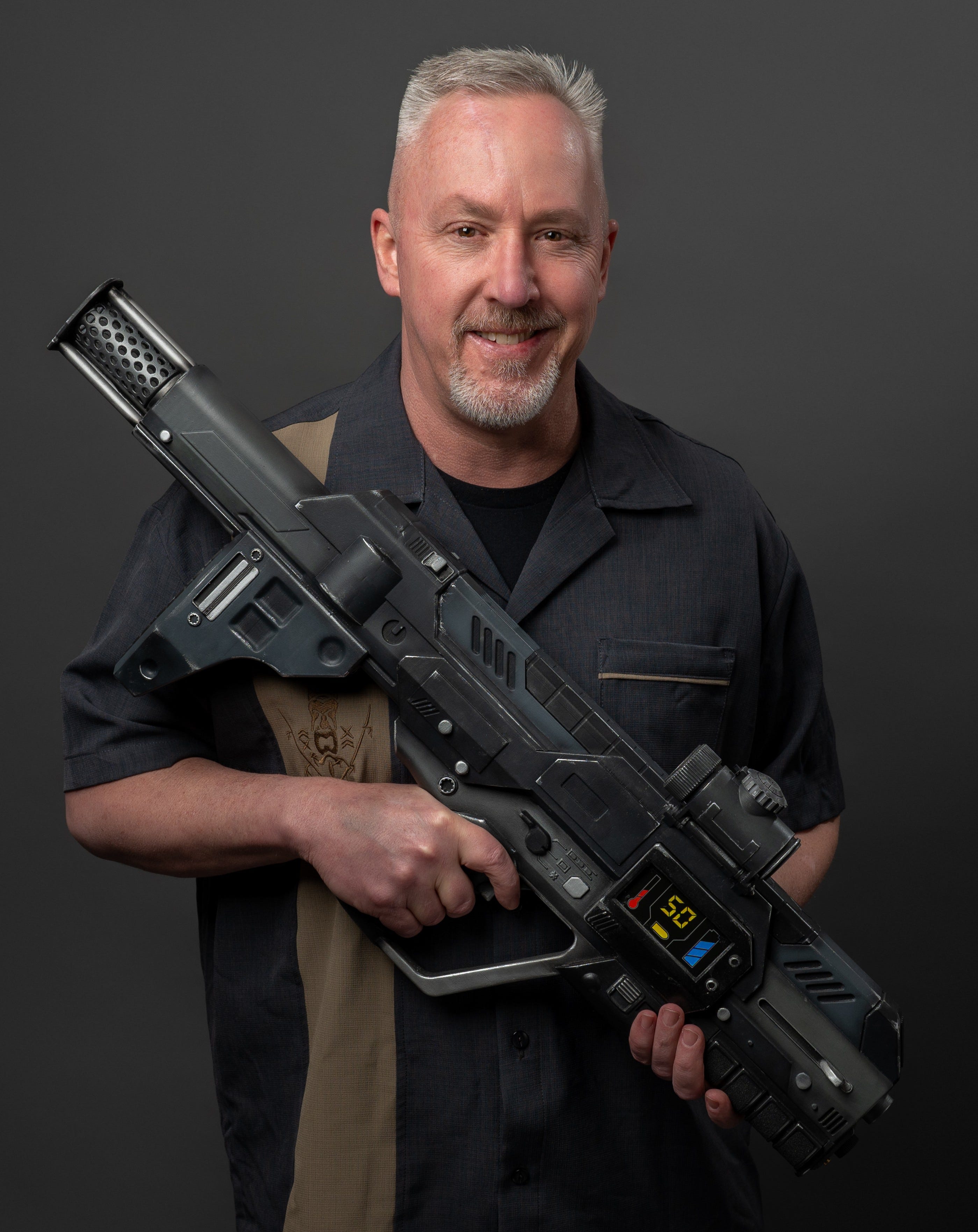
LINDA: I was just looking at it in your book, wondering if that was it.
CHRIS: That was it.
A prop maker actually built the thing. And I only bring it up because I have a whole manual of arms—how to load, inspect, operate that particular space firearm.
I developed the whole thing. Scott didn’t use any of it—he has it—but like you say, write a level down from what you know, and then you can always pull it out if you need to have that extra detail.
But most of the time, you’re not going to need it—but it keeps everything you do consistent.
CHRIS: There are some really, really good movies out there, though. And they’re getting better.
A movie that is just tremendous is called Way of the Gun. It’s got Benicio del Toro in it, and the firearms depictions in that movie are just amazing.
In one particular scene there’s a sniper up on the hill, and you hear the round come whizzing in, one of the characters gets hit, falls over, and then you hear the report of the round from up the hill.
And that’s reality right there.
Of course, Heat—the shootout in Heat was just an incredibly well choreographed and executed movie scene.
LINDA: What we’ve talked about today has been in the context of writers, but anyone who reads or watches thrillers probably won’t experience gunfights the same way again.
And apologies if we ruined that for you.
If you’re a writer, pick up Trigger Guard. And don’t forget Chris’s upcoming novel, Schrodinger’s Glass.
Thank you again for being here.
CHRIS: Thank you. It’s been a pleasure.
LINDA: And we’ll see everyone next time on From Fact to Fiction.
Thanks for reading From Fact To Fiction with Author L M Whitaker! This post is public so feel free to share it.
Comments
Nothing yet. Say the first thing.
Sign in to join the conversation.