
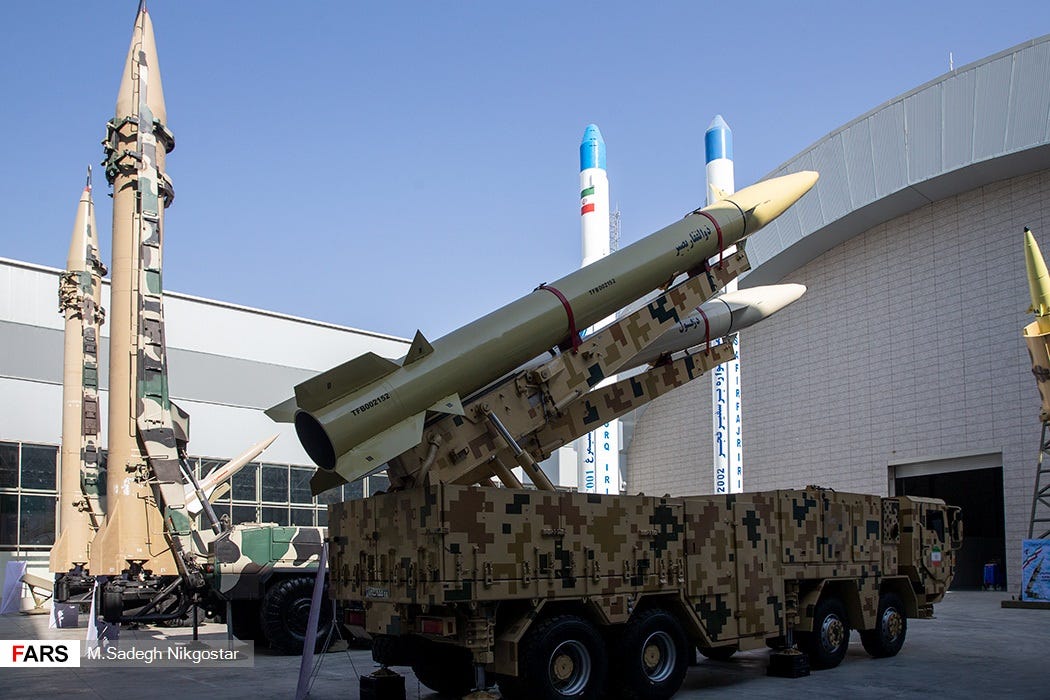
Iranian President Massoud Pezeshkian said on June 21, 2026, that his government had given 20 million barrels of state-owned oil to the Aerospace Force of the Islamic Revolutionary Guard Corps (IRGC). He also said the government had given foreign currency to what he called “these dear ones.”
Video: President Masoud Pezeshkian speaking at the Basij Professors gathering at the University of Tehran on June 21, 2026.
President Masoud Pezeshkian speaking at the Basij Professors gathering at the University of Tehran on June 21, 2026, where he said the government had allocated 20 million barrels of oil to the IRGC Aerospace Force.
His remarks raise a basic question. Which oil money was he referring to?
The question matters because Iran’s state budget already allocates large oil revenue to the armed forces. The budget also contains less transparent channels that can move oil revenue outside normal public spending.
Speaking at the University of Tehran, Pezeshkian said that the armed forces could not have fought without government support. He then said that 20 million barrels of oil belonging to the government had been given to the IRGC Aerospace Force. In his words, the oil came “from our own money.”
The IRGC Aerospace Force oversees Iran’s missiles, drones, and aerospace operations. The IRGC itself is one of the Islamic Republic’s most powerful military and political institutions, with its own budget lines, economic network, and access to state resources through channels that are often opaque.
Factnameh reviewed Iran’s 2026-27 budget law to understand where this 20 million barrels could have come from.
Note: Iran’s budget uses its own official exchange rate to convert oil revenue from tomans into dollars. This rate is lower than market exchange rates, so the size of an oil allocation can look different depending on whether it is measured in tomans, dollars, or barrels of oil.
Possibility One: The Armed Forces’ Regular Oil Allocation
The first possibility is that Pezeshkian was referring to the regular oil allocation already written into the budget for the armed forces.
According to the 2026-27 budget law, at least 7.5 billion dollars worth of crude oil has been set aside for the armed forces. A major share of this goes to the IRGC.
This estimate comes from Table 24 of the budget. Several budget lines, numbered 830001 through 830006, allocate a total of 915 trillion tomans to the armed forces. Tomans are the currency unit commonly used in Iran. One toman equals 10 rials, Iran’s official currency. These funds are described as money for strengthening defense capacity and for special military and security projects.
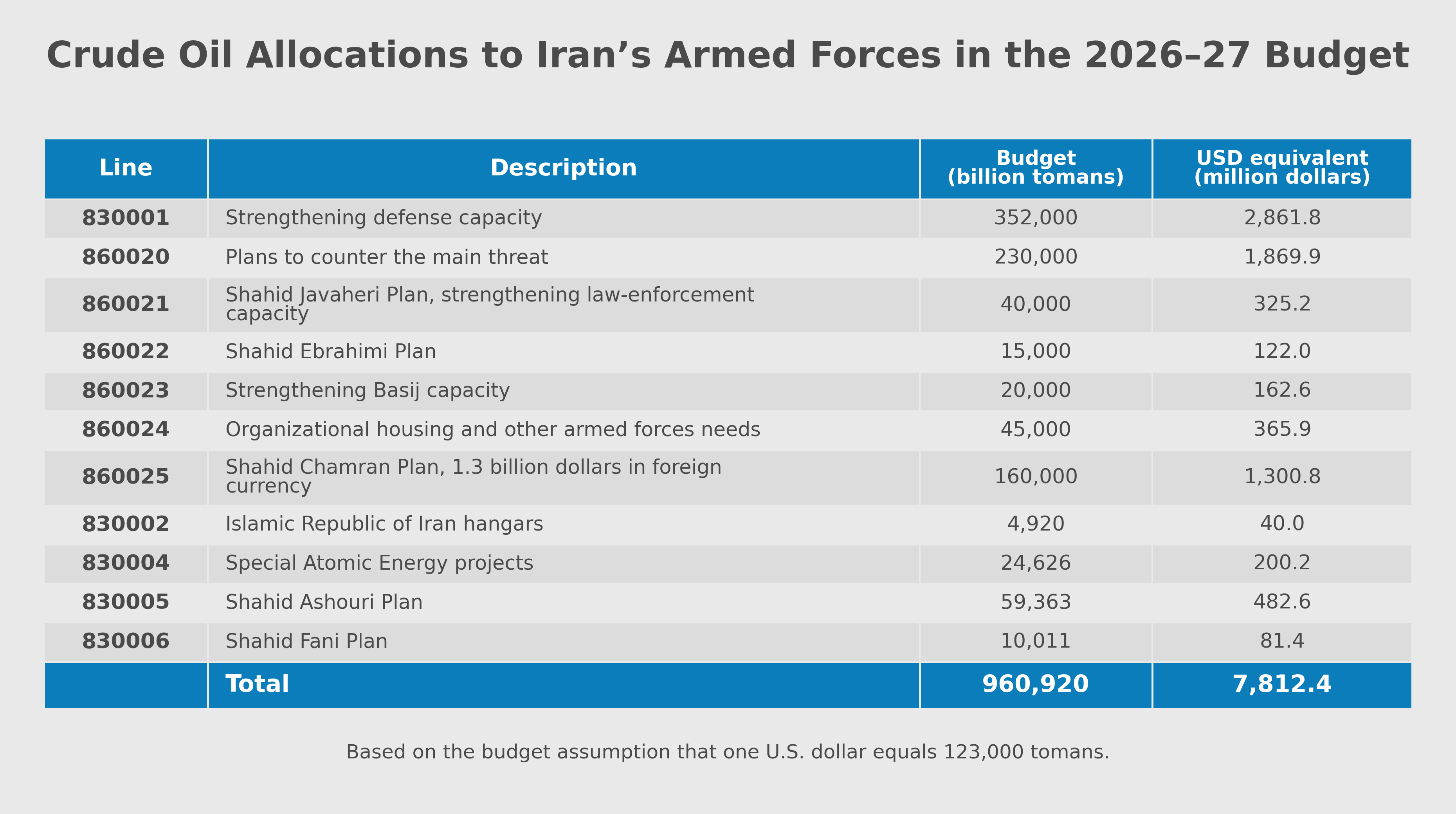
One of these lines names the Shahid Chamran Plan, a special military budget project whose details are not publicly clear, and assigns 160 trillion tomans to it in foreign currency. The same line says this equals about 1.3 billion dollars. This means the budget is using an official budget exchange rate of about 123,000 tomans for one U.S. dollar.
Using that exchange rate, the total 915 trillion tomans oil allocation for the armed forces is worth about 7.5 billion dollars. If each barrel of oil is valued at 100 dollars, that equals about 75 million barrels of crude oil.
This means the armed forces already receive several times more oil than the 20 million barrels Pezeshkian mentioned.
This is only part of the military budget. The armed forces also have their regular budget lines, as they do every year. Other parts of the budget include additional funds for military institutions.
There is another important clause at the bottom of Table 23. It says that if the government sells oil-related foreign currency at a rate higher than the budget’s accounting exchange rate, the extra money must be added to the Shahid Chamran Plan.
In simple terms, if the government sells those oil dollars for more than 123,000 tomans per dollar, the difference also goes to the armed forces. During the past three months, the official exchange rate used by Iran’s exchange center has been about 17 percent higher than the budget rate. Under that clause, the extra 17 percent would also go to the armed forces.
These provisions make one point clear: the armed forces’ oil allocation under the 2026-27 budget is substantially larger than the amount Pezeshkian cited.
What remains unclear is how much of that allocation goes specifically to the IRGC Aerospace Force. The budget does not provide that level of detail. Much of the money is distributed under project names taken from the names of fallen military figures, and there is no public information about what those projects are or which forces receive the funds.
Possibility Two: Oil Allocated to the Public Budget
The second possibility is that Pezeshkian meant money that normally belongs to the government’s public budget.
This would be more politically significant because the public budget pays for ordinary state spending. It covers salaries for government employees, payments to retirees, health spending, education, ministry programs, construction projects, and the regular budget lines of military institutions.
In the 2026-27 budget, the government’s public share from oil and petroleum products is listed in Table 5, line 210100. The total is 263 trillion tomans.
That amount is only about one third of the crude oil allocation given to the armed forces. If it is converted into dollars using the budget’s exchange rate and then into oil at 100 dollars per barrel, the entire oil share of the public budget comes to about 21 million barrels.
That number is very close to the 20 million barrels Pezeshkian mentioned.
So, if Pezeshkian meant that the government redirected oil from the public budget to the IRGC Aerospace Force, then the amount he named would be almost equal to the entire annual oil share assigned to the public budget under the budget’s own assumptions.
The budget also allows the government to borrow from the National Development Fund, which is Iran’s sovereign oil fund. The law allows the government to take up to 20 percent of the fund’s oil revenue share as a loan for public spending.
For 2026-27, that loan is about 947 trillion tomans, equal to around 7.7 billion dollars using the budget’s exchange rate. But this is not free revenue. It is counted as a loan to the government.
Possibility Three: Oil Used to Settle Government Debts
The third possible source is the oil used for settling government debts.
Iran’s 2026–27 budget includes a separate oil barter channel in Table 23, line 430011, meaning the government can use oil instead of cash to settle some obligations. This channel is worth 1,252 trillion tomans, or about 10 billion dollars.
This part of the oil revenue is meant for settling government debts with real people, companies, and other legal entities. The details are not clear.
This may be what Pezeshkian meant when he said the government gave the armed forces money “from our own money.” In that case, the government may have taken oil that was supposed to be used to settle debts with creditors and given it instead to the IRGC Aerospace Force.
If that is what happened, the cost has not disappeared. It would likely be pushed into future government debt.
Another Budget Mechanism
The budget law also makes an important distinction. Some oil allocations are given to the armed forces or used for barter on a net basis. That means they are delivered without first deducting the National Development Fund’s share or the National Iranian Oil Company’s share.
Normally, 40 percent of oil revenue is supposed to go to the National Development Fund. The National Iranian Oil Company also receives 14.5 percent to cover costs related to production, extraction, and exploration.
But when oil is delivered on a net basis for military allocations or barter deals, the government is responsible for later returning those deducted shares to the fund and the oil company.
That creates another layer of future pressure on the state budget.
Factnameh’s conclusion is that Pezeshkian’s statement is not precise enough to identify the exact source of the 20 million barrels he mentioned.
If he meant the armed forces’ regular oil allocation in the 2026-27 budget, then the number is not surprising. The budget already gives the armed forces the equivalent of about 75 million barrels of crude oil, possibly more depending on exchange rate gains.
If he meant the public budget’s oil share, then the statement is much more serious. The entire public budget’s direct oil share is only about 21 million barrels under the budget’s own assumptions.
If he meant the barter channel for settling government debts, then the government may have shifted oil away from debt repayment and toward the IRGC Aerospace Force. That would likely move the burden to future budgets.
Because the budget is not transparent, it is impossible to say exactly how much of the armed forces’ oil allocation goes to the IRGC Aerospace Force. What is clear is that Iran’s 2026-27 budget contains several major channels for transferring oil revenue to the military, and some of them are far larger than the 20 million barrels Pezeshkian named.
No posts
Comments
Nothing yet. Say the first thing.
Sign in to join the conversation.