
If you are short on time
This investigation reviewed 319 articles published in the “Reports and Analysis” section of Sputnik Persian between January 1 and June 15, 2026
Over those five and a half months, Sputnik Persian, the Persian-language branch of the Russian state-owned Sputnik news agency, repeatedly went beyond reporting events in Iran. The outlet openly took positions on some of the country’s most sensitive political questions, including the suppression of protests, the succession of Iran’s supreme leader, the conduct of the recent war and whether Iran should develop nuclear weapons.
Foreign state-backed media outlets are not unusual in Iran. Several international broadcasters publish in Persian and operate according to their own editorial frameworks and the interests of their sponsoring governments. However, they generally make at least some effort to maintain the appearance of editorial distance. Sputnik Persian made little effort to do so.
Sputnik endorsed Mojtaba Khamenei as the best choice to succeed his father, Ali Khamenei, after the latter was killed. Sputnik Persian defended attacks on Arab countries during the war, opposed an early ceasefire, and later portrayed the eventual agreement as a major diplomatic victory.
The outlet’s regional manager in Iran described nuclear weapons as a legitimate means of survival, arguing that Iran should follow North Korea rather than the “failed” example of Libya. The outlet also supported hardline political factions inside Iran, attacked politicians portrayed as pro-Western, and described protesters and opponents as rioters, mercenaries, traitors, and spies.
Some of its analyses promoted elaborate conspiracy theories, linking the war and the deaths of schoolgirls in Minab to Satanic rituals, virgin sacrifice, black magic, Freemasonry, and alleged Jewish cartels controlling the world.
The period covered by this review coincided with one of the most consequential stretches in Iran’s recent history.
It began with nationwide protests in January and an unprecedented crackdown on January 8 and 9 that left thousands dead. On February 28, the United States and Israel launched a war against the Islamic Republic. Ali Khamenei and several senior political, military, and security officials were killed, and his son, Mojtaba Khamenei, succeeded him.
Military and security facilities across Iran were attacked. Hundreds were killed, including civilians and children at a school in the southern city of Minab. A ceasefire took effect on April 6, followed by an agreement formally ending the war on June 15.
Each of these events marked a major turning point for Iran’s politics, society, and international relations. Together, they generated intense media attention.
Most outlets reported on these events. Some also sought to shape the political debates surrounding them.
Sputnik Persian was one of them.
Sputnik is the Persian-language branch of Sputnik, the international news agency established by the Russian government on November 10, 2014. Its official operations in Iran began only a few months later, when its Persian-language website began publishing from inside the country in late March 2015.
The Sputnik Persian website does not publicly identify its managers, editorial board, or professional editorial standards. Available evidence, however, indicates that Emad Abshenas manage its operations in Iran.
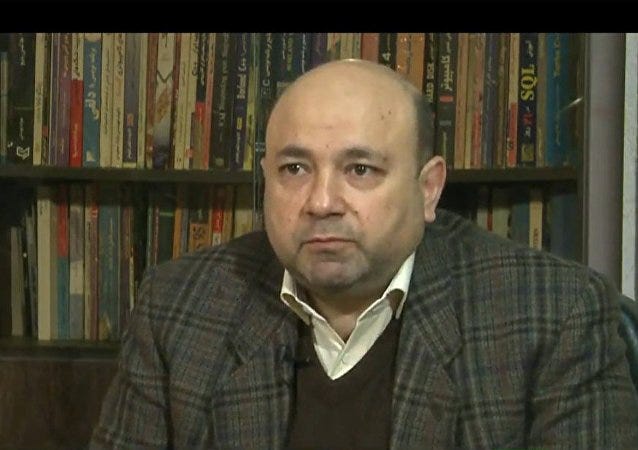
In a professional CV submitted during his 2020 parliamentary campaign, Abshenas described himself as Sputnik’s “representative and regional director in Tehran” from 2014 onward. He had previously held international roles at the Islamic Republic News Agency and other Iranian state media organizations. Before joining Sputnik, he served as international director of the Iran Newspaper Institute and managing editor of the English-language newspaper Iran Daily.
Abshenas has an unusually dominant presence on Sputnik Persian. Of the 319 articles reviewed, 241 carried named bylines. More than half of those (124 articles, or approximately 51 percent) were attributed to “Dr. Emad Abshenas.”
The second most frequent byline was “Shiva Abshenas,” who was credited on 99 reports, or approximately 41 percent of all attributed articles. She shares Emad Abshenas’ surname and may be related to him, although this review could not confirm the nature of any relationship.
Questions were sent to the contact email listed on Sputnik Persian’s website regarding the outlet’s management, editorial staff, editorial policies, and the political positions reflected in its articles. No response had been received by the time of publication.
The review found that Sputnik Persian consistently defended the Islamic Republic while aligning itself with hardline political factions often described in Iran as “value-oriented.” At the same time, it attacked groups it portrayed as moderate or pro-Western.
During the January protests, the outlet adopted the language used by Iranian authorities to describe demonstrators disparagingly and defended the government’s crackdown. During the war, it framed events almost exclusively from the perspective of the Iranian government and armed forces.
Its coverage went beyond reporting events. Sputnik Persian promoted hardline political currents, attacked factions described as moderate or pro-Western, and accused parts of the state and political establishment of serving as a fifth column (a term used to describe internal actors working on behalf of an external enemy).
Its Reports and Analysis section also published political and social conspiracy theories as serious analysis.
Sputnik Persian presented the January 2026 protests as part of an operation conducted by armed agents of Mossad, Israel’s foreign intelligence service, to divide Iran and trigger a civil war.
Its writers repeatedly used terms such as “rioters,” “mercenaries,” and “troublemakers” when referring to demonstrators. They also defended the authorities’ response.
In an article published on February 13, Emad Abshenas outlined what he described as the plan behind the unrest. According to his account, Israeli agents were intended to infiltrate legitimate demonstrations and shoot both protesters and security personnel, causing widespread bloodshed. Members of the armed forces would then supposedly defect, allowing American and Israeli operatives to join them and initiate a civil war.
He wrote:
“Israel’s mercenaries were to begin shooting at citizens and security forces amid public demonstrations in order to create bloody clashes. The second objective was for part of those countries’ armed forces to stand against the government under the pretext of joining the protesters. American and Israeli infiltrators would then join them, and a civil war would begin.”
Before the protests reached their most violent stage on January 8 and 9, Sputnik Persian had already begun framing what it considered legitimate economic grievances as separate from so-called riots.
An article published on January 3 argued that certain groups were exploiting economic conditions to recreate what it described as the situations of Libya or Syria. It claimed that the organizations supporting those groups were backed by the same forces.
The article stated:
“Protesters never attack public or even government property, and ordinary citizens do not carry weapons. Citizens are different from thugs and rioters.”
On January 16, less than a week after the mass killings, Sputnik Persian praised the security response.
It wrote:
“Iran’s security forces managed to bring the situation under control. Since last Saturday, we have not witnessed further demonstrations. Although some tried to ignite scattered incidents in certain places, citizens realized that others were trying to hijack their legitimate protests and separated themselves from those seeking disorder.”
Sputnik Persian also defended the nationwide restrictions on internet access. One article described internet connectivity as an essential part of modern life, but argued that it could lose its civilian character when used by terrorist groups or networks seeking unrest. Under those circumstances, it said, the internet became a military instrument and a weapon for sabotage. The article presented cutting access as a lawful measure for “containing terrorism.”
It stated:
“Access to the internet is an essential and fundamental necessity. But when this communication tool is used by terrorist groups and networks seeking disorder, it changes from a civilian tool into a military instrument used for illegal and illegitimate objectives.”
It continued:
“In such circumstances, the internet is no longer an instrument of public awareness. It becomes an instrument with a terrorist nature, resembling a weapon used for acts of sabotage.”
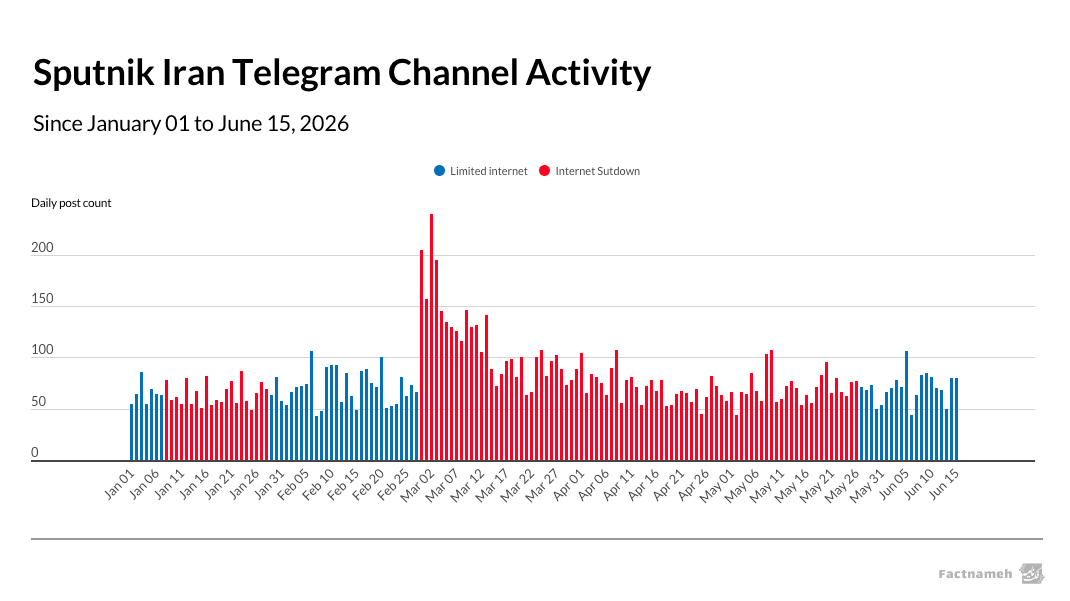
Publication records from Sputnik Persian indicate that its own operators continued to have internet access throughout the shutdowns in January and February and again during the subsequent wartime restrictions. Its social media channels also remained active.
Sputnik Persian’s involvement in Iran’s internal politics became particularly clear after the killing of Ali Khamenei, Iran’s supreme leader.
In his first article responding to Khamenei’s death, Emad Abshenas praised him as a historic figure who had restored Iran’s power.
He wrote:
“History will record his name as an enduring figure. He took charge of Iran after the Iran-Iraq war, when it had no defensive capabilities, and after 2,500 years succeeded in extending Iran’s power to the Mediterranean Sea and the Red Sea. Today, Iran can stand powerfully against the United States and Israel. At the time of his martyrdom, he stood like a mountain at his workplace and did not hide in a shelter.”
Abshenas had previously praised Khamenei for appearing in public rather than remaining underground. Several weeks earlier, he had described one of Khamenei’s public appearances as “a powerful display by Iran’s leadership” and “a firm slap in the face of all those making absurd claims.”
After Mojtaba Khamenei was selected to succeed his father, Sputnik Persian extended the same admiring language to him. The outlet described his appointment as powerful, unifying, and as capable of defeating the objectives and plots of Iran’s enemies.
However, the outlet’s support for Mojtaba Khamenei’s succession predated his appointment.
On March 6, Sputnik Persian responded to a statement by US President Donald Trump opposing Mojtaba Khamenei’s succession. Rather than treating the American opposition as a reason for caution, the article argued that it made Mojtaba an even more compelling choice.
It stated:
“Even those who may have hesitated over selecting him for specific reasons, or who may have considered other candidates, will now become certain that the best response to the assassination of the martyred Khamenei is to choose his son as his successor.”
Abshenas’s advocacy for Mojtaba Khamenei did not begin with the war. Approximately four years earlier, his writings supporting Mojtaba’s possible leadership had attracted public and media attention in Iran.
In an article discussing what might happen after Ali Khamenei’s death, he wrote:
“When the time comes for the leader to pass away, the question of his succession will arise. If Ayatollah Mojtaba Khamenei is the most qualified person at that time, there would be no logical reason for the Assembly of Experts not to select him because of media uproar.”
The Assembly of Experts is the Iranian body responsible for selecting the supreme leader.
Sputnik Persian was therefore not simply reacting to Mojtaba Khamenei’s appointment after it occurred. Its most prominent contributor had publicly promoted Mojtaba Khamenei as a future supreme leader years earlier and actively argued for his selection when the position became vacant.
The war became one of the main focuses of Sputnik Persian’s coverage during the period reviewed. Its reports and analyses consistently presented the conflict from the perspective of Iran’s government and armed forces, using language similar to that of official Iranian media and outlets affiliated with military institutions.
Some articles went beyond conventional reporting and made highly dramatic claims about Iran’s military capabilities and the scale of American losses.
On April 4, Sputnik Persian published an article claiming that members of Iran’s ethnic minority Lur and Arab communities had confronted heavily armed American aircraft using hunting rifles.
The article stated:
“Lur and Arab citizens, using the most limited equipment and rifles intended for hunting animals, confronted heavily armed American aircraft. Social media is now filled with proud scenes of courageous Iranian men and women confronting those seeking to destroy Iran and send the Iranian nation back to the Stone Age.”
In another report, published on April 27, Sputnik Persian claimed that the United States had used or lost more than half of its defensive and offensive missiles during the war. It claimed that Iran, by contrast, had used only between 10 and 20 percent of its weapons over 40 days of fighting.
In the same article, Abshenas moved well beyond conventional news language while praising an Iranian pilot.
He wrote:
“The Iranian pilot had not only skill but, as the saying goes, guts. And what guts he had, enough for a hundred enemy pilots.”
The comment referred to a report claiming that Iran had used roughly 70-year-old F-5 fighter jets to attack American bases in the region and had “reduced them to dust.”
Sputnik Persian also published material justifying Iranian attacks beyond US military targets, namely those on neighbouring Arab countries.
One day after the war began, an article argued that Iran’s response would no longer be limited to American military bases or personnel after the killing of Ali Khamenei.
It stated:
“After the assassination of Ayatollah Khamenei, the issue will probably no longer be limited to targeting American bases and forces. Because the Iranians know that America’s current vulnerability is economic, they may move toward targeting all American projects and economic interests in the region.”
Several months later, Abshenas published an article titled “Why Did Iran Attack Some Arab Countries?” The article argued that Iran had attacked them because governments in the region had cooperated with the United States and Israel.
This position was not entirely consistent with Sputnik Persian’s earlier coverage. In other articles, Abshenas had claimed that Iran targeted only American bases. He attributed attacks on other sites in Arab countries to American and Israeli “false flag” operations designed to damage Iran’s relations with its neighbours.
The outlet also opposed negotiations and an early ceasefire.
On March 26, it published an article arguing that stopping the war under the existing conditions would be a strategic mistake.
It stated:
“Accepting any ceasefire under the present conditions would be considered a strategic mistake for Iran. Iranians are in no way prepared to accept such a ceasefire before their demands have been achieved.”
In another article, Abshenas warned that the United States and Israel declared ceasefires whenever they realized they were losing, using the pause to rebuild their strength.
Sputnik Persian later changed its position after the final agreement was signed in June. It described the agreement as a major diplomatic victory.
The shift was notable. The outlet had initially argued against a ceasefire, warned that it would allow Iran’s enemies to regroup and insisted that Iranians would not accept such an agreement. Once an agreement had been reached, however, Sputnik Persian presented the outcome as evidence of success.
Sputnik Persian’s articles did not portray the possibility of an Iranian nuclear weapon primarily as a danger. Instead, they presented nuclear deterrence as a legitimate right and possible means of survival against what the outlet called the “law of the jungle” imposed by the United States and Israel.
The central comparison was between Libya and North Korea. Libya was presented as a state that abandoned its strategic capabilities under Western pressure and was later destroyed. North Korea, by contrast, was presented as a state that developed nuclear weapons and preserved its existence. For Iran, Sputnik Persian argued, the North Korean model was preferable.
On April 9, Abshenas published an article proposing a religious and legal path by which Iran could move toward producing nuclear weapons despite former Ali Khamenei having publicly opposed them.
He wrote:
“Today, a debate is taking place in Iran over whether Iranian officials should continue to adhere to the late leader’s religious ruling or reconsider it in light of changing circumstances. Trump and Netanyahu have left Iran no path except moving in the direction taken by North Korea.”
On May 12, Sputnik Persian published another report titled “Producing 90 Percent Enriched Uranium Is Iran’s Inalienable Right.”
The article stated:
“Today, many believe that Iran is being forced to move even toward the production of nuclear weapons.”
The argument had appeared before the war as well. Approximately one week before fighting began, Abshenas published an article titled “Iran’s Zulfiqar Sword Has Two Edges,” referring to Zulfiqar, a symbolic sword. In the piece, Abshenas contrasted the outcomes of Libya and North Korea, stating:
“Libya obeyed out of fear of confronting the Americans and was destroyed. North Korea moved toward building nuclear weapons and at least preserved its existence.”
He then applied the same logic to Iran:
“Iran is already in so deep that one metre or one hundred metres makes no difference. At the very least, it will try to preserve its existence.”
These articles did more than discuss nuclear policy. Invoking Libya and North Korea to argue that acquiring a nuclear deterrent was a rational and even necessary course of action, positioning Sputnik Persian not as a detached observer but as an advocate for a particular strategic outcome.
Supporting hardliners and attacking political opponents
Sputnik Persian’s intervention extended beyond foreign policy into Iran’s domestic political disputes.
Its reporting during the examined period consistently favoured hardline groups often described inside Iran as “value-oriented” factions, which define themselves through ideological commitment to the Islamic Republic and its official revolutionary principles. At the same time, the outlet amplified their narratives while directing aggressive language at their opponents.
Opponents of the Islamic Republic were described as “dollar-paid mercenaries,” “disillusioned individuals,” “fascists” and “traitors.” The outlet also attacked political groups operating within the Islamic Republic, portraying figures it regarded as pro-Western as a fifth column or as spies working from inside the state.
In an article published on May 3, Sputnik Persian argued that fifth-column activity within the state could cause more damage than conventional espionage.
It stated:
“The betrayal committed by members of the fifth column is far greater than the betrayal of spies themselves. Their activity may take place in administrative positions, through the deliberate disruption of the country’s governmental or administrative structure.”
Another article blamed profiteers and politically connected beneficiaries for rising prices before linking economic disruption to espionage and political sabotage.
It warned:
“Many of them are members of the same fifth column. Some are responsible for espionage and assassination, while others are assigned to disrupt the country’s economic and psychological conditions.”
Sputnik Persian also criticized what it called “the pro-Western current inside Iran that has always acted against Russia.”
In making this argument, the outlet warned against repeating Iran’s previous agreements with Western governments. It referred first to the 2004 Saadabad agreement, signed when Hassan Rouhani served as secretary of Iran’s Supreme National Security Council, and then to the 2015 nuclear agreement, commonly known as the JCPOA.
The article stated:
“Many may have forgotten that in 2004 the Iranians signed an agreement with the Western parties known as the Saadabad agreement. At the time, Mr. Rouhani was secretary of the Supreme National Security Council.”
It continued:
“The same thing was repeated with the JCPOA in 2015. Although Iran carried out all its commitments, the United States withdrew from the agreement and did not fulfill even one of its commitments.”
Within this narrative, engagement with Western governments was presented not simply as a failed policy but as evidence of the influence of pro-Western factions, internal subversion, and the risk of betrayal from within the Iranian state.
The most extreme material identified in the review consisted of conspiracy theories published as political analysis. These articles connected American and Israeli military objectives to Satanism, black magic, ritual sacrifice, Freemasonry, and alleged Jewish cartels controlling global affairs.
One of the most extraordinary examples was published by Emad Abshenas on April 19. The article connected attacks on schools in Iran, including the deaths of girls in Minab, to supposed Satanic rituals and the ritual sacrifice of children.
Abshenas referred to reports about Jeffrey Epstein’s island and claimed that practices there included sacrificing girls and performing forms of Kabbalistic black magic.
He wrote:
“According to many reports, Satanic acts took place on Epstein’s island, including the sacrifice of young girls and forms of sorcery known as Kabbalistic magic, which are connected to ancient Jewish traditions and black magic.”
He then claimed that individuals seeking to surrender their bodies to demons were required to perform certain rituals:
“For them to place their bodies at the disposal of demons and devils, they must carry out Satanic acts and ceremonies. One of these is the sacrifice of virgin girls or the drinking of their blood.”
The article then connected this theory to the deaths in Minab:
“The fact that the Americans and Israelis began their attack on Iran with the massacre of innocent girls in Minab may be part of the teachings of these Satanists, who probably believe that beginning a war by spilling the blood of young virgin girls will bring them good fortune.”
In the same article, Abshenas also suggested that American and Israeli leaders could be human-looking beings whose bodies had been possessed by demons.
He wrote:
“Some religious texts and beliefs also hold that demons and jinn can enter the bodies of individuals, provided those individuals permit them to enter. Under such circumstances, their bodies become possessed by those jinn or demons. They become jinn and demons who appear human on the outside but are demons within.”
He cited public statements by American officials as evidence of possible possession:
“The recent remarks by the US secretary of war about the Battle of Armageddon, Trump’s insults against the pope and other such behaviour indicate in some way that the opposing parties may have been possessed.”
Another Sputnik Persian article promoted a conspiracy involving Freemasonry and alleged Jewish cartels. In one article, Abshenas described wealthy technology figures, including Bill Gates and Elon Musk, as puppets controlled by those networks and argued that the internet had been developed as a pre-planned operation for collecting humanity’s information.
He wrote:
“The world’s wealthiest individuals, such as Elon Musk or Bill Gates, are in reality puppets of these cartels.”
He then referred to ARPANET, the early computer network developed by the US military, and argued that technology companies had been used to disguise the internet’s true origins and purpose.
He stated:
“Everyone knows that the internet originated as a US military project known as ARPANET. Had the US military openly said that it wanted to carry out this work under its own supervision or that of the CIA, a large part of the public would certainly have refused to use the internet.”
He continued:
“When a company such as Microsoft, led by someone like Bill Gates, provides the relevant software, the public develops trust.”
Rather than appearing as fringe content circulating online, these claims were published in Sputnik Persian’s Reports and Analysis section under the byline of its most prolific contributor and apparent regional manager.
Sputnik Persian is not the only foreign media outlet operating in Iran or publishing in Persian.
Other governments also sponsor Persian-language media services, and those outlets operate according to their own institutional interests and editorial priorities. Partisan or state-aligned coverage by foreign media is not unprecedented.
The difference lies in the degree and directness of Sputnik Persian’s intervention.
Over the five and a half months reviewed, the outlet defended the suppression of protests, justified internet shutdowns, advocated for Mojtaba Khamenei’s succession, defended attacks on neighbouring Arab countries, opposed an early ceasefire before later celebrating the final agreement, portrayed nuclear deterrence as essential to Iran’s survival, supported hardline political factions, and published conspiracy theories as political analysis
The concentration of authorship is also significant. More than half of all attributed reports reviewed were published under the name of Emad Abshenas, who has described himself as Sputnik’s representative and regional director in Tehran. A further 41 percent were attributed to Shiva Abshenas.
The result is a Persian-language outlet whose analysis is dominated by two contributors, one of whom repeatedly took positions on some of the most consequential political questions facing Iran.
Rather than maintaining even the appearance of editorial distance, Sputnik Persian consistently aligned itself with particular factions, policies, and political outcomes inside the Islamic Republic.
In doing so, the Russian state-owned outlet went well beyond the role of a foreign news organization covering a country in crisis. Over the period reviewed, it was an active participant in the political debates unfolding inside Iran.
No posts
Comments
Nothing yet. Say the first thing.
Sign in to join the conversation.