Today, I wish to draw your attention to a recent paper on ‘the economics of a shrinking world’ by Jesús Fernández-Villaverde and Patrick Norrick. I’m unsure what to make of it, but I found it interesting and thought-provoking.
Here’s the abstract (here and below, emphases and [snark] mine):
As of 2026, humanity is likely below replacement fertility. That has never happened before, not in wars or pandemics. But the real surprise is that the fall has been concentrated in low- and middle-income countries and among poorer and less educated women. We fit a single-factor model to 236 countries since 1950: the common component peaked in 1978, and what drives fertility down today are country-specific trends, 219 of them negative and not one leveling off. None of the commonly cited mechanisms can account for this pattern, so we offer a conjecture: modernity itself, which makes a third child expensive and childlessness cheap. Children come in integers, so it takes very little to move a cohort’s fertility rate from 1.8 to 1.3. And nothing in an economy pushes fertility back to 2.1. We close with the main economic consequences, in particular slow growth.
So, shall we keep going? (references omitted for read-ability)
Falling below replacement follows from a fast and accelerating drop in fertility worldwide. Demographers and economists have long expected fertility to fall, but its decline over the last decade has been unusually steep, above all in countries where no one expected such a fast decline. Mexico’s total fertility rate (TFR) in 2025, 1.51, for instance, is likely to be below that of non-Hispanic whites in the U.S., 1.57, despite a GDP per capita at purchasing power parity (PPP) of only around 28% of the U.S. level. Even more striking is Tunisia, whose TFR in 2024 stood at 1.45 with a GDP per capita at PPP of 18% of the U.S. level …
This inversion of the historical relationship between income and fertility across countries also seems to be happening within countries. The negative relationship between household income and fertility, one of the oldest regularities in demography (Jones et al., 2010), flattened in the U.S. between 1980 and 2010, a phenomenon that seems to be spreading to other countries (a similar statement holds for the relation between fertility and education). Even more surprisingly, Doepke et al. (2023) document how the cross-country correlation between the TFR and the female labor force participation rate has also become positive in the OECD data …
Unfortunately, we do not understand the mechanisms behind this fast drop in fertility, or its concentration among lower- and middle-income countries and among the poorest and least educated women within them. A classical quality-quantity trade-off has serious difficulties matching these observations: it is hard to find movements in the skill premium over the last decade large enough to do the work. This is not to say that the trade-off has stopped operating. Rather, no plausible calibration delivers a 35% fall in births in ten years, as in Colombia, through that channel alone. Country-specific mechanisms (poor labor market prospects for the young, high housing prices, contraceptive use, childcare availability) often help account for the timing and speed of a fertility decline. But they fail to account for the global dimension: we would need dozens of them all operating at once in the same direction …
Three popular candidates to account for the fall in fertility are shifts in preferences and social norms, smartphones and their effect on in-person interaction, and rising housing prices. It is too early to adjudicate among these. But, in our reading, smartphones accelerate the change in the TFR more than they cause it, and housing prices have an ambiguous effect because they make owners richer and renters poorer. We are left with shifts in preferences and social norms more by elimination than by conviction.
Thus, we will conjecture a more speculative possibility: modernity itself. We live in a society built around large organizations and formal credentials, which makes a third child expensive and childlessness cheap, and that circumstance has created a mismatch between women’s position outside the home and men’s inside it. As modernity has spread everywhere, even to countries with low income per capita, fertility has also fallen everywhere.
Not knowing the causes, we cannot forecast fertility over the coming decades. And forecasting is the easy part in comparison with designing policy. Economists are used to markets that correct themselves, but nothing in an economy pushes fertility back to replacement.
I’ll stop the flow here to note one aspect: if ‘modernity’ per se is the issue—which seems plausible—I suppose that using such a catch-all phrase or idea isn’t helpful. I suspect one would (should) use a more refined part of the thing itself as, say, modern cars, painkillers, GMO food™, and the internet aren’t exactly the same thing.
That said, the relative cheapness of childlessness, in social, societal, and personal terms, is a real issue, and in this, I think we can point to generous welfare state transfers (health insurance, retirement funds, social insurance) as a prime co-culprit; the same goes for (universal) daycare for children, which was once something shared between parents, grandparents, neighbours, etc.
The economic consequences of these demographic forces are large. As the total labor force starts falling, the trend growth of GDP decreases mechanically. Even if total factor productivity (TFP) growth remains the same, which is unlikely, countries will move to a “new normal” of very slow economic growth. Debt service, pensions, and health care come out of aggregate output, not out of ratios.
None of this is idle speculation. Japanese GDP grew at 0.79% a year from 1991 to 2023, far below the 2.60% of the U.S. But once we control for demographics by looking at GDP per working-age adult, Japan grew at 1.33%, not much below the 1.73% of the U.S. And Japan may be the best-case scenario: it has a homogeneous population, it is well governed, and it is rich [I suspect the authors said the quiet part out loud: diversity™ isn’t a strength]. Countries such as Mexico or Tunisia will face the same demographic pressures with less consensus, far weaker states, and lower income per capita.
However, not all the consequences of a fall in fertility are bad. For example, teenage pregnancies in the U.S., most of them unintended, fell by 71% between 2007 and 2024. Slower population growth eases pressure on infrastructure, housing, and emissions, and gives emerging economies a window to educate smaller cohorts better.
In the second half of the 1980s, a new pattern appeared: countries fell below replacement rate by wide margins. Japan and Italy are the paradigmatic cases. Driven by expensive housing, unbalanced gender norms, and poor labor market prospects for the young, Japan’s TFR stood at 1.54 and Italy’s at 1.36 by 1990 (Retherford et al., 2001, Del Boca, 2002, Feyrer et al., 2008) …
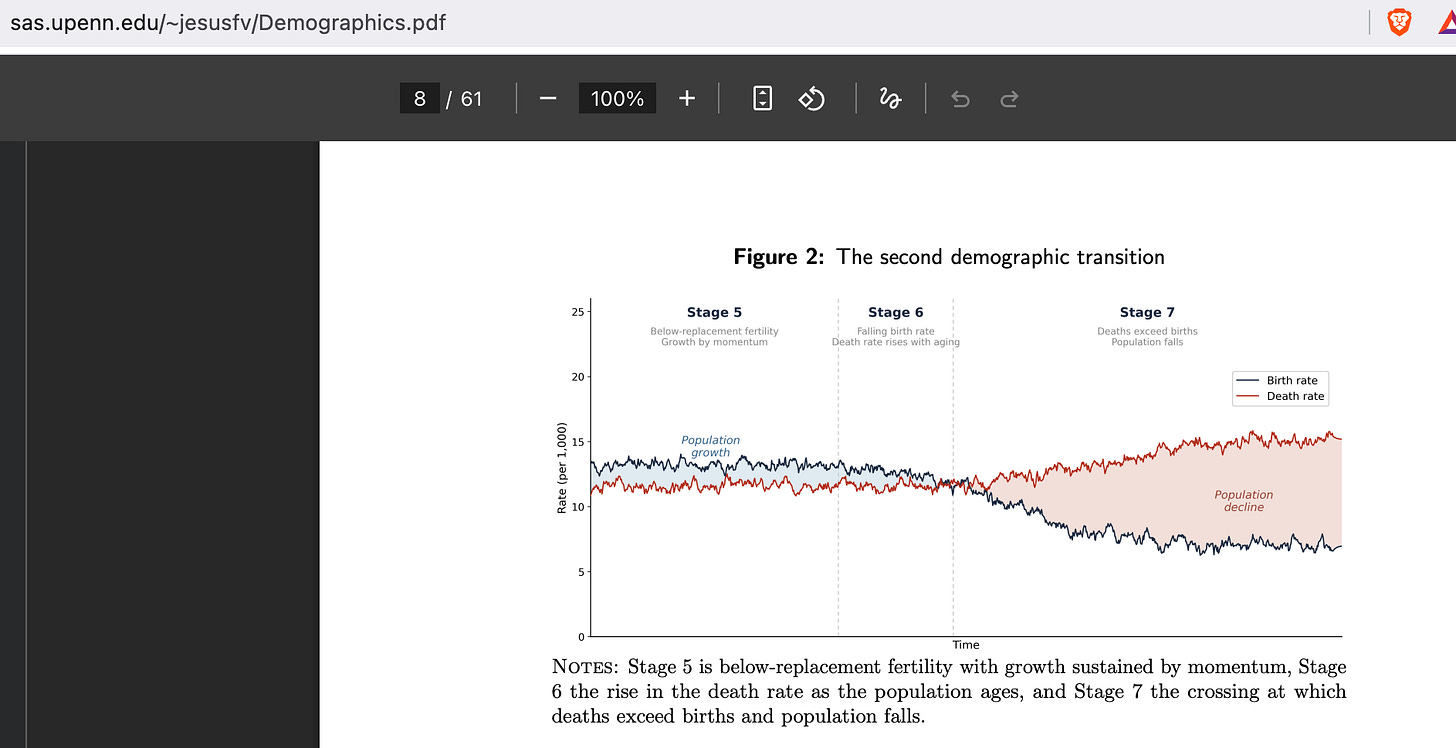
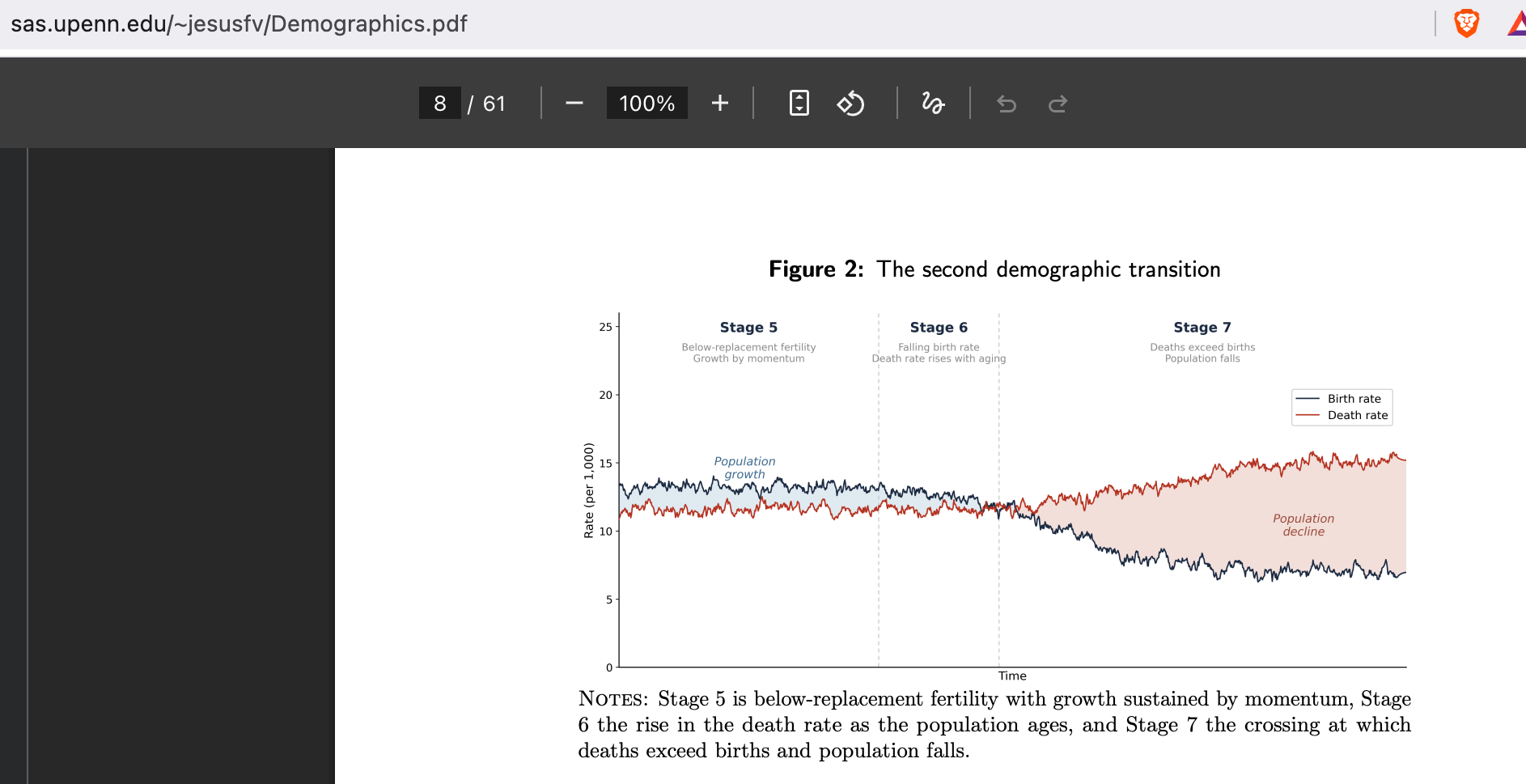
Demographers call the whole phenomenon the second demographic transition (Lesthaeghe, 2010). Figure 2 shows the CBR falling to 5-7 per thousand while the CDR climbs to 12-13, opening a large gap of population decline in Stage 7 (ignoring migration).
And this is where the above-related (in the abstract) ‘splanations are given, much to the chagrin of the authors who suggest (drum roll) this:
Modernity. The surprising case of Guatemala’s TFR collapse points to one final possibility: modernity. While we are aware that this view is more speculative than the mechanisms discussed so far (and what economists usually entertain), it deserves some space. By modernity, we mean a society organized around formal institutions, specialized expertise, and large-scale systems of coordination. We are influenced here by Max Weber. He argued that modern societies increasingly organize economic life, law, and government through calculation, impersonal rules, and bureaucracy staffed by trained specialists (Weber, 1930, 1978). Large, complex societies become manageable only because knowledge is standardized and detached from local custom, whether through mass education, expert systems, or the state’s effort to make society legible (Gellner, 1983, Giddens, 1990, Scott, 1998). On the economic side, our use of the term modernity is close to Mokyr (2002), who argues that sustained economic growth became possible once useful knowledge was codified, accumulated, and widely shared.
Modernity is not simply another name for capitalism. If anything, the historical record points in the opposite direction [ouchie, for that’s precisely Weber’s point, but never mind, dear economists, your misreading of Weber is widely diffused among academics]. Fertility declined earlier and, often, more rapidly in socialist economies than in market economies. Hungary, for example, fell below replacement fertility in 1960, followed by Czechoslovakia in 1966. Both countries experienced modest and short-lived baby booms in the mid-1970s, but neither reversed the broader downward trend.
Our conjecture is that a modern society makes the third child expensive and childlessness cheap, even when GDP per capita is only a fraction of the frontier (i.e., the U.S. level). Children are expensive because a child must be equipped to function in a world of formal knowledge and credentials, which takes years of costly investment (Restuccia and Vandenbroucke, 2013, Doepke and Zilibotti, 2019) [I do see the point, but once you have had one child, subsequent children don’t cost nearly as much as, say, clothes, strollers, equipment, etc. can be re-used]. At the same time, children are no longer productive in the household, not even for smaller chores, having been replaced by “engines of liberation” such as the electric appliances now available even to poor households (this idea extends the intuition in Greenwood et al., 2005) [nevermind the fact that poor households must buy, say, laundry machines stretching payment instalments over two years now]. Modernity also imposes tight career schedules, set by large-scale organizations, that collide with the biological clock and with the kin networks that used to share the work of raising children (Adda et al., 2017, Compton and Pollak, 2014) [it thus renders grandparents virtually useless due to the mobility of young people, thus requiring ‘care homes’ and the like]. And modernity makes childlessness cheap, because an impersonal society imposes next to no penalty on those who have no children: pensions and health care do the work that sons and daughters once did (Boldrin et al., 2015), and lineage counts for little.
I think the last aspect begs elaboration—and it might change rather sooner than later as pension funds and welfare systems cannot be maintained much longer due to already-high taxation, mass immigration of people who take out way more than they ever paid into these social insurance systems, and, of course, the exploding costs of health and elder care.
Goldin (2026) pushes this line further with an argument about a growing mismatch between genders. Modernity also changes gender roles unevenly. Women’s opportunities expand rapidly through education, work, and greater independence, while expectations about housework and childcare often change more slowly (Goldin and Katz, 2002, Goldin, 2021). This is particularly true as economies shift toward services, where women’s comparative advantages are better rewarded (Ngai and Petrongolo, 2017). The mismatch operates at both the extensive and the intensive margins: more women remain childless, and mothers have fewer children on average. This argument is attractive because it explains why East Asia and now Latin America have such low TFRs. These are the societies where the gender mismatch is largest.19 It also suggests an intriguing possibility: societies with highly unbalanced gender norms start with very high TFRs, as men impose their preferences (Ashraf et al., 2014), and end with very low ones, as women resist (Doepke and Kindermann, 2019, Doepke and Tertilt, 2018). A paradoxical reversal of demographic fortunes.
The combination of expensive children and cheap childlessness gets us well below replacement, perhaps to 1.4 or so …
From there, countries move in either direction. Those with higher income, better work-family balance, more gender equality, cheaper housing, and less acute educational arms races (Ramey and Ramey, 2010, Seth, 2002), or that have a significant religious subpopulation (Berman et al., 2018) can climb back to 1.6 or 1.7. The U.S. has many, though not all, of these features (Baudin et al., 2015), and the pattern is consistent with the finding that fertility turns up again at the highest levels of development if gender equality is high (Myrskyl¨a et al., 2009, Goldscheider et al., 2015).
Countries with the opposite bundle (lower income, no work-family balance, less gender equality, expensive housing, brutal educational competition, and rapid secularization) fall to 0.7 or 0.8. East Asia is the obvious example: China, Taiwan, and South Korea have all of these features at once. In short, modernity in its current form seems largely incompatible with replacement-level fertility …
Not all consequences of a fall in fertility are bad. Hudson and Moscoso Boedo (2026) document a 74% drop in teenage pregnancies in the U.S. between 2004 and 2024. Since around three-quarters of pregnancies among American teenagers are unintended (Finer and Zolna, 2016), much of this decline is welcomed (Kearney and Levine, 2012).
When population grows slowly or falls, it also becomes easier to design policies that keep natural resource use sustainable, and pressure on infrastructure, housing, and emissions eases along with it. Latin American countries could, for instance, redesign the cities that grew wildly, and often without decent services, during the demographic boom of the 1950s to 1980s (Davis, 2006, Glaeser, 2014). For emerging economies more generally, lower fertility opens a window of opportunity (Bloom et al., 2003, Ashraf et al., 2013). These countries can educate smaller cohorts better, rebuild their infrastructure, and, before population aging fully takes hold, enjoy some fiscal space to facilitate structural reforms.
And for the planet as a whole, lower fertility might ease the transition to net-zero emissions (Casey and Galor, 2017). Integrated assessment models take population as an exogenous input (Fernández-Villaverde et al., 2025), and their emission paths are sensitive to that input in ways the literature has rarely explored.
And at this juncture, we must, it seems, discuss the implications before perhaps moving on.
There we go—we’ll perhaps discuss the remainder of the long paper at a later stage, but for the time being, I suppose the core hypothesis merits consideration. If, as the authors write, the
combination of expensive children and cheap childlessness
is drives this demographic transition, it follows that the implications are massive:
gender relations will be affected
intergenerational solidarity is weakened
and virtually the entire financial-political governance is at stake
If one would like to address these issues, I suppose we should bring out several golden calfs to the chopping block, incl.
changes to voting rights, perhaps removing passive voting rights for those who didn’t serve in the military and/or don’t have children
higher taxes for childless individuals (or lower taxes for parents) as those who don’t have kids will consume the extra output of someone else’s children who work in the future
we’re likely embarking on several decades of salvage as population decline will first depress real estate prices, then crash the financial system (declining tax base), poison politics (see the prior two points), and destroy the welfare state due to the shrinking of the labour force
Somewhere in-between we need to address pollution, the danger of nuclear war, and every other stupid conflict, be over resources or other stuff.
I suppose nothing will (should) be done in terms of too much planning, for unintended consequences are lurking literally everywhere.
We’ll look at a few other segments of ‘the economics of a shrinking world’ by Jesús Fernández-Villaverde and Patrick Norrick in the next few days: stay tuned.

Comments
Nothing yet. Say the first thing.
Sign in to join the conversation.