
Time to revisit the agit-prop du jour mix and match with the framing of yester-year, specifically the Covid shitshow. Do enjoy this adventurous stream of (un)consciousness.
Needless to say, if you’re like me and ask yourself, ‘well, turbine rotor blades are made of toxic composite fibres’ and, perhaps more importantly, read on trying to figure out of this little factoid is known to the journo™, well, here’s where you could educate yourself (spoiler alert: these rotor blades are as toxic and carcinogenic as asbestos, the German Bundeswehr notes):
And should you, kinda, find this too stoopid, you’re not alone.
Translation, emphases, and [snark] mine.
Despite [sic] the energy crisis, it takes much longer to build a wind turbine today than it did 20 years ago, says Markus Winter from Windkraft Simonsfeld. The counter-pressure is currently massive
By Alicia Prager, Der Standard, 15 Aug. 2026 [source; archived]
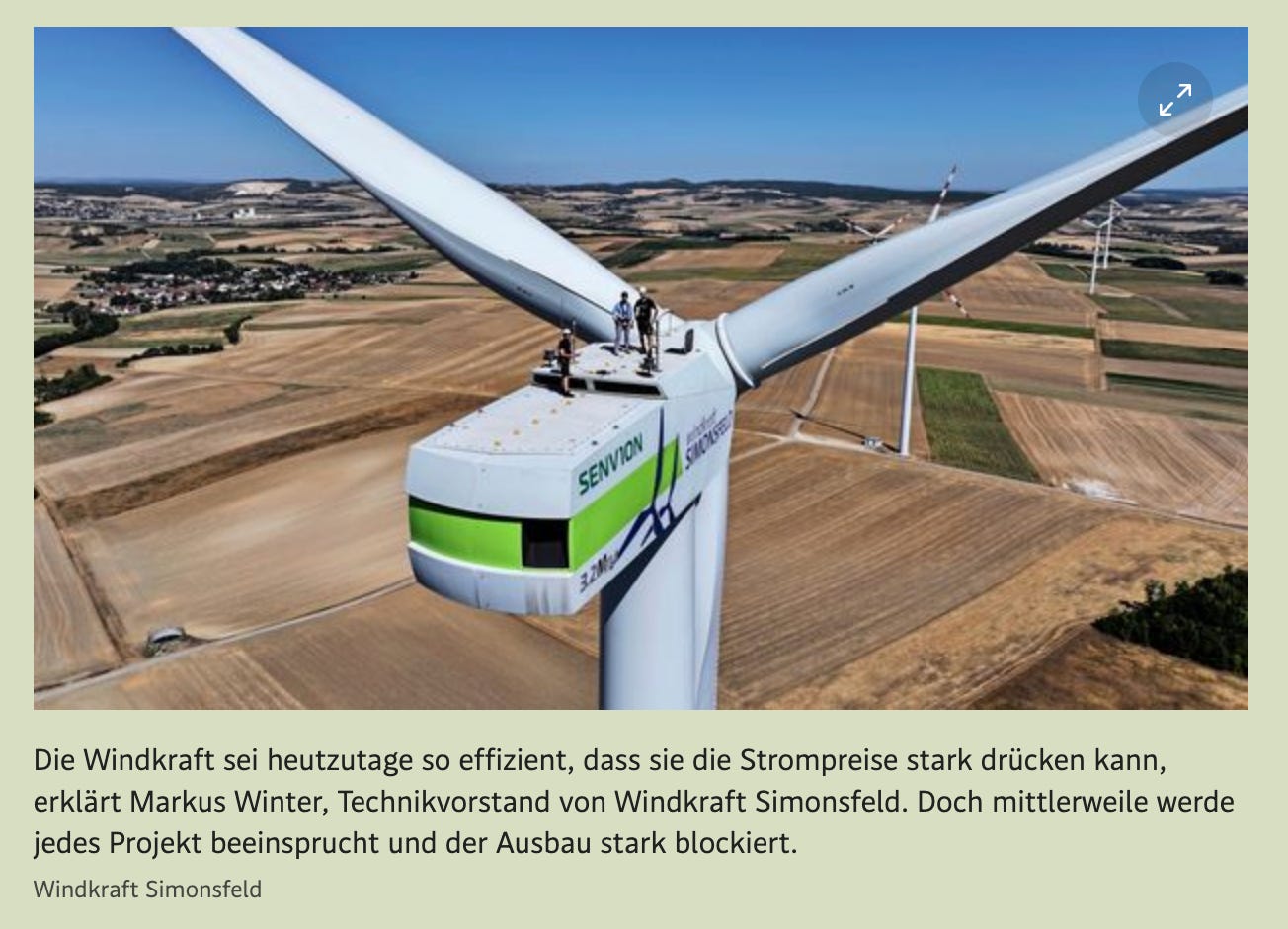
You can no longer stop the shift to renewable energies, says Markus Winter, Chief Technology Officer at Windkraft Simonsfeld AG. However, it is currently being severely delayed. This means that Austria will remain dependent on fossil imports for longer and will contribute to the continued heating of the earth. A conversation about disinformation since the corona pandemic, bird shutdown systems, and the lack of political support [because without said support™, the wind industry wouldn’t exist, eh?].
Der Standard: We want to get out of natural gas, but at the same time hydropower is weakening due to the drought. Experts and politicians emphasise that we particularly need to strengthen wind power. As a company, have you noticed any of the support?
[Winter] When I started in the wind power industry over 20 years ago, it took us three to four years to plan, approve and build a wind farm. We now have projects that have been stuck for 15 or even 20 years.
Der Standard: Why does it take so much longer today?
[Winter] We have state governments that say we need expansion, but don’t take any measures to make it possible.
Der Standard: … with the exception of Burgenland.
[Winter] Yes, Burgenland is the model federal state [it’s also flat and windy, you know, stuff that helps]. It has built large wind farms with the backing of state politicians and the population. In recent years, photovoltaics have been introduced and hybridised [with wind power] on a large scale.
Der Standard: This means that wind turbines share a grid connection with solar systems and storage systems.
[Winter] Exactly, this would allow us to achieve the performance of small Danube power plants. We have been trying this in Lower Austria for ten years. So far without success [perhaps because that’s not good enough in terms of economic viability, to say nothing about the issues revolving around absence of light (night) or wind].
Der Standard: When did the mood change?
[Winter] Especially after Corona, some groups were looking for a new topic to jump on. We see the same people who were at Corona protests back then among the wind power opponents today. They spread fake news every day and massively block the expansion. Every wind power project is objected to, even though there are designated zones. And there is often a lack of support from state politicians.
Der Standard: What are you doing about disinformation?
[Winter] We communicate widely in all directions. For specific projects, we go to events in communities or set up local citizens’ offices that are staffed once a week and provide information about a planned project. We also try to disseminate information via the project homepages, with folders and participatory processes. But unfortunately it is much easier to stir up fear than to explain facts [away, like, say, the carcinogenic ‘nasty fibres’, right?].
Der Standard: Part of the anti-wind script is to push for citizen surveys [yeah, that pesky mob shouldn’t be considered]. However, these often contribute to divisions in communities through election campaign-like campaigns. How do you deal with it?
|Winter] The biggest problem with such surveys is that only opponents or particularly committed supporters go to the polls. So you have to try to motivate people to vote [mandatory voting is a good idea, ideally combined with open ballots and no booths]. But such surveys often divide people in the long term. However, some form of participation is still required. In a community in the Waldviertel, we have now tried a new concept with a participatory planning workshop.
Der Standard: How does a workshop like this work?
[Winter] An energy advisory board will be set up with support from the science. In this context, citizens develop an energy concept that they want for their community. If you decide that wind power should be part of the energy mix, a proposed resolution can go to the local council [that sounds like a good idea, why isn’t this done on a regular basis? Oh, silly me, that would afford the hoi polloi a say, which is why it’s dangerous™].
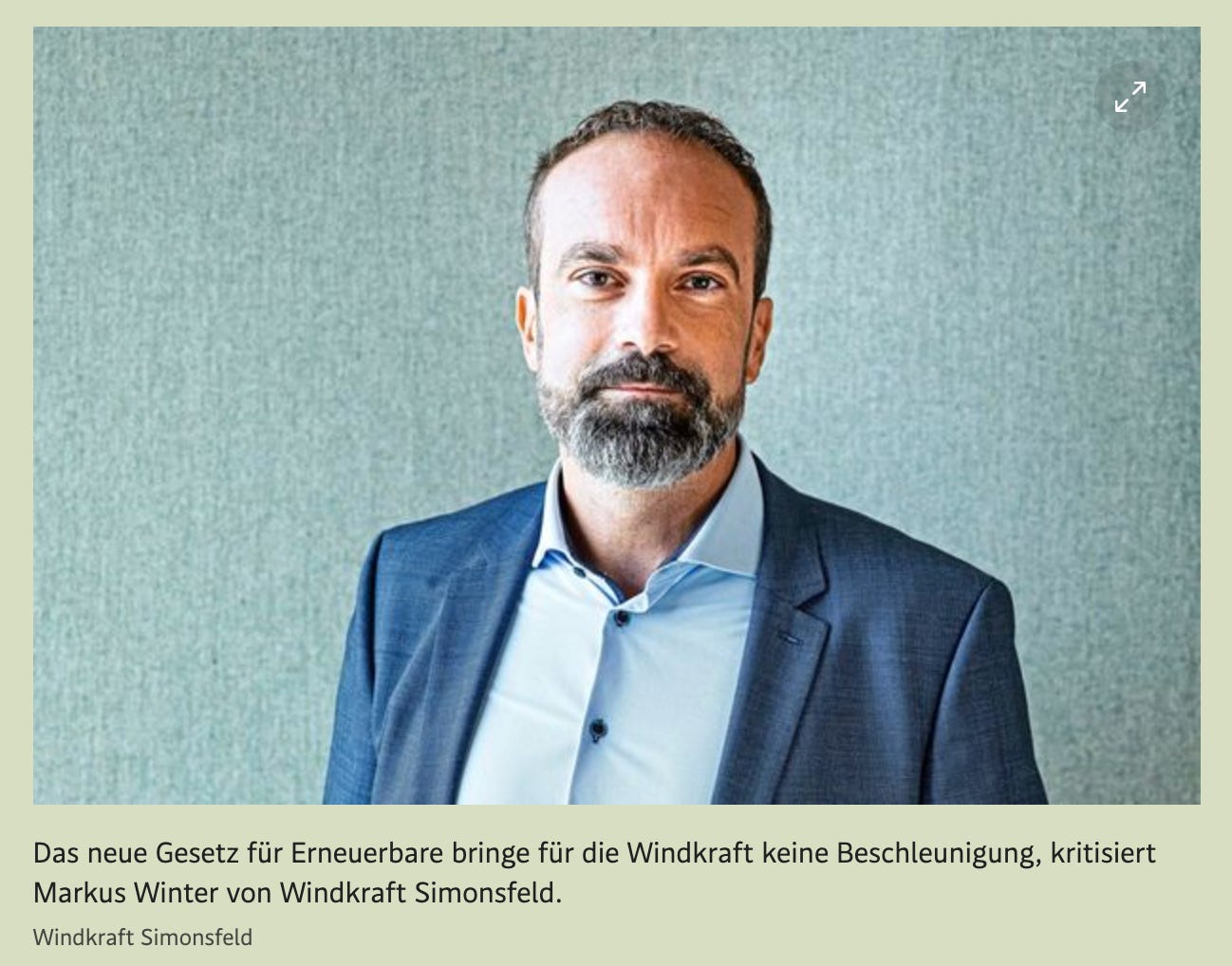
Der Standard: In addition to the search for locations, the lack of grid capacity is also a major issue for wind power. Did the network operators simply not believe that wind power expansion would actually occur on this scale?
[Winter] Above all, the technology has quickly become more efficient and more powerful. Ten years ago we were still planning on a system size of three megawatts. Now we are at seven megawatts [that’s a more than 100% increase of (intermittent) capacity, which doesn’t mean it’s constantly flowing electricity (also requiring transformers); note the massive omissions of these things here]. Accordingly, the networks were planned to be far too undersized.
Der Standard: And today the network expansion is not keeping pace.
[Winter] Until a few years ago, we simply weren’t asked where we were planning wind farms. Grids were built where the current hunger for energy was greatest [guess where energy is used first—near where it is produced]. In Lower Austria, for example, there has been a zoning system since 2014 where wind power can be built and Netz Niederösterreich [the state-level grid control] is also aware of this.
Der Standard: The Renewable Energy Expansion Acceleration Act (EABG) was recently passed and is intended to boost the expansion. Do you expect this to accelerate the switch to renewables?
[Winter] There are a lot of good things in the law for the networks. The EABG does not accelerate the expansion of wind power.
Der Standard: But the law is supposed to simplify and speed up the procedures?
[Winter] Yes, but only if acceleration zones are assigned. And not a single federal state has done that so far. Styria is now considering where it could show some. Upper Austria says you don’t need that. And Lower Austria explains that they already have suitability zones, but that is something different again. According to the EU, acceleration zones should have been defined by February 2026. So far there are none in Austria.
Der Standard: A common argument against wind turbines is the risks to birds. Do you now have new systems that turn off the wind turbines when a bird approaches?
[Winter] Exactly, such systems can be very helpful in making expansion even more environmentally friendly [I’m unsure if Mr. Winter believes this kind of crap, but he may well do]. Unfortunately, these are currently not recognised by environmental advocates and some NGOs, although they are already being used successfully in many locations across Europe.
Der Standard: How do these shutdown systems work?
[Winter] The system works with highly sensitive cameras and an AI behind them. Hundreds to thousands of images are recorded for each habitat and each protected bird. The AI uses this and the flight pattern to recognise whether the bird is entering the dangerous area and switches off the system [how does one re-start a wind turbine? Is there a crank and a diesel-powered backup generator? Also, what’s the energy use of such bird protection systems? As a follow-up, note the absurdity: no AI or any concerns over, say, such systems killing people in the Middle East, Skynet-style, can be shouted down by invoking the, ‘so, you’d rather have birds killed, too?’ trope]. We tested the system for a year and it works.
Der Standard: Where did you test the system?
[Winter] In the Dürnkrut area. In addition, there are already a total of 70 wind farms in Germany that have this system in operation and we have received data with statistical evaluations. In Austria, wind farms are subject to objections despite the use of this system.
Der Standard: Who is behind these objections?
[Winter] They usually don’t come from the local community, but from outside, for example from NGOs or from the portal Report24 (a right-wing platform, editor’s note) around chief reporter Florian Machl and author Angelika Starkl. They are there at all sorts of information days and stir up the mood with the usual fake news, such as infrasound or other alleged health risks [you mean the carcinogenic issues mentioned above, right?].
Der Standard: With what goal? [never-mind, that’s not a relevant issue for a follow-up question]
[Winter] We don’t know what these groups’ intentions are. We don’t know who’s paying them. In any case, they’re spending a lot of money on renowned lawyers and communication campaigns. The pressure from legal challenges has become extreme in recent years [is it too early to point to, say, this being the exact playbook with which Greenpeace has looked for sympathetic pensioners in Switzerland to sue the gov’t in the European Human Rights Court?].
Der Standard: You describe an incredibly difficult environment for wind power projects. You face a lot of opposition, and there’s little support from politicians. Why do you put yourselves through this?
[Winter] We started in 1996 because our founders already [sic] saw back then that we have to phase out fossil fuels if we want to curb climate change and become energy independent. With wind power and solar PV, I can generate energy cleanly and regionally. Nuclear power has never proven itself. Wind power, on the other hand, is so efficient today that we can generate electricity very cheaply [I’m not sure that the real-world experiences from other countries might help, but here goes:
Funny enough (sigh), let’s get the Standard piece over with]
Der Standard: And electricity consumption will increase in the coming years, due to electrification and also because of things like data centers.
[Winter] We need a lot of energy. So what options do we have? What kind of world do we want to pass on to future generations? I certainly want my child to be able to lead a good life. But that’s incompatible with fossil fuel interests. I’m convinced they’re behind the opposition to wind power [pretty sure that’s the case, plus the concerns of citizens who organise, but that, once again, provides agency to the hoi polloi, hence it must not be mentioned]. Every year that wind power projects are delayed, more gas can be sold. We have to oppose that [which leaves … (drum roll) a gov’t ban the only option, right? (Also works for ICE-powered cars).
Der Standard: You repeatedly emphasise in interviews that you’re increasingly looking abroad for project development [yeah, doing these projects is so hugely profitable that they wanna do this abroad: sure *eyeroll*].
[Winter] We currently have projects in Romania, Bulgaria, France, and Slovakia. We’ve been operating plants in Bulgaria since 2009, but there, too, we have the problem of grid connection. It’s infrastructure that was never built. The same applies to Romania. We’re currently preparing to build a wind power project there, and a second, very large one is already well into the approval process. In Slovakia, we have several projects in the approval process, but unfortunately, they’re hardly feasible with the current government. In France, we’ve had strong opposition from the nuclear lobby so far. Now it depends on what the next government there will be like.
Der Standard: Despite the bleak political situation, expansion is still progressing because renewable energy production is simply cheaper.
[Winter] You can no longer stop this development, but you can delay it. However, this delay will lead us to climate collapse and keep us dependent on energy imports.
[this brief bio accompanies the piece] Markus Winter has been at Windkraft Simonsfeld for 20 years and has been managing it as Chief Technology Officer since 2022 together with Chief Financial Officer Alexander Hochauer. Both previously worked as managing directors in the company, which operates almost a hundred wind turbines in Austria. Winter is also part of the executive team of IG Windkraft and a member of CEOs for Future.
Needless to say, the IG Windkraft is the lobby group of the Austrian wind power industry—which means that Der Standard pushed a piece by a industry lobbyist (and please, by no means, imagine legacy media doing such puff pieces with, say, weapons industry lobbyists, though a nice shit storm that would be).
As regards the Austrian ‘CEOs for Future’ chapter, it’s totally normalised by now to see, e.g., state-level officials, executives of state-owned (outsourced) enterprises like the Austrian Federal Railways, and private™ business people all coming together to lobby the gov’t for more handouts. Oh, lest I forget, leaders from the regulatory agency—the Umweltbundesamt—are also on the roster.
It’s fine, it’s for the greater good, and if you disagree calling this form of private-public (sic) partnership a form of fascism—actually, it’s the textbook definition, kinda—you’re a NADSI. Or a Climate NADSI. Or worse.
Setting aside, once more for the time being, the adverse health and environmental aspects (I’ve written about this before, just look for ‘wind turbines’ in these pages), here’s the most likely outcome, courtesy of what already happens in Norway:
Ten times in the last ten years, turbine blades have fallen down at wind power plants in Norway, according to an overview from NVE [do you trust the gov’t?]. This was revealed when Minister of Energy Terje Aasland (Labour Party) recently reported on this to the Norwegian Parliament [in 2025] …
The concessionaires inform NVE [the Norwegian gov’t regulator] of faults or damage, and NVE maintains an internal overview based on communication with concessionaires, monitoring and partial reporting. While the overview is not complete, it shows that there have been ten cases in the last ten years where turbine blades have fallen down.
Again, I’m reminded of stuff we all knew once upon a time; hence a few words by French political economist Frédéric Bastiat (1801-50) shall conclude this long-ish piece (sources in the linked Wikiquote piece):
When plunder becomes a way of life for a group of men in a society, over the course of time they create for themselves a legal system that authorizes it and a moral code that glorifies it.
That’s a quite well-known quote, but there’s another one from the same essay (‘Economic Sophisms’) that’s perhaps even more appropriate in this context:
It is a rather singular argument to maintain that, because an abuse which has been permitted a temporary existence, cannot be corrected without wounding the interests of those who have profited by it, it ought, therefore, to claim perpetual duration.
And thus the charade continues; hence, I shall conclude with another quote by Frédéric Bastiat to sum up where we are (and where we’ve been at since time immemorial):
When law and morality contradict each other, the citizen has the cruel alternative of either losing his moral sense or losing his respect for the law.
It is high Time for Outrage, to pay homage to another French author, Stéphane Hessel.
Chose wisely.
No posts
Comments
Nothing yet. Say the first thing.
Sign in to join the conversation.