
Hi everyone. Happy Belated Opposites Day (yesterday).
“You can’t have fun today, as nothing is allowed and nobody wants to have fun with you.
Of course, on Opposite day, all of that means the opposite!” - from DaysoftheYear.com.
I’ll be honest. I’ve been struggling to get back into writing this year.
Partially it is because my body is hibernating and reflecting - it doesn’t want to be out in the world yet.
Partly, I just struggled to find something I wanted to write about for the letter O.
And then Opposites Day presented itself and realised how many examples are of facilitation approaches that play with the power of opposites.
And then I took part in a training on Lewis Deep Democracy and I realised the words Opposite and Opposition are two absolute zingers for a facilitator as often they are tools we can use to get groups unstuck because they are great at making things more visible.
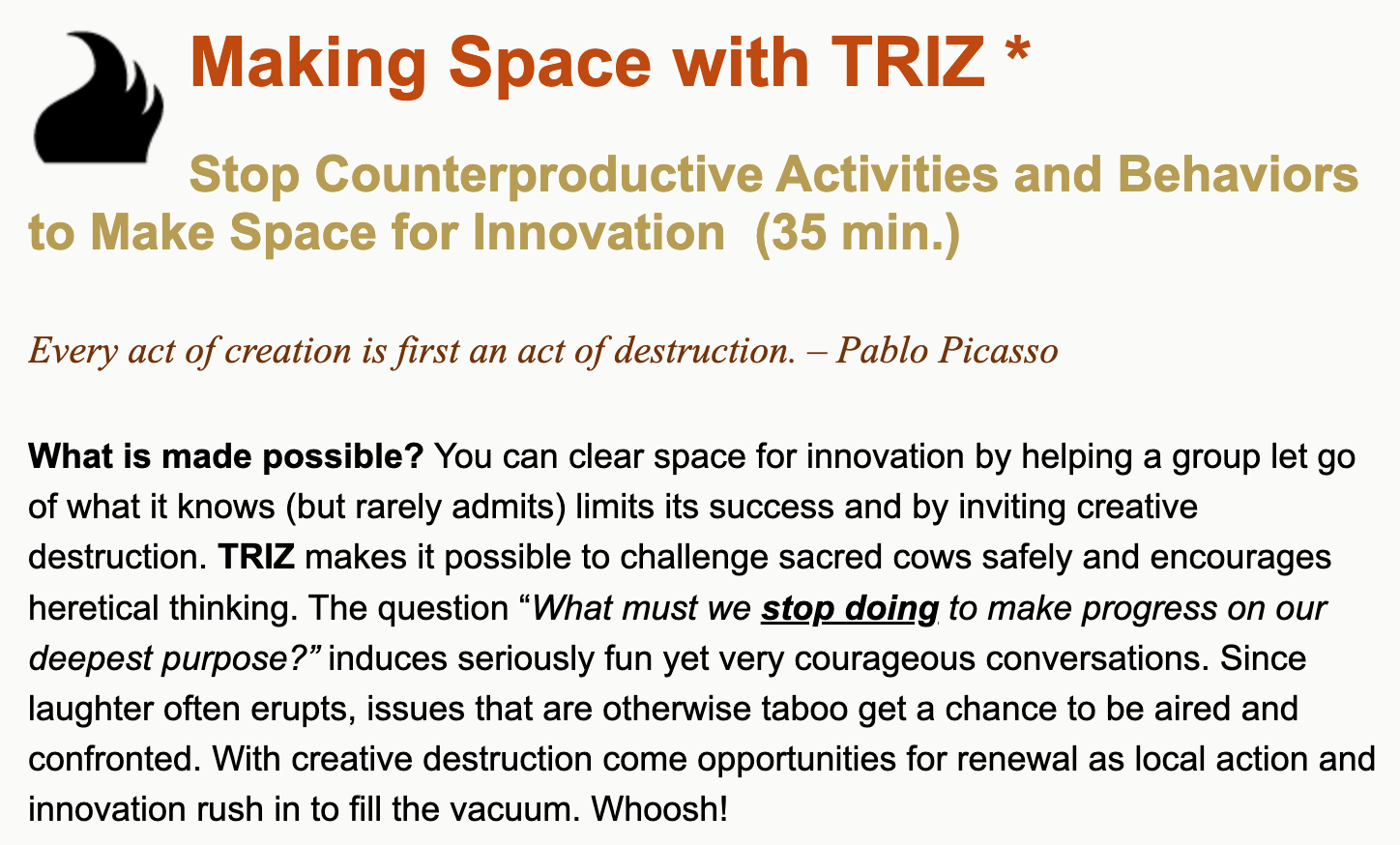
TRIZ - from Liberating Structures
In my experience, people looooove talking about what they are going to start.
Getting them to talk about things they are going to STOP is a LOT harder.
TRIZ is a classic exercise aimed at being honest with ourselves about what we need to stop doing in order to make space for what we want to achieve.
Firstly participants are asked to imagine the worst possible outcome related to the topic at hand.
Next they imagine all the steps or behaviours that lead to that outcome.
In the final step, they reflect on whether there are any behaviours which they are currently doing which remind them of the behaviours that would lead to the undesirable outcome.
From experience this exercise often reveals much deeper insights than if we just asked the question: “What should we stop doing?”
This is just one wonderful technique using opposites as a key mechanism. Let me know your favourites and if I get enough, I’ll do a roundup!
As I mentioned above - last week I got to be trained in Lewis Deep Democracy - Level I.
Trying to summarise Deep Democracy in a few words is like trying to bottle a thunderstorm. You might catch some rain, but the electricity is missing.
I’ll try my best below to give you a tiny taster - but if you’d like a more zingy version Theresa Destrebecq of Emerge Book Circles and I will be doing a Substack Live debriefing from the training tomorrow at 10am CET. Join us!
In a (very, very, very shallow) nutshell - this approach is a way to use conflict as an essential part of both good decisions and strong relationships as often only through going below the surface to difficult and emotional topics do we get to solutions that all parties can support.
(Note: There are several types of Deep Democracy, but I was learning Lewis Deep Democracy.)
I picked the words Opposites and Opposition because Deep Democracy has a couple of key approaches that go in the opposite direction to other practices and often, our intuition.
Where many groups default to advocating for a position, taking a vote, and smoothing over dissent, Deep Democracy intentionally tunes in to the “no” even when it isn’t spoken aloud.
The facilitator listens for hesitation, resistance, energy shifts or subtle cues of discomfort. Once a “no” or some form of resistance is detected, it is spread deliberately: the facilitator asks,
“Does anyone else feel this way, even a little bit?”
The principle behind this practice is simple but powerful: if one person feels resistance, it is highly likely that others do too.
By leaning into these quieter or minority perspectives, the group creates space for authentic expression, surfaces hidden concerns, and uncovers whether there is genuine support for the initiative at hand. The result is not just more honest feedback, but decisions that are better understood, more resilient, and more widely owned.
Deep Democracy uses structured methods called Debates and Arguments to surface and work with opposing views when groups are stuck or going in circles.
Unlike traditional “this house believes…” debates, the purpose is not to win, persuade, or perform expertise, but to reveal the full range of perspectives in the room.
Participants physically stand on opposite sides of a line in the room, each side representing a different viewpoint. As points are made, participants are free to cross the line whenever they genuinely agree with something said by the other side. This often leads to people occupying both positions at different moments, making visible the complexity that usually remains hidden.
Rather than polarising the group, this approach typically deepens understanding. Areas of agreement become immediately visible, minority perspectives are seen, and the group can move beyond stuck positions toward decisions that are more informed and more sustainable.
A traditional debate produces winners, losers and often quite resentment because it assumes one side is right. A Deep Democracy Debate, done well, acknowledges that each side holds part of the truth and forms the basis for agreements that have much deeper roots.
From: managing disagreement as a problem
To: seeing opposition and resistance as information
Conflict is clearly the theme of the week. I recently had a conversation with professional facilitator and mediator Thomas Lahnthaler about the differences between facilitation and mediation for the #edgesoffacilitation series.
I hope you enjoy it - I learned so much from this conversation.
Also available on Spotify.
Comments
Nothing yet. Say the first thing.
Sign in to join the conversation.