
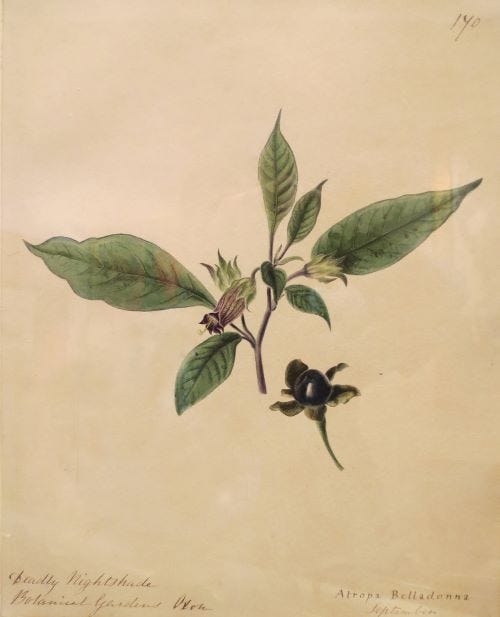
Deadly Nightshade (Atropa Belladonna) is part of the Solanaceae family, which also contains peppers, aubergines, tomatoes and potatoes! This most famous of poisonous plants is also known as belladonna, banewort, deadly dwale, Devil’s cherries, or death’s herb (Baker 2011: 107).
The deadly nature of belladonna was noted as far back as 1550 BCE (Inkwright 2021: 85). It’s not a particularly common plant in the wild, although it does prefer woodland.
Yet it’s not necessarily a plant you might rush out to grow. You might also be hard-pressed to use it for meaningful communication. According to Mrs Burke’s Language of Flowers dictionary, nightshade meant ‘truth’ (1867: 42). In the same book, belladonna is listed with the meaning ‘silence’ (1867: 11).
So how does this plant appear in folklore, besides its links to the Devil and witchcraft?
But before we delve into the folklore and legends of these plants, I’d like to remind you that this article is for entertainment purposes and it does not provide nor constitute medical advice. Any interaction you have with these plants is at your own risk. I’d advise you to look but not touch!
The plant appears in history at various points, and rarely for anything good. According to rumour, Lucia Drusilla poisoned the Roman emperor Augustus, her husband, by spiking figs with deadly nightshade (Brown 2018: 100).
Nicholas Culpeper included deadly nightshade in his Complete Herbal, if only to warn people off the plant. He advises that the plant shouldn’t be allowed to grow where children play due to the berries (1789: 269).
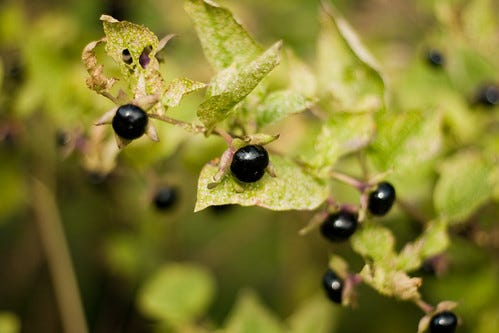
Richard Folkard noted the deadly nightshade berry bore the nickname “the Devil’s berry”, while the rest of the plant was “Death’s Herb”. He further explained that the berries were once called “Dwale-berry”, from a Danish word, dvale, meaning a deadly trance (1892: 85). In more modern translations, dvale means hibernation or dormancy.
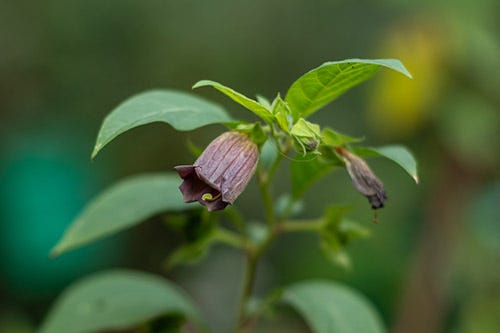
He also resorts to the doctrine of signatures to explain what different plants might be used for, based on what they look like. Using this logic, the black or spotted flowers of the nightshade could cause “bad dreams, excite giddiness, vertigo, and epilepsy” (1892: 157). We’ll ignore the fact that the flowers are often purple.
Most poisonous berries are bitter to deter ingestion, with both the bitterness and the toxicity used by the plant to ward off predators. In deadly nightshade, the berries are sweet to encourage ingestion, and the hapless creature that eats them becomes the delivery mechanism for the seeds (Inkwright 2021: 86).
Earlier herbalists understood the dangers of the plant, and mostly warned people off using it. However, in the 19th century, chemists began to understand the compounds found in the plant, and it made its way into mainstream medicine. Scopolamine, hyoscine, and atropine all affect the parasympathetic nervous system, which explains why they induce hallucinations. Atropine also acts as a muscle relaxant (Kenicer 2020: 108). There is a very small margin between a therapeutic and a toxic dose.
Deadly nightshade’s botanical name, Atropa, comes from Atropos, the third of the Greek Fates. Her sister Clotho measured the thread of life at birth, Lachesis wove the thread throughout a person’s life, and Atropos cut the thread at the end of their life.
It was also sacred to Bellona, a Roman war goddess (Lawrence 2020: 184).
Its other name, belladonna, is believed to come from the Italian, ‘beautiful lady’. There was a belief that the plant would create visions of a beautiful but dangerous temptress, leading to its name (Mitcheson 2024: 36).
There is another explanation. In the 1500s, Venetian women believed that dilated pupils made them more attractive, so they dropped belladonna into their eyes to dilate the pupils. It’s not as mad as it sounds. The pupils naturally dilate when the person is aroused, so it would serve to make the ladies look more interested than they perhaps were. Quite handy if you’re after a husband. You had to be careful how much you used and how often because too much could cause madness. Yet opticians still used it during eye surgery into the 20th century (Inkwright 2021: 87).
That said, there’s no proof the trend ever made it beyond Venice. Instead, it might comes from ‘buona donna’, or good girl, as a reference to the folk healers the poor used when physicians were too expensive (Inkwright 2021: 87). Michael Brown also noted that having had belladonna used on him during eye surgery, his vision became blurry, and theorised that women used it to make men look more attractive (2018: 101).
At one stage, people believed the Devil himself tended deadly nightshade, and he did so on each night of the year, except Walpurgisnacht. That meant people could only safely dig it up between April 30 and May 1. He left behind a fearsome monster to guard it, but the monster could be placated with fresh bread (Inkwright 2021: 89).
Alternatively, you could release a black hen, which the Devil would chase, leaving the nightshade unguarded (Baker 2011: 108).
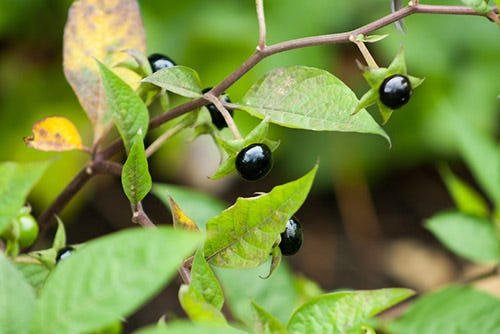
Parents told their children that those caught picking the berries would meet the Devil face to face. They needed a way to discourage their children from eating the berries given their sweetness (Lawrence 2020: 184).
Much as we saw with aconite last week, deadly nightshade was also associated with Hecate in her role as the goddess of witches (Folkard 1892: 91). Richard Folkard further added nightshade to the list of “most esteemed herbs” for witches, alongside cuckoo pint, henbane, mandrake, and even fern (1892: 95).
In classical accounts, deadly nightshade is sometimes confused with mandrake. While mandrake has been moved into the Mandragora genus, it was once called Atropa mandragora (Kenicer 2020: 107). This is why getting plant names right is so important, something botanist William Turner worked on!
Despite its toxicity, deadly nightshade did have some uses.
People apparently made it into a collar for their cattle to avert the Evil Eye. You could also lift an enchantment from a person by putting a wreath of nightshade on their head (Baker 2011: 108). It was believed to grant the ability to see ghosts (Inkwright 2021: 88).
Nightshade was also mixed with mandrake and hellebore to make an early surgical anaesthetic (Brown 2018: 100). The presence of hellebore apparently acted to prompt the patient to vomit following the operation – assuming they woke up! This mixture was also called dwale.
Atropine, one of the compounds from the plant, was used as an antidote to nerve gas poisoning (Stewart 2010: 33). Apparently, atropine was also used as an antidote to foxglove poisoning (Gillam 2008: 10). Whether it worked is up for debate.
It was even used to counteract the effects of Novichok during the 2018 Salisbury poisonings (Inkwright 2021: 88).
Witches’ flying ointment has been the subject of some debate, although I think most people agree that no one actually applied this ointment to physically fly anywhere. Most writers describe how the combination of plants was more likely to provide the sensation of flying through its hallucinogenic properties. This helps to explain why some people used deadly nightshade in spells to “induce second sight” (Baker 2011: 107).
Reginald Scot included deadly nightshade in a recipe for flying ointment in his Discoverie of Witchcraft. The recipe also included water parsnip, calamus, potentilla, olive oil, and bat’s blood (Kenicer 2020: 107).
The ointment’s ingredients vary almost as much as how accusers assumed people applied it. One theory is that people smeared the ointment onto broom handles to apply it to the genitals, though other writers have debunked this, seeing it as part of the anti-witch propaganda. I can’t help thinking the threat of splinters alone would put people off that method.
In the 1500s, a Spanish physician named Andrés de Laguna made an ointment containing hemlock, nightshade, henbane, and mandrake. After coating the local executioner’s wife in it, he watched as she fell into a deep sleep for 36 hours. When woken up, she was rather annoyed by being disturbed from what sounded like a delightful dream (Lawrence 2020: 177). The contents of the dream did little to persuade people that flying ointment was entirely innocent!
Like other poisonous plants, there is less folklore than you might imagine about deadly nightshade. What lore exists is designed to warn people away from its use, particularly given its attractive-looking berries.
Its links with the Devil become a means to keep people safe, while its association with witches perhaps refers to its hallucinogenic properties. Yet the plant has still yielded useful compounds that serve a purpose in medicine, as long as they’re used by trained professionals.
Nightshades as a family go far beyond the deadly variety, with bitter, black, and woody nightshade being beyond our scope here. They live on every continent except Antarctica. But like many plants, we should enjoy deadly nightshade from a distance – if at all.
Don’t ingest any part of the plant, and treat it with the utmost respect.
Baker, Margaret (2011 [1969]), Discovering the Folklore of Plants, 3rd edition, Oxford: Shire Classics (aff link).
Binney, Ruth (2018), Plant Lore and Legend, Hassocks: Rydon (aff link).
Brown, Michael (2018), Death in the Garden: Poisonous Plants & Their Use Throughout History, Barnsley: White Owl.
Burke, L (1867), The illustrated language of flowers, London: G. Routledge & Sons.
Culpeper, Nicholas (1789), Culpeper’s English physician ; and complete herbal … Illustrated with notes and observations, critical and explanatory, London: E. Sibly.
Folkard, Richard (1892), Plant lore, legends, and lyrics: Embracing the myths, traditions, superstitions, and folk-lore of the plant kingdom, second edition, London: S. Low, Marston, Searle, and Rivington.
Gillam, Fred (2008), Poisonous Plants in Great Britain, Glastonbury: Wooden Books (aff link).
Inkwright, Fez (2021), Botanical Curses and Poisons: The Shadow-Lives of Plants, London: Liminal 11 Press.
Kenicer, Gregory J. (2020), Plant Magic, Edinburgh: Royal Botanic Garden Edinburgh.
Lawrence, Sandra (2020), The Witch’s Garden: Plants in folklore, magic and traditional medicine, London: Welbeck (affiliate link).
Mitcheson, Fiona (2024), A-Z of Poisonous Plants: The deadly, dangerous & downright bizarre, Peterborough: Jarrold Publishing.
Stewart, Amy (2010), Wicked Plants: The Weed That Killed Lincoln’s Mother & Other Botanical Atrocities, Portland, OR: Timber Press.
No posts
Comments
Nothing yet. Say the first thing.
Sign in to join the conversation.