
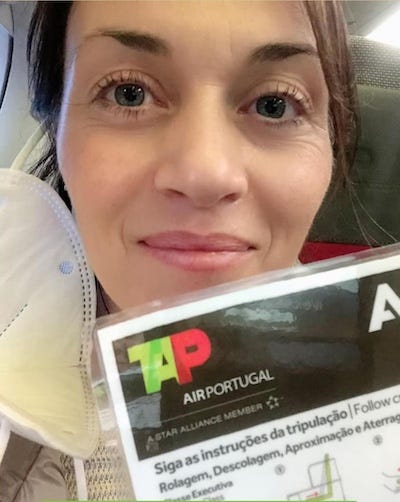
It was the end of August 2021. I was flying from Miami to Rome, via Lisbon.
As we waited on the tarmac in Lisbon, a strong, fleeting smell of crude oil filled the cabin. The air turned tense.
“I’ve never smelled this before. It seems like kerosene,” an American woman whispered behind me, alarmed and suspicious.
“It’s normal, lady. There’s nothing to worry about,” came the calm reply from a Portuguese man beside her.
TAP flight 834 took off, all passengers safe from fire or explosions. But the comment lingered with me. I sensed there was more to the woman’s concern than a fleeting fear of the moment. The anxious remark gave birth to an idea for an article I never wrote about Americans’ fears of flying non-national carrier planes.
I’ve been boarding flights across the Atlantic for more than forty years – I was raised between two cultures. But sometime while living in Los Angeles these last eight years, I began to understand why Americans were so reluctant to fly non-U.S. carriers. The few I’d encountered on Alitalia flights were usually Italian-American citizens with strong ties to Italy. But I imagined many Americans would never even consider booking a flight on TAP, Alitalia, Iberia, or even British Airways.
I’ve often found that American airline carriers fall short on quality, etiquette, and pricing, especially when compared to equally competent non-U.S. competitors. But what stands out most is the subtle fear-mongering: the way American companies condition their consumers to buy American products, fly American airlines, and avoid traveling to places framed as unsafe or second-rate. It’s a kind of marketing I’ve rarely encountered elsewhere. Fair competition in the U.S. often comes tangled in the blindfold of patriotic bias and a stunted perception of the outside world.
When I boarded the TAP flight, Covid restrictions were still heavily in place and US media warned of airport closures and vaccine requirements upon entrance to many European countries. Non-US airline carriers, whose traffic had been decimated due to the US-imposed restrictions permitting re-entry only to U.S. citizens, were slashing their fares. News outlets warned of nightmare scenarios for anyone leaving the country.
I was not deterred. As I boarded my flights across southern Europe, I found nearly empty airports, affordable tickets, and functioning systems. Italy, Spain, and Portugal required testing—but not vaccines—and their airports were fully operational.
This is one of the many pieces I never pitched or published. It would have explored how American airlines—and the larger U.S. travel narrative—conditioned passengers to fear anything unfamiliar, including international airlines. Decades of aggressive marketing from U.S. airlines may be part of the answer.
The piece I envisioned would’ve traced this history. It would’ve pulled archival ads, tracked pricing patterns, interviewed retired flight crew members. But I let the scope scare me. I didn’t know how to access that kind of research, and the idea slowly drifted into my notes folder.
Things are changing rapidly now, and more Americans are flying non-US carriers.
Still, that woman’s voice and behavior on the plane proved that I wasn’t the only one to understand the silent code. The way the man beside her offered quiet reassurance meant he too understood Americans’ conditioning and their fear of “foreign.”
This story might still have some scope – maybe for a documentary. For now, it will be grounded in this series.
No posts
Comments
Nothing yet. Say the first thing.
Sign in to join the conversation.