
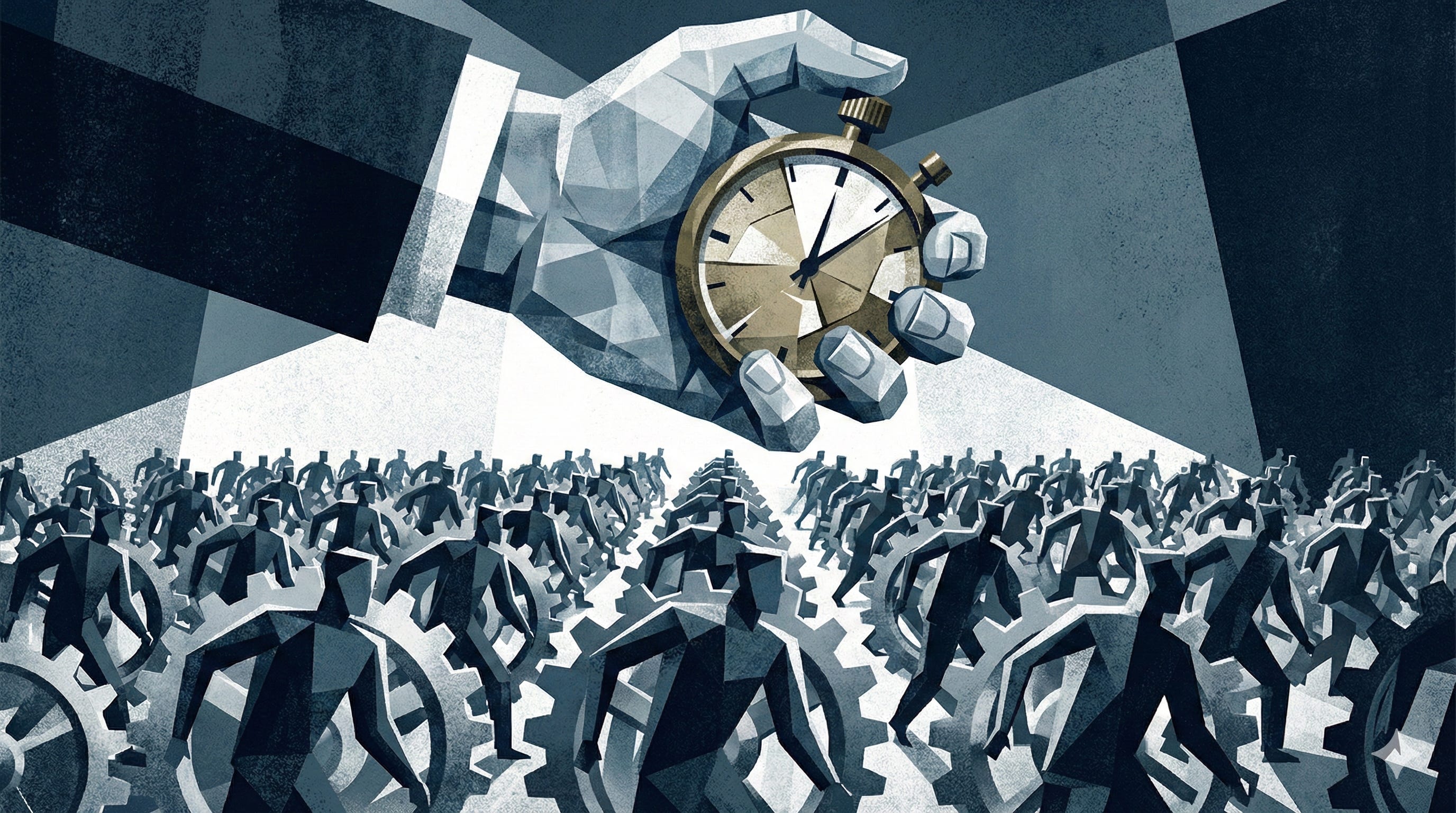
It seems to me that the early success or failure of almost any major enterprise AI project can be found in the stories of two men and the same stopwatch.
The first is Henry Noll, standing on the gritty floor of a steel plant in 1899. His job was to haul 92-pound pigs of raw iron onto rail cars. It was brutal, back-breaking work that paid $1.15 a day. But Noll had a clear purpose: every cent he could save was for a house he planned to build. An engineer approached him with a proposition. If Noll would agree to be timed…to work, and to rest, precisely when a stopwatch dictated…his pay would jump to $1.85. Noll, seeing a direct path to his goal, became a willing participant. His output skyrocketed from 12.5 tons a day to nearly 48.
The second story unfolds a decade later, in the Watertown Arsenal. Imagine the scene: the resonant clang of hammers, an atmosphere thick with the taste of hot sand and iron. A master molder stands over his work. His value isn’t in his raw output, but in his judgment. He has a feel for the craft, an intuition for the perfect temperature and the flawless seam that no manual could ever capture. The stopwatch arrives here, too. But when the engineer tries to time him, the molder refuses. The act implies his years of accumulated wisdom are worthless. It is an insult to his identity. He is fired. His colleagues walk out in solidarity.
This hundred-year-old tension between transactional compliance and true partnership is the central, unacknowledged problem in almost every modern AI strategy.
Of course, when a company decides to invest in AI, they involve their teams. There are steering committees. Stakeholder interviews. Feature checklists are dutifully reviewed by domain experts. On paper, the process is inclusive.
But it often mistakes token involvement for genuine partnership. It’s the equivalent of asking the Watertown molders if they like the design of the new stopwatch, rather than asking them to help invent a better way to cast metal. It’s a process of vetting a purchase, not co-creating a capability.
And so, when the expensive new tool is rolled out, it’s met with a quiet, stubborn resistance. It doesn’t get used, because it doesn’t truly fit the way work is done. It doesn’t understand the nuances. The data feeds run dry. The project fails not for lack of technology, but for a lack of willing participants.
The crucial variable in both of these stories is willingness.
Henry Noll was willing because the system offered him immediate, personal, undeniable value—a faster path to his house. The molders were unwilling because the system devalued their expertise and offered nothing meaningful in return.
The primary job of a leader implementing AI is not to procure the best software. It is to create the conditions for willing participation.
And how does one do that?
You don’t start by showing your team a grand, transformative vision. You start by finding a small, persistent annoyance (a pebble in their shoe) and offering to remove it. You build a simple tool that solves a real, tedious problem and gives them back an hour of their day. You offer value first.
This act doesn’t feel like a top-down mandate; it feels like help. It demonstrates a respect for their time and their focus. It earns a measure of trust. And from that foundation of trust, a partnership can begin. The conversation can then shift from “Here is a tool you must use” to “Here is a tool that gives you leverage on your own intelligence. How can we make it better, together?”
This is the only way forward. The goal is not to find people who will comply with your new machine.
The goal is to build a system that earns the willing participation of your best people.
No posts
Comments
Nothing yet. Say the first thing.
Sign in to join the conversation.