

“I have this feeling a whole new set of rules apply up here.” – Ramona, Roadkill, 1989
In Roadkill, director Bruce McDonald’s “rock and roll movie about a girl who learns to drive,” a music promoter’s intern named Ramona (Valerie Buhagiar), is sent to track down an AWOL rock band that’s imploding mid-tour. Throughout her strange encounters with tripped-out musicians and odd, sketchy characters like an aspiring serial killer (Don McKellar), Ramona keeps a diary to chronicle her misadventures. Her entries include wide-eyed insights, banal observations (“I hope I brought appropriate clothes.”) and dark, soul-searching thoughts about her quest through the “idiot wilderness” of eastern Ontario. The diary also unpacks Ramona’s spirited, at times ruthless determination. “I’m still confident I can handle the situation,” she writes. “I am a little nervous, but it’s a good kind of nervous.” Ramona has a lot to make her nervous: a forever fuming, possibly criminal boss; a stoner cabbie that drives off with her money and luggage, a homicidal maniac who can’t stop unburdening himself, and small animals getting crushed whenever she travels any distance in a motor vehicle.
I’m not certain people felt the “good kind of nervous” during the June 27 screening of Roadkill at the Revue Cinema, but there was an undoubtedly nervy vibe, with the Roncesvalles rep cinema’s possible doom dangling before them. Since its shaky re-opening after the COVID pandemic, the Revue worked its way back to a triumphant state with packed film showings and revenues to reflect it. And now the venerable movie house appeared like the doomed rabbit from Roadkill’s opening sequence, in the path of an oncoming campervan with ‘MOVE OR DIE’ blazoned on its hood—a tender beast about to be crushed by the machinery of greed.
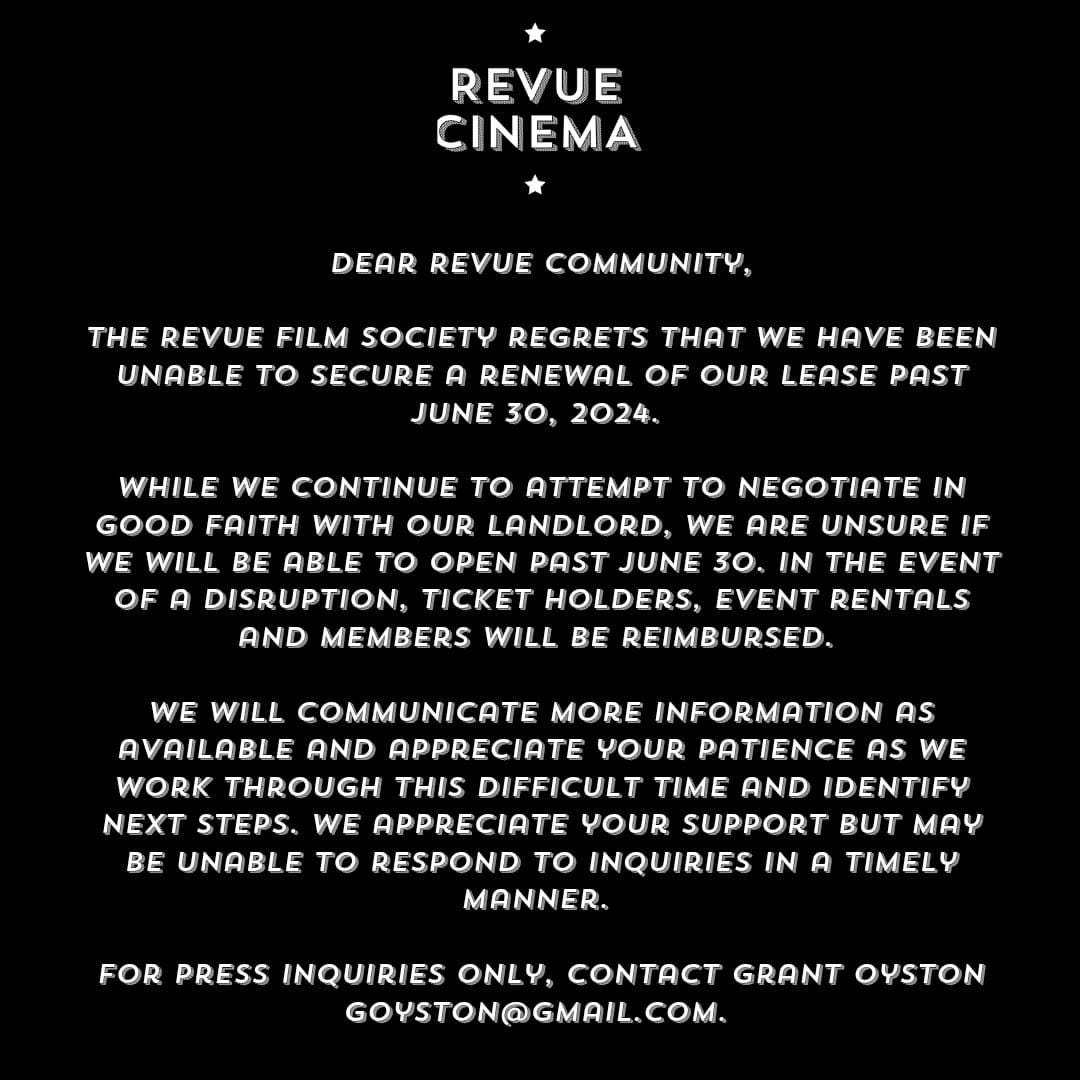
On the day of the classic Canadian film’s screening, an unsettling notice made the rounds online. It stated in bi-coloured block letters, “The Revue Film Society regrets that we have been unable to secure a renewal of our lease past June 30, 2024,” cautioning that the cinema might not be showing films after that date. I read this dire-sounding note around mid-afternoon, in the midst of recovering from my own out-of-town adventure. I had shuttled back to Toronto the night before, specifically to catch the Roadkill screening, with Buhagiar and McKellar in attendance. For a moment or two I rested on the thought, “Look what happens when I leave town for a couple of weeks.” I then spent the rest of the afternoon chasing rumours. The message, on a matte black, Instagram-sized square, wasn’t long on details. “We continue to negotiate in good faith with the landlord,” it read, implying that negotiation might end badly.
Who was this villainous, moustache-twirling landlord, and why did they want to tie my favourite rep house to the railroad tracks? A quick Google search turned up news articles from around June, 2007. A piece in the Toronto Star had the happy headline, “Revue Cinema rescued.” The article featured a smiling photo of then-new landlords, real estate millionaire, Daniel Mullin, just shy of his 79th birthday, and his wife Letty, 67. The article talked up their benign act, “saving the historic Revue Cinema on Roncesvalles Ave., a feat that even keep-it-alive campaigners feared was impossible.” The Revue started off 2007 in a bad state. It had closed its doors in 2006, along with other venues in the doomed Festival Cinemas chain, and then its marquee came crashing down in February during a snowstorm. Mullin, who purchased the building, gave the century-old cinema a literal new lease on life. “I’m buying this place; now you can run it,” he said. Seventeen years later, the Revue’s onetime saviours, were swooping in to claim the whole pie, two days before the cinema’s lease was schduled to renew.
“All I want now is to get rid of the board,” Daniel Mullin told the Globe and Mail, explaining he wanted to run the venue himself. Maybe this move was foreshadowed in 2007, when Letty Mullin told the press, “[Daniel] always wanted his own movie house.” He now seemed intent on achieving this end through foreclosure.
I read a freshly published Globe article, where Mullin made clear his intentions, from the screen a friend’s phone, minutes before the movie started. The mood around me was pregnant and edgy—but for all that surprisingly upbeat. After spending the afternoon reading variations of, “local culture is dead, oh no,” on social media, it was pleasing to detect good-natured defiance rippling through the room. People were moved to cheers and boos when David Bertrand, who programs for the Stompbox film series, faced the elephant in the room head-on while introducing the movie.
“He’s just decided he wants to cut the board,” Bertrand lamented, “or cut people that run this place and take it over himself and do—nobody knows.”
Substantial boos.
“I don’t know,” he went on. “I’m not on the board. I’m a programmer here, who loves this place deeply with all my heart.”
“Just a programmer” might be underselling the situation, however, since the programming is what makes the Revue a miracle among rep cinemas. Second-run films at the Revue are usually presented in curated series, such as Silent Revue (silent films with live accompaniment), Dumpster Racoon (beautifully trashy cult films) and Stompbox, which showcases rock and roll movies—outright concert films or rock-adjacent cinema gems like Roadkill. A Stompbox audience is properly versed to navigate the irony, Gen-X snottiness and lo-fi artfulness of Roadkill, along with its soundtrack, a playlist of late-eighties indie bands, mostly from Toronto. A unified cheer went up when legendary art rock weirdo, Nash the Slash, appeared onscreen, bandages and all, ripping through a tune appropriately titled “Roadkill”.
The film’s punk energy seemed to further further feed the evening’s rebel mood, which included one patron chaining himself to the building’s front door. During the post-film Q&A Don McKellar interjected, “What is going on with this theatre? We’ve got to save the Revue.”
Rousing cheers.
McKellar called out the Mullins’ surprise move, claiming, “It seems likes the landlord is trying to punish [the Revue] for actually succeeding. You know what I mean? Like, ‘They’re actually doing a good job. I want a piece of that.’ That’s a mistake. That’s not going to work.” Addressing the audience, he added, “You’re not going to come, because it’s going to be terrible programming.”
And therein lies the rub for any soul trying to replace the Revue’s board and programmers. The Revue’s success comes from excellent curation, the satisfying feeling that each film in a series beautifully follows the next, so there’s always an aesthetic payoff for returning. Attentive choices by programmers, who usually introduce the films, engender loyalty in audiences, and as they keep showing up, a deepening sense of community. Mullin’s unwanted power play will swiftly alienate the audience base he presumably hopes to capitalize on. While it might be possible for the Mullins, or whoever they hire, to emulate the Revue Cinema’s formula, they’d need to rebuild its culture from scratch. If the board and programmers are forced to go, audiences will follow. The Mullins risk killing the goose with the golden egg if they follow through with their plan to dissolve the Revue Film Society and make the cinema a for-profit venture.
When I take a seat at the Revue, I feel welcomed home, in a room full of people that I mostly don’t know but who nonetheless feel like neighbours rather than strangers. That feeling was especially strong on June 27, in a roomful of film buffs circling the wagons. With the warmth of that group around me, it felt impossible this cool thing could end.
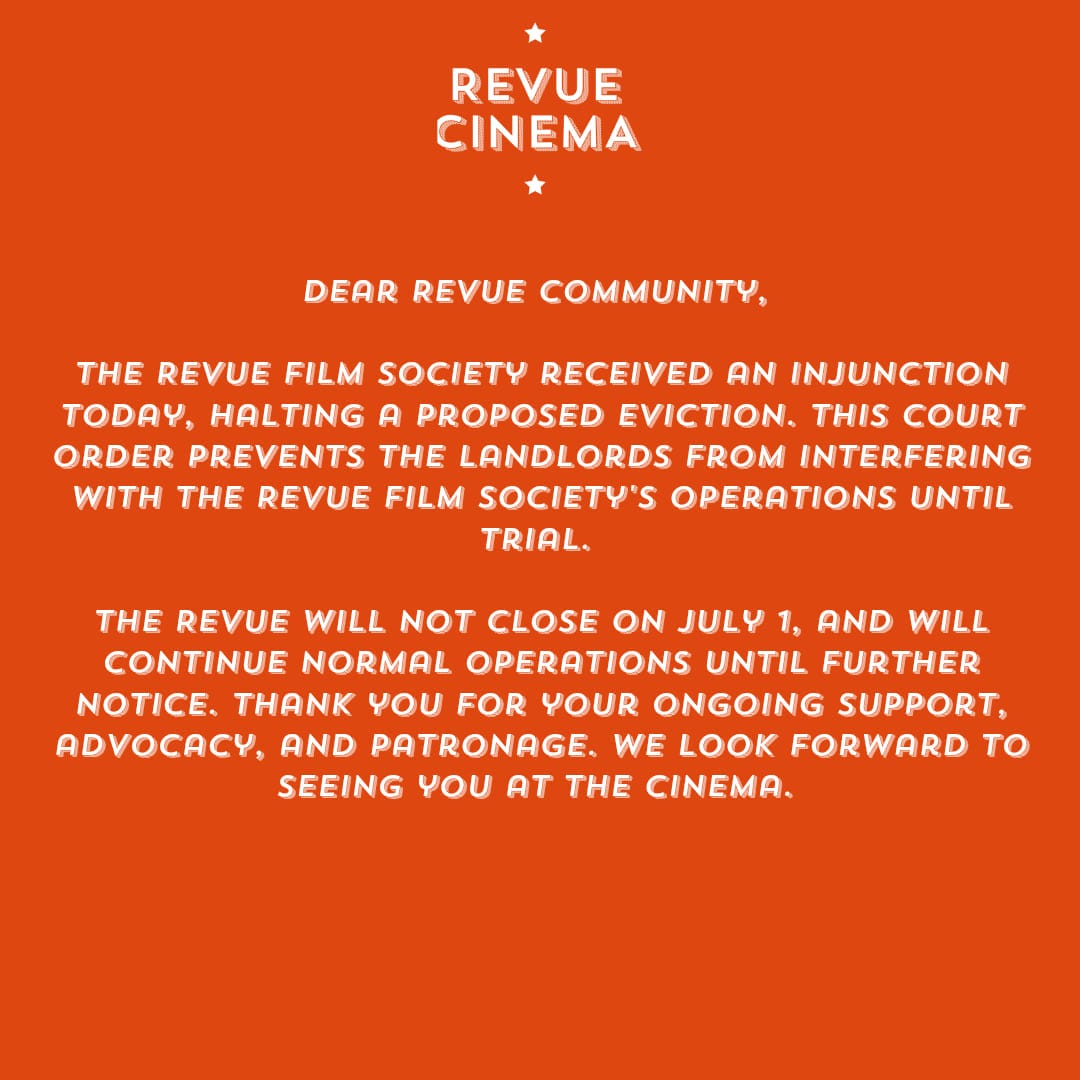
Luckily defiance of the Mullins’ efforts was more than symbolic. The day after the showing, the Revue team obtained a court injunction, preventing immediate closure of the venue. The injunction’s a lifeline but not a forever fix. Still, it keeps the Revue’s doors open, at least until their scheduled court date with the landlord, July 8. That’s at least long enough for the Revue to honour tickets for the midnight showing of Dark Star on Friday, July 5, where I’ll be headed. For now I’ll grant myself a smidgen of optimism about the cinema and its team’s continuation. Anyhow, if you’re going, see you next Friday.
No posts
Comments
Nothing yet. Say the first thing.
Sign in to join the conversation.