
Welcome to China Trend Watch (Week 28–29 | 2026), where I bring you the latest trends, memes, and debates driving conversation across Chinese social media. I'm Manya Koetse, a sinologist specializing in Chinese digital culture.

I had planned to send out a newsletter last week, but a week-long holiday with a toddler and a kindergartener is not for the faint-hearted. I was caught up in pool inflatables, animal-shaped pizzas, and chasing Pokémon. I did, however, keep up with everything happening online - and it’s been an intense two weeks on Chinese social media.
In this issue, I’m catching you up on the stories you need to know about, including the extreme weather and the noteworthy narratives surrounding it, China’s second “DeepSeek moment,” the nostalgic summer hit at the cinemas, how the Hong Kong bookshop raids did not go trending, and why “grassroots plagiarism-detection” is the word of the week.
😷 COVID-19 returned to the top of Weibo’s hot lists. Mainland China recorded 79,000 newly confirmed COVID-19 cases between June 1-30, including 130 severe cases and 1 death. In July, COVID numbers have continued to climb. This summer surge reignited discussions about wearing face masks and other precautions to avoid contracting COVID (again). One commenter wrote: “What do you mean, “COVID is back? It never completely went away!”
💳 Chinese banks are giving away AI tokens as loyalty rewards. Six of China’s major banks are launching “AI bank cards” – debit and credit cards - that come with token allowances and AI memberships from companies such as Kimi, MiniMax, Alibaba Cloud, and Tencent instead of traditional perks like coffee coupons or travel benefits. The moves show new ways for traditional banks to embrace the AI boom.
👑 Erling Haaland has become China’s meme king for summer 2026. The Norwegian striker became the biggest viral sensation of the 2026 World Cup on Chinese social media, where his combination of monstrous goal-scoring, Viking-like appearance, and cheeky behavior (such as drinking his opponent’s water during matches) made him irresistible and highly ‘memeable’ to netizens. Haaland also joined the fun on Douyin, where he soon had over 7.3 million followers (& counting).
📚 China’s best-known “delivery poet” has won one of the country’s highest literary awards. Former delivery rider Wang Jibing (王计兵), known as China’s “delivery rider poet” (外卖诗人), is receiving renewed attention after his poetry collection Flying Low (低处飞行) was first shortlisted and then won the prestigious Lu Xun Literature Prize. The 56-year-old first rose to fame in 2022 for writing relatable poems on scraps of paper between food deliveries, and he is the first delivery rider to ever win the award.
🚗 A parking dispute between an ordinary citizen and a local official turned into one of China’s biggest online discussions recently. What started with a Changsha resident finding his privately owned parking space occupied by the car of a government official spiraled into a days-long standoff involving police, mediation, and a social media circus. For netizens watching the story unfold, it wasn’t about parking space but about abuse of power and privilege.
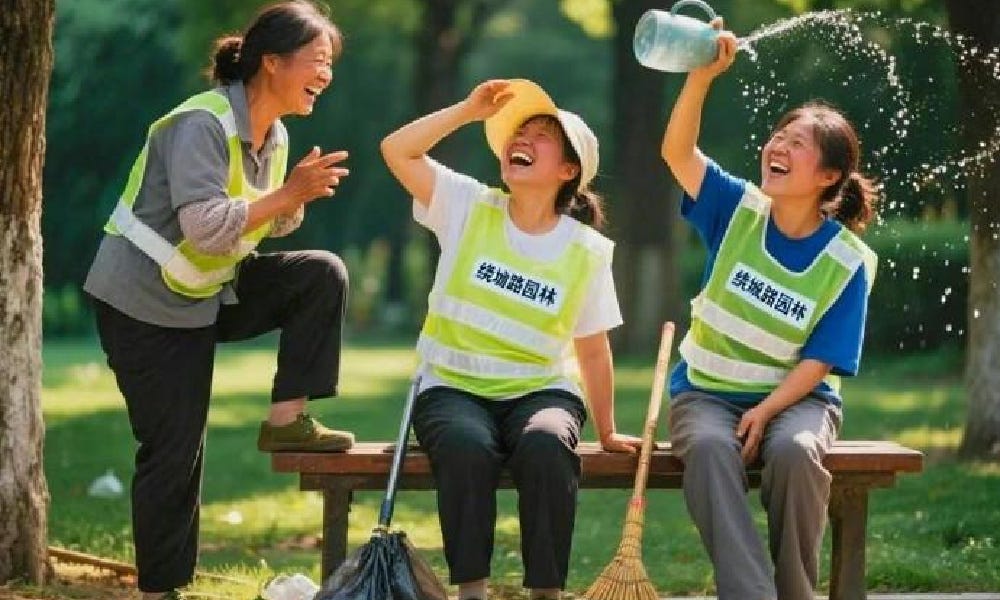
📸 An AI-generated “photo” won first prize in a much-discussed photography contest. The contest was organized by the Federation of Literary & Art Circles in Hohhot, the capital of Inner Mongolia. It was only after it became the winning entry that the picture, showing sanitation workers laughing in the sun, was discovered to be AI-generated. For now, the federation has not only revoked the award but also canceled the entire competition to reflect and do some soul-searching (officially: “carrying out a comprehensive review and rectification process”) in these confusing AI times.
🚖 Baidu is doing the Belt and Road by robotaxi. On the sidelines of the World Artificial Intelligence Conference (=WAIC, where Xi Jinping personally delivered the opening keynote), Baidu signed a partnership deal to bring its robotaxi service, Apollo Go (萝卜快跑), to Kazakhstan, marking its first major expansion into Central Asia. Apollo Go, with a strong focus on international expansion from Germany to Dubai, has already facilitated 22 million rides worldwide.
🌙 Overnight, everybody is talking about K3, the latest model by the Beijing-based Moonshot AI (月之暗面). Released just before the WAIC, Kimi K3 is now the world’s largest open-source model with 2.8 trillion parameters. Compared to Western counterparts, it stands out for its affordability and coding capabilities. Kimi K3 is available through Moonshot’s own website and API, but they promised to release the full downloadable version around July 27. That would make it the largest, most powerful AI model ever made freely available for download. Some are already calling this a second “DeepSeek moment.”

“Dear, you Chinese are very strange,” says a Western woman at the start of a video recently posted on social media, questioning why Chinese people don’t share a collective belief in God.
The video appeared after the floods in Guangxi earlier this month—marking the beginning of an extreme summer weather period that disrupted daily life, flooded villages, and caused buildings to collapse.
Comments
Nothing yet. Say the first thing.
Sign in to join the conversation.