
Amit Kumar
Even before China established itself as a principal challenger and peer to the US, it had accumulated enough power to deter American coercion by military means. However, the US’ enormous economic and financial might meant that it could still pursue coercion through economic means. The US weaponised its dominant economic and financial position to carve out several coercive measures, including the Entity List, the Section 301 mechanism, the Office of Foreign Assets Control sanctions regime, the Foreign Direct Product Rule, dollar clearing, and control over financial messaging infrastructure, among others. This capability allowed the US to resort to coercion against its adversaries during peacetime as well.
Notwithstanding its rising clout, even China couldn’t manage to escape this form of coercion. As late as 2018, despite being the second-largest economy, Beijing was coerced into acquiescing to the Trump administration’s demands. Later in 2024, when the US-led West threatened secondary SWIFT sanctions on entities continuing to do business with sanctioned Russian companies, Chinese financial institutions ceased financial transactions with their Russian counterparts. The fear of being sanctioned kept the Chinese and Russian trades from settling for almost a year.
Washington has a long record of deploying similar instruments of economic coercion against its adversaries, often to complement its coercive military means. Years of application have enabled the US to build, develop, expand and perfect the toolkit. For a long time, no other country could claim to operate a toolkit of economic statecraft as extensive as the US.
But this reality may be changing fast. Or perhaps it has already changed. The period since 2018 has witnessed an unprecedented scale of economic sanctions exchanged between the US and China. Not only has recourse to such measures become more frequent and intense, but they have also been guided by geopolitical moorings.
Within a span of a decade, China has constructed an extensive toolkit of economic coercion, at times mirroring the US instruments, but also innovating on existing mechanisms. Beijing is laying down an extensive legal architecture around its coercive economic instruments to strengthen its economic warfare capabilities.
At the centre of this effort lies China’s National Security Law (NSL), enacted in 2015, which forms the foundation of each coercive economic instrument unveiled thereafter. It was perhaps the first serious attempt under Xi Jinping’s presidency to construct a legal architecture for economic statecraft. In 2015, China’s National People’s Congress (NPC) Standing Committee repealed the previously existing National Security Law or State Security Law, of 1993 and replaced it with a new and much more comprehensive law.
The NSL expanded the scope and definition of national security beyond its traditional reach to envisage an all-domain concept. Article 2 defines national security as:
A state in which the regime, sovereignty, unity, territorial integrity, welfare of the people, sustainable economic development and social development, and other major interests are relatively free from danger.
This definition establishes national security as an all-encompassing concept, which is broad and vague enough to include any act, event or decision within its scope. Under this all-encompassing approach, the concept of national security spans across political, territorial, military, economic, financial, cultural, social, technological, ecological, resource and nuclear security.
But more importantly, the NSL forms the foundational law for China’s economic statecraft owing to its heavy focus on economic security and encouraging an all-government and all-people’s approach to safeguard it.
The law makes economic security, alongside political security, the foundational basis of national security. Article 8 explicitly underlines that “national security shall be coordinated with economic and social development.” It also underscores the importance of “safeguarding security in important industries and fields that influence the populace’s economic livelihood, key production, major infrastructure and major construction projects, as well as other major economic interests.” Across several articles, it directs the state to safeguard economic, financial and resource security.
It directs the state to establish national security review and oversight mechanisms, for the purposes of:
“Covering foreign investment, specific items and key technologies, network information technology products and services, construction projects involving national security matters, and other major activities that affect or may affect national security.”
It is this mandate outlined in Article 59 of the NSL from which several of Beijing’s security review mechanisms draw their legitimacy and legal authority.
Accordingly, since the enactment of the NSL, Chinese authorities, at various levels, have unveiled several legislative instruments to build a legal architecture of Beijing’s economic statecraft and coercion.
These legislative instruments fall broadly under four categories in the order of hierarchy: laws, administrative regulations, departmental rules or orders, and announcements. Laws refer to the legislative instruments passed by China’s highest legislative body, the NPC. But since this body meets only once annually, the NPC Standing Committee is also empowered to enact laws. More often than not, it is the NPC Standing Committee which enacts laws. Laws are promulgated by Presidential order.
The next in hierarchical order are administrative regulations or decrees, which are issued by the State Council and bear the Premier’s signature. Departmental rules or orders are third in order and are issued by relevant departments within the State Council, i.e. respective ministries or commissions, such as the Ministry of Commerce (MOFCOM), the National Development and Reform Commission (NDRC), the Cyberspace Administration of China (CAC), or the State Administration for Market Regulation (SAMR). At the bottom are normative documents, also issued by respective ministries but not concerned with rule-making and procedures, such as MOFCOM Announcement No. 59.
Over the course of the last ten years, China has thus built an extensive toolkit of economic statecraft. And there are two ways to analytically approach its study. The first involves a legislation-led approach, wherein one begins with a single law that regulates and provides for coercive economic measures. It treats the law as the primary node of analysis, and subsequently explores the decrees, orders, and announcements that flow from the overarching law. The second entails a domain-led approach, wherein one begins instead with a specific domain or weaponised tool, such as trade, technology, or supply chains, and draws together the various legislative instruments that operate within it.
The limitation of the legislation-led approach is that a single law or decree may regulate multiple domains or tools, just as a single domain or tool may be regulated by more than one law or decree. Anchoring the analysis to an individual statute is thus likely to yield an incomplete picture of any given domain or tool. The domain-led approach resolves this difficulty. By drawing the relevant segments from across the entire legislative pool, it assembles every instrument of coercion relating to one domain into a single assessment.
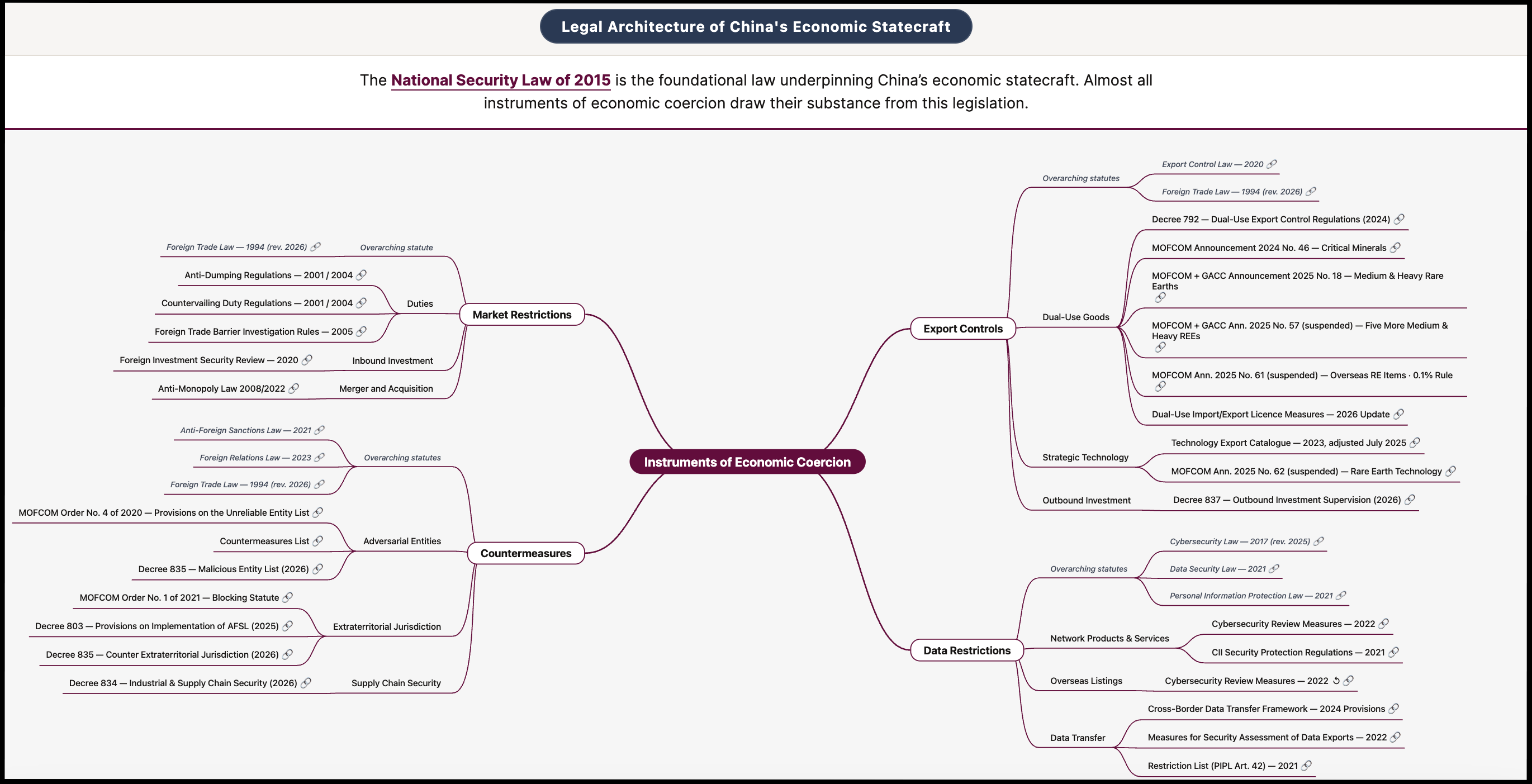
Adopting that domain-led approach in mapping China’s coercive economic toolkit, I have built an interactive repository classifying Beijing’s toolkit into four broad instruments, namely market restrictions, export controls, data restrictions, and countermeasures. Each of these categories further include a sub-classification of legislative instruments – new and old – and brief assessments for each that are intended to be helpful for both curious enthusiasts and practitioners in industries and governments.
View The Comprehensive Repository Here
Beijing has weaponised its market via anti-dumping and countervailing duties, inbound investment screening, and merger and acquisition review mechanisms. The common thread tying them is a restriction on entry into the Chinese market.
Export controls emerge as the second instrument of coercion, and also the most popular of all. It extends to goods, technologies and outbound investments. The common thread tying them is the restriction on what leaves the Chinese borders.
The third instrument entails the weaponisation of data, and the underlying infrastructure governed by China’s cybersecurity and data security regimes double as instruments of coercion against both foreign and domestic enterprises.
The fourth category comprises countermeasures aimed at foreign entities. Unlike the first two, which operate on grounds of national security, these instruments openly address discriminatory measures and long-arm jurisdiction directed at Beijing. They target foreign entities and, in some cases, foreign states themselves.
But how do domestic market-related restrictions apply differently to inbound investments and M&A review mechanisms? And how do export controls, to dual-use goods and strategic technologies? For more, keep an eye out for my upcoming paper with Takshashila on the coercive economic order China is weaving!
Thanks for reading ‘Eye on China’! This post is public, so feel free to share it.
Eye on China is a weekly newsletter curated by the Geostrategy Programme at The Takshashila Institution, a public policy think-tank based out of Bengaluru, India.

Comments
Nothing yet. Say the first thing.
Sign in to join the conversation.