
Can there be a formula for change? You can’t design a different future or build for tomorrow unless you’re capable of sustainable change. Time and change principles can work together to help you win more business and improve your profits.
Vision, commitment, and training represent what leaders do to create change.
If we’re going to be effective in our roles as leaders and team members, we need to be aware of three change principles:
A Vision of big dreams for a different future
Commitment to sustain our focus
Training to equip and prepare us.
It sounds simple. Leaders are most effective when they cast a vision about where they’re leading, what they expect, and what they want to accomplish. Teams perform best when they understand where they’re going, why it matters, and what they must do along the way.
Is the framework perfect yet? Probably not. Bear with me.
I originally wrote about these three characteristics in The Society of Extraordinary Strategists Substack:
Extraordinary Strategists confidently lead by learning from hindsight, guiding with insight, and acting with foresight to direct the company along a clear path to its desired future.
These three principles represent how leaders think across time. Future-focused leaders
Learn from hindsight
Guide with insight, and
Lead with foresight
Together, they integrate thinking with doing. Sustainable change is influenced by how a leader thinks over time (looking back, now, and ahead) and acts to spark change (dreaming big, sticking to it, and building skills).
Think of it as a Think x Act Matrix.
You can’t design a different future or build for tomorrow unless you’re an architect of sustainable change.
A Think x Act Matrix could look like this:
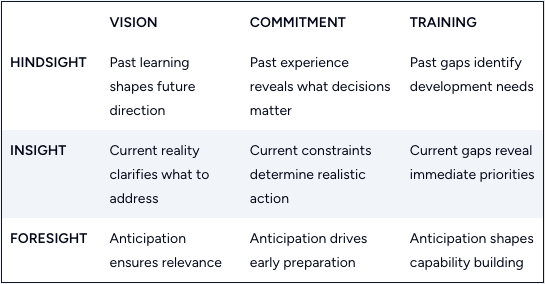
That version is a bit stiff at this point; here’s where I’m going with it. The rows show how you think about time. The columns (Actions) show what you do to push ahead and create change and a different future.
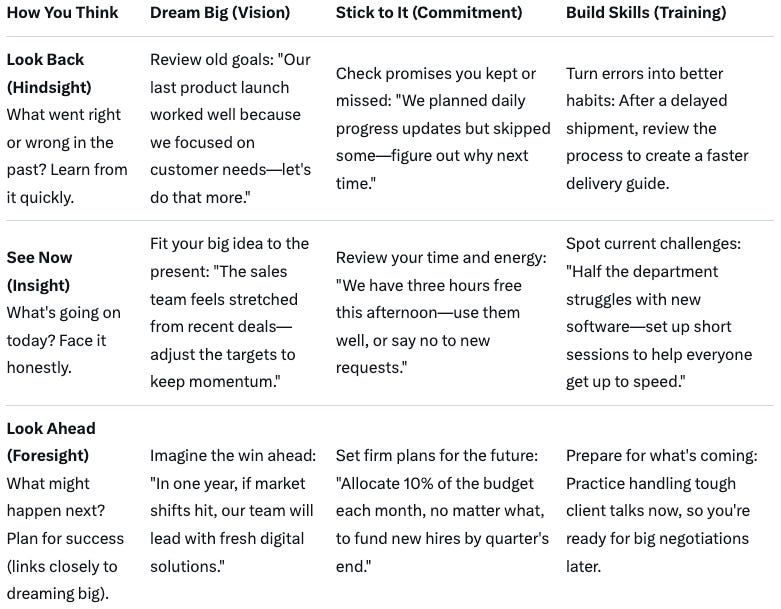
I applied this model to residential HVAC sales, using insights from HomePros.news.
In residential HVAC sales, the sales team must reflect on past home installs, address today’s homeowner needs, and prepare for future shifts—while driving sales through qualified leads, consistency, and skill-building. This grid tailors the framework to residential specifics, like promoting energy-efficient systems amid supply chain strains and refrigerant changes. Rows cover how you think about time. Columns cover what you do to close more deals.
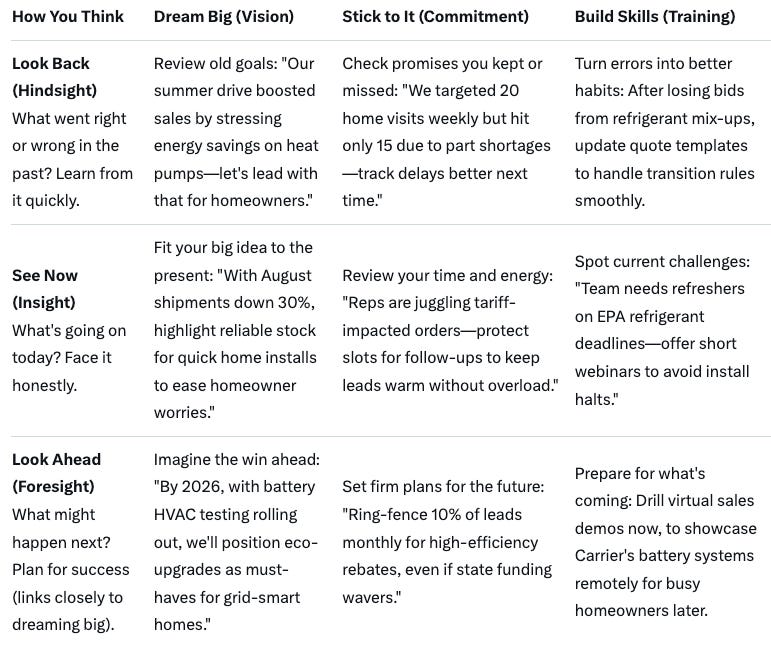
While this version isn’t specific to a particular business, it demonstrates how you can use this model to improve your sales process in 5 minutes a day:
Choose one row (like “See Now”) and note one residential-focused idea per box.
For teams: Rate each box 1-10 in a quick call—low scores trigger tweaks, like a rebate workshop.
For personal use: Apply it to your homeowner pipeline—target efficiency upsells, commit to site visits, and rehearse objection responses.
Thanks for being a subscriber and for joining me on this journey! I’d love to hear your thoughts on this framework; don’t be shy.
Thanks for reading The Society of Extraordinary Strategists! This post is public, so feel free to share it.
Get my new book, Blue Collar Branding: The Field-Proven Framework to Transform Service Companies into Market Leaders, exclusively from Amazon.
Comments
Nothing yet. Say the first thing.
Sign in to join the conversation.