
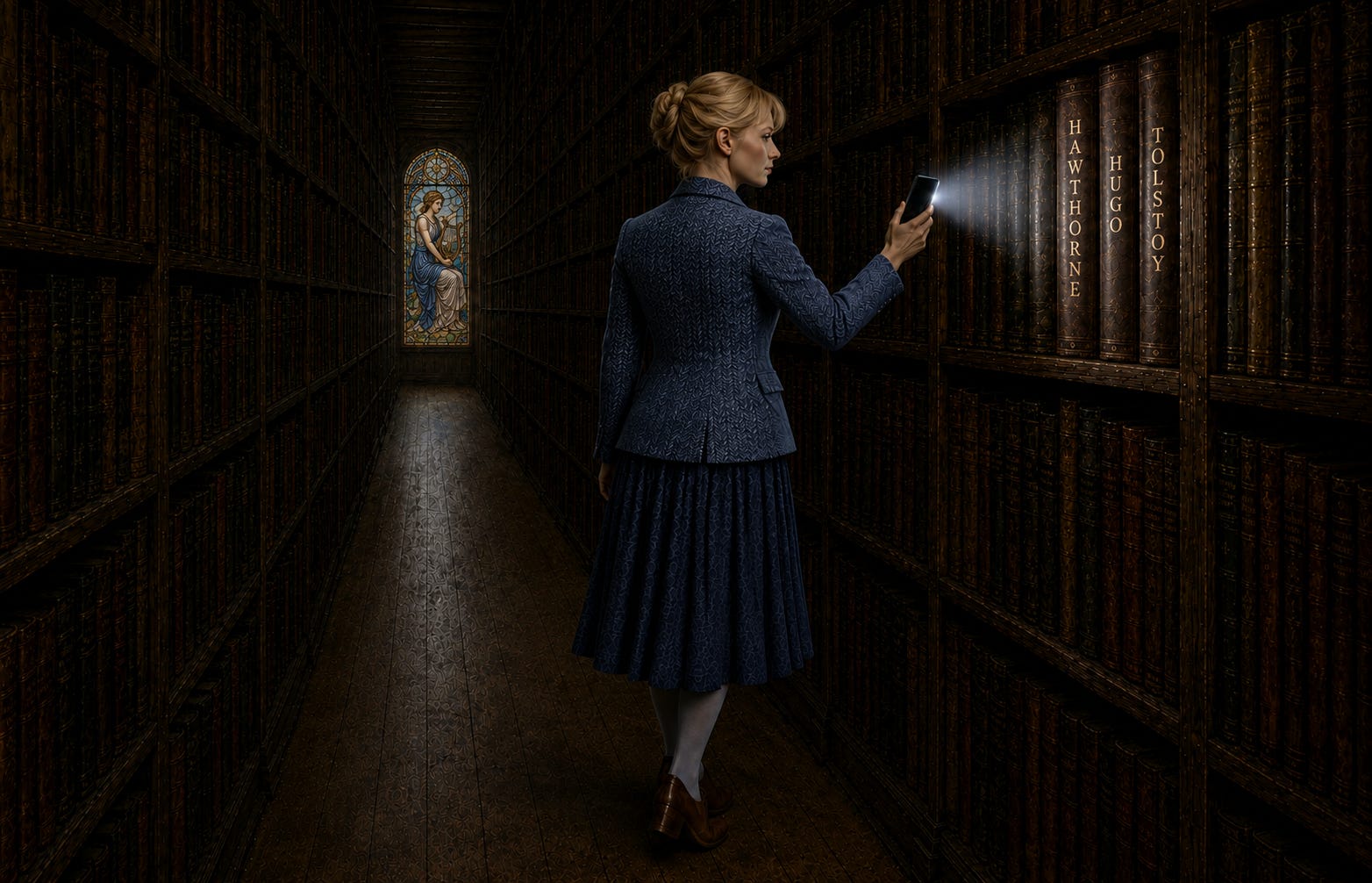
Programs for reading the classic works of our civilization usually start with the oldest works and end with the newest ones. Thus, whether enrolled in a college with a great books curriculum, working through a curated set of volumes, or following a series of videos, a learner engaging enduring literature will, as a rule, move forward in time.
This manner of doing things provides the reader with a powerful advantage. Before he engages a fresh text, he has become familiar with many of the works the author at hand has read. Thus, he will understand more of the references, whether to works, events, personalities, or other writers, that he encounters.
Alas, reading forward in time can also promote the idea that, since each author builds upon a foundation laid by his predecessors, he necessarily achieves greater heights. If, however, the learner reads with care, he will also be able to notice cases of decline. As a result, progressive reading may, paradoxically, provide a degree of inoculation against the parlous presumption of progress.
These things said, some autodidacts will want to take a different approach to the systematic study of the great books. Rather than starting at the beginning and moving forward, they would start at (or near) the present and work backwards.
This contrarian approach offers the obvious benefit of familiarity. Reading a book sent to the press a hundred years ago offers fewer obstacles, of language, culture, and context, than one set down at the dawn of Western Civilization. Moreover, the many references to things, people, and ideas of the past will whet the appetite of the reader. ‘So’, he will think, ‘who is this Socrates who keeps popping up in the books I read?’
The one drawback to this approach stems from the antiquity of the classic collections of classic works. The Harvard Classics, for example, contains nothing that emerged from the press after 1909. Thus, the series contains little that was written in the past hundred and fifty years and nothing that dates from the past century. The most recent edition of The Great Books of the Western World went into print in 1990. Thus, it contains more from the twentieth century than its older competitor. Still, I would wager that few of the more recent works in that compendium were written by authors who had been too young to dance the Charleston.
So, to quote the immortal words of David Crowther, ‘You pays your money and you takes your choice.’ The heart of the matter, after all, lies more in the quality of books read than in the order of their engagement.
Related Reading
No posts
Comments
Nothing yet. Say the first thing.
Sign in to join the conversation.