
Do you know the story? It begins with King Midas detaining (some say capturing) Silenus, the wise old tutor and companion of Dionysus, the god of revelry, wine, ecstasy, madness, death and rebirth. Knowing that Silenus was possessed of divine wisdom, Midas asks Silenus ‘what is the best thing for man?’ and Silenus answers, ‘It is best not to be born; and, for those already born, the next best thing is to die as early as possible.’ This is not quite the nihilism it appears to be for Silenus was a Dionysiac (‘Bacchic’) reveller, and enjoyed life to its limit. This is why he is usually portrayed drunk and happy. Silenus’ answer was rather a gesture towards eternity and an expression of disdain for mortal, ‘ephemeral’ things.
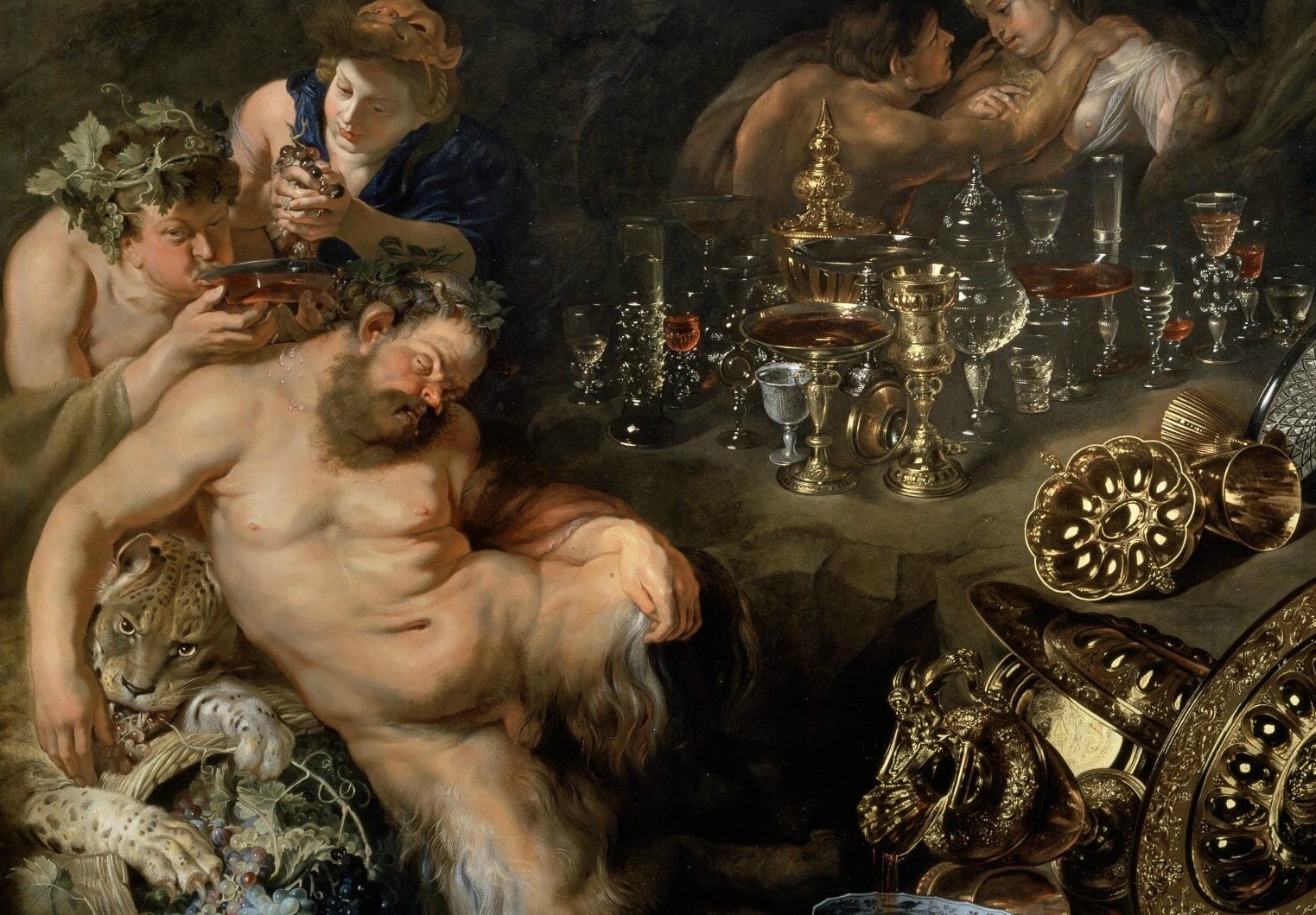
Midas then hands Silenus back to the god Dionysus with whom, before we proceed, it is worth reacquainting ourselves. Dionysus’ father, Zeus, was the divine ruler of the universe, his mother, Persephone, was the queen of the underworld. When Dionysus was a child he was, on Hera’s orders, torn apart (and then boiled!) by the monstrous Titans. In one version of the story Persephone’s mother, Demeter, the goddess of the harvest, gathers up the pieces and buries them in the earth, from whence the god is reborn. In another Zeus puts fragments of his dead child’s heart into a drink which he gives to Semele, mortal daughter of the King of Thebes, who is then (because she accidentally sees Zeus’ true form) burnt up in a lightning blast, leaving the intact godchild, Dionysus.
I’ve over-simplified the story — but does it sound at all familiar? A god born of the ruler of the universe and a mortal mother who is brutally killed and then reborn, to much delight? That’s right, he was the inspiration for Paul of Tarsus’ tale of Jesus, and the reason why immersion in the ritualistic death-and-rebirth of the god of wine (or of the vine — we being the branches of both Jesus and Dionysus) leads to much the same outcome as the mass in its original form; dissolution of the ordinary ego, and rebirth in the spirit. Paul, the originator of the myth of Jesus (and it was Paul’s myth) wanted the followers of his church (and it was Paul’s church) to go through the same ecstatic experience as that of the cult he, like all Graeco-Roman citizens, was most familiar with.
Dionysus appeared in human form more than any other Greek deity. He was, like Christ, god of the common people, women, slaves and ordinary labourers, who celebrated his appearance in the flesh with solemn rituals, followed by wine, song and ecstatic dancing, which took celebrants through a collective experience of death and rebirth. This communal aspect to Dionysiac rites, along with the fact that Dionysus represented joy of the flesh and a positive vision of the hereafter, explains why he was, despite his enormous popularity, pushed to the margins by Homer, whose primary audience were princely elites whose conception of the universe did not readily accommodate dissolution of the boundaries between mortality and divinity, particularly not for ordinary folk.
Let’s return to Silenus. Midas hands him back to Dionysus who rewards the king with a gift, a wish. And what does Midas wish for? Showing he understands nothing of what either Silenus is trying to teach him, or what Dionysus represents (or perhaps even what his father Gordias—the fellow who was good at tying knots—once tried to instil in him) Midas chooses to have everything he touch turn to gold, to possess the supreme power of money. Dionysus, writes Ovid, ‘agreed to this wish and gave its asker the power which would prove his downfall, sad that the king hadn’t chosen more wisely.’1
Indeed. Money, which had just made its appearance, not just in Greek society, but in civilised human experience, represents the opposite of communal joy (the rich man does not need to depend on his community for his needs) and of immersion in the cycle of life (the rich man need have no direct experience of nature). Money does away with the necessity of depending on reciprocal relations with one’s fellows and it freezes ephemeral quality into fixed, fungible quantity. It thus introduced a new, extreme form of individualism and abstraction—not to mention loneliness, uncertainty and nihilism—into human affairs. This quantification of reality led to the birth of science, very useful, to be sure, but it was the absolute opposite of what Dionysus represented and what Silenus taught, and it was a disaster for Greek society.2
The effect of money on those who possess it is more or less the model of tragedy— itself closely allied with Dionysiac rite and ritual.3 A wealthy individual splits himself off from the whole, turns the living quality of his life into a series of calculations, and then, finally, is punished by the gods for his hubris. But that is not to say that tragedies must all end in ruin; they can go two ways, which is why the tragedy of King Midas has two endings. In one, Dionysus, the god of revelry and madness, bathes Midas in a river of truth, after which he moves to the country and becomes a worshipper of Pan, the god of music and meadow, where he lives happily; even if he accidentally upsets Apollo for preferring Pan’s songs to those of Phoebus and gets a pair of donkey’s ears for his trouble.
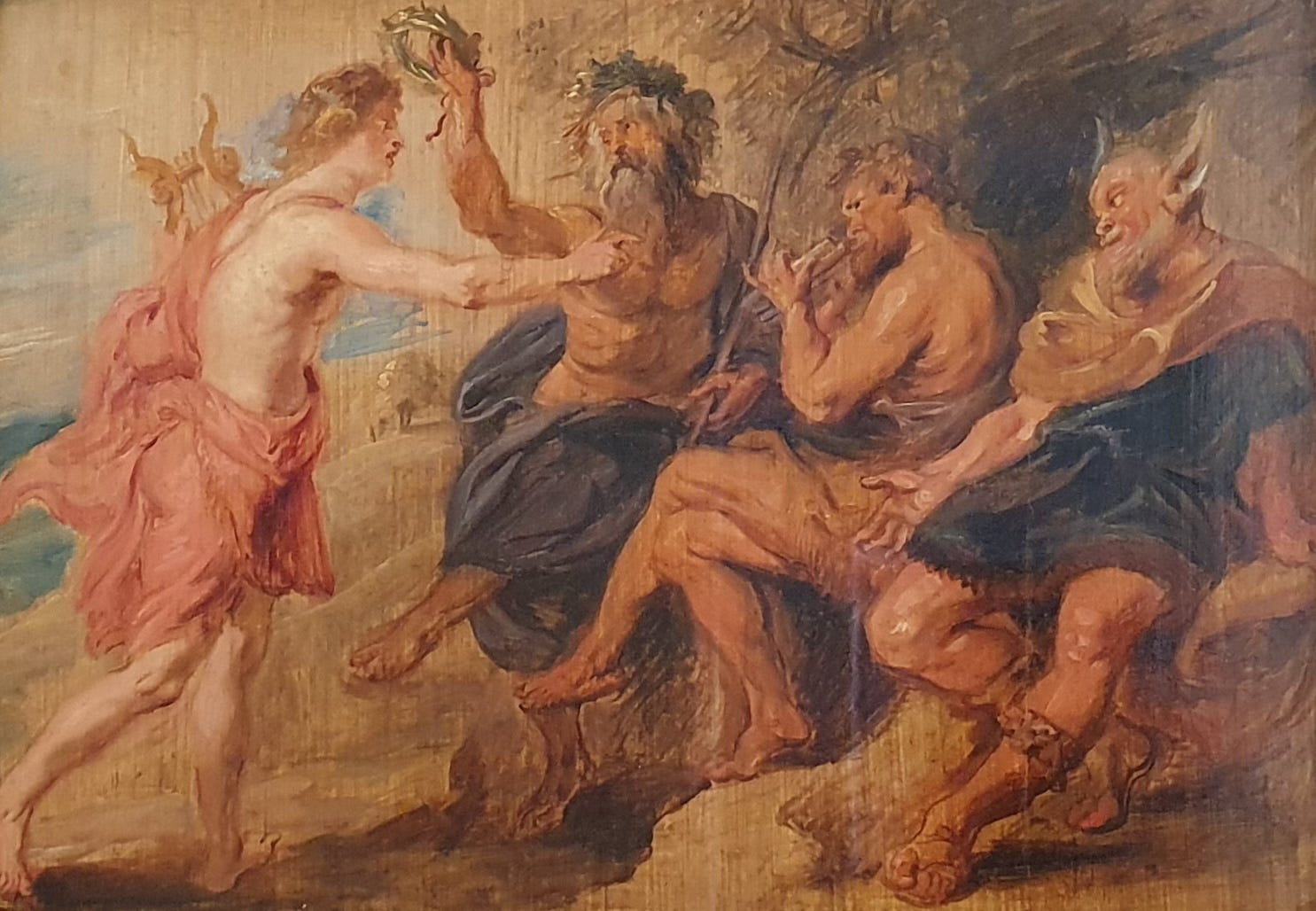
In the other version, Midas accidentally turns his daughter into gold, scorches his throat with liquid gold and then dies, miserably.
We are all King Midas in reverse. We are all living the tragedy of individualism, severed from the whole; the whole of life, the whole of nature, and the whole of mankind. This is why we are so lonely. We have ‘lost the cosmos’.4 Everything we touch turns to self-graspable, non-mysterious matter, a mere thing, that divides us from what the objects around us actually are, fragments of a fulfilling unity. We do not taste the fruit, we just taste the thing that self has made of it, and so we hunger and thirst for more.5 We reach for satisfaction—we buy clothes, books, musical instruments, jewellery, electronic gadgets, cars, houses, businesses and islands—and we buy people too, lovers, employees, followers, fans, even a family can be purchased—but when we get them we find we just have them. The substance is in our grasp, but the essence that we crave eludes us, and so we become either misers, hoarding the potential to have things, enjoying a pristine power over them (misers love pristine minimalism), or spendthrifts, supplementing the lasting fulfilment of loving something, or someone, with the fleeting gratification of acquiring (spendthrifts love fleeting luxuries)6—and not just misers and spendthrifts with money; man hoards knowledge and skills, or he dissipates his attention and his affection, all to avoid the catastrophic joy of being with his own inner life and through that, the life of things.
The tragedy of being an isolated individual compels man not just to seek satisfaction in the isolated bits of this thoughts, feelings, experiences and sensations, but to construct his entire self from the isolated shards of modernity. For King Midas is gold too, a hard, cold, metallic object, with no inner life from which to develop character. Me must therefore assemble his personality from external beliefs, opinions, attitudes and identities. The modern world, built by a billion cursed kings, allows him to do this; to live in one country, work in another, eat the cuisine of a third, have friends in a fourth, adopt the religion of a fifth, wear the clothes of a sixth, enjoy the art of a seventh, marry a wife from an eighth, support a football team from a ninth and furnish his house with objects built in a tenth, eleventh, twelfth, thirteenth… and never have to speak to his neighbours, who are as fragmented and unhappy as he is.
Traditional society constrains us, but it also provides man with identity, a sense of belonging, obligations, security and meaning. Modern society, in removing these constraints or making them optional, generates loneliness, uncertainty, selfishness, insecurity, nihilism and a dulled, blasé, matter-of-fact attitude towards life, all hallmarks of wealth. Money, representing every form of satisfaction, becomes the quintessential drug. Initially, man seeks money as a means, because of what it can do—it can provide food, shelter, tools, diversion—but this soon becomes a thirst for money in itself, because, unlike any other means, it represents every possible end — including every kind of potential action (i.e. every possible freedom).7 Thus, man accumulates money without ever really knowing what he wants from life, and, consequently, what to spend his money (and his freedom) on, other than making more money. This is the curse and tragedy of the rich, not just the super-rich the middle class hate for their wealth, nor even the middle-class that the poor hate for their wealth, but all of us in a money economy, all turning everything we touch into shit.8
And, as with the tragic tale of King Midas, there are two possible endings. We can bathe in the river of truth, and return to the fields and meadows, and to our fellows, and to the flute; or we can go mad and die of loneliness and hunger.
Ovid, Metamorphosis (tr. Raeburn)
Richard Seaford, Money and the Early Greek Mind
Richard Seaford, Dionysus.
D.H. Lawrence, Apocalypse
Like another old king, Tantalus, whose curse — also punishment (at least in some accounts) for gluttonous pride — was to stand in a lake of water that receded from his cup and below a bunch of grapes that rose beyond his grasp.
Georg Simmel, On Individuality and Social Forms
George Simmel, The Philosophy of Money
Comments
Nothing yet. Say the first thing.
Sign in to join the conversation.