
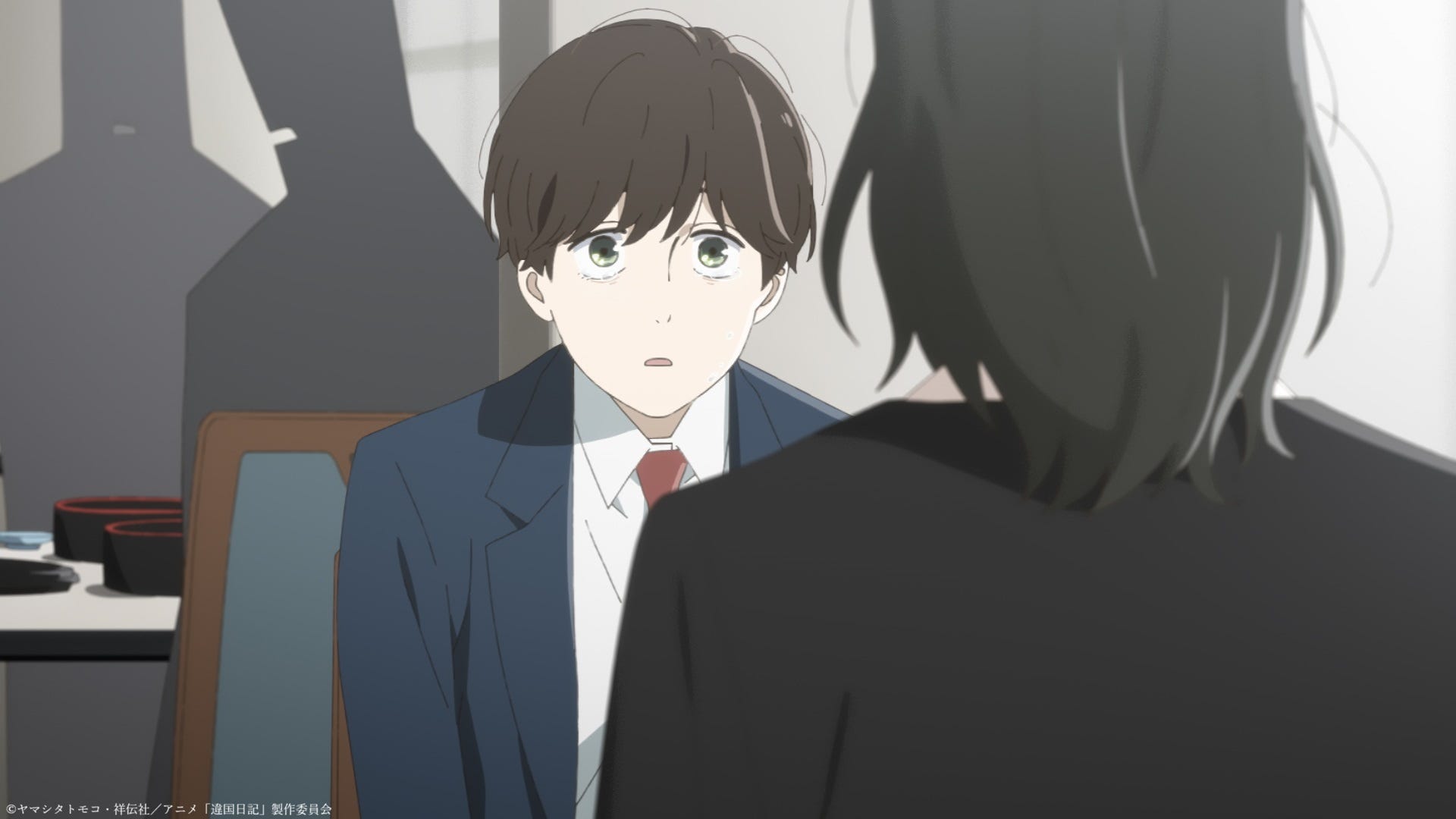
Few might have expected the best anime of the year thus far to be a quiet drama about an orphaned teenage girl. Yet Ikoku Nikki, aka Journal With Witch1, has stolen the show this season from much bigger franchises (Jujutsu Kaisen, Frieren: Beyond Journey’s End) with a markedly more quiet, yet nonetheless engrossing story of grief and transformation. Based on the manga by Tomoko Yamashita, Ikoku Nikki follows young Asa (Fuko Mori) as she moves in with her estranged novelist aunt Makio (Miyuki Sawashiro) following the accidental death of her parents and slowly acclimates to a strange new life.
Makio is certainly not a witch, but the two women’s personalities couldn’t be more distinct, with the affable teenager contrasting sharply with her moody, often-scatterbrained aunt. Still, the two find ways to relate to each other as Makio counsels the girl through their mutual loss, perhaps coming to terms with her sister’s death in her own way as well.
It must be emphasized how rare it is to see a story like this, told with such thematic sophistication emotional depth, adapted into animation. There are few analogues for such a series in TV anime but plenty in cinema. I’m reminded of the social realist dramas of Hirokazu Kore-eda or the films of Kenneth Lonergan, a writer equally concerned with grief and its lasting effects.
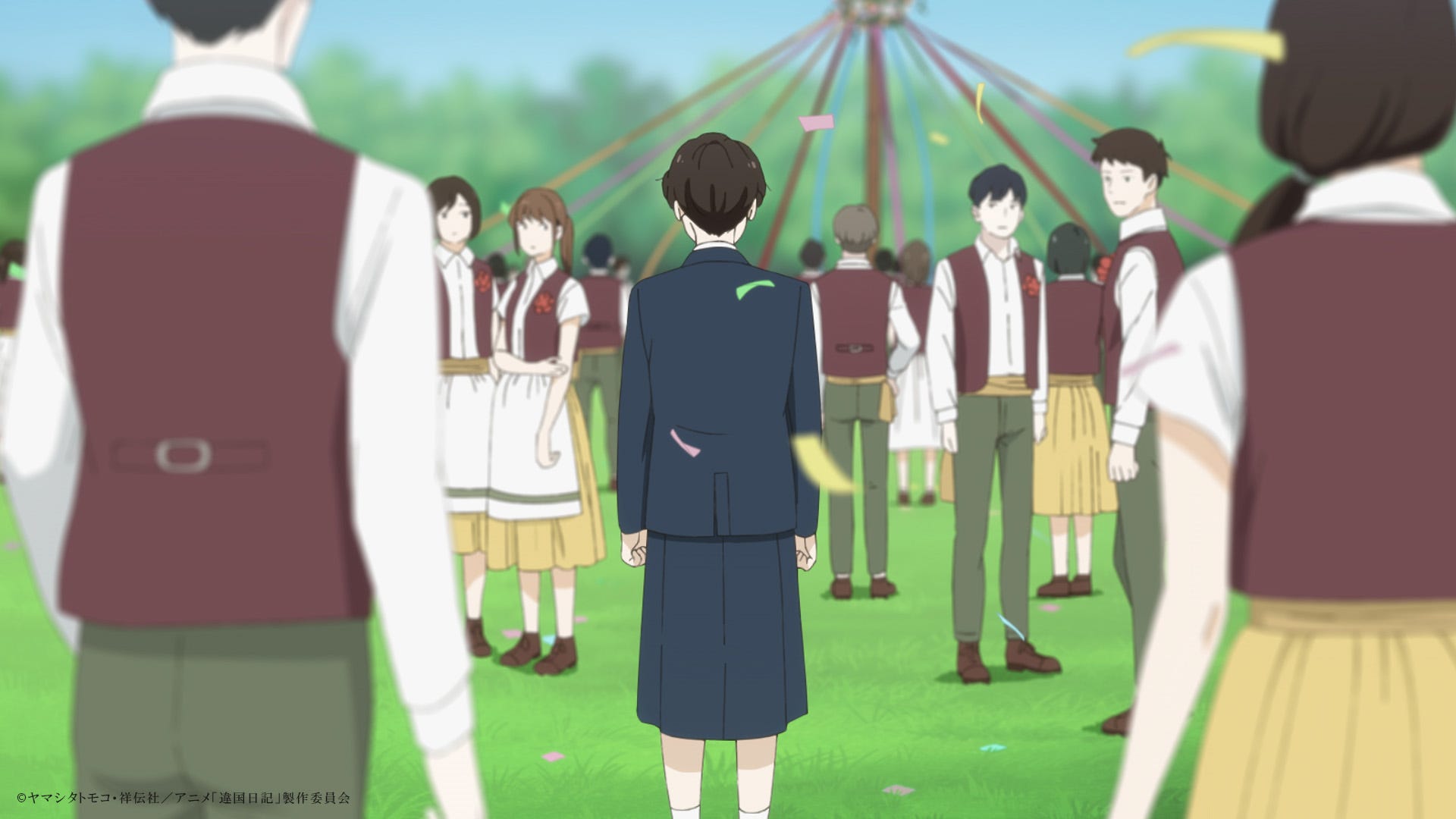
Throughout the show, we find moments where the characters’ mental realms rise to the surface, cutaways where the animated medium finds ideal application. Asa frequently envisions herself wandering through a desert in moments of doubt or confusion, lost in a foreign land as the title implies. She imagines adult conversation between Makio and a friend as if they’re traders in a Silk Road bazaar, speaking an inscrutable dialect used only by adults. She reads her mother’s diary and finds herself looking down a gaping hole, startled by the emptiness of the dead woman’s innermost feelings. In one dramatic scene she lashes out at her middle school teachers for informing her classmates about the tragedy, running out on her graduation ceremony; The students and teachers suddenly become maypole dancers, celebrating a festival she’s suddenly been shut out from.
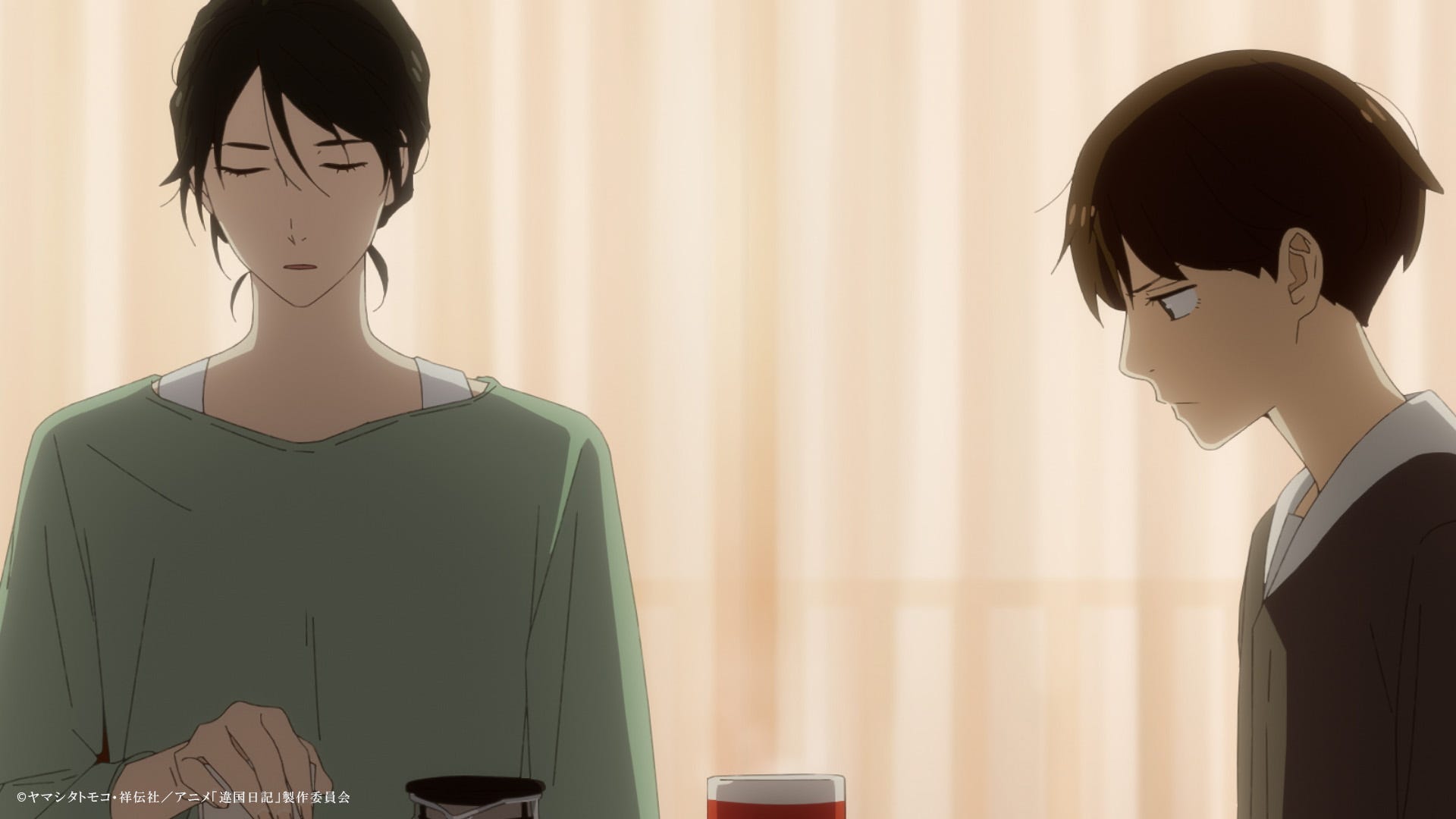
Each of the show’s focus characters wrestle with identity. Makio, a maverick and recluse who is comfortably single well into her 30s, must now find a way to import her own values into serving as a decent parent for her niece. Asa’s friend Emiri (Sumire Morohoshi) has to deal with the changing nature of their friendship while also coming to terms with her romantic preferences towards other women. We even see Asa’s mother Minori (Sayaka Ohara) in flashback, seemingly choosing motherhood and family out of fear that her peers will leave her behind.
Their struggles go hand in hand with the confining structures of Japan’s conformist, misogynist society, and the show frequently serves as a thrilling vehicle for the interrogation of that very structure. A late season plotline revolves around a real-life scandal over medical schools in Japan systematically manipulating female applicants’ exam results, inducing a personal crisis within one of Asa’s schoolmates. And it’s not simply the show’s women that reckon with these issues. Another breathtaking moment involves Kasamachi (Junichi Suwabe), Makio’s on-again-off-again paramour, discussing the humanizing effect of rejecting “male-centered rituals”:
Once I decided not to take part, everything suddenly started getting easier. Who can do the scariest dare? Who can objectify girls the most? Who can gain the most while trying the least? Even though I was being crushed by the pressure deep down, I’d laugh it off. That was the only crowd I knew. So I clung for dear life to keep my standing. And all the while, I had the potential to be anyone I wanted. I didn’t realize that game of chicken was no real measure of my value. So I jumped off the bandwagon and ran away. I think it finally made me human. It gave me a backbone.
So rare is it to see discussions like this in scripted media, let alone in a TV anime and certainly not coming out of the mouth of a man. It’s almost miraculous, even.
But of course, nobody has it harder than Asa, who has to go through the usual teenage consternation of figuring out who she is and what kind of adult she wants to be, all while shouldering immense and shifting grief and acclimating to Makio’s quirks. Rather than taking guidance from her aunt, she feels frustrated by the author’s disorganized personality and abnormal lifestyle, envious of her comfort with solitude, and just plain lonely. The graduation scene illustrates why Asa is really afraid of being “the girl with dead parents” – she’s in denial about their death, certainly, but mainly she doesn’t want to be labeled as different, to “stick out.”
Why don’t we see more anime like this? In my view it comes down to commercial incentives. The anime industry prioritizes action and fantasy stories because, put simply, they sell. For a realistic drama, meanwhile, usually a live action adaptation is faster and cheaper to produce and potentially easier to market thanks to the presence of star actors. Ikoku Nikki itself serves as an example of this: A film adaptation starring celebrity actress Yui Aragaki as Makio debuted in Japanese theaters in 2024. Though the “media mix” principles of Japan’s entertainment industry show that this isn’t necessarily an either-or proposition – a popular enough manga will be adapted to live action, anime, and other mediums if it suits the property – this tendency is so prevalent that it’s become grounds for satire. An arc in the showbiz drama Oshi no Ko has the main characters trying to salvage a middling TV adaptation of a popular manga to win the author’s trust.
There’s also the fact that, even in Japan, animation has to fight perceptions of being for kids. Plenty of people simply don’t watch anime as adults or grow out of the medium, and a TV drama with real actors is going to capture a different audience than a cartoon. But this line of thinking should change. Anime is extremely popular with younger adults: 42 percent of Gen Z Americans and 25 percent of Millennials watch anime weekly according to data publication Hub Intel. Twenty and thirtysomethings are no longer dropping cartoons when they grow up, celebrities frequently namedrop famous anime during red carpet interviews, and even my professional friends working office jobs are hooked on Jujutsu Kaisen.
Among this demographic there is a craving for stories that go beyond fantasy and escapism and appeal to more mature concerns: stories about relationships, about navigating adulthood, about the complexities and injustices of the real world. There are so few of these types of stories that when one pops up it inevitably causes a stir, even for older works. GKIDS’ 2025 rerelease of Satoshi Kon’s Perfect Blue (1997) earned over $1.7 million at the box office, while Madhouse’s 2004 adaptation of Naoki Urasawa’s true crime manga Monster gained attention in the U.S. when it streamed on Netflix a few years ago. And last year on Reddit, a sex scene from the office rom-com I Have A Crush at Work that might have seemed bland compared to American live action TV went viral on the site’s anime board, with commenters praising it as a rare, realistic depiction of adult romance in anime. Ikoku Nikki has attracted attention online for similar reasons, but the writing, characters, and thematic depth is even more superlative.
There’s also, perhaps, a fatigue with more realistic, digital imagery, something Ryan Coogler spoke about when describing his motivations for shooting Sinners on film: “The average person is going to interact with hundreds and thousands of digital images,” he said. “We’re so used to the digital image that when you see something captured with celluloid, it feels different.” I would argue the same is true for animation, with drawings and 2D art providing a break from the swarm of real-world, high-fidelity images we’re exposed to daily on social media. As digital as contemporary anime production is, the medium still represents a major industry built upon human artistry and craftsmanship in a world inundated with artificial, computer-generated images. In a time when compassion and humanity seem all more abstract, Ikoku Nikki reminds us that living and caring for each other day by day, and encouraging others to do the same, is nothing short of radical.
Journal With Witch is available to stream on Crunchyroll.
All images belong to original copyright holders; attribution given where available. Expo claims fair use on images used in criticism and commentary.
I’m using the Japanese title from here. I don't know who came up with the name “Journal With Witch” and why the show’s marketers declined to come up with a better, more authentic translation (I’m only using it in the headline for SEO). “Diary from a Strange Land” would be ideal, not just because it’s more direct from the original Japanese title, but because it exemplifies the bizarre journey that Asa finds herself on.
No posts
Comments
Nothing yet. Say the first thing.
Sign in to join the conversation.