
FILM
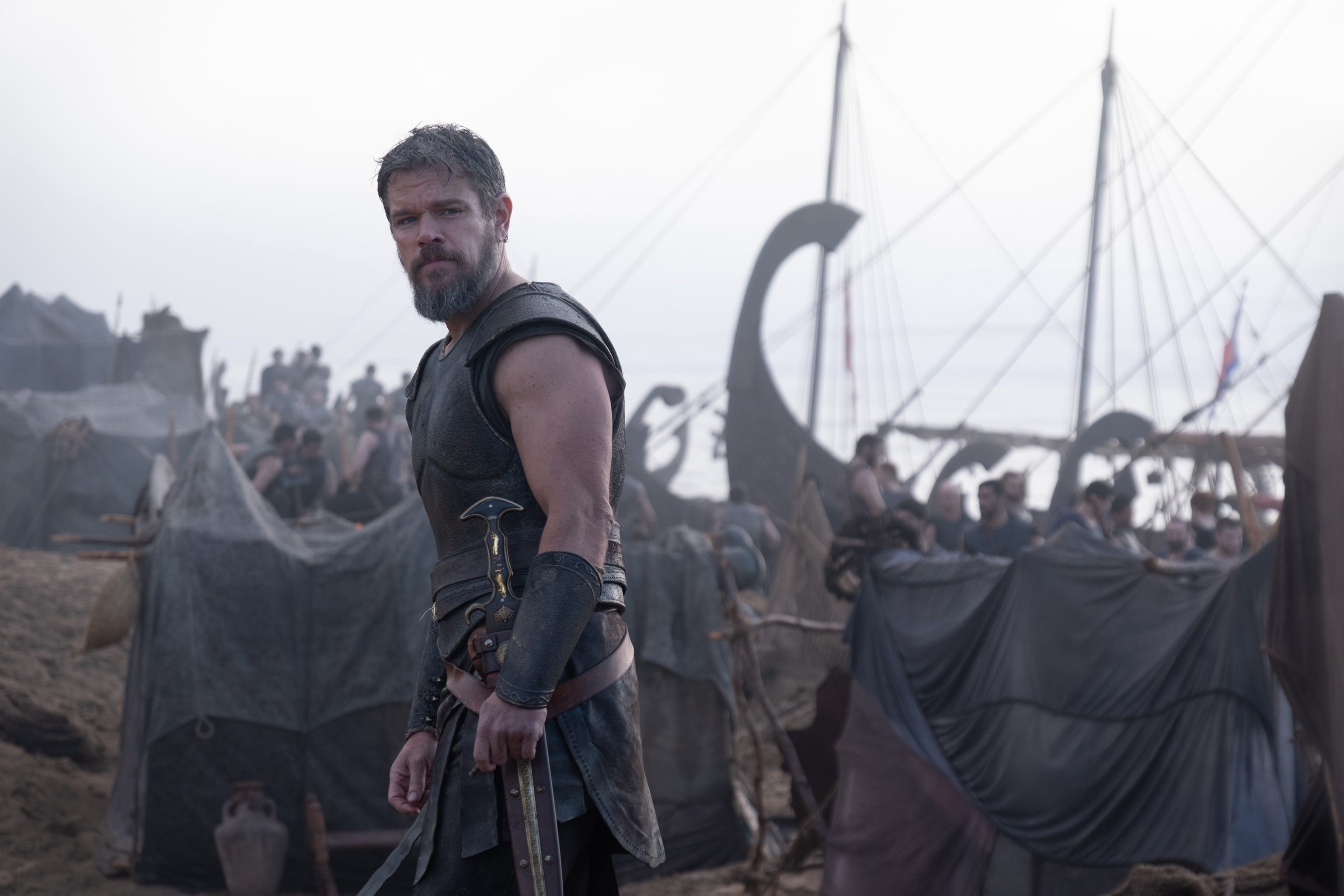
I will give Christopher Nolan this much: For all his flaws, he makes movies in ways no one else would think of. Maybe someone else would have come along and made a horror version of The Odyssey. Maybe someone else would have come up with the nightmare imagery of Circe molding flesh like dough or Scylla as a many-mouthed abomination. Maybe someone else would have ditched the sun and sex and swashbuckling and recast the voyage as a journey of death and terror with a stop at the gates of hell, the Homeric world a dark, primeval, aesthetically Nordic realm. But only Nolan would have rethought the very nature of the story in the way that he did, not as a tale of glory and conquest but of atrocity and penance for those that commit it: Troy as a site of betrayal against human decency and civilization, a breaking of the very foundations of society, and Odysseus as its guilty architect. I certainly never would have thought of it that way. But the power of great literature is such that no matter how old the work is, there are always parallels to the way we live today, and a great adaptation is able to bring those connections to the fore.
Somehow though, I always seem to feel a bit let down by Nolan’s films, even when I schlep out to see them in IMAX 70mm as I did for Oppenheimer, Dunkirk (twice), and now The Odyssey. He really is the Kubrick of our time, getting us all excited for the big epic spectacle only to answer our desires with something that’s fine but can never live up to expectations. I wrack my brain over why I can’t really give myself over to him, and ultimately I think it’s because he can match someone like Kubrick or Spielberg in terms of breadth and spectacle, but he can’t match their freak. He’s a very dry, reserved filmmaker stylistically. He has no eye for composition and lets editing and continuity jumping do all work. His visuals often look exquisite: The locations, production design, and sfx on this film are extraordinary. But his aesthetic sensibilities can make the film feel too colorless and withdrawn, as can the performances he gets from his actors. He continues to exhibit little skill at directing action, as evidenced by the shockingly poor execution of the final fight with the suitors. Nolan is never going to be one of my favorite directors. Try as I might, I just can’t love him as much as I want to. But that’s not going to stop me from seeing them as big as possible every time.
MUSIC
This is one of those records that makes you feel like you can do anything. The first time I listened to the new record from Steven Hall I joked on Twitter that the record would’ve been a hit with the millennials, both because of his personal mythology as a downtown New York scenester and close friend of Arthur Russell’s and because his music touches on a lot of the archival sounds that cohort was fond of digging up. There’s glamorous sophisti-pop (“GO FOR THE NIGHT,”) unwieldy acoustic rock (“FRESH FEELING” / “SPECIAL WEAKNESS”), Balearic-tinged disco (“ENGLISH PARTY”), and that’s just scratching the surface. It’s a polyglot album with antecedents not just in the ‘80s but in LCD Soundsystem, Studio’s West Coast, Destroyer’s Kaputt, and other records from 20 years ago that consciously tried to emulate those older sounds. And that diversity of styles is truly inspiring. Too often it can feel like artists nowadays are confined by the needs of commerce and identity. Because of social media and the internet there’s so much pressure to define oneself narrowly just to make any sort of noise. Hall’s work here proves the folly of such an approach – just do what you want, don’t worry about what other people think, and even if it takes decades you will find your audience. More often than not a brave artist is better than a successful one.
BOOK
I don’t know what drew me to this book in particular – the evocative title, perhaps – and from the jump I was a bit reticent. Bolaño writes the entire novella as one run-on paragraph, the stream-of-consciousness of a dying old priest in Chile. This made me not want to put the book down because I couldn’t find a place to stop, so I read it all in a day. Really it doesn’t get going until the middle: European churches patrolled by birds of prey, reading the Greek classics as Allende rises and falls, and then the horrors of the Pinochet years and the priest’s role in that awful play of shadows. I am not an expert on Latin American literature, but I can see how By Night in Chile, with its political intrigue, evocative imagery, and unravelling dread, could serve as a good introduction for anyone looking to dive in.
FILM
I was never a Godard guy. After a film studies syllabus brush with Breathless I mostly wrote him off entirely as overrated and style-over-substance, to my now chagrin. Lately I’ve been trying to rectify this; last year I planned to run through his entire filmography ahead of Linklater’s Novelle Vague (which I ultimately skipped). I rewatched Breathless (still hated) and watched Week-end before abandoning the effort entirely.
It took a brief encounter with Je vou salue Sarajevo – on Twitter, of all places – to give Godard another chance. The film is a mere two minutes long, was made long after his New Wave years, and consists entirely of cropping and zooming in on a single photograph of Serbian troopers harassing civilians during the Yugoslav Wars set to the director’s narration. “Culture is the rule, and art is the exception,” Godard’s gravelly voice intones. “The rule is to want the death of the exception. So the rule for Cultural Europe is to organize the death of the art of living, which still flourishes.” So much is packed into that brief montage about war, complicity, human nature, the barbarity of the civilized. It is impossible not to see Gaza in these images and words, for instance.
After this I can no longer ignore Godard. I will watch all of his features in order. I start with Le Petit Soldat, then Une femme est une femme. Fine, not bad. Some interesting ideas. And then Vivre sa vie. Finally he reaches me. Nothing before this has the same empathy, the same depth, the same thoughtfulness, or even the same formal consideration. I can see the intelligence of Godard’s cinephilia come to the fore: The Dreyer reference, a window into Nana’s soul and a foreshadowing of the way society will let her be burned at the stake in her own way. I can see the influence this specific film has had on more contemporary auteurs: Wong Kar-wai, Pawel Pawlikowski, Sean Baker. I can feel the warmth and sadness radiating from Anna Karina’s brilliant performance of a lost soul defined by how people see her on the outside. Now I get it. This is the exception.
BOOK
It’s strange to read a series like Robinson’s Mars Trilogy from the vantage point of 2026. The concept of colonizing Mars feels like a fairy tale, a delusion for the billionaire class to burn money on trying to achieve. Then there’s the idea of an anti-aging treatment that catapults lifespans into the triple digits, a nightmare scenario for anyone under the age of 50 in 2026 – imagine if the boomer gerontocracy letting the world burn stuck around for another century. But credit to the author, Blue Mars, set in the 22nd century as Mars enters its final stage of terraforming and humanity begins to colonize the rest of the solar system, actually manages to touch on this. One character names the undying, superaged original Martians as “kleptoparasites” – animals that steal food from their own young. Surprisingly prescient for a book written in the ‘90s – if that doesn’t describe the Trump generation squatting on housing and jobs and political influence and refusing to give an inch, I don’t know what does.
In any case, Blue Mars is a grand conclusion to the series. It’s not as exciting as the first two and perhaps a bit too idealistic – a much-foreshadowed confrontation over immigration from Earth ends in a bloodless “revolution” that reads more like a neoliberal political campaign – but Robinson’s imagery and ideas nevertheless impress, especially when we move off Mars and onto disaster-inflicted Earth and the outer solar system. He’s truly one of the best active writers of speculative fiction, and I can’t wait to dive into his other books, even if they are incredibly dense and mildly forbidding. I hope they can invent a longevity treatment like the one in the book, or else I’ll die before I get to finish them all.
MUSIC
2026 has seen a number of great records delving into deep, atmospheric techno, from K Wata’s cavernous dubsteppy soundscapes on Give U Space to Picture’s two recent albums of bubbly, groovy dub techno, all on the brilliant label Short Span. But for my money, the return of Rezzett has given the year its most exciting electronic album. Few artists are as adept at building such a bold and immersive world of sound as them, and the extra-length, self-released comeback record Into the Boiling Darks takes us deeper than ever into a dark, muddy realm of fuzzed-out techno rhythms, breakbeat excursions, and iridescent synth chords, like a run through a subterranean jungle. There is so much genre experimentation going on here too, from the grime-y “Kopli” and trapped-out “Dread” to the beautiful vintage Aphex vibes on “Jib Jab” and all the straight-up jungle in the back half. It’s the kind of record I want to make a movie out of.

FILM
Though relegated to an extra on the upcoming Criterion Blu-ray of The Secret Agent, Kleber Mendonça Filho’s documentary on the vanished movie houses of his hometown of Recife – and his own filmgoing practice as an attempt to keep cinema alive there – nevertheless impressed and moved me more than the Oscar-nominated fiction film. Even though “fiction films are the best documentaries” as a character says in an archival film clip (a statement I agree with), Pictures of Ghosts nevertheless excels as it examines the nature of film and its relationship with time and the past. Cinema and the culture around it serves as a time capsule as archival photos show theater marquees commenting on political events. Characters from Kleber’s films reappear as apparitions when they’re shown on TV. The once grand movie palaces of Recife – all but one it seems – are reduced to ruins or transformed into unfinished, bat-infested shopping malls. Maybe the film worked on me more than The Secret Agent because it reminded me of something closer to home: the dilapidation and tropical decay in central Recife reminded me of downtown Miami, a place with its own fair share of disused movie theaters. There really isn’t a culture of cinema in Miami. It’s too new of a city, too rich and dumb and unfriendly to artists and writers and people that appreciate and look for inspiration in the culture of the past. There aren’t enough ghosts around.
MUSIC
We’re about 15 years removed from the “EDM Boom,” the massive upswing in commercial dance music that codified a new American rave movement. To be sure, that era’s legacy is still being assessed – a lot of bad music and awful DJing came out of it – but “WannaCry,” a tremendous collab between Porter Robinson, one of the period’s brightest stars, and Ninajirachi, a talented Australian revivalist of the style, serves as a compelling argument for what made EDM so undeniable. It’s the genre at its best – loud, euphoric, searching, wistful, and most of all earnest, a perfect blast of digital maximalism that tells us it’s still possible to seek excitement and joy. Crucially it’s also danceable, mostly rejecting the build-and-drop structure that most of EDM’s biggest hits became notorious for and reconciling with a more straightforward verse-chorus pop song composition. I can’t help but be reminded of Robinson’s Virtual Self project, an attempt to fuse EDM with earlier rave styles such as happy hardcore and trance (I somehow managed to see him play that show live, twice). Moving from that nostalgic revival project to this one feels a bit full circle. Time vindicated the rave generation of the ‘90s, and this track tells me the same thing will happen to EDM. Just keep the bangers coming.
Thanks for reading Expo! This post is public so feel free to share it.
No posts
Comments
Nothing yet. Say the first thing.
Sign in to join the conversation.