
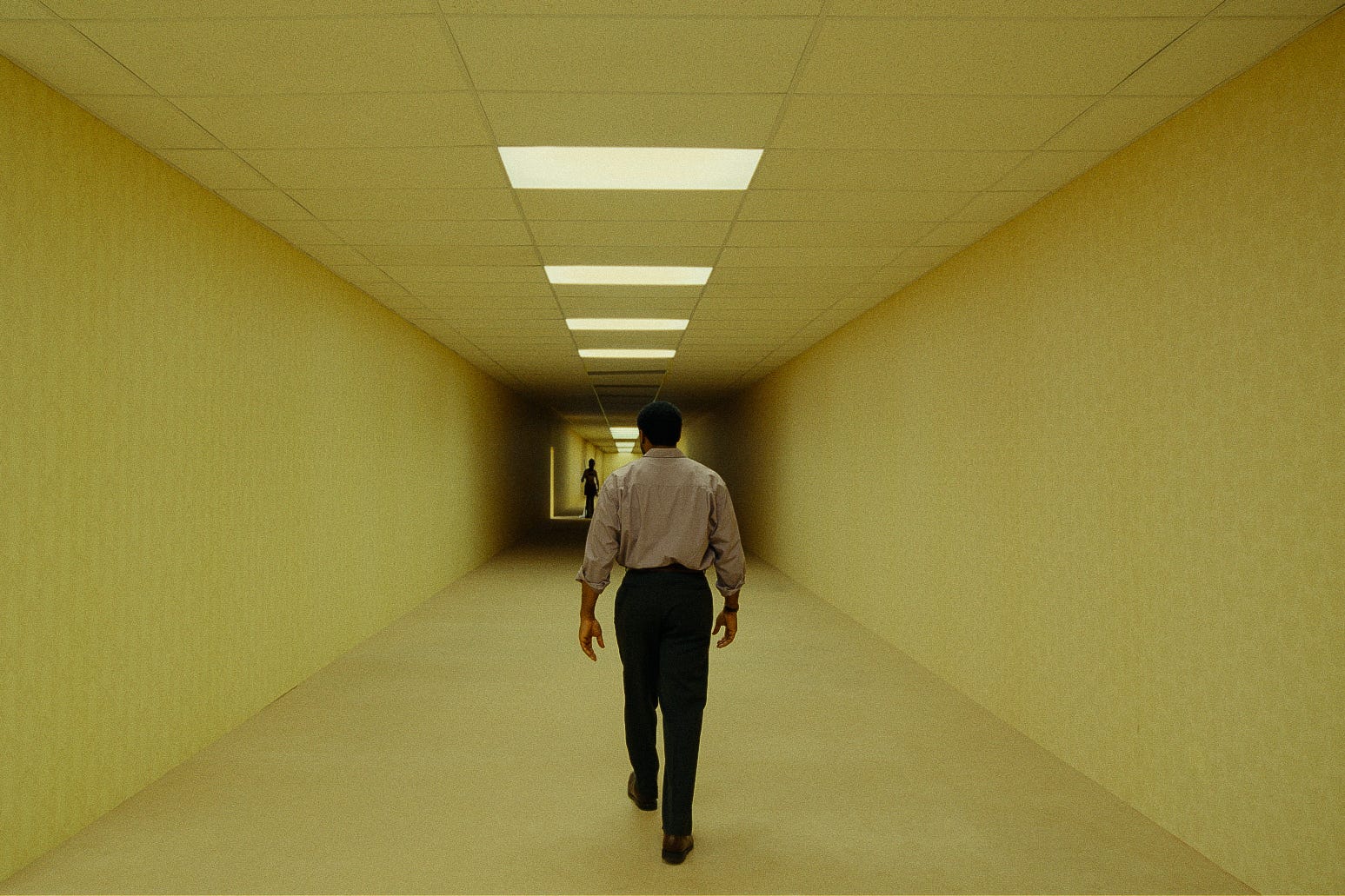
Is it frightening to be alone in an empty, windowless room? What if you can’t seem to get out of such a space? What if there’s something else in there with you? With the success of films like Backrooms and Exit 8, the global film industry seems to be unlocking the potential of so-called “liminal horror,” a genre coined from the term referring to states and spaces defined by their in-betweenness. The internet loves so-called “liminal spaces”, with social media accounts serving up supposedly-creepy images of waiting rooms and hallways.
But while a focus on these spaces is a new phenomenon in cinema, it’s long been a staple trope in video games. Survival horror series like Silent Hill and Resident Evil are defined by the player character’s traversal of abandoned towns and maze-like corridors, their scare potential amplified by the tension of traversing such liminal areas. And many components of game design, such as hub worlds and loading screens are liminal by their very nature.
So it makes sense that the cinema of liminal horror cribs heavily from video game logic, with Backrooms serving as a perfect example. While the film is adapted by YouTuber-turned-director Kane Parsons from his own web series, the concept itself was invented by an anonymous 4chan user, posting on the creepypasta forum /x/. The author came up with the Backrooms, an endless office space that someone enters when they “noclip out of reality in the wrong areas.” Anyone who’s ever seen a video of someone’s Grand Theft Auto character glitching out and falling outside of the boundaries of the game world will know what this means: Simulated realms in game engines always have backstage areas left in the final product1 that can be accessed intentionally via hacking or accidentally due to bugs.
The “Backrooms” creepypasta takes this idea into reality, positing that there is an off-map, inaccessible zone in our physical reality that can be visited by stepping through the wrong door or falling through a false wall. And Backrooms, the movie, is basically a dramatization of this scenario. We follow Clark (Chiwetel Ejiofor), a frustrated, recently-divorced architect-turned-furniture salesman who finds a passage to the Backrooms in his own store in suburban California. He becomes obsessed with mapping the infinitely-repeating space, an endless labyrinth of cheap furniture and tacky decor where dangerous, unseen entities lurk behind poorly-lit corners.
While the Backrooms sprawl infinitely with an unending variety of distinctive rooms and objects, Genki Kawamura’s film Exit 8 takes place in an inverse setting: A single, inescapable subway corridor that the protagonist, named in the credits as “The Lost Man” (Kazunari Ninomiya) finds himself trapped in. The film is a direct adaptation of an actual video game, The Exit 8, which tasks players with escaping from an infinitely-repeating subway corridor. It’s a smart, relatable concept: Tokyo’s Metro really is infamously hard to navigate even if you read Japanese because the subterranean accessways all look very similar. And because it is a direct adaptation of a game, the film is much more indebted to video game logic than The Backrooms. Every time the Lost Man walks through the passage he finds an identical set of features – the same advertising posters, the same coin lockers, the same signs and doorways – and he teaches himself to spot the differences to determine whether to go forward or turn back. Any slight variation means an “anomaly,” which can take the form of anything from a misplaced knob on the electrical closet door to a life-threatening wall of water. The only way out is to literally play through the game, to advance when the corridor is normal and to retreat in case of an anomaly. A wrong choice will land him back at the start.
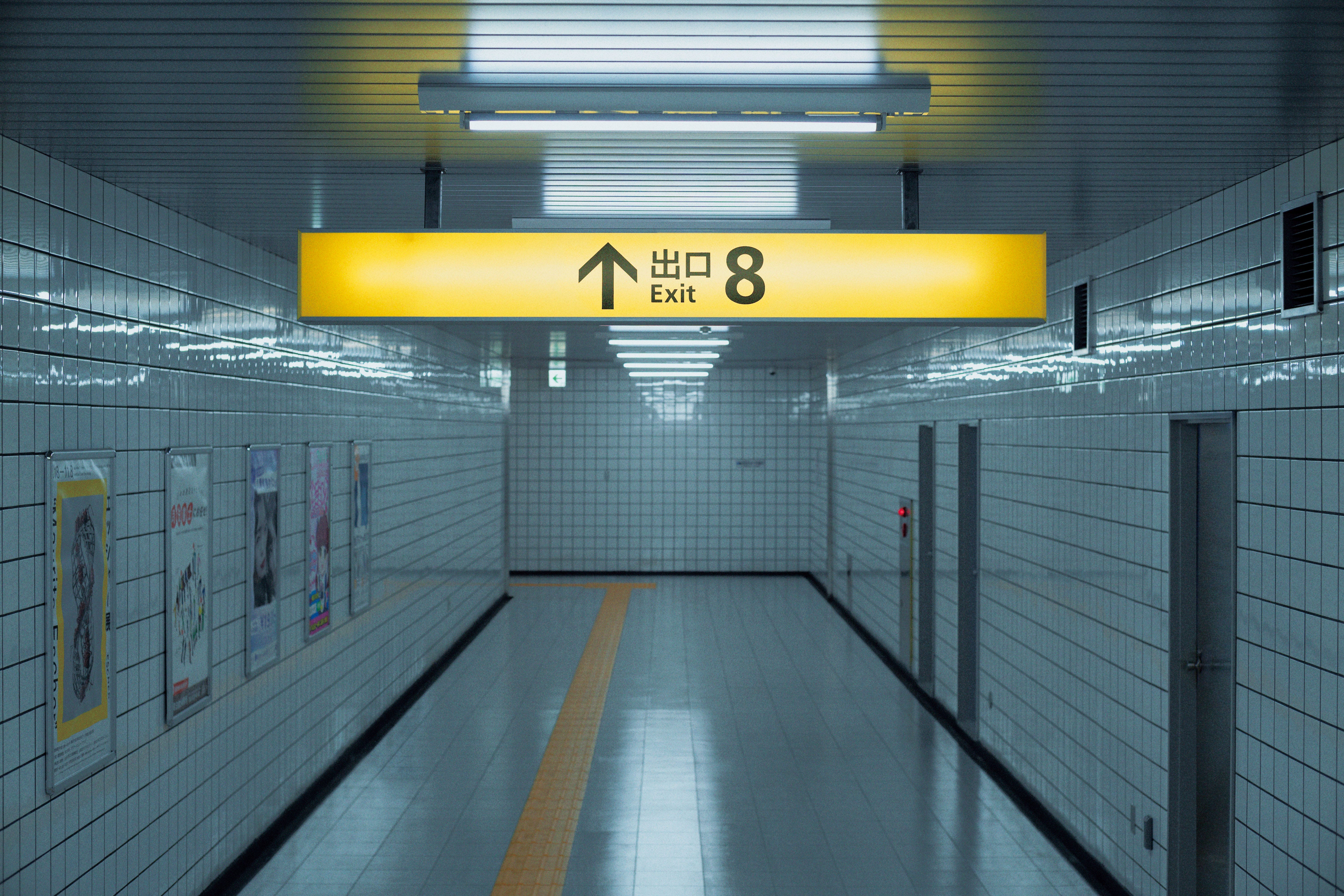
The problem that both of these films have is that neither one is particularly thoughtful when it comes to characters or deeper themes. They feel like theme park rides for viewers rather than complete worlds. Exit 8 has a little bit more on its mind, with fatherhood emerging as a recurring theme in the protagonist’s arc. When he enters the corridor he’s going to meet his erstwhile girlfriend, who has just called to tell him she’s pregnant. He encounters a lost child on one of the later levels and tries to protect him from the dangers they face. And there’s also a framing device in which the protagonist begins the film watching a mother with a crying baby get harassed by a fellow train commuter; he later decides to do something at the end when the situation repeats. It’s tempting to call this commentary on the birthrate crisis in Japan, a pro-natalist message to all the guys out there that parenting can give you purpose and lead you out of the crushing monotony of a solitary life. But ultimately any deeper themes feel auxiliary to the main gimmick of the film.
Still, it’s deeper than anything Backrooms cares to express. Rather than delve into the cosmic implications of its macabre world, the film seems much more fascinated in its least compelling element, Clark and his fracturing psyche. Yes, for some reason the protagonist of this film, with a built-in youth audience of Zoomers in their teens and twenties is…a divorced furniture salesman with an ego problem that spirals out of control, played by a 49-year-old actor. The overriding focus on Clark and his personal problems as our gateway into the Backrooms mean that we know next to nothing about the Backrooms and their nature by the film’s end, a decision that strikes me as a product of strict adherence to Hollywood storytelling structures and the overriding influence of a large group of older, male producers (both James Wan and Oz Perkins, who are 49 and 52 respectively, are attached to this thing for instance).
Ultimately it’s because the world that Parsons has crafted is so fascinating that Backrooms feels like such a missed opportunity. It strikes me as a profound lack of imagination on the part of the filmmakers that their best use case for an infinitely-repeating, Borges-esque realm of cheap interior design and cast-off consumerist detritus is as a mere backdrop for boring monster-movie scares à la Five Nights At Freddy’s. We get a mere hint at the film’s end of the true nature of the Backrooms, with the conclusion seeming to imply the dimension is formed by imperfectly copying our own world via the mental recurrences of those that enter it. Why not explore that? Why not use this endless zone of ugly ‘90s interior design to thoughtfully consider why these liminal spaces seem to be so prevalent in our own reality, why so much of our built environment is made up of these cheaply-built, disquieting spaces? This is also why I question the decision to set the film in the ‘90s: Wouldn’t the ravages of time have added an extra element of creepiness to the Backrooms?
While I was leaving the theater after Backrooms, I began thinking of another liminal zone in a video game: Mementos, the roguelike area in Persona 5 Royal that takes the form of an endless, procedurally-generated subway. The players drive around in a van like in Scooby Doo and fight monsters called “Shadows,” but within the game’s lore the place is a little more sophisticated: It exists only in the collective unconsciousness of all of Tokyo, and the Shadows are manifestations of the corrupted desires of individuals. Persona 5 is a much larger and deeper experience than Backrooms – we’re talking a 100+ hour game versus a 110 minute film – and exploring Mementos takes up only a fraction of the game’s runtime. But if that small part of a larger whole can serve as a better and more detailed expression of liminal horror than Backrooms or Exit 8, it goes to show that cinema has a lot of catching up to do.
Thanks for reading Expo! This post is public so feel free to share it.
A very illustrative example of this is in Cyberpunk 2077, which features an entire offscreen area just for its stylish opening montage. The excellent YouTube channel Game Maker’s Toolkit has a great breakdown of how they did it:
No posts
Comments
Nothing yet. Say the first thing.
Sign in to join the conversation.