
When I started looking for work after college, I thought one thing was pretty weird: the initial interview with HR.
I was like… why do they constantly ask for our long term goals? “How do you see yourself two years from now? Five years from now? How about ten years from now? WHYYYY”
I am not sure if HR still asks those questions today. But to me, HR personnel back then seemed to treat first time job seekers as if they had already figured their lives out.
Personally, I had never felt so lost until graduation, or in my case as an engineer, the board examination.
Without the curriculum to guide me, the professors I looked up to, and the classmates I navigated things with, I felt like a fish out of water and my life completely paused.
I knew I wanted to put my degree to work, but engineering has so many different paths. You know how it is; the more options you have, the tougher it is to decide.
Another reason I felt lost and stuck was I could not decide between moving away for better opportunities and leaving my family, or finding something local for less money.
I swear, you really cannot underestimate how much family matters in Filipino culture. I honestly think if there were better options at home, we would not see so many Filipinos living abroad.
Anyway, whenever the question about my long term goals came up during an interview, I would feed the recruiter what they wanted to hear: I am building a career related to the job I was applying for… to be an expert and climb the ladder to a high-paying position.
My cousins taught me that while we were having drinks on New Year’s Eve, lol.
A decade later, I really cannot stress how important it is to have long-term goals. It is not just about your career; long-term goals matters for business and everything else in your life too.
What’s easy is you do not need a ton of long-term goals.
Having one big goal that truly matters to you can be all the fuel you need to keep going.
The first time you pick a long-term goal, you are going to feel like you have some direction in life. Personally, it felt awesome. It is pretty liberating.
And once you have a long-term goal, expect it to kick off a domino effect.
After finding that direction, you will feel motivated to build self awareness and work on yourself. You will also be inspired to take care of your health.
Along the way, it will make you resilient against setbacks and resistant to impulsive desires.
You will start feeling like you are making real progress, experiencing greater life satisfaction, and living a meaningful life.
I don’t want to sound like I’m better than everyone else, but once I found my long-term goal (see my homepage), I became super determined to cut out things that ruin me or waste my time. For example,watching porn, endless scrolling, fighting with people online about politics, shopping compulsively, playing video games, and stuff like that.
And honestly, because of my ultimate goal, avoiding these things has become second nature to me.
Whenever I see these temptations, I keep thinking of them as roadblocks to reaching my goal, which I believe, is what will actually bring “more” meaning, sense, and happiness to my life.
Also, since I want to enjoy the success I am working toward, I am taking way better care of my health. I do not want my money going to hospital bills once I am finally making it big.
I also think: If I feel good all the time instead of sluggish or sick, I can work way harder and faster to hit my goals.
Get this: based from experience, having one ultimate goal keeps the anxiety away because you quit comparing yourself to everyone else.
With that goal, you realize you are on a totally different path than your friends, neighbors, and everyone else. You stop worrying about their progress compared to yours. You move your focus off what they are doing and onto how you can make your dream a reality.
You essentially get rid of the thief of your happiness.
As a creator and online business owner, I believe having an ultimate goal is absolutely necessary.
(But let me be clear, it has to be a goal you personally want to achieve. A goal that involves your audience, like helping them solve a problem, is a different story.)
This ultimate goal is valuable because it is what will keep you and your business going for years.
I have already explained how it will sustain you. As for your creator business, I can think of several ways your ultimate goal can sustain it.
The most obvious is that your ultimate goal, when you show it in your content, is what brings your audience in. These are people who want the same thing as you or have a similar goal.
I know you already know why, but to be precise, it is because we tend to gravitate toward people with the same goals.
People rally behind those with a shared purpose and join those who are after the same outcome.
Birds of a feather flock together.
In my case, I want to surround myself with people who are on the same path as I am, and I believe that is what you want as well.
Given that, as long as there are people trying to achieve similar goals to yours, you will always have an audience to nurture.
One of the best things about having an audience made up of people with the same goals is that it is easier to build a community.
This is because you are not only sharing common interests. But also, you can also relate to each other’s reasons and values.
Let’s take a founder community as an example, and you’re one of them.
I am certain that you will never feel like an outsider because everyone there understands the need for freedom, making your own money, or even just having a flexible schedule. Most of them are totally into things like a growth mindset, stoicism, long-term vision, and staying accountable.
As a creator, having an ultimate goal also gives you an endless supply of topics to write about. And for me, that is honestly the best part.
The steps you take, the roadblocks you solve, and the discoveries you make along the way to your goal can all be turned into blog posts.
Even the travels you take can be written about, as long as you frame them in a way that remains beneficial to your audience.
For example, say your goal is building a successful media company and you head off to Switzerland. You could write about how you handle your team and keep things running while you are out exploring Lauterbrunnen and Lucerne.
The thing is, what you are writing is not just regular blog posts. These posts about your journey are the real, authentic content that everyone is looking for these days.
Authentic because they come from real experiences.
In demand because everyone is getting tired of AI slop full of hallucinations and is looking for content that actually gets things done.
On top of everything, writing about your journey pursuing that goal can boost your growth as a creator too.
Think about it, when you watch a TV series, what keeps you hooked?
It is the story.
You want to see what happens next and you are interested in the progress the characters make. If it is an educational show, you are also curious about what you will learn next.
When you add a narrative flow to your content, which happens naturally when you write about your journey, more people tend to follow or subscribe. You grow faster, and that is what I want for you.
I don’t want to make this week’s letter too long, so let’s wrap things up by pondering these words from Nelson Mandela:
“Action without vision is only passing time, vision without action is merely daydreaming, but vision with action can change the world”
Let’s make sure everything we create has a clear direction and a purpose behind it.
I hope I am truly leading by example.
Again, you can check my homepage (exploretothrive.com) to see what my ultimate goal is, and you can look at the progress tracker later in this letter to see where I am currently at in my journey and mission.
Explore to Thrive Newsletter is part of my personal mission to walk alongside fellow creatives and show that it’s possible to build a sustainable online business from your lived experiences and passion. It’s completely free and open to everyone.
If it resonates with you and you feel inspired to support it, I would be very grateful for a tip. Your support helps me build Explore to Thrive, a community and resource I dream of creating where no creator feels alone and where we can grow, learn, and truly thrive together.
First time here? Come join my newsletter and stay in the loop.
I share honest insights from building an online business with a blog from the ground up, lessons from my mistakes so you can avoid wasting time, discoveries that lead to wins, and methods that support long term success as a creator.
This section is where I share what I’ve been working on with Explore to Thrive Blog since the last newsletter. My goal is to be transparent about the process. And also to give a real sense of what building a creator business actually looks like.
In my previous newsletter, I mentioned that I am working on post-project tasks. These include quality checks on links, readability, and visuals. I also mentioned that I will be launching a new project and starting a new blog post.
So far, I am done with the content plan for the new project, which is about another travel destination in our country: the Island of Bohol. We only spent one day on the island so the amount of blog posts I have listed is not as high as my Cebu project.
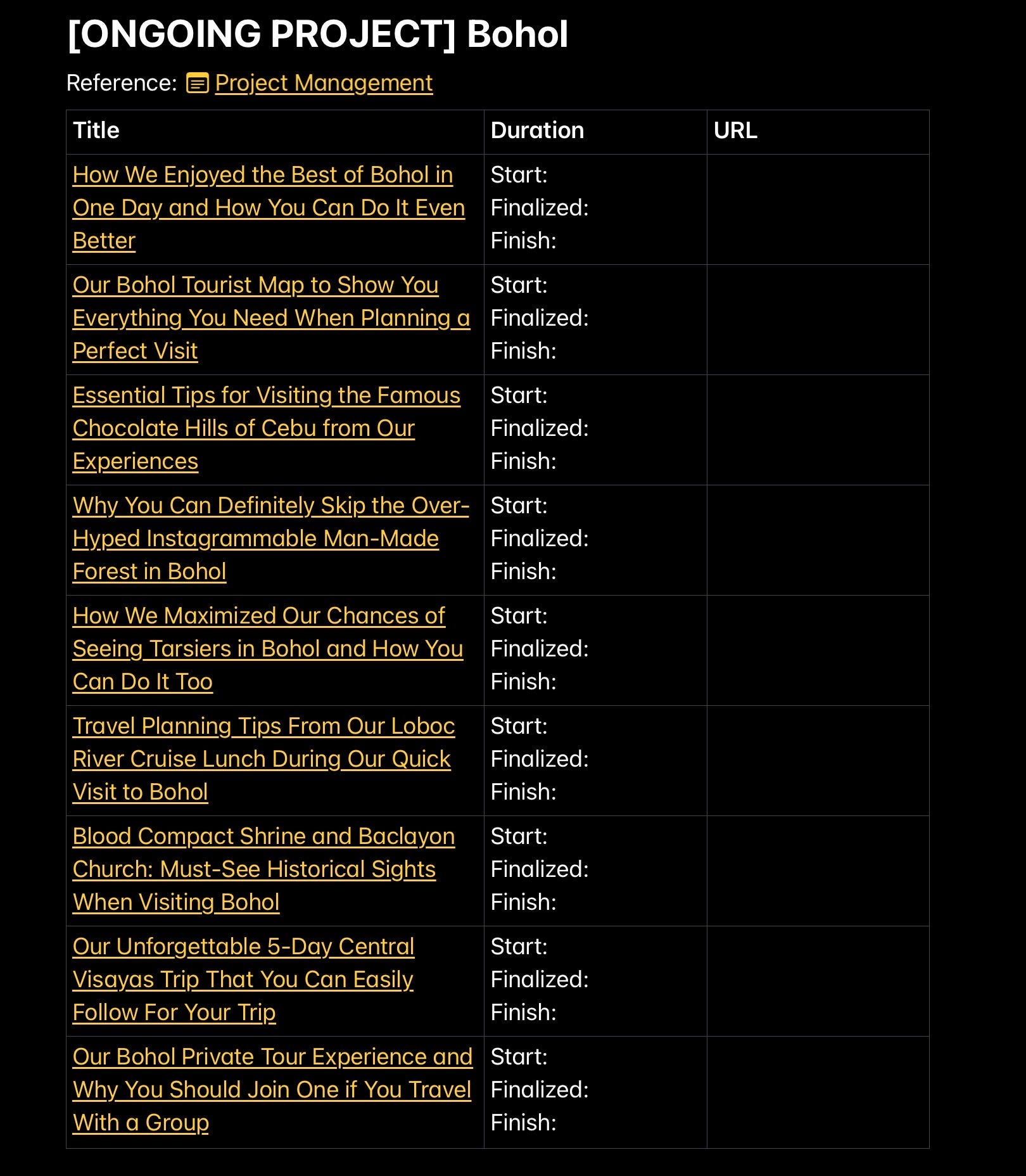
I tried to do a little bit of keyword and topic research for these posts. This way, I could validate whether there are actual people interested in what I will be writing.
Basically, I checked the topics or search terms under some Google Search features like People Also Ask, People Also Search For, and search bar suggestions. The data under these sections should be enough to tell what people want to read about a certain topic.
When it comes to writing the titles, I asked AI to give me ideas on how I can write them in a way that immediately sounds helpful to the readers. That should increase the CTA if ever they discover the post in search or social.
After I finished the plan, I went on to determine which products, services, or travel experiences to promote. I am not yet done with this task, but I started it so I can also publish the Travel Planning Page for Bohol at the same time as the first blog post for the project. The page is where I offer affiliate products and services. This way I can help travelers organize their trip to Bohol even before I post every blog post in this project.
This Travel Planning Page should also help me determine the structure and flow of the blog posts. Since I already have an idea what products or services to promote, I can craft the storytelling or topic discussion to segue to these promotions. This way, I avoid sounding so sales-y.
I figured I must do this because I had so many instances where I had to edit published blog posts to create more links to the promotions in the Travel Planning Page. It is inefficient. So I am making this improvement.
When it comes to post-project shenanigans, I originally planned to check the quality of my posts under the Cebu Project only. Then after some random checks in other projects like Sapa, Ninh Binh, Hanoi, and Sagada, I realized I also need to check the quality of each post of each past project as well.
Among the five projects, two are already done: Cebu and Ninh Binh. I am currently working on Hanoi. Sapa and Sagada are next. I have edited or proofread over 35 posts so far. That took me 2 days to complete.
As I go through my posts about Cebu travel, I realize that I have overused buttons.
For example, in one of my posts, whenever I mention a topic discussed elsewhere, I not only link that topic within the text but also add a redundant button linking to the same post immediately after the paragraph.
Yes, I added redundancy and I realized while reviewing the post that this repetition creates a poor reading experience, so I am now removing the buttons.
In replacement of the buttons, I am writing better CTAs that blend into the discussion of the post. Some actively ask the reader to click on the link. Others use curiosity and helpfulness context so the reader clicks on them. What I mean with helpfulness context is that I emphasize the value that the readers would get should they click and read the post.
Speaking of links, I have links in the reusable patterns at the end of each post. They allow me to easily interlink posts of the same topic or category. I updated some of them, adding more links, to give visibility to my other posts.
For example, if you check my posts about Ninh Binh, each of them now has links going to the post where I share my Northern Vietnam map.
My blog posts also have patterns linking to the Travel Planning Page. They float on top of the post and stay on the screen for easy access. I also updated this pattern by making the button going to the Travel Planning Page larger.
By the way, if you check the buttons on my blog posts now, specifically those about Cebu and Ninh Binh, they have arrow hand emojis. I placed them to catch attention more effectively and invite readers to click through to other posts and pages.
My quality checking efforts revealed problems with my posts. There were missed opportunities to promote content, sections that appeared detached from the tone of a travel blog, and buttons or links that lead nowhere. The last one is problematic and I will explain why.
But first, let me share what the missed opportunity involves. Reading my posts, I noticed mentions of activities, services, and products I have included in the Travel Planning Page, but the links are missing. Those links could have brought more visits to my Travel Planning Page and potentially generated sales.
The thing is, it is not only links to the Travel Planning Page that were missing. There were also mentions of other topics about which I have written blog posts, yet I found them unlinked. Readers could have discovered those other blog posts and found my blog more helpful if the links had been created.
Another problem I encountered with my posts was that some did not look like they are blog posts about travel at all. As I go through them, I notice parts that give an impression that readers are reading a book rather than a travel blog. I tried to fix that by adding more visuals, which should increase engagement and inspire travelers to read further and travel.
The worst problem I met as I audited previous projects was the links and the buttons. I found that instead of URLs, the words “view” and actual titles of the blog posts were embedded in them. When readers click these buttons or links, the browser opens a new page with “//view” on the URL bar.
This wasn’t the first time I encountered this problem. I found that it is a glitch on Apple Notes, at least on iPad. It happens when I copy a link embedded in a phrase or word in Safari and then paste it directly to a highlighted word or phrase in Apple Notes to convert the text into a link. Instead of the URL, the word where the URL was embedded is what gets pasted. The view word that was pasted came from the Posts page of WordPress.
Anyway, this is problematic because it affects SEO as well. Google treats broken links as a negative factor in ranking in their search engine.
I definitely underestimated the tasks for last week. So, for next week, I am not going to commit to finishing certain tasks but will instead do my best to accomplish as many as I can. I am yet to discover the problems in the remaining blog posts I am going to check.
Aside from the posts, I also still have to review the travel planning pages for other projects. That is one whole set of tasks to do.
Since I am already editing blog posts and refreshing the cache stored in my CDNs, I am giving myself permission to edit the design of the website as well. I am looking forward to replacing the image dividers because they look awkward. It is a shame I did not think twice before using them.
Another thing that I am going to change is the font size of the posts. They are a little small and could be hard to read for some people. I might increase their size by one or two pixels. But we will see.
Another thing I plan to do is create a content plan for Pinterest for the month of July and create pins for the next 31 days. I should schedule them too.
I shall do the project cleanup by archiving old posts and notes and deleting drafts after all of this. Finally, I am going to proceed to the next project or I might perform the retrospection for the second quarter of 2026 first, depending on how fast I finish all other tasks.
Alright! That is all for this week’s newsletter. Thank you for reading and I will see you next week.
Hiraya Manawari!
Ciao.
Comments
Nothing yet. Say the first thing.
Sign in to join the conversation.