
“AI is here to stay.“
It’s one of the most ominous things I’ve heard since I started my content creator career.
The first time I heard the line, I honestly felt a real sense of existential dread.
I think it was around January or February of 2023, or sometime in the first half of that year. I can’t remember exactly. But yeah, it was months after OpenAI dropped ChatGPT in November 2022.
And one of the first things that came to mind was… what was going to happen to the hundreds of posts I had written?
To give some perspective, I was pretty much just grinding out informative content on my two websites back then. One was a travel blog, and the other was a niche travel site where I published travel guides and articles about different destinations.
I started my travel blog, Engineering Travels, during the peak of the pandemic in 2021, writing about my past trips. But once I finished publishing everything from my 2019 travels, I completely ran out of topics to write about.
Since I was already invested in blogging and had learned a lot about WordPress, SEO, and content marketing by that time, I felt like I shouldn’t stop publishing.
Blogging or web publishing had become my dream career anyway, and that is how my travel website, wanderineurope.com, was born.
Basically, WanderInEurope is a project aimed at helping budget travelers like me explore the continent.
It is where I have kept up with my writing, covering topics I actually care about. You know, historical sites… breathtaking nature… awe-inspiring architecture…
I would scour the internet for travel information, piece it all together, and share it in a way that helps travelers plan their upcoming trips.
The posts were optimized for search engines so people could easily find them. That way, I could passively attract readers and earn passive income from the ads on the site.
Mostly, I put out 2000 to 5000 word articles loaded with everything a traveler needs to pull off the perfect trip. I treated each post like my own go-to guide, which explains why I packed them with so much detail.
And yes, web publishing turned out to be such a rewarding experience to me. That kept me writing and writing and writing articles.
I mean, isn’t it amazing to actually make money doing something you enjoy, writing topics you’re passionate about? 100%!
That said, I want to stress that writing truly informative articles is NO small task.
Just drafting the content alone can take TWO or THREE or sometimes FOUR freaking days.
If all the material were sitting neatly on Wikipedia, it would be quick and easy, but that’s definitely notthe case.
You have to dig through endless forum threads, blogs, and YouTube videos to get opinions and the latest news. On top of that, you need to check the official websites of destinations and news outlets to make sure the information you’re finding is actually accurate.
I can’t tell you how many times I ended up grabbing PDF booklets, tour apps, or audio guides just to make sure my articles had cool insider tips and fun facts you couldn’t find anywhere else on the internet.
Then, beyond writing the content, you still have to spend time researching the right images.
And it’s not just about grabbing stock photos. You can spend hours searching because unattractive pictures turn readers away, while great visuals spark interest and keep people engaged.
BUUUUUUT in an instant, this complicated, time-consuming, and demanding yet fulfilling task suddenly felt pointless. You know when: once tech companies started rolling out Artificial Intelligence.
I kept thinking, why bother digging deep and writing articles when people can just fire up AI to get what they need?
And honestly, the WORST part is knowing AI can just “steal” your research and serve it up like it did the work itself.
Basically, what AI companies are doing amounts to plagiarism.
But how can I, just an ordinary person living on an island somewhere in the Pacific, possibly fight back when the opponent is a trillion‑dollar tech monopoly?
All this and you hear people say, “AI is here to stay.”
Man…
While I believed from the moment OpenAI released ChatGPT that AI cannot and will not replace human creativity (especially in industries that demand accountability, ethics, and moral judgment), it’s still hard not to worry about the profound changes that the commercialization of AI could bring.
I don’t have the hard data, but from what I can tell, failing to adapt quickly and wisely could lead to some serious existential concerns (or at the very least, a career crisis) in the near future.
In hindsight, the line ‘AI is here to stay’ was kind of a wake-up call.
It was a reminder to realign and refocus on what matters most: making things that AI simply can’t.
Write from real experience.
Share your own authentic stories.
Put out ideas that are truly original or groundbreaking.
Create work that carries genuine emotional resonance and empathy… or simply anything only humans can bring to the table.
It’s just that this wake-up call wasn’t loud enough, or maybe I was too stubborn to listen and adjust right away, because I felt I couldn’t just drop everything I’d accomplished and start over from square one.
Yes, I have to admit, I really did the wrong thing when I got that wake-up call.
Instead of changing the kind of content I was putting out, I kept telling myself I could do better than AI and continued publishing the same kind of posts.
“I know how to fact-check… AI can’t.“
“I know how to pick better photos… AI doesn’t.”
“And I know what’s right and wrong… AI won’t.”
As a creator in travel niche, I even told myself:
“I know how to read maps. I know which attractions are close together. I understand what budget travelers look for. Meanwhile, AI is just making mathematical guesses… and that’s not enough to create something truly useful, especially if you’re aiming for content that’s not only accurate but factual.”
Although some of it was true, thankfully it didn’t take very long for me to realize I was fighting an uphill battle I couldn’t win. I also came to see how urgent it is to create authentic, first-hand content and to really master the craft of making it.
I think it was mid‑2024 when this clicked, a few months before I founded Explore to Thrive.
Around that time, I started fully understanding that AI is only going to keep improving and becoming more powerful.
It’ll learn to research with almost no errors and generate content that looks just like what most people create.
I even bet that, soon, AI will be able to do nearly everything a human can do with a computer. The “agents” we’re hearing about from tech bros right now are just the beginning.
I’m already imagining how powerful AI could become, especially once the technology moves beyond large language models and runs on quantum computers with unlimited computing power, fueled by nuclear fusion for unlimited clean energy.
At that point, AI could be virtually all-knowing and all-powerful. A digital god. That’s the perfect way to put it.
For real, it feels more frightening than exciting…
Anyway, it wasn’t an accident that I realized I needed to make a complete pivot.
After Google’s algorithm updates wiped out my site’s traffic, I realized I never wanted to go through that again. That experience pushed me to set a goal of building a sustainable online business, which I believe is possible if I focus on creating content AI can’t replicate.
Actually, Google calls this ‘non-commodity content,’ and from what I understand, it basically sums up everything I mentioned earlier about writing from personal experience and similar approaches.
To be precise, according to Google’s documentation, “non-commodity content” is basically content that:
is NOT “based on common knowledge, which could originate from anyone, and typically adds little unique insight for readers.” In other words, it’s not the generic stuff AI can spit out.
Instead, it’s content that “provides unique expert or experienced takes that go beyond common knowledge and the ordinary.”
Now, I’m fully committed to writing non-commodity content.
Why? Because that’s what readers actually want right now in the internet.
Google agrees.
Right now, this is the kind of content they’re pushing to the top of search results. Why? Because they’ve seen that people prefer non-commodity content. They figured that out by analyzing user behavior across their platforms: Chrome, Search, Android, and more.
Actually, it makes sense that people want non-commodity content, even without the data.
Everyone’s sick of slop, effortless, made-for-engagement content. What they really want is that bit of humanness in what they’re reading online.
I know, because I’m one of them, and folks on Substack are saying the same thing.
Funny enough, I think that after years of using AI for just about everything (from searching the web to proofreading and brainstorming) I’ve developed a kind of sixth sense.
Whenever I don’t feel any humanness in what I’m reading or watching, I lose interest fast. And if it feels like slop, I’m out right away!
Because I tune out when content lacks a human touch, I try to keep my own work different: no bland, no boring, no monotone junk.
And I encourage you to do the same when you write.
Like, make your personality shine! Use unexpected vocabulary, slang, idioms… or, depending on your audience, some non-standard grammar.
Sprinkle some “burstiness” into your sentences too. It sounds really human.
What I mean by that is: add variation in sentence length and structure. You can naturally vary the pace. You can also mix short, punchy statements with long, complex, clause-heavy sentences.
Anyway, more importantly, I’m really trying to make content that doesn’t feel generic and actually sounds like a real person for a few different reasons.
If my posts are non-commodity, people are naturally more interested in reading them. Even more so if they feel like the posts are written by a real human for other humans. This high interest leads to better engagement, letting me build an authentic connection through my writing. Once that connection is there, it becomes much easier to get them to join my newsletter and establish lasting relationships, which is a core pillar of building a sustainable online business.
If people are actually reading my posts because they are non-commodity and sound genuinely human, they will stick around to read every single paragraph, which helps them find the exact solution I provided for their problem. When that happens, they get the impression that my blog or website is truly helpful. The next time they face a similar problem, my site will be the very first place they look. This is how you build brand equity through audience trust, providing another path to long-term online business sustainability.
Writing non-commodity content that reads very human can also lead to more income. When readers are hooked, they will stick around for the whole post, reading even the promotions for products and services that can help them out. If they buy something, not only you make money. But also, you gain their trust, especially if the product or service delivers on its promise. This keeps people coming back for more, which is a great way to keep your online business going.
Finally, get this. The real essence of sharing non-commodity content is profound.
When you share your new ideas, publish the incredible things you have done, post your breakthroughs, write about relatable experiences, or craft something of significant worth, media outlets and publications will feature you, other bloggers will link to your site, and more people will share your work.
Each of these actions brings recognition, credibility, and authority that makes people trust you, which is the ultimate key to online business sustainability.
(By the way, this letter is an example of non-commodity content. I hope enjoyed reading!)
Explore to Thrive Newsletter is part of my personal mission to walk alongside fellow creatives and show that it’s possible to build a sustainable online business from your lived experiences and passion. It’s completely free and open to everyone.
If it resonates with you and you feel inspired to support it, I would be very grateful for a tip. Your support helps me build Explore to Thrive, a community and resource I dream of creating where no creator feels alone and where we can grow, learn, and truly thrive together.
First time here? Come join my newsletter and stay in the loop.
I share honest insights from building an online business with a blog from the ground up, lessons from my mistakes so you can avoid wasting time, discoveries that lead to wins, and methods that support long term success as a creator.
This section is where I share what I’ve been working on with Explore to Thrive Blog since the last newsletter. My goal is to be transparent about the process. And also to give a real sense of what building a creator business actually looks like.
Between the moment I hit publish on my last newsletter and opened a new note in my Notes app to start drafting this one, which was basically just over the weekend and Monday, I managed to finally get a new blog post live.
The blog post is called “Our Visit to Cebu City Highlands: Takeaways to Make Your Trip More Unforgettable” and it goes into my honest thoughts about visiting the highlands, specifically Sirao, Tops, the Temple of Leah, and the Taoist Temple. Lots of travel tips and photos for inspiration.
Other than this, I made no significant progress on the project since I also spent time resting and working for our apartment business. You won’t believe the bathroom I scrubbed over the weekend! Haha.
Anyway, did you know that I went through several rounds of revisions for the title of this post? I had to find a balance between targeting keywords to show readers that the post is helpful and non-commodity.
The word “Our” highlights first-hand experience, while “Your Trip More Unforgettable” shows how helpful it is.
There’s nothing much interesting that happened in the past three days.
But I have to mention that before publishing the latest post, I did several revisions to make sure other posts could link to this new one, specifically the ones I will write in the future.
Interlinking is incredibly important, and not for SEO reasons alone. It helps your readers discover more of your content and provides more value.
Pinterest. Usually, I re-pin my pins to other group boards to increase their reach, but one night, I noticed that four published pins had the completely wrong images.
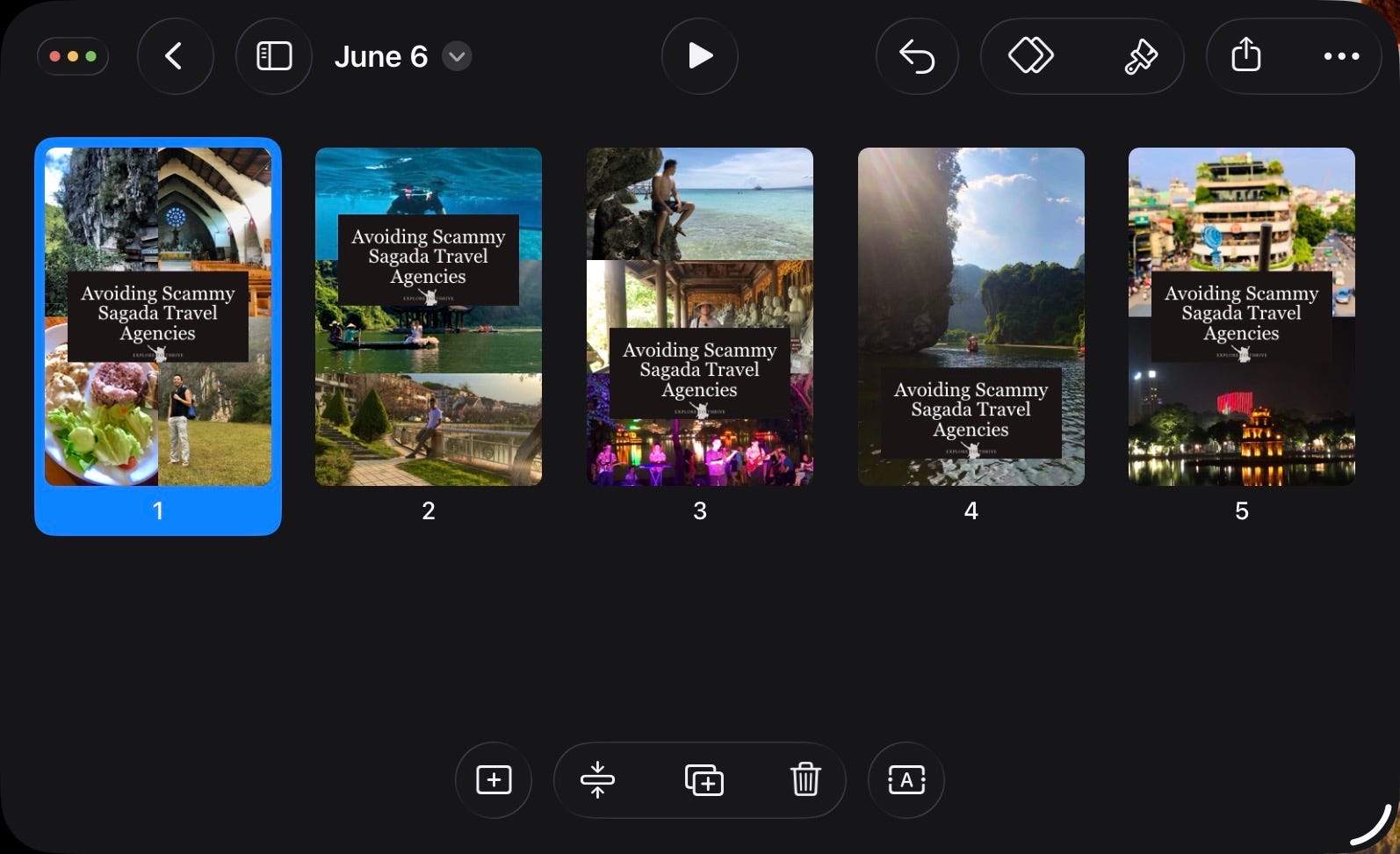
The pins were supposed to be about a destination in the Northern Philippines, but the placeholder photos for Cebu and Vietnam travel were still there. They were already published, and it is a shame I did not notice the mistake when scheduling them.
I am pretty sure I updated the right images, so it was likely a syncing error between devices that caused the issue.
When I was editing the pins, I had the Keynote app open on both my iPad and iPhone. The same file was open on both devices because I keep photos stored across them, and I use those pictures when making the pins.
It turned out to be a small mistake, but still, I need to be more careful next time.
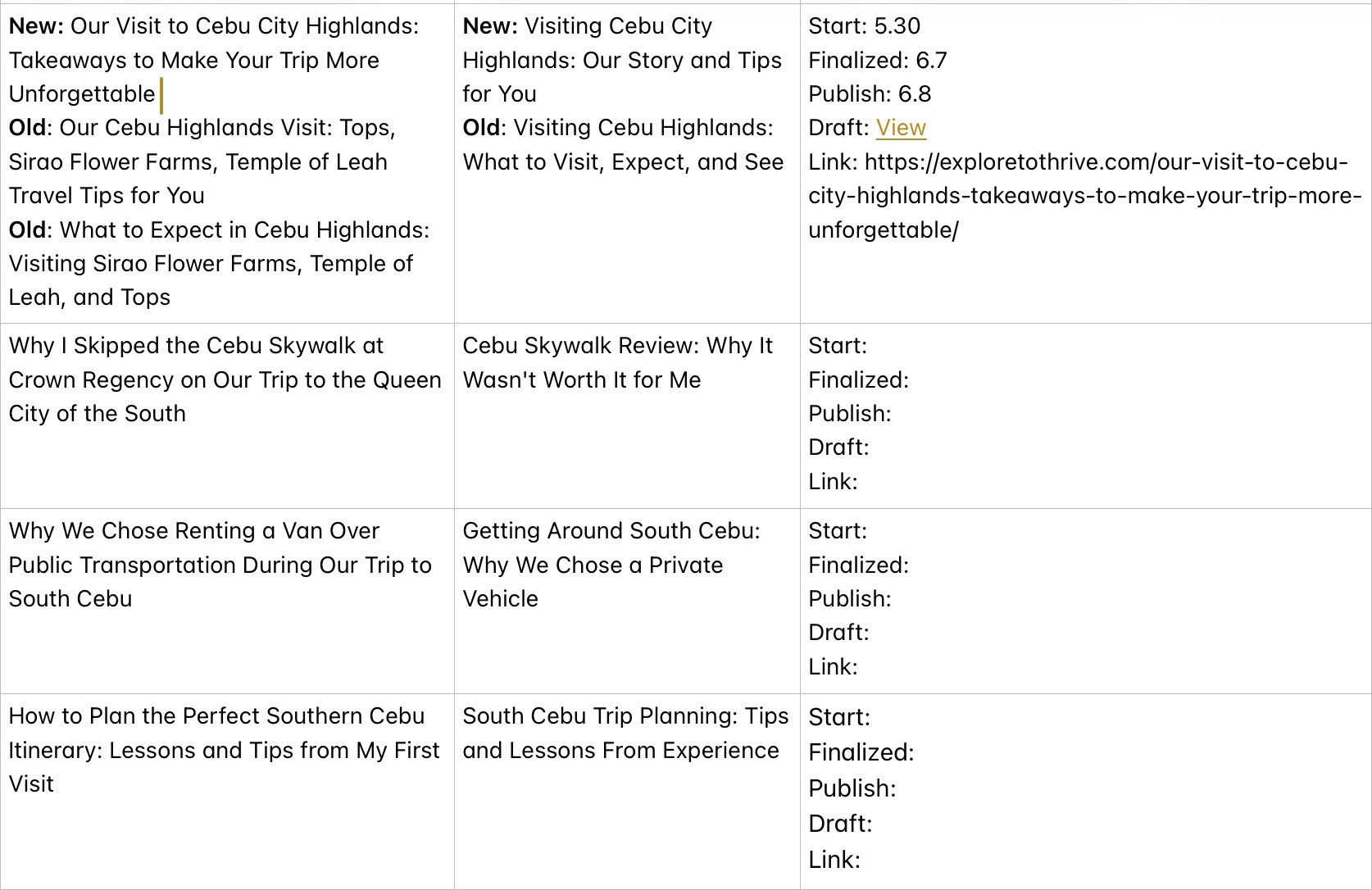
I’m down to the last three blog posts for my Cebu Travel project! Since the last week of February, I’ve already published 19 posts plus a few pages. Hard to believe it’s been over three months.
Before I send out the next newsletter, I plan to finish 2 more posts. Super excited to wrap this up and move on to the next project: more maps, more info products!
Screenshot of my project tracker below.
Alright, that’s it for this week. Thanks again for reading; see you next week!
Ciao.
Comments
Nothing yet. Say the first thing.
Sign in to join the conversation.