
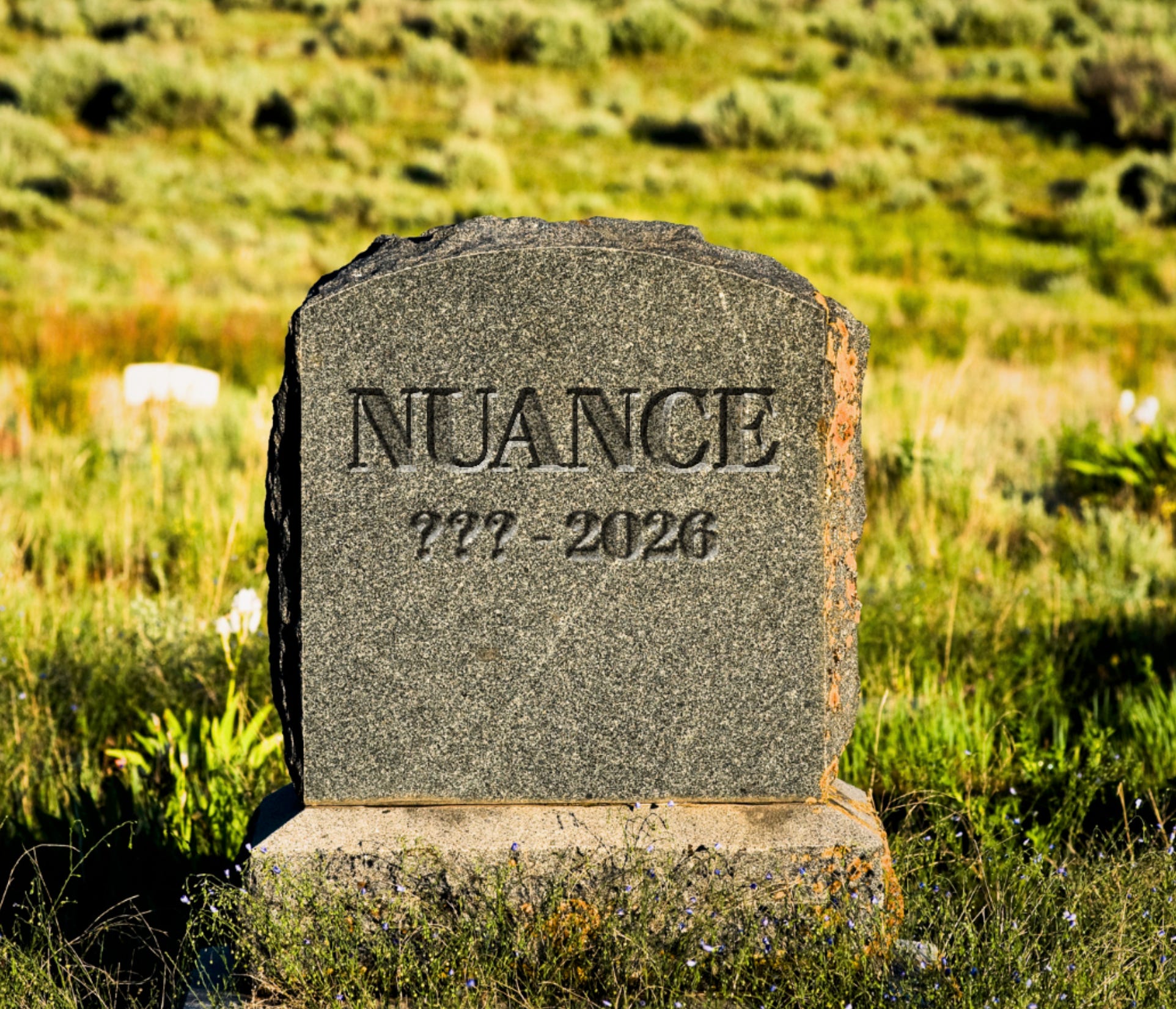
Let me start by apologizing for the headline to this piece.
The phrase “The Death of Nuance” is embarrassingly self-contradictory – it’s completely lacking in nuance.
A more proper headline would be:
“For Various Reasons, There Has Been a Decline in Nuanced Information and Nuanced Thinking in Some Parts of Our Lives!” (1)
But I was worried no one would click on that headline.
Which illustrates the very real problem I’m writing about: binary thinking and extremist statements are so damn alluring.
My headline is also inadequate because it leaves out perhaps the more important part of this essay: The potential solutions. A more nuanced headline would end with the phrase:
“…But I Have A Quixotic Belief That We Can Stop Or Even Reverse This Trend, And Here Are Some Suggestions On How To Do It!”
To back up: I decided to write this piece after reading Rose Horowitch’s article in The Atlantic called “The End of Reading is Here.” (2)
Horowitch’s article caused a stir for a reason: It’s a great essay, and a disturbing one. It contains disturbing statistics – only 16 percent of Americans read for pleasure on any given day, according to a 2023 survey. Less than 10 percent of 20-somethings read the newspaper every day.
And disturbing quotes. A Harvard sociology professor is quoted as saying some of her students view assigned reading as a punishment. They think “professors are arbitrarily withholding information from students by forcing them to get it through this more difficult medium.”
Horowitch says reading books and long articles are being replaced by TikTok videos, podcasts, Instagram captions, and text messages.
This is bad for many reasons, says Horowitch. One of which is that it imperils democracy. Democracy requires citizens to be informed by lenghthy, complex chains of reasoning. If most of us are informed by 10-second clips, our politics become more emotional, visual, and personality-driven.
As I said, it’s a great article in many ways – and disturbing. As an author, I was tempted to curl up in the fetal position under my desk after I finished it.
But there’s a profound irony in The Atlantic’s presentation of this article. The article —which decries the decline in subtle thinking and the rise of outrageous binary statements – is headlined with an outrageous binary statement.
The article argues there’s a war against nuance, quoting a scholar at a conservative-leaning think tank on how best to exploit social media. “You name an enemy and you polarize the public,” he said. “You don’t allow for nuance, because nuance is just a confusion when you’re in a struggle for power.”
Isn’t that an apt description of the headline itself? I understand the incentive of the headline writer, and I don’t blame them too much. They want people to read an article that decries the incentive itself.
Thankfully, the article is much more balanced than the headline. First of all, Horowitch points out reading itself is not ending. We are still reading a huge amount – it’s just that we’re reading short, simple things: Text messages and Instagram captions.
The real problem isn’t the death of all reading, but instead the decline of deep reading. We’re reading fewer complex books and long arguments. Deep reading is becoming “a kind of niche hobby, like stamp collecting or growing orchids,” as one historian said to Horowitch.
Horowitch’s article belongs to a long line of obituary-themed headlines and titles. A small sampling includes:
The Death of the Author (an essay by literary theorist Roland Barthes)
The Death of Newspapers (a common headline in media articles)
The Death of Expertise (a book by Tom Nichols)
The End of History and the Last Man (a book by futurist Francis Fukuyama)
The End of College (a book by education writer Kevin Carey)
The End of Work (a book by Jeremy Rifkin)
Not to mention that original clickbaiter Friedrich Nietzsche, with his
“God is dead”
In fact, many years ago, I did a series of humor pieces for Esquire poking fun at this trend. I wrote fake obituaries announcing the death of some aspect of culture, such as
“The last shred of human dignity died Sunday on the set of Big Brother 7 in Los Angeles. It was 10,052 years old. The cause was contestant fellating a zucchini.”
I understand why “death of” titles are such a popular trope. They’re tailor-made for the amygdala. They inspire fear, shock, and outrage. Simplicity sells.
Imagine if The Atlantic piece had the more accurate headline:
“If Current Trends Continue, Very Few People Will Spend Time Reading Deep and Lengthy Texts And This Is a Problem for Our Society”
Would it have gone as viral? Probably not. It’s the same reason you rarely see headlines such as “The Pros and Cons of X.” Or why you don’t see books anymore with titles like the memoir of 19th century scientist Robert Boyle
“Occasional Reflections on Several Subjects.”
Yowza! Who could resist picking that one up?
In fact, the “Death of” headlines are just a subset of absolutist and binary headlines. Another popular variety are headlines with superlatives– “The Best Movies in History,” “The Worst Vegetables for Your Health.”
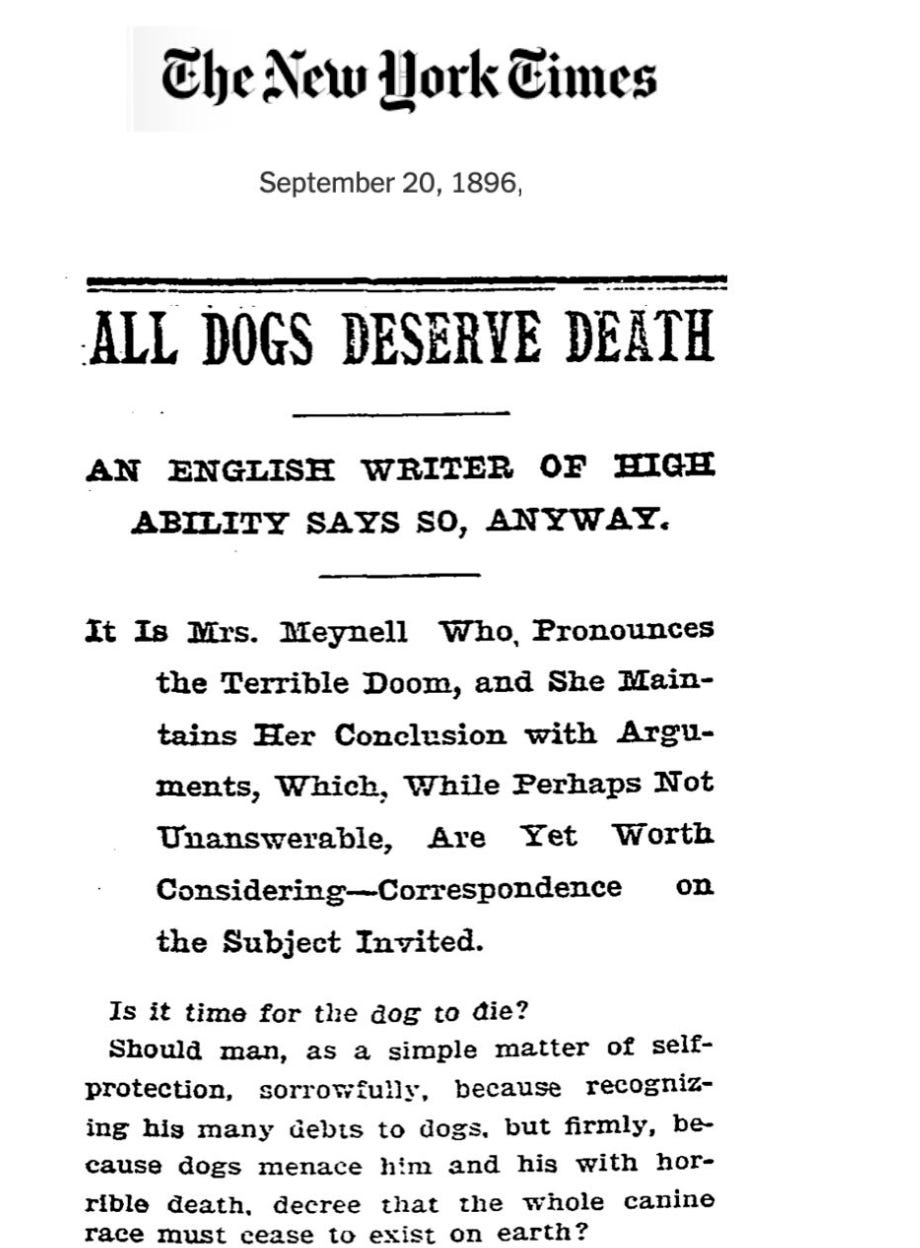
And there are the titles that use absolutist words such as “All” or “None.” Of course, this is not a new phenomenon. I recently ran across an 1896 article from The New York Times called…..“All Dogs Deserve Death.”
Wow. That is one ye olde hot take! And it proves that clickbait existed long before clicks.
Such outrageous titles increase the chance the article will get read, so you could argue that’s a worthwhile sacrifice. But the absolutist language comes at a huge cost.
It encourages binary thinking and discourages nuance. The best kind of nuance is about exposing the complexity of life, showing the grays in between the black and white. It’s about showing that there is often a third (or fourth or fifth) way, an alternative solution. It’s about looking at the world from the 30,000-foot view, putting life into context, asking why does it have to be just those two options?
All-or-nothing language also causes rage and fear and overreaction, which I believe are ill-suited for discovering the best solutions to our world’s many problems.
So what are the solutions to this particular problem? Well, I shouldn’t use the word solution. There’s no perfect solution. But here are some humble suggestions on how to battle absolute, headline-like thinking:
Whenever I see a headline in the media, I do a fun mental exercise: I try to translate it to a more accurate headline.
If an entertainment site runs a list called “The Best Movies of All Time”
I translate that in my mind into:
“Here’s a list of some movies that our three movie critics really liked, though admittedly they haven’t seen every movie ever made and have tastes that may not align with yours.”
Or else, consider this headline I found on today’s NPR homepage:
“Adults have struggled to set rules for AI in school. These teens figured it out.”
After reading the article, I translate the headline to:
“A group of 98 students came up with a series of suggestions about AI use in school that may help, but are untested, and also the technology is changing so fast they may be obsolete soon.”
And don’t restrict yourself to just headlines. When watching The Bachelor, I translate the host’s comments to: “This rose ceremony is slightly to the right of center on the bell curve of dramatic rose ceremonies.”
If you create content, try to resist the temptation of absolute and sensational headlines.
I confess! I’m a sinner myself. I’ve used plenty of sensational headlines. For instance, my book “The Year of Living Biblically” would probably be more accurately titled:
“The 14 Months I Tried to Follow the Rules of the Bible Literally And Also Meet Various Religious Groups, Though I Still Used Some Modern Technology Because The Bible Doesn’t Say ‘Thou Shalt Not Use Your Laptop.’”
But I pledge to try to do better. And in my defense, I often try to hedge my headlines, or give them a self-deprecating gloss. For instance, my Substack essay, “Can Puns Save Democracy? Probably not. But Maybe?”
Of course, absolutist thinking isn’t limited to the media. It’s all over our everyday lives – especially in relationships.
Therapists wisely advise us to avoid all-or-nothing language.
If you say “You never listen to me,” you’re pretty much guaranteed to make the other party defensive.
Instead, you could say:
“When I was telling you about my client just now and you checked your text messages, I felt ignored. Could you put it away while I finish?”
Read widely. Read things that annoy you. Or bore you. The Week magazine used to have a section called “Boring But Important.” I love that phrase, because much of the information we need to understand the world is, in fact, kinda boring. Budgets are boring but important. Base rates are boring but important.
Speaking of base rates, when you read something, ask yourself what is the bigger picture. Use questions such as “out of how many?” “How has it changed over time?” “Compared to what?” If there’s a shark attack, ask how common are shark attacks (especially compared to other ways of dying).
For those of you who use AI for research (and I understand the moral complexities of doing so), I recommend framing your prompts to encourage nuance. For instance, try saying “Tell me about the pros and cons of X topic.”
And when AI gives you its results, make sure to check the sources and weed out hallucinations.
But that’s just a start. I know there are other ways to battle the all-or-nothing plague (is that sensational, to call it a plague?) Please put your suggestions in the comments. I need more strategies.
Also, thank you for reading this article, especially if it’s the last article you will ever read in this post-literate world!
FOOTNOTE 1: An important Nuance about the Nuance of Nuance!
As I said, the best kind of nuance is about exposing the true complexity of life.
But the idea of “nuance” can be exploited by those looking to introduce unwarranted doubt. I wrote about this phenomenon in an essay on the phenomenon of “agnotology.”
This distortion of nuance comes in several flavors: “Both-sideism,” “What-aboutism, and false equivalencies, of instance. When writing about evolution, it’s an abuse of the concept of “nuance” to provide so-called balance by quoting a debunked creationist.
True nuance is not the same as giving voice to pseudo-science and quacks. Like everything in life, nuance requires nuance
FOOTNOTE 2:
The headline “The End of Reading Is Here” is from the online version of The Atlantic article. Interestingly, the print edition of The Atlantic headlined the piece “The Age of Reading Is Over” – which seems equally all-or-nothing.
FOOTNOTE 3:
Thanks to my friend Peter Norvig for alerting me to a related media sin: Headlines that end in question marks. He told me about the Betteridge Law of Headlines, which states that any headline ending with a question mark can be answered “no.” The reason: If the journalist had proof, they wouldn’t pose it as a question.
No posts
Comments
Nothing yet. Say the first thing.
Sign in to join the conversation.