
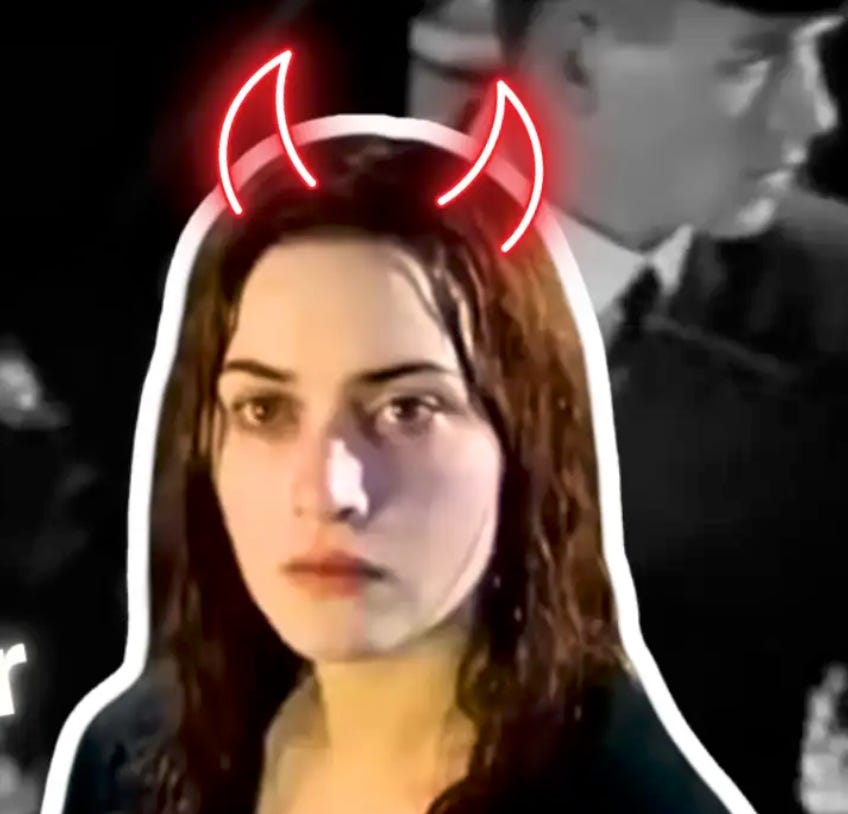
Am I a fun vacuum, as my wife and kids sometimes assert?
This allegation often arises when we are watching movies and the main character makes a big romantic gesture and I simply point out how morally objectionable that romantic gesture is.
For instance, Rose in Titanic.
Remember when she threw the Heart of the Ocean diamond into the water as a passionate gift to her long-lost lover Jack?
A diamond that, according to my Googling, was worth an estimated $250 million. A diamond that Rose could have sold at auction, donated the proceeds to charity, and prevented roughly 50,000 deaths from malaria (according to estimates from GiveWell).
WTF, Rose? (1)
I have a knack for finding such scenarios in almost every movie, much to Julie’s and the boys’ vexation.
In this column, I want to explore – in a fun way, of course! – the costs and benefits of this type of thinking.
Yes, perhaps it does suck the fun out of our post-movie discussions.
But on the other hand, I see it as my earnest protest against Main Character Syndrome, which I believe is a problem not just in movies, but in real life, and one that is at the root of many of the world’s very real problems.
I told you: Fun!
The scenarios that frustrate me the most are when a character does something that he or she finds wonderfully fulfilling, but that has potentially terrible consequences for others. They ignore the externalities, the costs to those around them.
I decided to write this column in the middle of watching Moonstruck, the lovely 1987 movie with Cher and Nicolas Cage. In Moonstruck, there’s a scene where an older man is walking his dogs on a New York Street, and the man looks up to see a huge full moon. The man encourages his dogs to howl at the moon, going so far as to howl at the moon himself to demonstrate.
The dogs obey and start howling at the moon.
So charming, right?
Except all I could think of was: What about the neighbors? What about the parents with a three-year-old who just fell asleep after a two-hour tantrum, and this asshole thinks it’s funny to get his dogs to make a bunch of noise? It’s not cute. It’s thoughtless and cruel. Have some compassion!
The disadvantages of this type of thinking are clear:
First, your family and friends call you a fun vacuum.
Second, you are quite possibly a fun vacuum.
Third, perhaps I’m taking simple-minded consequentialism – aka “act utilitarianism” – to its ridiculous extreme. (2)
If you apply short-term cost-benefit morality to every phenomenon, including movies, it could lead to quite a dreary world. In fact, maybe this world wouldn’t even have movies at all. A purist could argue that we shouldn’t spend money on art or sports or hobbies until world poverty is solved. (Counterarguments: This is short-term thinking: Art can motivate us to act morally, and art provides human experiences that cannot be measured or quantified).
On the other hand, let me defend my allegedly buzzkilling mindset for a moment. I feel it’s important for humans – including me – to be wary of Main Character Syndrome in both movies and real life. Main Character Syndrome is the illness of believing that you are the most important person in the world and that everyone else is a supporting character or extra. Those who suffer from MCS forget that all other humans have inner lives as rich as their own (MCS is not yet recognized by the DSM, but I’m hoping soon). In Titanic, Rose happens to be a Main Character. But should she act like a self-centered one, and disregard the feelings of the supporting characters? I don’t think so. I want Hollywood to create more Main Characters who consider how their actions affect non-speaking extras.
Here’s my bigger point: I believe critiquing Main Character Syndrome in movies is good practice for building empathy in real life. Stories are simulations. They train our moral instincts. If movies repeatedly celebrate characters who ignore everyone else in pursuit of their personal fulfillment, we start accepting that mindset outside the theater too. At least that’s my hypothesis. And it’s worked for me. Critiquing selfish fictional characters has kept the greater good in the front of my mind long after the credits roll.
And there’s no shortage of movies that help me practice moral thinking. One other random example: I recently watched a romcom – I won’t say which one, for fear of spoiling the plot and harming the public good. But anyway, in this romcom, the protagonist pretends to be drowning in the ocean, and emergency services have to rescue him by helicopter and, at his urgent request, fly him to his beloved. That’s some serious Main Character self-absorption. What about the people who were actually drowning and needed the rescue helicopter? What about all the taxpayer money he’s wasting?
Now you might say: This is a pretty ironic position for a writer who has engaged in stunts that sometimes have inconvenienced others.
Fair point. I can think of several examples of such behavior. When I was living constitutionally –- a project in which I tried to follow the U.S. Constitution as literally as possible -- I went to visit the Liberty Bell in Philadelphia, all decked out in my tricorne hat. When we got to the front of the security line, and the security officer told me I had to put my bag through the X-ray machine, I objected, pointing out that this was a violation of my Fourth Amendment rights, which protect me from unreasonable searches.
My protestation delayed the line for half a minute, and also made my sons wish they were several miles away from me.
My lukewarm defense is that I did it as part of a book in which I was trying to defend democracy. I momentarily harmed the good of the people on the security line for the greater good of the reading public. But I realize that’s a rationalization.
Here’s perhaps a more legitimate defense of my mindset: I’m not against all ridiculous, grand, or romantic gestures. In fact, I love them.
I just want to make sure the ridiculous and grand gestures are fun for everyone, or at least not harmful to large numbers of people.
If you’re doing a gender-reveal party, maybe don’t set off blue fireworks near a dry forest. Instead, hire a cellist to come to the park and treat strangers to a free rendition of “Beautiful Boy” by John Lennon (which, I hope, would appeal to most park-goers).
Suppose you’re the world’s biggest pop star and you decide to have 1,000 of your powerful friends attend your wedding at Madison Square Garden, thereby inconveniencing New Yorkers by shutting down nearby streets and requiring dozens of police officers to neglect their other duties. How about turning that wedding into something that benefits far more people? Maybe release a video of the performances and donate the profits to charity.
Or what about Rose? If she really wanted to honor Jack, she could have sold the diamond at a special auction, then set up the charitable Jack Dawson Foundation, with a fantastic kickoff party featuring sketch artists and a polka band. To me, that’s a lot more fun than throwing $250 million into the Atlantic.
I’d love to hear your thoughts — including what other Main Characters in fiction have the worst cases of selfish Main Character Syndrome.
FOOTNOTE 1: I’m not even getting into the moral question about whether there was room on the floating door for both Rose and Jack. I leave that to other scholars.
FOOTNOTE 2: Philosophers distinguish between "act utilitarianism," which evaluates the consequences of individual actions, and "rule utilitarianism," which evaluates the consequences of adopting general rules (such as prohibitions against murder or theft). The latter seems stronger to me.
No posts
Comments
Nothing yet. Say the first thing.
Sign in to join the conversation.