
Tahel’s chin was almost touching her chest as she reenacted herself, earlier that day, hearing the nationwide siren for Yom HaShoah. At the time, she was a 20-something Israeli with a mountain of unruly curls cascading down her back and a joint in one hand.
She looked at me from beneath her curls, making sure I was still listening.
“…and I thought to myself, this country is so fucked up.”
Then she passed the joint, threw her head back, and laughed.
I was sitting on the beach in Tel Aviv with Tahel and a few friends. I was new in Israel. I had never experienced Yom HaShoah until that day.
Every year, at 10 am sharp, a siren wails for two solid minutes in every kibbutz, village, moshav, and city in the country. People stop what they are doing and literally freeze in place if walking, or, if driving, pull over, get out, and stand next to their cars. Everybody bows their heads until the siren is over.
If you are in a city, the sight of so many people acting in lock step is either awe-inspiring or a little eerie, as if you’ve somehow wandered onto the set of a science fiction movie.
Every year, the siren blows, life stops, and the only thing on the radio or television is about the Holocaust. Some channels show a still photo of a single candle until sunset. Then life resumes.
One year, I was sitting at my desk writing when the siren went off.
I am not an automaton, I thought. This is fucked up.
Why does this country center the Holocaust as its founding story? How is this good for us? What about Arab citizens of Israel? How are they supposed to feel?
Even though there was nobody there to see whether I did or didn’t, I stood up and bowed my head. My god. It wasn’t asking so much of me, was it? It was the least I could do for the memory of the six million.
Another year, a filmmaking friend sent me a video of a woman in dominatrix-style black leather standing on a pedestal outside of Yad Vashem. She writhed and hissed:
“How could you justify 1948 and 1967 without me? Who deserves credit for enabling you to place three million people in a ghetto without the superpowers bombing you? Do you think you could get on without me?”
My friend loved the daring, provocative brutality of it.
I was disgusted. And yet.
As shocking as the performance was, it made me think, if grudgingly:
Does Israel owe its existence to the Holocaust? You can indeed make that argument.
Has the horror of the Holocaust been used by various Israeli governments and public figures to justify things or to prove a point? Oh, hell, yes.
Does Yom HaShoah mean the same thing to everyone here? For Mizrahi Jews whose families came from North Africa and the Middle East? For Arab Israelis, who make up roughly twenty percent of the population?
Gidon and I once accompanied Elon Musk to Auschwitz on International Holocaust Remembrance Day in 2024. There were officials from European Jewish organizations, a small army of security, and cameras. After the obligatory publicity photos were taken, it became clear that Gidon was a necessary set dressing, swiftly left behind in the cold.
I’ve never forgotten how angry that made me.
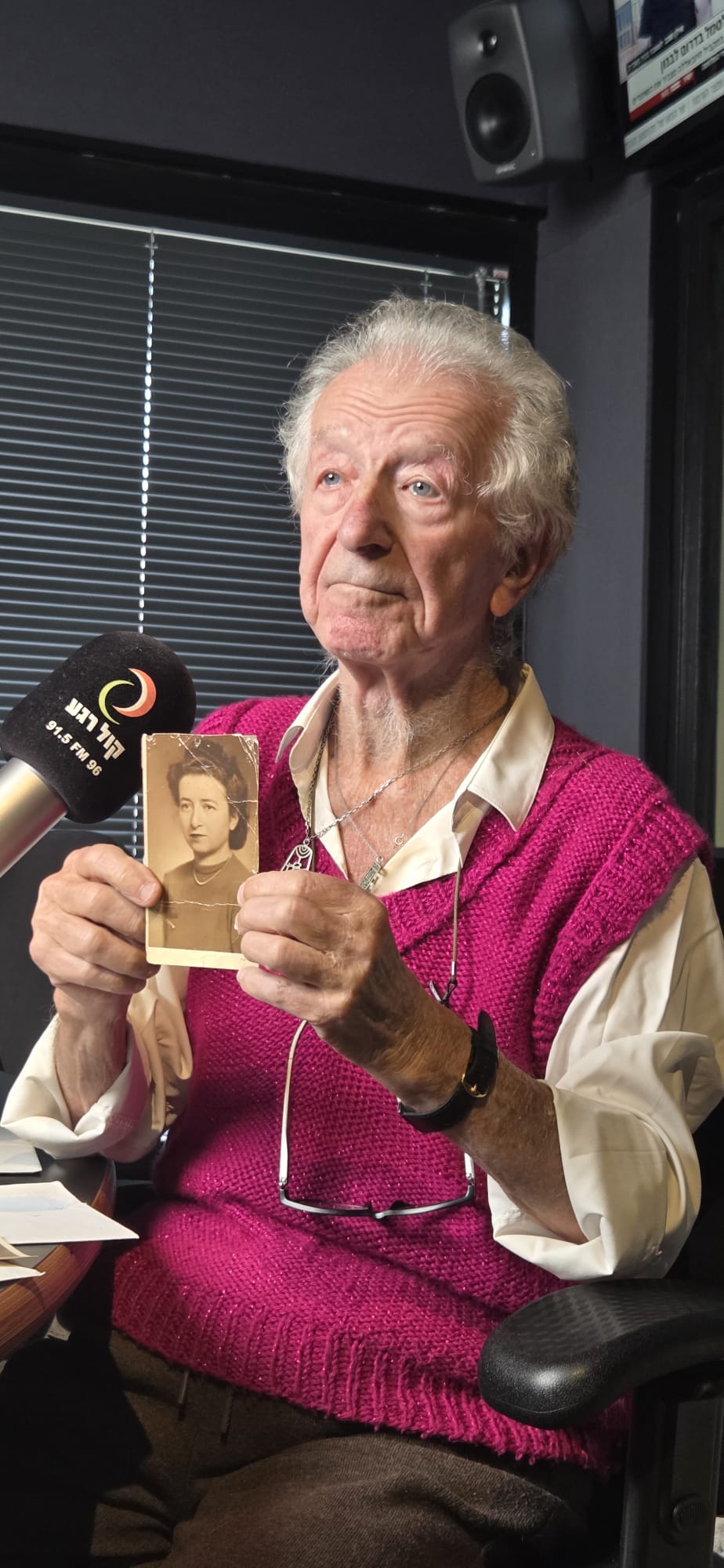
We were in the car, headed to a radio station in Northern Israel. Gidon was scheduled to tell his story as part of Zicharon B’Salon, a program that brings people in Israel together to hear Holocaust testimony in informal settings.
Gidon has never worried about “messing up” his story. But this time was different. In his 91st year, yes, sometimes a word slips, a name, or a date. He didn’t want to look foolish.
Suddenly, I asked myself, what am I doing?
Driving this man, my most beloved, to the thousandth telling of his story, in the middle of a war, when he is feeling particularly vulnerable?
Was Gidon being used as part of a national project?
Was this really in his best interest? How many times is enough?
The large ceremony at Yad Vashem had been pre-recorded. A major event in the north, where Gidon was supposed to light a torch, had been canceled. Security guidelines change by the minute. It wasn’t safe.
Gidon was crestfallen.
At the radio station, I told him I would sit nearby so that if he forgot anything, I would be there.
Minutes later, he was in the studio, surrounded by sophisticated-looking, blinking equipment. Gidon, the little boy who never quite grew up, in his sparkly red vest. His feet didn’t quite reach the floor.
He didn’t forget a word. Of course, he didn’t.
And as Gidon spoke, I could see, as if for the first time, what it costs him to recount his childhood, from the mossy mountains and rivers of what was then Czechoslovakia to the hunger and filth of Theresienstadt.
To the last time he saw his father, before he was sent to Auschwitz.
Saying goodbye to his grandmother, Rosa, the day she was sent to Treblinka, where most arrivals were murdered within an hour or two after arrival.
Imagine knowing that is how your grandmother died. Stripped and shaved first.
In his day-to-day life, Gidon does not live in those moments. But once a year, he goes back.
And who is it for? The youth? The country? The Jewish narrative?
All of that. None of that.
If others learn something from it, that’s fine. But that’s not why he does it. He tells his story because the earth cracked open and swallowed his childhood, his family, his innocence and that story needs to be told.
This year, unlike any other, the media has issued frequent reminders ahead of the two-minute national siren. Israelis are war-weary and traumatized. A smattering of Israelis have posted on Facebook that this year, we shouldn’t do the siren, some people could panic. I feel mixed about this. On the one hand, I get it. On the other hand, shall we bend our customary annual ritual honoring the six million because there is a war? I don’t know.
For the past nine years, my time with Gidon, I am very busy on Yom HaShoah and the days preceding it. Driving Gidon from event to event, putting the proffered flowers in water, fielding phone calls, giving reporters and organizations Gidon’s bio over and over. Scheduling this camera crew’s visits, and that one, so they don’t conflict. Making sure I have coffee, tea and snacks for those who crowd our home.
I am sure that for many of these people, I may seem a bit unpleasant, insisting, as I do, that no, this event is one too many, or that Gidon needs a break in between.
I ask Gidon over and over, are you sure? He always says yes. Is he exercising his best judgment? I have to believe he is.
People often thank me for amplifying Gidon’s story. I am not sure what to say to that. I am not sure what this all means.
But I can tell you that when Gidon tells his story, he lights up. It enlivens him to be heard and seen.
Nobody on planet earth has heard Gidon’s story as many times as I have. Nine years, two books, social media accounts with over half a million followers, and so many presentations and events in Israel, Europe, the US, and even Dubai that I have lost count.
But this year, sitting in the radio station, when Gidon broke into German,
it broke my heart in fresh, new ways. A man worried that at age 91, he might forget some detail, still hears those soldiers shouting at his five-year-old self.
For Gidon, telling his story is not a national project, it’s catharsis. His memories of the Holocaust are imprinted in his every cell as sights, sounds and deep emotion that he only accesses by telling his story.
Nobody has an answer to the question of how we, as a people and as a state, should remember the Holocaust, or why. I just don’t know. I don’t know.
I can only tell you here what Yom HaShoah means to Gidon; how it functions for him as a therapeutic retelling. And that, despite my larger misgivings, is what matters to me as long as Gidon lives.
Comments
Nothing yet. Say the first thing.
Sign in to join the conversation.