
Welcome to the latest edition of The Expand Democracy 3. Typically released every two weeks, we highlight promising pro-democracy ideas and local, national, and global news. Subscribe below to receive Expand Democracy staff and guest posts and descriptions of our new Democracy Lab podcast episodes.
We have good internal news to share: Senior Fellow Eveline Dowling is the happy mother of a new child. Eveline will be on leave until October, and during that time Nivea Krishnan and I will mostly lift up past content that has new relevance. Each edition, we’ll introduce a previous post with an introduction explaining its timeliness.
Expand Democracy is a charity that depends on donations from people like you. If you’re enjoying this newsletter, please share it with others who might find it interesting. Thank you!
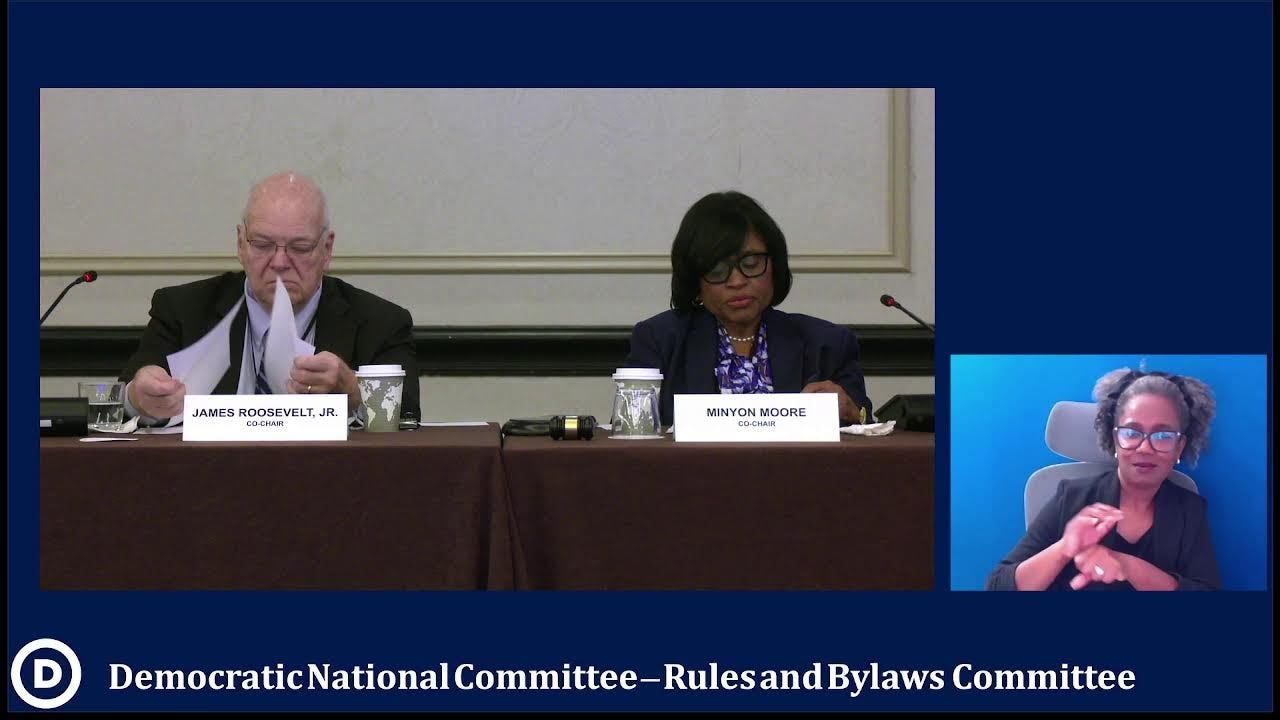
The Rules and Bylaws Committee co-chairs backed the proposed RCV ban. Source: YouTube
One of the most surprising developments of the year is that Democratic National Committee insiders are poised to ban the use of ranked choice voting (RCV) in selecting the Democratic presidential nominee in 2028 – overriding presidential primary laws in Maine and Washington, D.C, and squashing great interest in this use of RCV among state legislators and the many state parties who run their own primaries.
Earlier this year, I spotlighted this compelling use case for RCV. Presidential primaries draw crowded fields of candidates that voters get to know and are eager to rank rather than be limited to one. Parties need to bring together their big tent of voters, and RCV rewards unifying candidates. The sequential nature of contests is a problematic fit with early voting – in 2020, for example, more than three million Democratic voters cast a ballot for a candidate who had withdrawn before that vote was counted.
But the senior citizens who dominate the DNC Rules and Bylaws Committee (RBC) reflect the conservatism I’ve found among many older people on adopting RCV. The age gap in support for RCV is breathtaking. While that makes me optimistic for the future of RCV as a reform, it reflects a short-term challenge in a nation that too often looks and acts like a gerontocracy.
Even among seniors, however, support for RCV is strong among Democrats. Maine, for example, has the nation’s oldest median age, yet its voters adopted RCV for state and congressional elections on the ballot in 2016, ratified that support in a 2018 referendum, and had its legislature extend RCV to presidential primaries and general elections heading into 2020. A recent University of New Hampshire poll found that among registered Democrats in Maine, the state’s RCV law is supported by an overwhelming 84% to 6% margin.
Maine’s Democratic Party leaders of course want to keep using RCV for presidential primaries. Washington, D.C. voters are also enthusiastic about RCV after its successful rollout in primaries this June in the wake of 73% of voters passing RCV for all DC elections, including the 2028 presidential primaries. State Democratic Party leaders in Alaska, Hawaii and Wyoming used RCV in 2020 and want to use it again, as do other states like Iowa.
But the Rules and Bylaws Committee recently passed language mirroring the position of national Republicans who voted to block use of RCV after the GOP in the U.S. Virgin Islands used RCV in 2024. The proposed rule would ignore any rankings on an RCV ballot by only awarding delegates based on first choices. Some RBC members are protesting that this proposed rule is not a “ban,” but that’s disingenuous – it would be analogous to a rule that vote-by-mail ballots could be cast in presidential primaries, but only ballots cast in person would count toward awarding delegates. That would as effectively ban vote-by-mail as the proposed rule bans RCV. The RBC’s surprise attack on RCV was organized quietly by Frank Leone, a long-time opponent of RCV who had badly lost local battles about using RCV among Democrats in his previous home city of Arlington (VA) and his current home of Washington, D.C, yet has found this new way to block RCV’s progress. Leone’s tactic was to mislead RBC colleagues that using RCV is somehow incompatible with the party’s long-time proportional representation requirement. That claim is absolutely false, yet RBC leaders like Leone and RBC co-chair Jim Roosevelt have shamelessly
As spelled out clearly in the state plans approved by the RBC in 2020 and in the Washington, D.C law, RCV would be used not to elect a majority winner, but with a “bottoms up” rule. That is, trailing candidates would be dropped (either sequentially or all those under 15% at once) until the remaining candidates are all above the viability threshold of 15% for earning delegates.
Some backers of the DNC’s proposed ban suggest this way to use RCV is some kind of “Frankenstein,” but it is eminently sensible and rooted in party traditions. This way of using RCV ballots closely aligns with the long-time rules among Democrats for in-person caucuses, such as in Iowa, where in-person participants would have a chance to realign with a viable candidate if their first choice had too little support to earn delegates.
Using RCV this way in 2020 led to nearly 100% of voters having their ballot count for a viable candidate earning delegates in the four states where we have data. In those party-run primaries with RCV, more than 99.8% of voters cast a valid ballot and nearly 90% of backers of withdrawn candidates had their ballots counted in the final round for Joe Biden or Bernie Sanders. Done nationally, it would have meant more than 2.5 million votes for withdrawn candidates would have counted for an active candidate.
The actions of the RBC are rarely overturned, but the full DNC at its mid-August meeting may do just that. Many state party leaders not asked for their opinion are shocked by the RBC’s divisive overreach. They’d prefer Democrats to focus on winning elections, not picking unnecessary internal battles where a party gerontocracy overrides state parties being able to use RCV to attract more participation by younger voters, make more votes count, and reward a more unifying nominee. Because this is a party decision, please share your opinion with any DNC members know while national pro-RCV groups like FairVote and Rank the Vote can help you make a difference
I’ll close by sharing what I wrote about this topic in early June.
Every four years, Americans experience a massive lesson in the power of electoral rules: the presidential nomination process. The schedule of contests means early primary states may get literally 100 times more attention from candidates than states voting later. A timely early win can create unstoppable momentum when it’s soon before “Super Tuesday.” as February primary winners like Joe Biden in 2020 and Donald Trump in 2016 have shown. Republicans allowing a mix of primaries where delegates are allocated proportionally and by winner-take-all often leads candidates to chase “all or nothing” outcomes in the winner-take-all states. Yet such rules can be changed relatively easily by states and the parties themselves.
I’ll zero in on a change that I believe is an inevitable norm: a ranked choice voting ballot (as opposed to “ranked choice voting” in itself) to handle increasingly crowded fields by allowing a voter’s second or lower choice to count if their first choice isn’t viable - as persuasively called for by Congressman Jamie Raskin just last week in The Guardian. Both parties have those who resist change, to be sure, but here’s why it makes so much sense for both Democrats and Republicans.
For both parties, using an RCV ballot has “centripetal” impacts on rewarding candidates able to build consensus support across their party, as both parties traditionally shaped at in-person conventions and as Democrats carried over to caucuses where voters “realign” to viable second choices after indicating their initial preference.
Both parties have primary calendars where a string of contests happen soon after early primaries result in many candidates dropping out. Nearly all states also now have generous early voting rules – ones that increase turnout by expanding voting access, but that undercut voting rights when combined with candidate withdrawals – leading to some three million Democrats in 2020 voting for candidates who had withdrawn by the time those votes were counted.
Democrats have a strict requirement for proportional representation across all states, with statewide delegates allocated to any candidate earning at least 15%. That makes winner-take-all forms of RCV a non-starter with Democrats. But 15% is a high number, and millions of votes are “ineffective” because they are below the threshold. Embracing a caucus-like ”realignment” rule with ranked ballots would allow those voters to get a chance to have their vote count. That is, you would count all first choices, then, in the realignment round, move all ballots cast for nonviable candidates below the 15% threshold to their next-ranked viable choice. In 2020, about 90% of such voters in the four states providing data about how voters used their ranked ballots had their ballots count toward viable candidates. Translated across all states, that would be a huge win for voting rights and likely result in more votes making a difference than any other reform.
Republicans drive toward faster selection of nominees by allowing states to hold winner-take–all contests after their early contests are decided based on proportional representation. But when those winner-take-all contests have more than two candidates, you get winners with far less than half the vote - a dynamic that was clearly unrepresentative of voter opinion in 2016, as FairVote demonstrated conclusively. Republicans wanting a more reliably representative outcome would benefit from RCV.
How RCV might become the norm in presidential primaries
Widespread use of ranked choice voting for these reasons will depend above all on faster, cheaper and better election administration of RCV. Most cities have met that goal with transparency, audits, election-night tallies, and voters embracing RCV ballots. Moving those practices statewide can take more investment, but that journey is well underway. Once RCV is as quick and easy to use as non-RCV elections, it will become a relatively non-controversial choice for states and parties.
As to viability, a lot of Republicans are pouting about RCV because Democrats won hotly contested congressional elections with RCV in Alaska in 2022 and Maine in 2018. But blanket opposition is irrational, and Republicans’ experience with RCV in nomination contests has been uniformly positive, as in the Republican Party of Virginia’s 2021 gubernatorial nomination. Over time, I expect Republicans will embrace the practical strength of RCV, including in presidential primaries.
For Democrats, this is a key cycle for their commitment to voting rights. FairVote’s polling shows a remarkably broad and high level of support for RCV among Democratic voters, including a margin of greater than 10 to one for its voters under 50. Democrats also have a great lesson from 2020 showing that RCV ballots work, which is why many of their state party leaders want to use RCV ballots in 2028. With numerous state parties that run their own contests wanting to do vote-by-mail with RCV, national Democrats would do well to get out of their way and simply spell out clearly the acceptable rules for using RCV ballots to make more votes count. I’ve drawn on my coauthored 2021 academic article
Grounded in experience in 2020, both major political parties have reasons to expand use of ranked choice voting (RCV) in their 2024 presidential primaries. RCV may offer a ‘win-win’ solution benefiting both the parties and their voters. RCV would build on both the pre-1968 American tradition of parties determining a coalitional presidential nominee through multiple ballots at party conventions and the modern practice of allowing voters to effectively choose their nominees in primaries. Increasingly used by parties around the world in picking their leaders, RCV may allow voters to crowd-source a coalitional nominee.
Most published research about RCV focuses on state and local elections. In contrast, this article analyzes the impact on voters, candidates, and parties from five state Democratic parties using RCV in party-run presidential nomination contests in 2020. First, it uses polls and results to examine how more widespread use of RCV might have affected the trajectory of contests for the 2016 Republican nomination. Second, it contrasts how more than three million voters in the 2020 Democratic presidential primaries backed withdrawn candidates with the low rate of such wasted votes for withdrawn candidates in the states with RCV ballots. Finally, it concludes with an examination of how RCV might best interact with the parties’ current rules and potential changes to those rules.
No posts
Comments
Nothing yet. Say the first thing.
Sign in to join the conversation.