
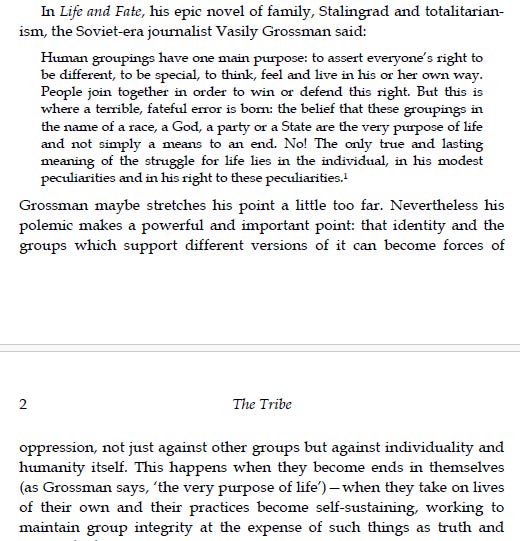
I began my first book with a quotation from the Soviet-era journalist Vasily Grossman’s novel Life and Fate (see bottom of article). These lines, concerning what Grossman called ‘human groupings’, spoke to my book’s subject matter of identity politics – of how it can become the purpose of life itself, a way of binding us into the world via our skin colour, ethnicity or gender, etc, with sometimes-terrible consequences.
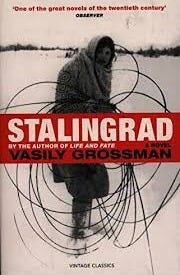
Recently I found a copy of the prequel book to Life and Fate in a local library. Entitled Stalingrad: A Novel (later renamed For a Just Cause) and published first in serial form in 1952, I didn’t like it so much. The reason for this was Grossman’s evident striving to flatter the Soviet authorities, with the intimidating figure of Joseph Stalin looming large at the top. As a writer, or composer or artist, you had to do certain things – and Grossman does them in this book to a degree he doesn’t in the second.
Literature and the arts – and intellectual activity more generally – were hugely important to the Soviets. We would tend to think of this as being just for ‘propaganda’ purposes, but I think it’s deeper than crudely supporting the regime/leader. Soviet – like much contemporary left-progressive – propaganda, was much more sophisticated than this – and often came with dollops of genuine faith and belief. I think we might conceive of it more in terms of a role: to inculcate what we might now call Soviet society’s ‘values’, demonstrating the progress of that society and giving the population confidence in themselves and their own roles, for example as ‘workers’ whose productivity would usher in the Communist paradise.
And Grossman was, by the time of the Second World War, one of Soviet literature’s major figures: one of two potential candidates to be the ‘Soviet Tolstoy’ come 1945.
Translator Robert Chandler’s Introduction to the book has some fascinating biographical details about Grossman’s struggles with the system as a writer. These started immediately on writing his first novel, Glückauf, set in a mining community in the Donbass, with one editor calling some aspects of it ‘counter-revolutionary’ and refusing to publish.
Grossman wrote to Maxim Gorky, then the most influential figure in Soviet literature, for advice and support, saying, ‘I wrote the truth [about the miners]. It may be a harsh truth. But the truth can never be counter-revolutionary.’
In his reply, Gorky gives us what I think is a superbly-crafted intellectual justification, not just for the editor’s accusation, but for censorship, for what we might call the ‘cover-up’ and for the modern ‘cancellation’ in any place of social power, from schools and universities to the media and the arts, including literature.
‘It is not enough to say, “I wrote the truth,”’ Gorky wrote in his response to Grossman. ‘The author should ask himself two questions: “First, which truth? And second, why?” We know that there are two truths and that, in our world, it is the vile and dirty truth of the past that quantitatively preponderates. But this truth is being replaced by another truth that has been born and continues to grow … The author sees the truth of the past quite well, but he doesn’t have a very clear understanding of what to do with it.’
Gorky pointed out that Grossman depicted ‘the obtuseness of coal miners, their brawls and drunkenness” truthfully. However, ‘it is a disgusting and tormenting truth. It is a truth we must struggle against and mercilessly extirpate.’
Reading this, I immediately thought of the British state and wider overclass response to the grooming gangs in places like Rotherham and Rochdale (now revealed as nationwide); also to the current procession of asylum seekers through the British justice system, accused of everything from stealing phones to rape and murder.
These are disgusting and tormenting truths. They are also truths that the overclass struggles against and seeks to extirpate – and by the same means: by censorship, covering up, denouncing those who highlight them for racism and xenophobia and for threatening ‘community cohesion’/‘race relations’. And by retelling the same counter-narratives, of ‘another truth that has been born and continues to grow’ – that of the great diverse, inclusive society, one which by definition doesn’t have industrial-scale rape and widespread crime by migrants of certain national and ethnic origins.
And here, I believe, you can see how what some call ‘the best of intentions’ (I wouldn’t) can end up supporting the interests of the worst, most dangerous people in the world.
I think it’s another example of how we aren’t so far away from the Soviet reality as we might like to assume.
Indeed I wonder if the Soviets would have allowed their ideals to stretch so far as we have with notions such as tolerance, internationalism, anti-racism and that dubious trio of ‘diversity, equality/ equity and inclusion’.
Perhaps, in some ways, we are – or rather our ruling class is – worse then them, albeit in the same lineage, the same style?
No posts
Comments
Nothing yet. Say the first thing.
Sign in to join the conversation.