
There’s an emerging outrage about automated license plate readers (ALPRs) from conservatives, progressives, and libertarians, particularly Flock Safety, the Atlanta-based company that supplies cameras and software to governments, schools, and even homeowners associations across the country. The cameras automatically photograph passing vehicles and turn those images into searchable records that can include the license plate number, make and model, color, location, and time the vehicle was observed. Flock says its network is now used by more than 5,000 law enforcement agencies and 6,000 communities, providing access to a massive and increasingly interconnected database of vehicle movements.
Richard Hanania published a piece on Monday in which he rather boldly claims “Flock cameras likely explain the recent crime collapse.”1 His theory is essentially a sort of Kalam cosmological argument for Flock. Crime fell rapidly at roughly the same time that Flock and other surveillance technologies proliferated, and Hanania treats that coincidence, combined with a plausible deterrent mechanism, as strong evidence of causation.
Let’s contextualize this. There has been a lot of rhetoric about crime in the past six years, including by the Trump administration. Much of that rhetoric paints a picture of crime that isn’t accurate. Violent crime peaked in 1991 at 758.2 crimes per 100,000 inhabitants. By 2000, it dropped to 506.5. Prior to 2024, the lowest post-1991 rate recorded was in 2014, at 361.1 violent crimes per 100,000 inhabitants. In 2024, it was 348.6.
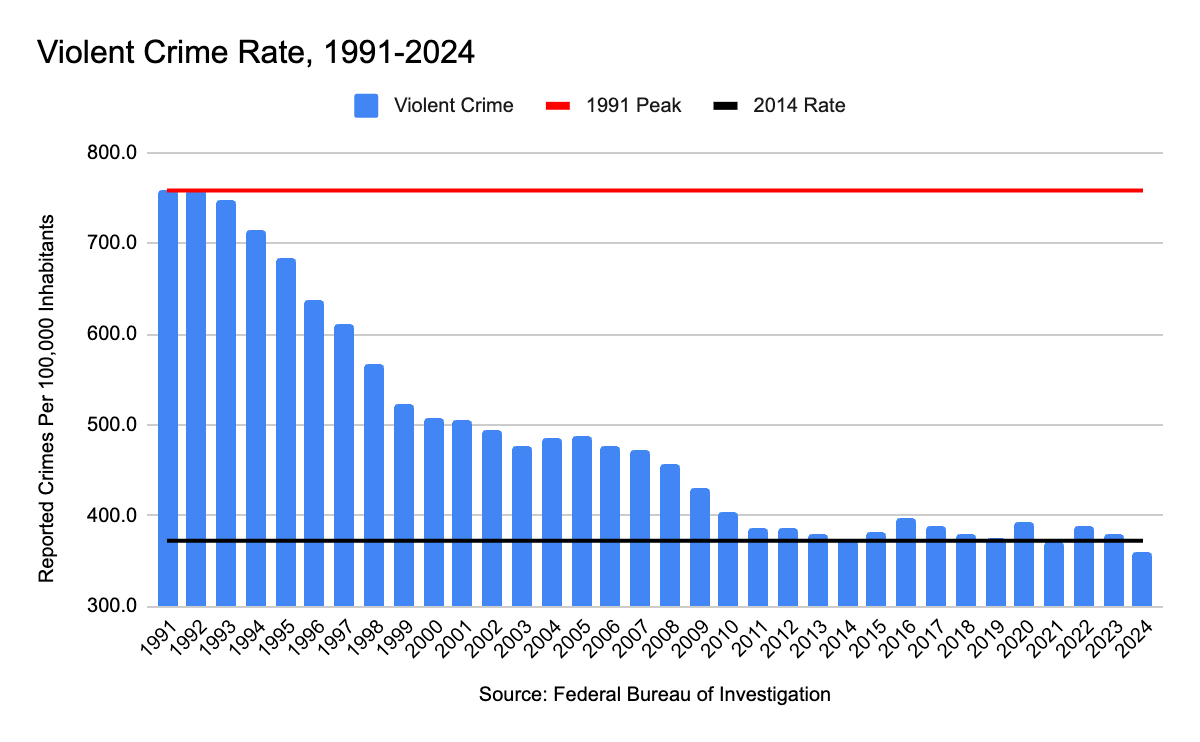
Hanania notes that “[v]iolent crime reached a peak around the early 1990s before falling dramatically over the next three decades.” This is true. He doesn’t explore causation, but it’s worth discussing because there’s no singular cause for the decline in violent crime. The simplistic response is that Congress and state legislatures got tougher on crime, enacting lengthy prison sentences for crime, particularly drug-related crime. In August 2016, Sen. Tom Cotton (R-AR) proclaimed that the United States has “an under-incarceration problem.” His almost religious devotion to the carceral state is his primary reason for opposing the First Step Act and other criminal justice reform legislation over the years. Cotton, of course, made this comment during a brief uptick in violent crime—385.5 violent crimes per 100,000 inhabitants. Still, in context, the violent crime rate was relatively low.2
The belief is that the more people we incarcerate, the less crime we’ll have. The argument has holes. Incarceration wasn’t the only reason why crime began to fall in the 1990s. In February 2015, University of Texas professor William Spelman explained, “When you get down to it, nobody really knows [why the crime rate has fallen]. A bunch of us tried to examine the crime drop of the ’90s that extended into the last decade, but with a few exceptions, we could not find any policy levers that had a clear and consistent effect on the crime rate. Potential explanations include demographic shifts, better economic opportunities, changes in drug markets, new police strategies, and increased imprisonment. But most attempts to parcel out responsibility among these explanations are unpersuasive.”3
Even more importantly, Spelman also noted, “Our research concluded that about 25 percent of the 1990s crime drop can be linked to increased incarceration. Incarceration rates flattened out in the 2000s, but crime rates kept dropping. So incarceration can’t account for the last 15 years of reductions.” If incarceration is responsible for 25 percent of the decline in crime in the 1990s, that means 75 percent of the decline came from other factors. Some of those factors are mentioned by Spelman, such as better economic conditions, but others include the end of the crack epidemic, more and better policing, declining lead exposure, and aging of the population out of the age groups most associated with criminal offending.
In 2018, Flock had as many as 2,000 cameras across the United States. In 2026, the estimate is as high as 120,000. DeFlock, however, has mapped nearly 130,000 in all 50 states. That’s a vast surveillance network, and it doesn’t include other surveillance that a city may have, both public and private.
Hanania writes, “Flock therefore probably shouldn’t get credit for the full crime decline, but it is likely that the combined effect of all surveillance technologies is the predominant cause of the post-Floyd collapse. This is far and away the leading theory as to what changed so quickly over the last few years.” I’m curious to know who is putting that theory forward. Hanania doesn’t say, and I haven’t found much in the criminological literature to support the claim that surveillance technology is the predominant explanation for the recent decline in violent crime, much less that it is “far and away the leading theory.” There’s also an obvious problem with the timeline. Violent crime had fallen dramatically from its early-1990s peak and reached historically low levels before Flock and similar large-scale ALPR networks became ubiquitous in American cities. Could Flock be responsible for some of the more recent decline in crime? Sure. But based on the research available, the best we can say is that the evidence is inconclusive. Studies show that ALPRs can help police identify stolen vehicles, generate investigative leads, and sometimes clear crimes. Establishing that they have anything significant to do with the post-2020 decline in crime is a much harder proposition.
There are two studies I’m familiar with that look at ALPRs, An Evaluation of a Major Expansion in Automated License Plate Reader (ALPR) Technology and Measuring the Cost-Effectiveness of New Technologies in Policing: The Case of Automatic License Plate Readers (ALPR). Neither makes the claim that ALPRs were responsible for decreases in violent crime. Neither supports the claim that ALPRs are responsible for the broader decline in violent crime. The first study, which examined a major expansion of ALPRs in Atlantic City, found no significant reduction in violent crime overall, although it did find that the expansion was associated with reductions in shootings, motor vehicle theft, and property crime. The second study reviews the broader body of research and reaches a much more cautious conclusion, which is that ALPRs are unquestionably more efficient than manually checking license plates, but the evidence that they produce broader crime-control benefits remains mixed.
Admittedly, I’m reluctant to write about crime rates in 2025 without having the final data from the Federal Bureau of Investigation’s Crime Data Explorer (CDE). There’s data available, but I’ve found the annual crime data is the best way to make year-to-year comparisons. Still, I want to look at Atlanta, which is the most surveilled city in the United States on a per-capita basis.4 According to DeFlock, Atlanta has nearly 3,000 ALPRs. Despite the surveillance network around the ATL, clearance rates haven’t improved. For example, an arrest was made in 54.3 percent of homicides in 2021. In 2025, only 48 percent of homicides were cleared. There are categories of crime where clearance rates have improved, specifically burglary and theft from a motor vehicle.
Even though Atlanta has this vast surveillance network, the violent crime rate, based on the preliminary data, has increased from 2024 to 2025, rising from 348.9 violent crimes per 100,000 inhabitants to 407. To put this in context, violent crime in Atlanta has still declined significantly since 2021, when the violent crime rate was 505.8. Looking even further back, violent crime in Atlanta was 764.8 in 2011.
If surveillance is the predominant cause of the crime decline, what happened in the most heavily surveilled major city in America?
It would be wrong to say that ALPRs have no benefit to public safety. They work for some purposes and may even prevent some crimes. That still doesn’t establish that it caused America’s crime decline. Even if it did, Americans are entitled to ask how much surveillance they’re willing to accept in exchange.
That question becomes more important as ALPR networks grow. These cameras don’t only photograph vehicles suspected of being connected to crimes. They photograph everyone who drives past them, recording a vehicle’s license plate, location, and the date and time it was observed. Flock says that data is generally retained for 30 days, depending on local law and agency policy, but the sheer number of cameras means those individual observations can collectively reveal a great deal about someone’s movements. A person doesn’t have to be suspected of committing a crime for the government to potentially have a record showing that his car was near a political protest, a church, a gun store, a medical clinic, or someone’s home. That’s a fundamentally different form of surveillance from a police officer occasionally running a plate on the highway.
The privacy concern isn’t really the existence of any single camera. It’s the network. A camera that records cars passing one intersection tells the government relatively little. Tens of thousands of cameras whose observations can be searched and shared across jurisdictions can turn otherwise isolated pieces of information into a history of where a vehicle has been. That raises questions about who can search the data, what justification they need to conduct a search, how widely the information can be shared, how long it should be retained, and what happens when the system is inevitably misused. Those questions don’t disappear simply because ALPRs sometimes help police solve crimes.
One common response to concerns about ALPR systems is that people don’t have a reasonable expectation of privacy when they’re driving on public roads. However, more recent decisions draw a line between a single, isolated observation and the use of technology to build a detailed, long-term record of someone’s movements.
In Carpenter v. United States (2018), for example, the Court rejected the idea that you lose all Fourth Amendment protection just because you’re out in public. The Court recognized that there can still be a privacy interest in the pattern of your movements when they’re collected and assembled over time. That doesn’t automatically mean systems like Flock are unconstitutional, but it does mean the issue isn’t as simple as saying “your license plate is visible on the street, so there’s no privacy concern.”
Beyond the legal doctrine, there’s a more basic policy question that doesn’t depend on where courts ultimately draw the line. It’s one thing for a police officer to see your car pass through an intersection. It’s something else entirely for a network of cameras to quietly log every appearance of your vehicle, store that information, and make it searchable across time and jurisdictions.
The real question isn’t whether a license plate is private. Of course, it’s not. The question is whether the government should be able to take millions or even billions of ordinary, lawful public sightings and turn them into a detailed, searchable map of people’s movements, all without any individualized suspicion or meaningful oversight. Unfortunately, Hanania largely dismisses these concerns.
If Hanania’s thesis is wrong, what else explains the decline in crime since 2020? One place to start is with the conditions that produced the spike in violence in the first place. The United States was experiencing a once-in-a-century pandemic that profoundly disrupted everyday life. States and cities imposed lockdowns, schools closed, businesses shut their doors, unemployment soared, and normal social institutions were thrown into disarray. Social isolation and anxiety increased. Police departments, courts, community organizations, and other institutions that ordinarily help maintain public order were operating under extraordinary circumstances.
Then came the murders of George Floyd, Breonna Taylor, and Ahmaud Arbery, followed by a period of intense racial unrest, enormous demonstrations, riots in some cities, and a deterioration in trust between police and the communities they served. The country was also entering a period of heightened political instability and sporadic political violence. None of these factors, standing alone, explains the historic increase in homicide in 2020. Taken together, however, they describe a country experiencing an extraordinary social shock, one that gradually subsided as American life returned to something resembling normal. The Council on Criminal Justice explains, “Researchers and practitioners have pointed to a range of possible influences, including changes in criminal justice policies and programs, shifts in the use of technology, and broader social, economic, and cultural trends.”5
I’m not willing to say that ALPRs have had no effect on crime. To the extent that they have, though, other, more significant changes in American society since 2020 likely explain much more of the decline. Any serious attempt to understand what happened has to account for those changes, along with shifts in policing, demographics, economic conditions, violence-prevention programs, and technology. Maybe ALPRs belong somewhere on that list. The evidence just doesn’t tell us they belong anywhere near the top of it.
There’s also a bigger issue here that has nothing to do with whether Hanania’s theory is right. Let’s assume better evidence eventually emerges showing that Flock prevents some crimes. I still wouldn’t be comfortable with the tradeoff. Public safety matters, but it isn’t the only thing that matters in a free society. Privacy and autonomy matter. The ability to go about your daily life without the government quietly creating a record of where you’ve been matters. Flock’s cameras aren’t limited to people suspected of committing crimes. They collect information about everyone who happens to drive past them, the overwhelming majority of whom have done absolutely nothing wrong.
Of course, that information can be useful to police. That’s precisely why this is a difficult question. Almost any surveillance system can produce some public safety benefit if it gives the government more information about us. Put enough cameras in enough places, retain enough data, and give enough agencies access to it, and eventually that information will help solve a crime. The argument that “the government might find this useful someday” is a terrible standard for deciding how much surveillance Americans should tolerate.
There has to be a line somewhere. For me, a nationwide network of cameras capable of turning millions of otherwise mundane trips to work, the grocery store, a friend’s house, a political event, a church, or anywhere else into searchable records crosses it. Flock may make some crimes easier to solve and may even prevent some from happening. I don’t think those benefits justify making ubiquitous surveillance a normal part of American life. We shouldn’t have to live as though our movements need to be recorded just in case the government wants to know where we were later.
The irony of seeing Hanania’s column on Flock is that I bought his book on populism the night before.
It’s worth noting that the violent crime rate in 2016 was the highest recorded from 2011 through 2024. Again, though, in context, the violent crime rate in 2016 is still low. Just not the lowest. I should add that we probably shouldn’t take 2021 rates too seriously because participation fell. The FBI’s switch from the Summary Reporting System (SRS) to the National Incident-Based Reporting System (NIBRS).
There are eight cameras for every person. This includes Flock, CCTV, and other public and private networks.
No posts
Comments
Nothing yet. Say the first thing.
Sign in to join the conversation.