
The Census Bureau is now part of the Trump administration’s campaign to relitigate the 2020 presidential election. Over the weekend, Trump posted that the agency had identified “over 24,000 [n]oncitizens voted illegally” in 2020, the election in which he lost to Joe Biden. No other details were given, but the Census Bureau has now released its so-called “analysis” in a desperate attempt to bolster Trump’s frequent false claims about elections in the United States.
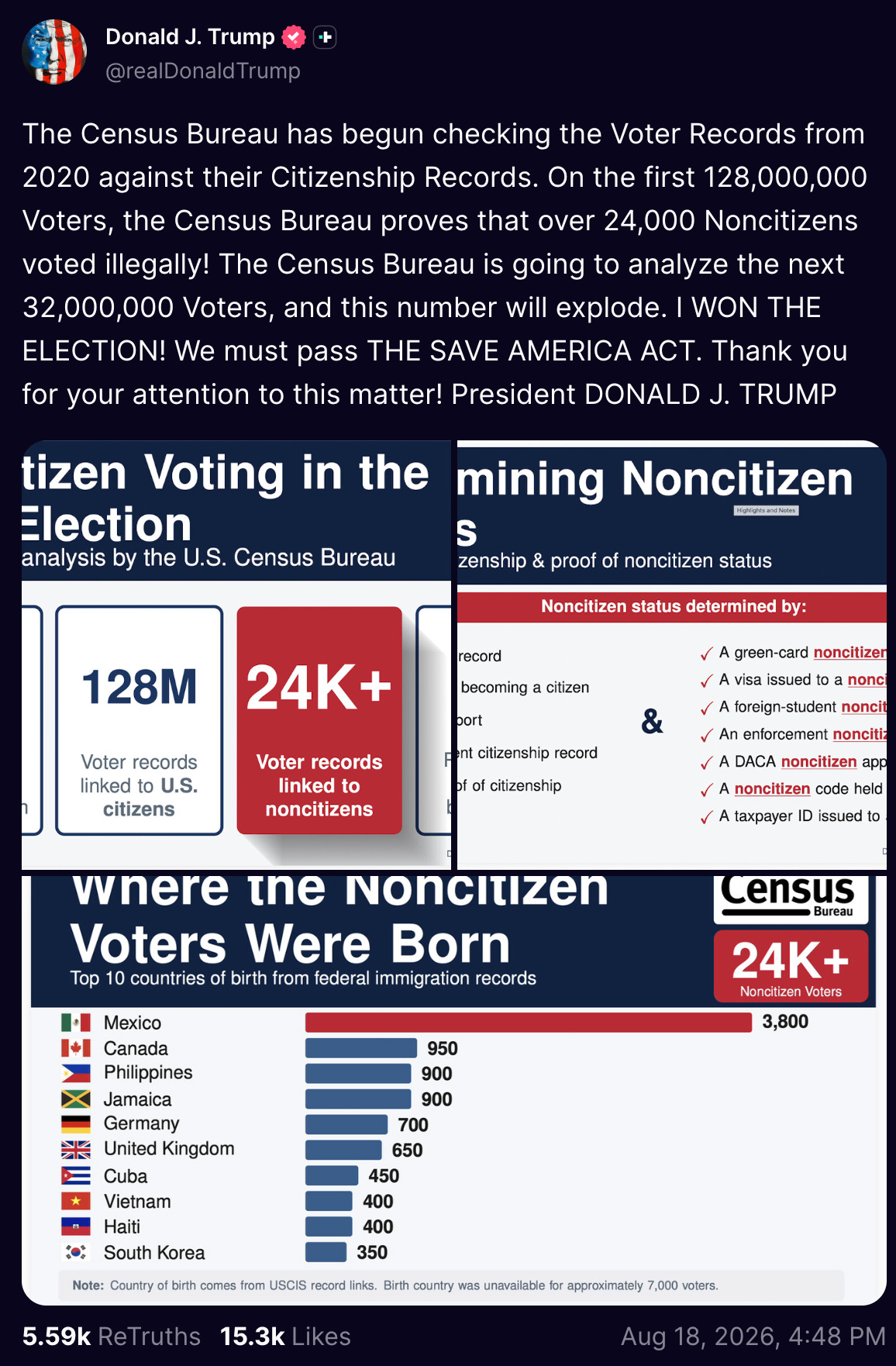
The methodology of the Census Bureau’s analysis is essentially a large-scale record-matching exercise. The analysis begins with a commercial voter file that compiles state voter registration records and vote history data and attempts to link those records to federal data using the Census Bureau’s Person Identification Validation System.1 A voter enters the analysis’’s potential noncitizen pool if they can be linked to a federal record indicating noncitizen status, such as an immigration record, a visa record, an Immigration and Customs Enforcement (ICE) record, a Deferred Action for Childhood Arrivals (DACA) record, or Social Security and Individual Taxpayer Identification Number (ITIN) records.
The Census Bureau then runs those individuals through a citizenship screening, looking for evidence such as a naturalization oath, a birth record, a passport, or other indicators of citizenship. Anyone for whom the system finds such evidence is removed from the pool; anyone with an affirmative noncitizen record but no citizenship evidence sufficient to establish citizenship by November 3, 2020, is classified as a noncitizen voter.
The analysis claims that 24,000 noncitizens voted in the 2020 presidential election. All the numbers in each state are round numbers. Of course, I don’t consider the numbers accurate due to potential data issues. At the very least, I would say that further exploration is necessary to confirm whether these individuals are noncitizens.
The other thing that stands out is that, if you believe these data are accurate, roughly 0.02 percent of the 128 million voters analyzed were noncitizens. Granted, the analysis is incomplete. The Census Bureau says that “[o]ver 32 million voter records remain to be analyzed.” The number of claimed noncitizens may increase as more voter records are reviewed.
Here’s the thing. The report doesn’t necessarily establish that each of these people was a noncitizen on Election Day in 2020 through a record of their citizenship status. Rather, it builds a pool of potential noncitizens from federal administrative records and applies the assumption that a person appearing in one of those noncitizen sources is treated as a noncitizen at the time of the 2020 election unless the government’s records contain evidence establishing citizenship by then.
To its credit, the analysis doesn’t simply count everyone who ever appeared in an immigration database as a noncitizen voter. It runs those records through a citizenship screen, looking for naturalization records, evidence of U.S. birth, passports, and other citizenship indicators. That screen appears to do real work. The report says approximately 63,800 people who had previously been green card holders but naturalized before the election were identified and excluded from the noncitizen count. It even gives voters the benefit of the doubt when it finds certain citizenship indicators that cannot be dated relative to the election, clearing those people rather than counting them as noncitizens.
Still, that leaves an important methodological question unanswered. For the remaining 24,000 records, the conclusion depends not only on finding evidence that the person was once a noncitizen, but also on the government’s administrative records being sufficiently complete and accurately linked to determine whether that person had become a citizen by Election Day in 2020. The report says that a person with an affirmative noncitizen record and no citizenship evidence that rebuts it is counted as a noncitizen voter. The report doesn’t provide an estimated false classification rate for that process. How often could citizenship evidence be missing from the administrative records? How often could records be incorrectly linked? How often could the methodology therefore classify an eligible citizen as a noncitizen? Those are really important questions when the headline finding is only about 24,000 records out of more than 128 million examined. Without quantifying those sources of error, the analysis cannot tell us how much confidence to place in a finding representing roughly 0.02 percent of the records analyzed.
The uncertainty is exactly why the Census Bureau needs to show far more of its work.2 Instead, we get a seven-page report that repeatedly describes its matches as “high confidence” without providing the information needed to understand what that means in practice. The report doesn’t identify its authors, estimate the false-positive rate, put a range of uncertainty around the 24,000 figure, or tell us how many of the voter records were matched using a verified Social Security number rather than combinations of names, dates of birth, sex, and addresses.
The methodology indicates that the Census Bureau’s matching system can use all of those identifiers and assigns a person a key only after a match meets a certain threshold, but it never reports the error rate for the matches used in this analysis. None of this proves that the 24,000 figure is wrong. However, it does mean the report hasn’t provided the public with enough information to determine how reliable that figure actually is. At that scale, the absence of basic error estimates is not a technical omission but a substantive failure of transparency, especially given how quickly the figure has been repurposed in public claims about the election.
If federal records identify people who appear to have been noncitizens when they voted in 2020, election officials should examine those cases and determine what actually happened. If some of them turn out to have voted illegally, enforce the law. That’s a very different thing from taking the output of a massive record-matching exercise, slapping the label “noncitizen voters” on 24,000 records, and treating the result as established fact before the underlying cases have been verified.
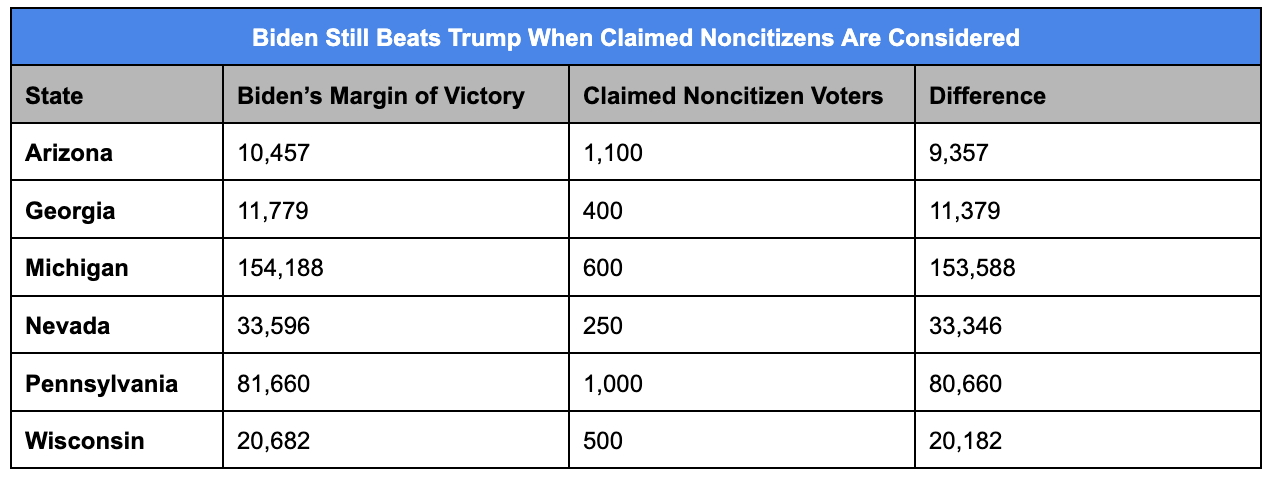
Even if every one of those 24,000 cases eventually checks out, the analysis still doesn’t prove what Trump says it proves. It doesn’t tell us who those voters supported, and the numbers identified so far aren’t remotely large enough to erase Biden’s margin in any of the six battleground states that Trump lost. Trump’s claim that this somehow proves he won the 2020 election simply doesn’t follow from the Census Bureau’s own numbers.
That’s what makes this episode so troubling. The Census Bureau is supposed to produce data the public can trust, not provide statistical ammunition for a president still trying to rewrite an election he lost. If the administration wants the public to take this analysis seriously, then release the researchers’ names, explain the role outside organizations played, publish the information necessary to evaluate the error rates, and allow qualified researchers to scrutinize the methodology. Until then, there’s no verdict here. What the Census Bureau has published is the output of an incomplete analysis with important unanswered questions, and it sure as hell isn’t proof that Donald Trump won the 2020 election.
The commercial data file used was produced by DataClear. I’m familiar with other companies that compile and sell voter data, but I’ve never heard of this one.
There are also questions about who actually produced this analysis. NPR reported that the work wasn’t done by the Census Bureau’s career civil servants and that people affiliated with an ideological organization with ties to the Trump administration were involved. That doesn’t mean the findings are automatically wrong, but it does make the lack of transparency around the report harder to ignore. If an ideological organization with ties to the Trump administration helped produce the analysis, we should know who they were, what they did, and how much influence they had over the methodology and conclusions. Those are reasonable questions when the Census Bureau is putting its name on an anonymous report about the election Trump still falsely insists he won and immediately pointing to that report as evidence that he was right all along.
No posts
Comments
Nothing yet. Say the first thing.
Sign in to join the conversation.