
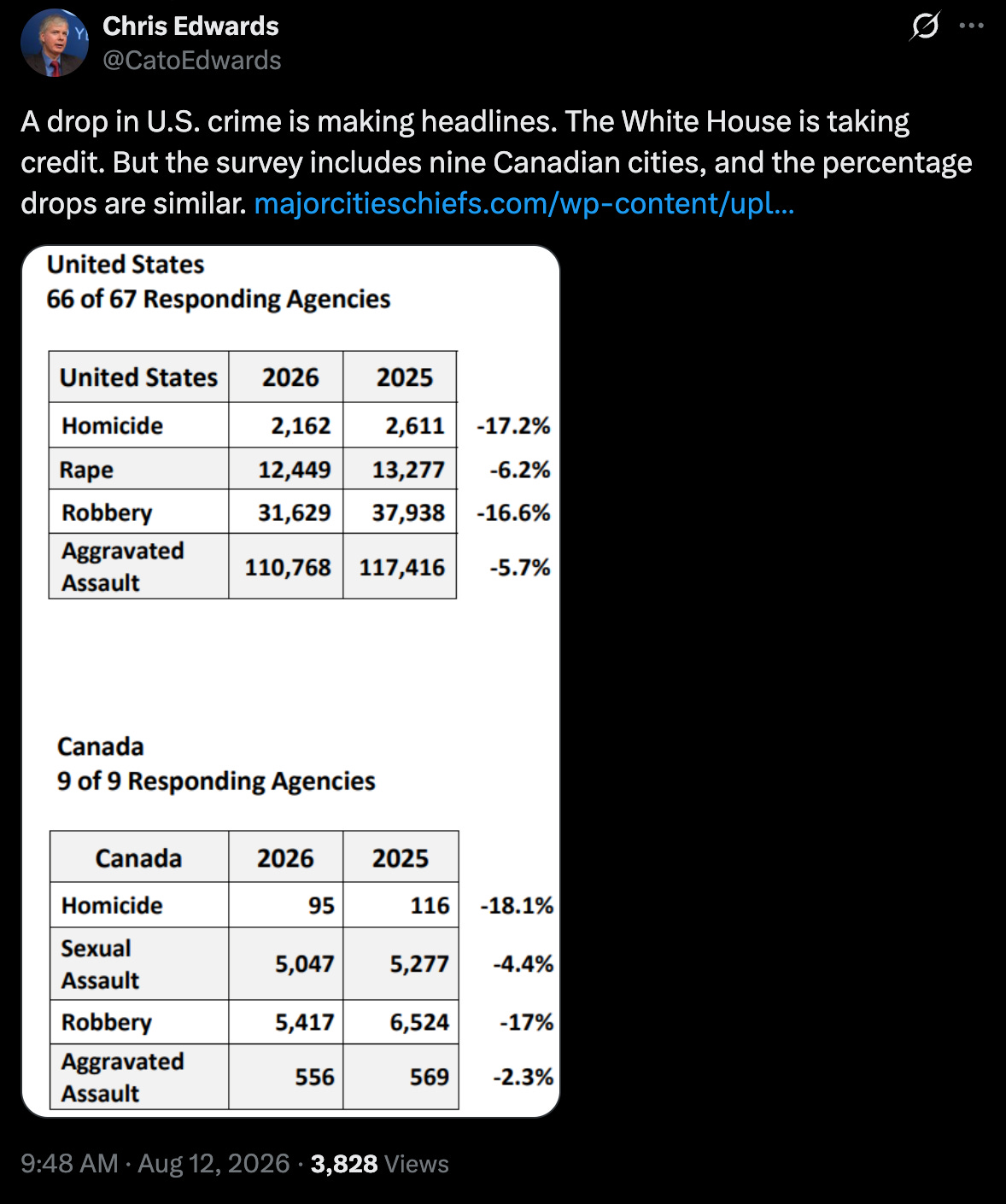
After publishing my response to Richard Hanania on automated license plate readers (ALPRs), I noticed that Chris Edwards of the Cato Institute tweeted data showing that the drop in crime in Canada is similar to what we’ve seen in the United States. As the tweet shows, the data come from the Major Cities Chiefs Association (MCCA) and indicate substantial decreases in violent crime in both the United States and Canada in the first six months of 2026 compared to the same period in 2025.
MCCA is the only nongovernmental organization whose data I use to look at crime across the country. Granted, the Federal Bureau of Investigation’s Crime Data Explorer is still my main source. The MCCA data are useful for this purpose because they are available back to 2014, allowing us to compare recent years.
As you can see, the trends in violent crime haven’t always been uniform, but there are similarities in the data. The biggest divergence comes during the first two years of the pandemic. Across the nine Canadian jurisdictions, violent crime fell roughly 27 percent in 2020, compared with an increase of almost 9 percent in the United States. The following year, the pattern changed dramatically. Violent crime increased by 27 percent in the nine Canadian jurisdictions and by another 9 percent in the United States. At least among the major cities represented in the MCCA data, Canada’s experience during the COVID-19 pandemic was markedly different from that of the United States.
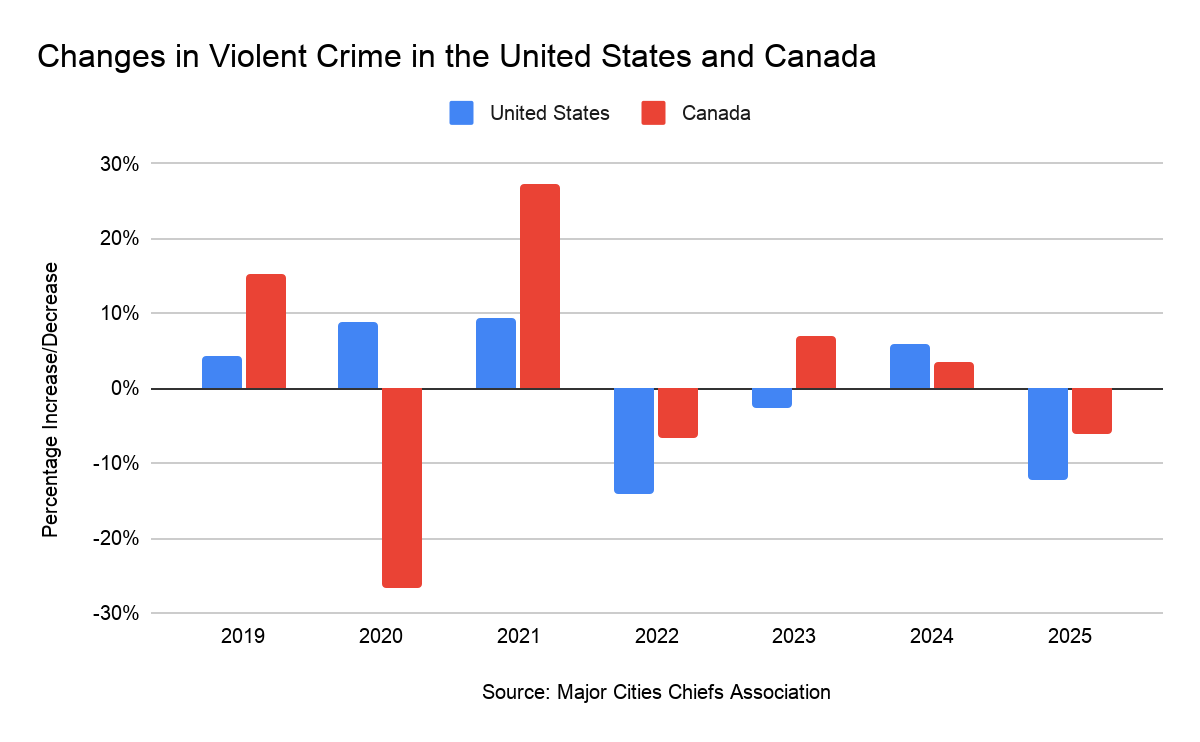
Did Canada’s more extensive disruption of ordinary social activity suppress opportunities for violent crime in 2020, with some of that crime returning as restrictions eased? The data are consistent with that possibility. Across the Canadian jurisdictions in the MCCA data, homicide, rape, and aggravated assault all increased in 2021 after violent crime fell sharply the previous year. That doesn’t prove that lockdowns caused the decline or reopening caused the subsequent increase, but it does suggest that changes in opportunities for interpersonal violence were probably part of the story.
You’re probably wondering where I’m going with this. Like the United States, law enforcement in Canada uses ALPRs. Use of the technology isn’t as pervasive as it is in the United States. Users on Panopti.ca have identified roughly 600 ALPRs across Canada. Most of those are in Ontario, its largest province. Most of the ALPRs in Canada are from RTX Corporation and Genetec. Flock has only 44.
Hanania’s argument isn’t simply that ALPRs are useful to police or that they can help solve crimes. His thesis is much broader. He says that Flock’s rapid expansion is an important part of the explanation for the remarkable decline in crime in the United States. Canada gives us an opportunity to test that theory against a country that looks very different on this particular variable but shares many of the characteristics that matter when comparing crime trends, including similar demographics, high levels of economic development and urbanization, stable institutions, and modern law enforcement.
Canadian law enforcement uses ALPRs, but with a significantly smaller footprint. Yet, violent crime in major Canadian cities has been falling, too. If Flock were a major driver of the American decline, we should expect to see some meaningful divergence between places saturated with its cameras and places that largely aren’t. Instead, Canada appears to be experiencing much the same broader trend.
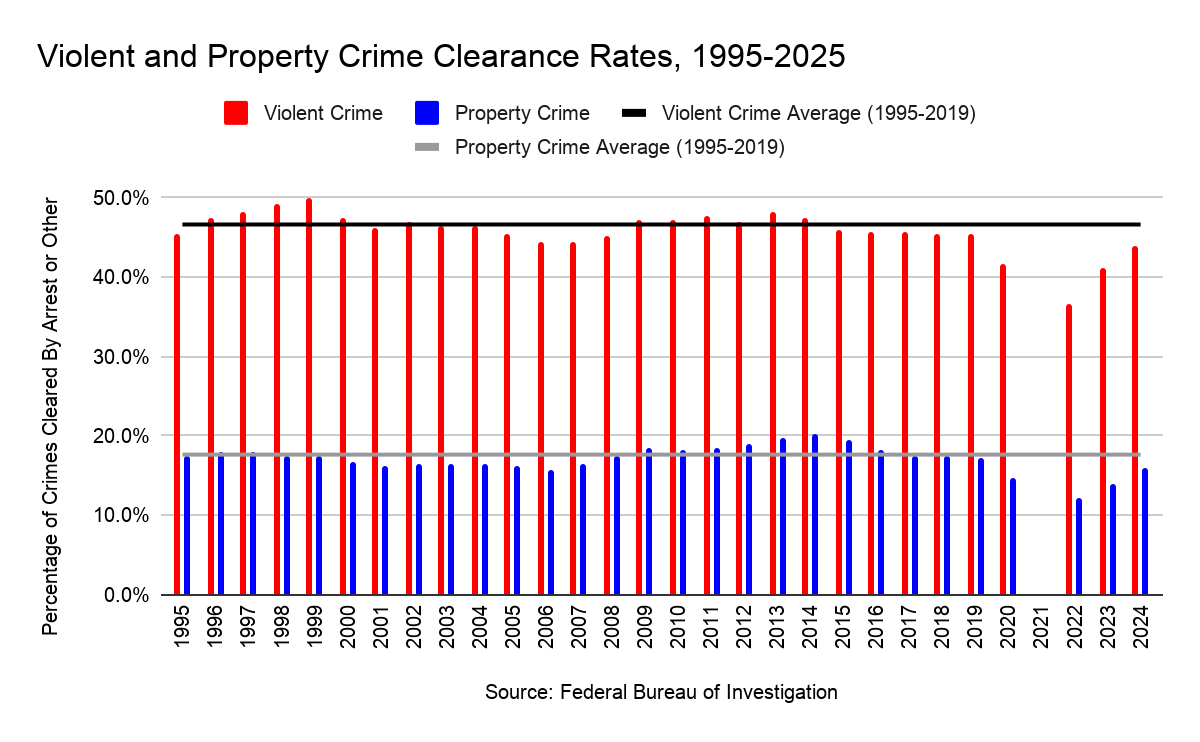
Again, I’m not saying that ALPRs haven’t had some effect on crime or that they’re not useful in solving crime. I do question Flock’s claim that 700,000 crimes have been solved using its technology or that it has “helped solve north of a million crimes last year,” as Flock’s founder and CEO claimed on CNN earlier today. Those claims are difficult to independently verify, and the national clearance data don’t show anything resembling a revolution in the ability of law enforcement to solve crimes. Clearance rates for violent and property crime remain below their average levels from 1995 through 2019. They have improved each year since 2022, which is worth acknowledging, but they still haven’t returned to pre-pandemic levels.
That brings me back to my original point. Hanania’s thesis—that “Flock cameras likely explain the recent crime collapse”—just doesn’t hold up under examination. That doesn’t mean Flock and other ALPRs have had no effect on crime. They may have, and they unquestionably give police another investigative tool. We simply don’t have evidence showing that their effect is large enough to explain the historic decline we’re seeing.
To make that case, we would need to know much more about the timing and scale of Flock’s expansion, such as when cameras came online, when agencies began using them regularly, how adoption varied across jurisdictions, and whether places that adopted Flock earlier or more extensively subsequently experienced larger declines in crime than comparable places that did not. In other words, it isn’t enough to show that Flock expanded while crime fell. The timing and geographic differences in adoption should produce patterns in the crime data consistent with the effect Hanania is claiming.
Canada makes that explanation even harder to sustain. Major Canadian cities are experiencing a similar decline despite having nothing remotely comparable to the United States’ enormous Flock network. The better explanation may be much broader. Both countries experienced extraordinary disruptions during the pandemic, both saw unusual changes in crime, and both are now experiencing substantial declines as those conditions have receded.
No posts
Comments
Nothing yet. Say the first thing.
Sign in to join the conversation.