
There has been a lot of concert discourse lately, and since I already commented on the state of undersold tours two years ago—before someone coined the catchy clickbait term ‘blue dot fever’, but not before it was a noticeable occurrence—I haven’t really weighed in.
What I wrote in that piece still applies, the only thing worth keeping in mind in today’s news cycle where high profile tours were canceling is that the financial incentive structure for touring artists is more complicated than simply wanting to perform for fans. Arena shows and up for the last few years have mostly not sold out. And also: the lack of midsize venues is a big contributor to arena shows regularly having empty seats. Locally, there’s a jump from 3k sheds to 10k and over. That’s a big, big leap for artists that have fewer avenues to advertise themselves and finding not listeners, but live music enjoyers who would be fans.
On the audience side, the biggest reason for acts underselling is economical, plain and simple. Some of these touring acts charge astronomical fees—more of them aren’t even touring anymore, externalizing the cost of travel and lodging and vacation time to their audience. And even if they do tour and their shows are technically affordable, individual circumstances change.
I went to 22 concerts last year, but this year I’m mostly sitting out. I’m certain I’m not the only usually avid concert-goer in this situation whose circumstances have changed.
I attended my second concert of the year a few weeks ago. One of my oldest and dearest friends, Nicole, was visiting. She’s an amazingly talented singer and has been referenced on this Substack before, borrowing her knowledge of the live music space. On her first day here, we went to see Brigitte Calls Me Baby.
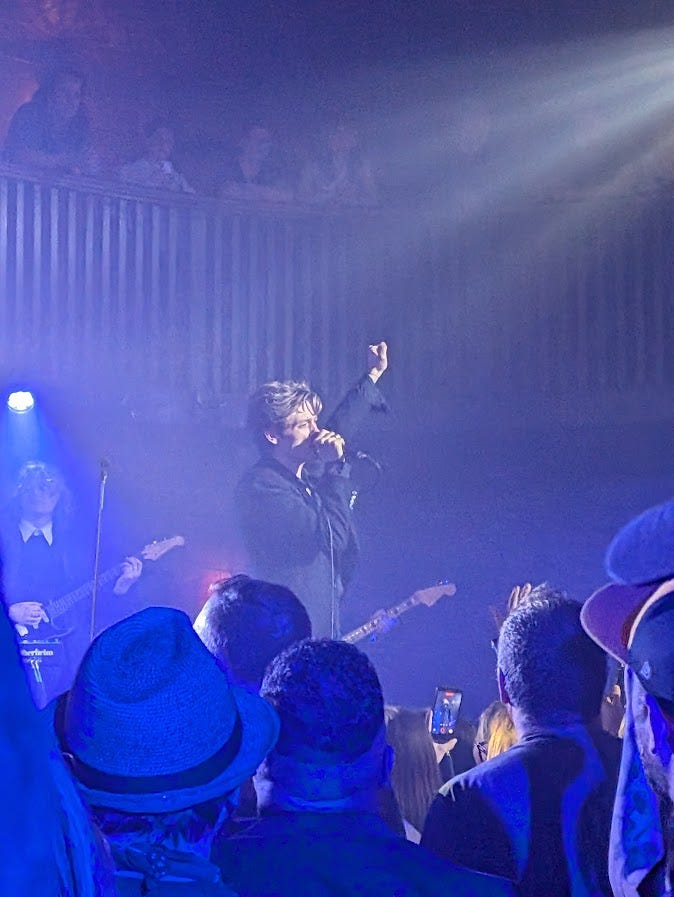
The show was solid, and Wes Leavins’ vocals were beyond impressive, though his theatrics reminded me a bit too much of his Elvis impersonator past, which took me out of it slightly. But it’s also entirely on brand for their sound. That posturing grandiosity suits it.
The show was sold out, and what we both noticed immediately was how “old” the audience was. Our age and above, really, with the occasional pocket of youngins.
One of the reasons for this might be that while the band is new, they harken back to Britpop and The Smiths—they even opened for Morrissey at some point. Those jangly tunes will be catnip for certain generations, and sure, I include myself in that. I’m not above nostalgia bait.
There also wasn’t a lot of phones or bad behaviour. I don’t think this is a generational issue so much as what type of concert goers were in attendance. The online cohort, if that’s what we want to call them, seem to have a different approach than the traditional concert goer.
It gets forgotten that “concert goers” or “live music enjoyers” are a specific subset of fans that certainly can overlap with online fannish activities and streaming, but certainly not always. Even people who stream heavily—which I don’t—may not be concert goers, and conflating those online statistics with a thriving audience chomping at the bit to see you live is a serious error.

There’s been a failure to acknowledge this. The data is out there about how going viral doesn’t increase attendance to shows, and the ones who do get audiences from TikTok have complained about it because the result is not an engaged live audience. Yet many artists are outright putting out what I call TikTok bait, songs that can easily be clipped and work in thirty second segments. These clips can take off, but they don’t come with music fandom built in. And the people that do go to shows based on one hook are not there for the same reasons as the live music enjoyer. Not everyone, of course, but at this point it’s an observable phenomenon.
Then there’s the people that go because of fandom. There is a difference between being fans of the music itself and the people that make it. There are plenty of people attending shows these days that are there primarily for the people themselves rather than any performance of the music. It’s why some acts can get away with charging exorbitant fees, especially in presale to their most dedicated fans. There’s an emotional drive to be present at these shows, wherein performance is secondary. They might not be disruptive (until we get to the barking…), but their intentions and drives are also different, which is worth looking at. These are the fans that are seen as wallets to empty because there’s an emotional drive to attend these shows, the FOMO is real, the attachment and emotional fulfillment of seeing someone you love live will make you more willing to overspend.
And the industry knows this. They were celebrating a “historic golden age” in 2023, despite the fact that only 3 tours cornered almost 22% of the gross of the top 100 tours. But hey, the average tour gross had also gone up that year! And we know the Live Nation and AEG executives have been very vocal that prices should continue to go up. Rick Mueller said, “I still haven’t seen a threshold where somebody won’t buy front row seats. So let’s get more out of that front row or best ten percent of the house.”
But what are fans paying for? And do they know? Because the expectations of paying a high fee, to see a widely lauded artist, still have to be delivered. And when an artist can’t live up to it for casual fans who feel robbed, the stans try to defend it, saying it’s exactly what they wanted. As a Harry Styles fan said when trying to combat the widespread criticism he’s facing for his current residency performances, “don’t go to [H]arry if you expect visuals, dancers and fireworks, you gotta go for vibes and comedy.”
To be fair, Styles was always like that, and we can blame the One Direction shows for training a cohort of fans to spend a ton of money to attend the music version of a boy aquarium. Their shows did have fireworks, at least, but over the years, they morphed from fairly choreographed sets to water fights on stage and mic-ed bathroom breaks.
Their Twitter Q&As remained a regular feature until their final tour, and these were also a way to interact with fans in a controlled manner, and it’s a spectacle for the fans that are there and whose question is asked.
These served as an interactive performance with the audience that was there, and an almost promise of surveillance. But the performances themselves came down to observing how they interacted with one another, and yes, that experience of being live, “in the same room.” So many videos exist and so many gif sets of interactions between them and the audience, each second loaded with meaning that can be analyzed, frozen in time and referenced as lore indefinitely. To outsiders, though, what a bizarre meaningless thing to experience, and considering the cost of tickets, it was insulting.
Bianca Tomori wrote an excellent post-mortem on her Harrie fandom, recounting specifically the banana eating Styles was prone to do while the others sang, “The banana was a microcosm of the effort being withheld from a show of that scale.”
This type of show carries the vibe of a large scale meet and greet. I’m not the first to use that term, and it seems an accurate description of how a certain subset of audience members seem to approach concerts. The point is to exist in the same space as your fan object and if you’re really lucky you’ll have an interaction with them. The music is secondary.
This is something that has come up on two podcasts recently. I was recommended Kate Lindsay’s Slate Podcast, ICYMI, specifically the episode on “blue dot fever.” Overall, they do a good enough job of contextualizing the issue. But at one point, Lindsay asks what the value of a concert is, because, “I can pay a bunch of money to be really far away from you in a room or I can follow your Instagram stories,” suggesting that social media has replaced the concert experience. But it also suggests the concert experience was never really about live music in the first place, as while describing pre-social media concerts, Lindsay says they were “a chance to be in the same room as an artist and feel like you’re closer with them.”
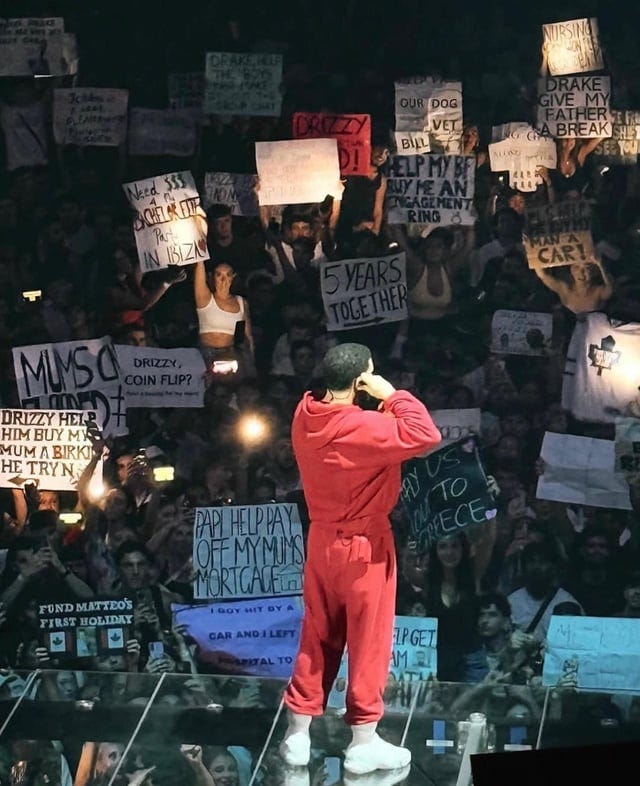
I can’t relate to this comment at all, and I’m someone who has travelled for concerts multiple times! I’ve been active in music fandom for decades! But despite my fannish bent, I’m primarily a live music enjoyer, not a meet and greet fan. I don’t follow most of the acts I’ve seen, and plan on continuing to see, on social media so it’s not an either/or proposition for me. I don’t care about most of their social media. But it would be naive of me to pretend that my approach is the majority, especially when everything online and the reality of concert experiences these days suggest otherwise. For many, it really is about paying a premium for a “vibe” and for how the experienced can be packaged in a personal narrative.
This is something that was pointed out in Money 4 Nothing’s episode on the Chaotic Good moment, when addressing the way existence online has shaped the drive behind concert attendance. Sam Backer explaining, “part of what you’re paying for now is the opportunity to put on your socials—which is how everyone does this—that you saw the show. That you were there.”
Backer also brought up that Bob Dylan has been setting up anti-photography measures that frustrated attendees that wanted the “proof” in the form of a picture or video. Some documentation to show that they had been in the same room as Dylan. Rolling Stone described his approaches as, “extreme measures — including a hoodie, bright lights, a grand piano, and a raised music stand — to deter fans from taking photos,” when cameras couldn’t outright be banned.
Then there’s the artists that seek out to create viral moments beyond the songs, in order to drive interest in the shows and reminding fans of what they’re missing out on by not spending big. Kiara wrote a great analysis of recent concert gimmicks, and pointed out that many artists have “concert gimmicks carefully crafted to guarantee virality with every show.” Stay in the conversation, and even if your shows don’t sell out, you look more “relevant” than you are. Keep people talking. Control the narrative, etc etc.
If you add the experience to one of fandom, specifically, where attendance can confer status within a social circle, the bar is even higher. These gimmicks help to shape the future attendee’s expectations. Cultural capital can be obtained based on how many times you’ve seen your fave, even better if you’ve captured an iconic on stage interaction, even better if you were part of that interaction. In the past, this could be accomplished by selling meet and greet opportunities, but COVID seems to have done away with that.
Instead, superfans are offered VIP tickets that come with no actual perks, no meet and greet, no soundcheck, but early entry so you can spend more money in the venue. And the artist gets to get rid of expired and outdated junk as swag to justify the price. It’s one of the most diabolical methods of value extraction where nothing is provided in exchange other than an identity marker/the status that VIP entails. It’s a word that’s so romanticized that getting dried up nail polish and a lanyard memorializing the occasion is desirable.
Again: meet and greet atmosphere.
And it’s because they can only extract more from the superfans with attachment and emotional investment that they crank up the price. Casual fans won’t put up with that. This increased spending on tickets breeds more entitled customers. So much discourse and complaints about bad concert audiences seem to harken to entitled attendees, but the biggest proof is in the rise of barking at concerts, and it’s absolutely part of an expression that will continue to grow. Especially the more people are asked to spend.
And sometimes you get burned. I paid way too much to see My Chemical Romance on their reunion tour, and the show was subpar. When they returned for an anniversary stadium tour last year, I couldn’t justify spending more money on them. Even though this time around, the performance seemed fantastic and well worth the price tag. It was simply too late.
There are different expectations that surround concerts, but also just what people want. The problem comes when different metrics are being used, and conflating the behaviour of one group with another. Some people can’t imagine the value in a concert in anything smaller than an arena. Those audiences operate on whims and vibes. While many complain about phones being out, I don’t actually mind the people who want to document things or livestream, because there often is a cohort online that feasts on this content—to a degree, this can be pro-social and enriching the fandom. But whenever the discussion about people being priced out of concerts comes up, I’m reminded of how differently so many people approach shows. At the very least, I’d like to avoid the barking entirely, and I’m concerned for the day it catches up with me.
Comments
Nothing yet. Say the first thing.
Sign in to join the conversation.