
Every #MeToo story takes me closer to a place where I realize that I need to completely reconsider how I look at art and artists. I’m not interested in rehashing the ‘should we separate art from the artist’ debate. My answer to that has always been no, you cannot separate the two. Artists are their art and vice versa. What I’m concerned with is a shift in the way we view artists and the status we grant because of their art. There must be a way to create a system that allows us to celebrate art and recognize it as a personal product of the artist’s labor, while understanding the elements of the artist’s personality that played into the parts of their identity that made the art, and the parts that made terrible decisions that hurt people and destroyed their lives. Sometimes they’re one and the same, and sometimes a world of nuance lives therein. Stupid nuance always complicating everything.
I watched HBO’s Allen V Farrow a couple of days ago, and I suppose I’m trying to reconcile what I watched (and what we all knew) with the reality of what Dylan Farrow went through for years and years as we continued to praise celebrities like Allen and their artistic genuins. But this isn’t a celebrity story, this is a sex abuse story. We are treating it like it’s a celebrity story, which means it’s now a spectacle, a show, and we feel qualified to pass judgment and give an opinion about whether “we like it or not”.
Allen v Farrow was a necessary and important shift in focus of the coverage of allegations against Allen. For years, and it came as no surprise, we’ve been hearing that Allen has been accused of sexually assaulting his daughter when she was 7 years old. But when stories emerge about a man who has the Hollywood PR machine at his disposal, anyone who works in PR can tell you that the only thing standing between you and the version of the story that you want to be salient is how good you are at PR.
This is the machine that changes the story’s narrative from one about child sexual abuse to one about ‘a celebrity’. And celebrity stories are traditionally engulfed in exaggeration, hyperbole and gossip. It’s important to understand these elements and to reflect on how they may have affected our reading of the events, and to an extent, which version of the narrative we believe. These stories benefit from the layer of celebrity ambiguity that surrounds high profile cases. If the damage caused by cancel-culture is great and irrevocable, it’s because the stakes of belief are extremely high.
I’m wondering if these victims deserve more than just occasional disruption to our media consumption. We get outraged and hold a sign or post something on social media, then we boycott the work for a bit, and before you know it you’re clicking on House Of Cards episode on Netflix because you remembered that you actually never finished the last few episodes and it’s been a minute since the whole Kevin Spacey thing and it’s lockdown so…
The scale of the problem is laughable. Perhaps one that merits a reevaluation of how we hold and view entertainment, and the power we have over it. The simple uncomfortable fact is that if we don’t consume it, entertainment won’t exist. On this formulaic level, it’s that simple. It is worth taking a second and thinking about our role and the power we have in that regard.
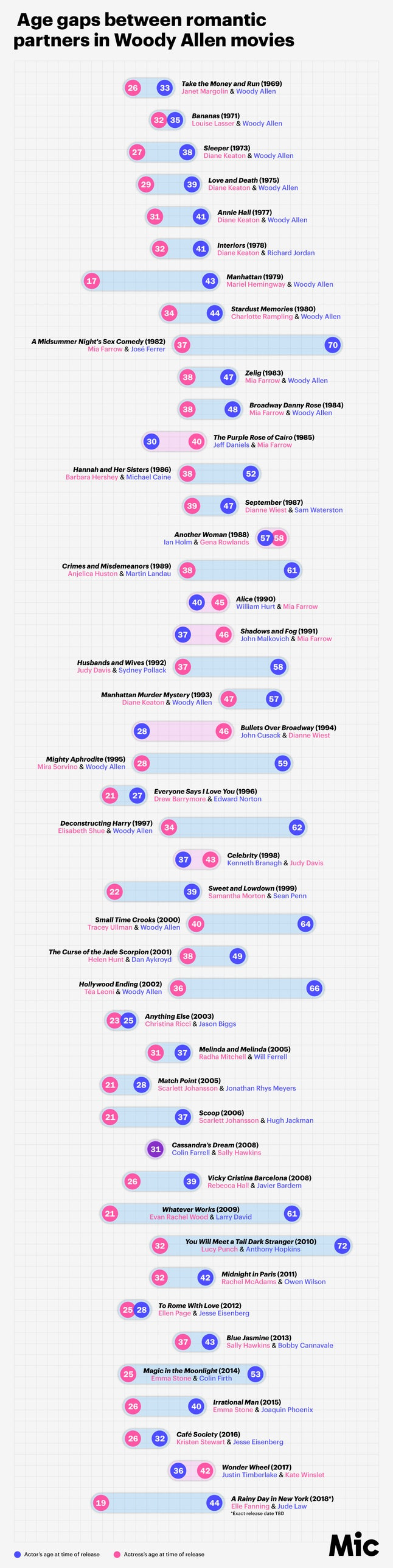
In Manhattan (1979), Woody Allen played a 42-year old man who is dating a 17 year-old girl. In A Rainy Day In New York (2018), Jude Law’s character is 44 and his romantic partner is 19. In You Will Meet a Tall Dark Stranger (2010), Anthony Hopkin’s character is 72 and his romantic partner is 32.
As Woody Allen’s male lead ages, his romantic partner often fails to age with him.
Enjoy this age gap chart:
[Chart copyright: Bustle Digital Group - Mic]
Why Can't I Stop Staring at My Own Face on Zoom? and what the post-lockdown world is going to be after having spent a year looking at my face on every Zoom call I’ve had. This quote got me:
“The technological “powers” of our age have, by and large, given us the inverse capacity: to make others see us as we see ourselves.”
*shudders*
The curious case of Estonia’s digital superiority and how in the meantime global superpowers like the US still has websites like this functioning with archaic last century technology. Apparently it cost $181m to build, host and maintain sam[dot]gov? Something I will never believe no matter how many credible sources try to prove it to me.
This podcast on the making of Facebook’s Supreme Court that just made me realize that the next tyrannical government none of us will be able to topple will be Facebook. The platform is now already more powerful than most governments and countries on earth.
That’s it for today. There will be more structure. There will be more substance. This will get better.
For now, I’ll leave you with this (all three of you who subscribed to this first issue): some of us may still be in lockdown, but the world is no less noisy. Here’s some peace and tranquility.
No posts
Comments
Nothing yet. Say the first thing.
Sign in to join the conversation.