
Hello! This is Everything Is Amazing, a science newsletter written by a guy who tried to see a once-in-a-lifetime eclipse, but unfortunately picked the wrong sky to do it under:
Physicist Alastair Williams had a much better view from near Zaragoza in Spain…
…while this shot by photographer Albert Dros in Menorca is absolute madness.
And honestly, how astonishing it is that we get to see this. How remarkable that our Moon - about 400 times smaller than our Sun, but by fantastic coincidence positioned around 1/400th the distance from here to the Sun - can be so perfectly covered from our vantage-point as to create the near-miracle that is a perfect occultation, allowing everyone in the right place on Earth to see with their unassisted eye, just for a few minutes, both the storms raging on the surface of our nearest star, and also the flash of sunlight momentarily beaming through the ragged mountains on the Moon.
Ours is the only rocky world where we know this can happens. What a gift.
Okay! Today I have a confession and a slight course-change to make, plus a dizzying new journey we can go on.
But first - a new home for an old thing.

Learning how to write this newsletter has been one endless series of experiments. I figured quite early on that if I was writing about the power of curiosity, I’d better bake that philosophy into the way I assemble this project.
This has meant working in seasons, where I pick a broad scientific topic I’ve always wanted to know more about, and then I enthusiastically but semi-cluelessly launch myself into it, in the hope you’d find the results interesting and entertaining enough to keep reading.
One of the earliest experiments was running challenges alongside these seasons, designed to help you stop reading my damn-fool nonsense, stride out your front door and go discover something that teaches you how unexpectedly amazing your everyday would can be.
(This was based on the success of my very first paid newsletter experiment, a thing called You’re So Not Bored, which ran for a few months and took off in a way I never expected.)
Only problem being: my audience was tiny back then. Just a couple of hundred folk, wondering where all this was going.
Now there’s 32,000 of us wondering where it’s going! (Gulp.) So now feels like a good time to have another go at these challenges - and I’m going to use Substack’s Chat function to do it, which can now be accessed via Substack’s website, not just the app.
The first one is here.
Totally optional, but if you’re at a loose end and like the sound of any of these, give them a go (and maybe leave a comment telling everyone how it went)!
Next up - well, okay, this bit is rather embarrassing.
Late last year I announced that accompanying our ongoing look at the very real benefits of being surrounded by what we think of as ‘nature’ (along with an upcoming, overdue return to looking at this book), here in this eighth season of Everything Is Amazing I’d also be doing what I did in previous seasons: running a smaller paid-supporter-only “mini-season” on a particular theme.
(We’ve previously looked at human memory and the way ancient geology affects modern human behaviour.)
This time, jumping off from everything I learned writing the piece below, which I’ve now made free to read…
Season 6
Why It Might Not Sink In Until You've Written It Down
·
February 18, 2024
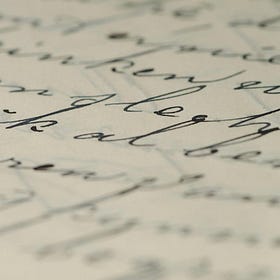
"In terms of what your hands are doing, there is a huge difference between typing a word and writing it. When you type, it’s much the same action happening - there is a bit of variation with what hand you use to hit which key, there’s a little pivoting of your arms or wrists as they move over the keyboard, but that’s about it. And tablets & smartphones? You can be hardly moving at all, frozen in place apart from a couple of your fingers doing all the work - and, perhaps more importantly, you're using those fingers in the same way for each letter you type.
Most of us can type much faster than we can write because we’re moving our bodies much less. But it seems the cost of that is we’re shortcutting our body’s role in helping us think and remember what we’re typing."
…I’d be looking at what science says reading and writing using paper can do for our minds, and how the rise of electronic reading is tinkering with our ability to comprehend, to think and to imagine.
It began here, with this edition about the far future of human information storage…
Something To Pass On
·
Feb 26
This is a three-inch disc of nickel, mounted beneath a protective glass hemisphere. On one side, the side facing us in this picture, are words in eight languages of the world, spiralling inwards to encourage you to look closer.
In each language, the text says:
“Languages of the World: This is an archive of over 1,500 human languages assembled in the year 02008 C.E. Magnify 1,000 times to find over 13,000 pages of language documentation."
..and then - well, I got stuck.
My idea for this bookish miniseries was something much closer to reportage than I’ve done before. I’m in a wood-harvesting and paper-producing part of Scotland, so surely I’d have people I could talk to, places I could visit, questions I could ask using my actual face for a change?
Alas, it turned out that key people were largely unavailable, the places I wanted to visit weren’t taking visitors right now - and it became clear that this story I wanted to dig up in person would take me longer to unearth than I’d planned for, so I couldn’t yet deliver what I’d promised to you.
Ghagh.
So - I’m pushing it back a little (it’s still coming your way, just not yet), and putting something else in its place.
Please watch this short but absolutely enthralling film to find out where we’re going instead.
It’s a film adaptation of the book Cosmic View: The Universe in 40 Jumps, written by the late Dutch reform educator Kees Boeke in 1956. You can read an online edition of that here.
But these days, it’s Powers Of Ten (1977) that everyone remembers. You’ve probably seen it before, or something like it, since it spawned a thousand copycats and has become part of the modern filmmaker’s visual vocabulary with the “epic map zoom” - as well as being, in the words of Professor Brian Cox, “one of the most elegant and creative pieces of science communication of modern times.”
But it’s no longer 1956, or even 1977. We’re nearly 50 years into the future here, and in that time, scientists of all kinds have massively expanded our awareness of what’s in both directions, from the near-impossibly big to the near-unimaginably small.
When the film stops at the 100 million light year point, centred on the Virgo Supercluster, even an amateur enthusiast like me knows we’ve now found far larger (and far odder) structures in the universe.
This is also true when we zoom into a carbon nucleus at the end of the film. We now have a good idea what’s beyond those protons and neutrons - even though it’s smaller than the resolution of any measuring instrument in existence, and may be so small that it could convincingly be said to have no size at all. (!)
(And yet there’s still the possibility it’s hiding an even more fundamental layer of matter - about which there have been suggested some very strange ideas indeed.)
All this feels like a fascinating romp to take towards the known logarithmic limits of our universe. So that’s what we’re doing, across a new 6-part series for paid subscribers, starting next week.
I can’t wait to see where it takes us.
If you’d be interested in reading this new series and you’re currently a free subscriber, I’d really love to welcome you onboard as an Everything Is Amazing insider - helping me keep this project running, and getting absolutely everything I write and publish around it.
To that effect: just for the next few days, until the end of Monday (17th August), a yearly or monthly paid subscription to EiA is discounted by a third, for as long as you want to remain a supporter.
It’d honestly mean the world to me if you considered helping me keep growing this project - and in return, I promise to do my best to give you great science stories that fill you with 🤯, and try to make you a little more hopeful for our world and where it’s going.
Click the button below to check out the options:
Cheers,
Mike
Comments
Nothing yet. Say the first thing.
Sign in to join the conversation.