
Hello! This is Everything Is Amazing, a newsletter that allows me to ask unlikely questions like “what if we flip our maps around when we cross the equator?” and “what if architecture was invisible? and “what if we could breathe through our rectums?”
(I’d love to blame science, but let’s face it, I’m the one choosing what I write about.)
It’s been over a week since I last sent something your way (below) - and on reflection, after receiving a concerned message from a reader, I realise that ending my last newsletter with a dramatic walk into the Scottish sea and then going silent…well, that might have conveyed a slightly different message than the one I intended?
To be clear, then: I haven’t just spent the last week in hypothermic shock, and I am still working on the second part of that essay, because I kept discovering new science papers to read - and then I found a whole book, which really messed everything up.
In the meantime, here in Europe we’re heading into another record-breaking heatwave, and while this part of the world isn’t known for embracing indoor cooling of all kinds, it’s clearly going to have to learn fast (despite it apparently being something of a taboo in some places).
Since that means our near-future energy requirements are only going to rise, here are three encouraging developments that could help with that.

This month, Switzerland is once again in the news for taking a look at stuff and saying, “hmmm okay, but - how about we did this instead?”
First, a question I’d not considered until now: are railways a waste of good land?
I don’t mean the specific parts that hold trains up (I’m all for those, especially the ones that allow trains to run overnight) - but everything around them. Whenever I encounter train tracks when out walking, I’m struck by just how much space they use, and how barren the results are - a vast, ugly scrape of metal, concrete and gravel, all to serve that relatively tiny strip of tracks in the middle. Is that really all that could be done here?
In a commendable bit of rethinking, Swiss startup Sun-Ways took a 100-metre stretch of rail track in western Switzerland, and paved the space between the rails with easily maintained photovoltaic cells!
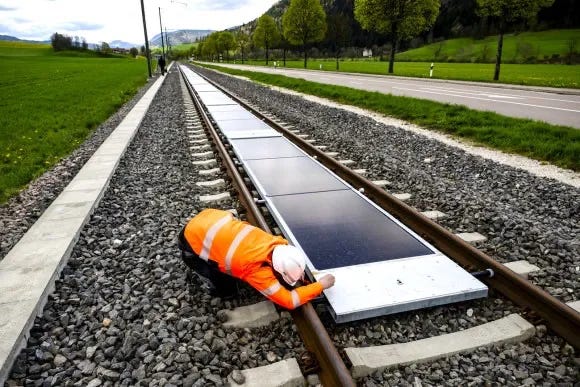
The result: despite a month’s shutdown due to bad weather and technical upgrades, these panels have still produced more than 16,000 kilowatt-hours (kWh) of electricity since May 20, 2025 - enough to power 3 or 4 households, all from a single stretch of track the length of a football field.
Scaling this up: Switzerland has around 5,300 kilometres (just under 3,300 miles) of rail lines, meaning that’s potentially up to one billion kWh of solar energy per year, enough for 300,000 households, if mass rollout could be made practical.
A lovely detail here: what about dust settling on the panels until their output is nobbled, which has been the bane of many a sun-powered Mars Rover? The answer is the Earth equivalent of a lucky Martian dust devil - the gust of wind accompanying the passage of the train! Very neat.
This was only a trial, therefore a long way from making the whole thing as affordable as it needs to be, but French and Italian railway companies have already expressed interest in seeing what’s possible elsewhere. And hey, what about the UK’s 14,700 kilometres (9,100-ish miles) of rail track? It’s fun to think.
Meanwhile, in the words of this understandably excitable headline in The Pulse a few days ago, “Switzerland bolted 5,000 solar panels onto a dam wall 8,000 feet up in the freezing Alps where everyone said solar made no sense, and the plant now makes three times more winter power than any farm down in the valleys.”
(More precisely, it’s being managed by the energy company Axpo, Switzerland’s largest supplier of renewable energy, and it’s generating about 3.3 million kilowatt hours a year, enough for 700 households.)
All this is, in a sense, upcycling existing land. It’s already in place, there’s comparatively little disruption in augmenting it this way, and presumably there’d be far fewer planning permissions needed before work can begin, making the process a lot quicker.
Where else would this work? Urban developers of the future: please scan through the Typology Of New Public Sites, seriously reconsider all those ugly concrete something-somethings we can’t name and therefore barely even see as we walk around our towns and cities, and let your imaginations go wild.
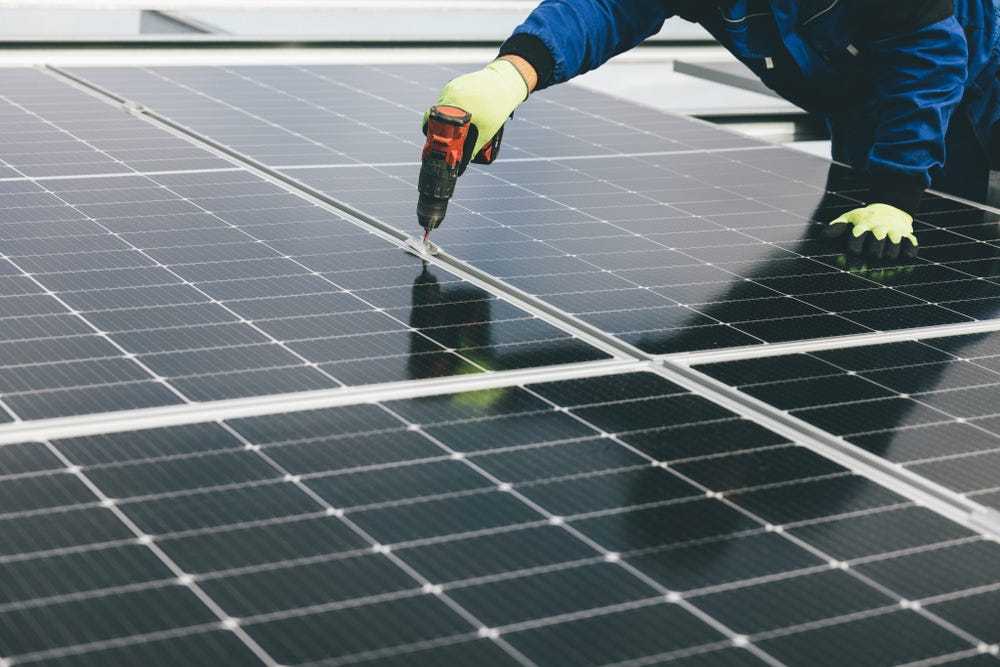
Not only is solar power rolling out everywhere at an astonishing rate (including in America, and particularly the plug-in kind), the tech itself is still improving quicker than expected.
Most commercially available solar panels are currently in the 20-25% efficiency range - that is, converting around a quarter of the energy in the sunlight hitting it into electrical power. The more efficient the panel, the more useful it becomes to folk in places that get relatively little sunshine, like up here in Scotland, and the better it works all year round.
A few decades ago, when I was first starting to get my head around how solar energy worked, I read a major newspaper article that stated with absolute certainty that solar panels will never, ever pass 31% efficiency, because of something called the Shockley-Queisser Limit.
This writer then used a line that’s forever seared into my brain because of how it affected me at the time: “Because of [this limit], we will never make solar panels efficient enough to power everyday life.”
I found this enormously depressing. Really? But - but science fiction has been telling me that solar energy is going to change the world! Are you saying that future can’t happen now?
In fact, the Shockley-Queisser Limit indeed a real thing, first calculated in 1961! It has not been disproven and seems unlikely to be. In this regard, the author was correct - and he was also yet dead wrong. The physics principle seems to be correct, but his conclusion failed to see how engineering could find a way round it to achieve higher module efficiencies.
This is more or less why I don’t trust performative certainty when I see it - even though it seems most online audiences instinctively crave it, especially in these hyper-polarised times! Want to get a ton of attention? Say something is utterly impossible in your shoutiest voice, and stand back while the traffic roars in!
(Meanwhile, good science continues to get things done in a state of rigorous uncertainty - which is exactly the kind of statement that will get you ridiculed from one end of X/Twitter to another by folk who are determined to believe some really outrageous things. Performative certainty is charismatic, it prints money and it’s often proven deeply stupid, given enough time. It’s a real problem in science communication, and I intend to have a go at writing about it soon.)
Instead, it seems we’re now in a time when, under lab conditions and using concentrated sunlight, a solar cell can achieve a staggering 47.6% efficiency. Nearly half!
But that’s in idealised conditions - what about on the roof of the average house?
This week, Germany’s Fraunhofer Institute for Solar Energy Systems (which set that 47.6% record in 2022), announced they’d developed a new panel for commercial use with an efficiency of 34.2%, and a new way of deploying panels in a shingle-like pattern that ensures no cell is caught in the shade of another.
Where next for solar innovation? I’m keeping my hopes alive for a ultra-lightweight, fold-out panel I can use while camping that will charge all my gadgets (laptop included) in maybe an hour to 90 minutes. Once that happens, I might never come back indoors ever again. See you out there.
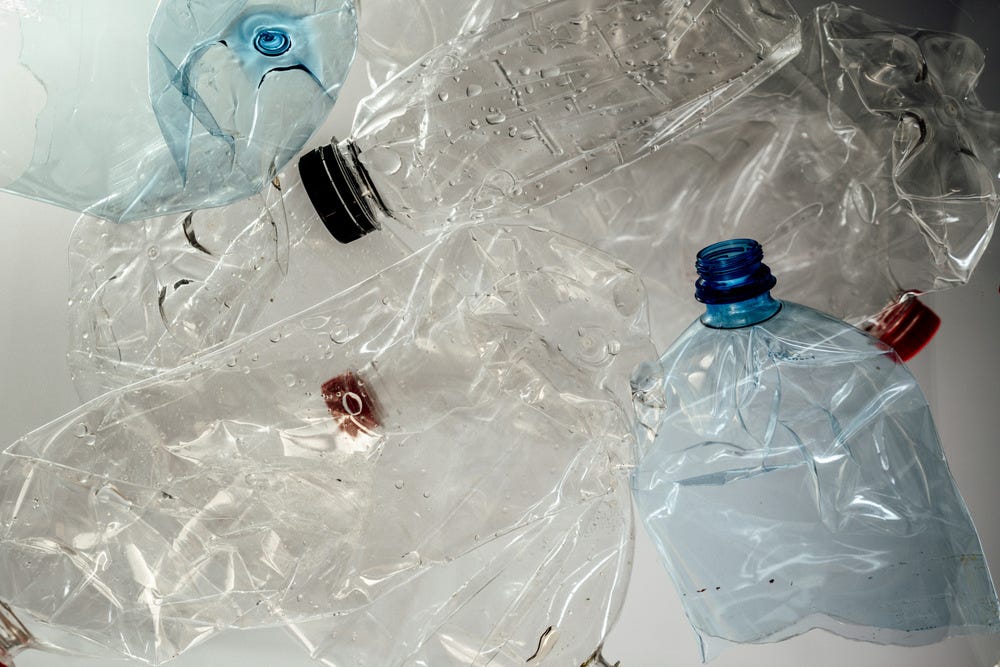
Plastic bottles are cheap, convenient and thoroughly awful. It hurts my soul every time I realise it’s time to chuck any into my recycling bin, because I know the majority will be burnt (!!!) and the remainder either thrown in a landfill, send to another country or - at last, but to a horrifyingly small extent - recycled into new plastic.
As I wrote here, glass really should become the new plastic - but in a way where food packaging is greatly reduced as a whole, so there’s a hell of a lot less waste. But in the meantime - well, here we are, with all of this waste plastic, fouling our environment and turning into bizarre new types of geology.
Surely there’s a better way to do this? (Hey, has anyone asked the Swiss?)
One spectacular new answer from researchers at the University of Cambridge that sounds like science fiction: you pop it in a device that uses sunlight to turn waste plastic into hydrogen!
This isn’t just theory. The team has built a lab-sized prototype, they’ve tested it in natural sunlight, and it worked. They used chopped up polyethylene terephthalate (PET) plastic bottles, and it gobbled them right up:
“What surprised me was, after all the optimisation, just how simple it is,” said [the paper’s co-first author Ariffin Bin Mohamad Annuar]. “We just have this huge panel, we spray our catalyst on it, put it into our solution, put it under the sun, and it produces hydrogen and other valuable chemicals just from plastic waste. It’s just simple and scalable.”
It’s a long way from becoming efficient and affordable enough to be rolled out at scale - but the fact it’s even possible is mind-blowing. Could it also become a way to do something with all that plastic currently in the ground? Fingers crossed.
In short: as usual, there’s an awful lot going on in the world. But some of it is from a future we actually want (and hopefully deserve), maybe arriving right in the nick of time.
On we go, then.
Images: Alison Pang; Teslariu Mihai; Markus Spiske.
Comments
Nothing yet. Say the first thing.
Sign in to join the conversation.