
Ray Dalio on the storms on the horizon for China, as we approach the century mark of China’s 20th-century revolution:
A few years ago, President Xi Jinping started warning that a 100-year big storm is coming. As is typical of the early days of a hurricane, one can now feel it. The circumstances and the mood in China have indisputably changed to become more threatening. These changes are mostly due to big cycle forces.
. . .
A Chinese leader, historian, and friend of mine told me several years ago that the conditions of the times create the type of leader that emerges because the evolutionary process pulls out the leader who suits the environment. In other words, how the times are transpiring determines the leader even more than the leader determines how the times are going. . . My point is that what is happening now and Xi’s leadership must be looked at within the context of the Big Cycle. In other words, it is important to distinguish between the hand that Xi was dealt and how he has been choosing to play it. It is also important to understand what is happening now and how Xi is playing his hand without judging these things, because judging them can stand in the way of understanding them.
. . . As I see it, the template to keep in mind is that capitalism (with or without “Chinese characteristics”) produces credit that creates spending power, which when used well unleashes creativity and prosperity, which produces the upward wave in the cycle. But it also inevitably creates a lot of debt and wealth gaps, and when the debt becomes too large to pay off and there are big wealth gaps, that causes the cycle to reverse. When there is a lot of debt and big wealth gaps at the same time as there are great domestic and international power conflicts and/or great disruptive changes in nature (like droughts, floods, and pandemics, which China is especially prone to) and great changes in technology, there is an increased likelihood of a “100-year big storm.” That is the current environment in China. Destiny put Xi in the position he is in, and how he plays his hand will reflect where he is coming from, motivating him to do what he does, which will have a big influence on what happens.
Among the critical challenges that China faces:
falling real estate prices, falling equity and other asset prices, fall employment and employee compensation
an aging population
the internal wealth gap and the CCP’s messaging about targeting that gap is fear-inducing and oppressive, especially to capitalist elites
the great-power conflict between China and the US is causing foreign invesetors and businesses to shirk China
climate issues
This is an interesting (and alarming) observation:
In addition to economic clashes with the West, there are cultural clashes. They were described to me by a Chinese leader as mutual cultural ignorance with evolutionary change. He explained that 1) the Anglo-European culture extended by Great Britain passing dominance to the US is having problems accepting the rise of China and its Chinese-Asian culture, 2) there are failures of the two sides to understand and accept the different approaches, and 3) Western culture is more zero-sum than win-win and more inclined to slip into lose-lose wars. I agree with his assessment and find it tragic. It is certainly the case that the Chinese fight wars differently. Think about the “art of war”—fighting to win by focusing on the “pressure points” that can weaken or hurt the other side without even being seen. For example, if one were conjecturing how the Chinese might play the existing geopolitical situation if the conflict rises, because the US is overextended in two wars, the Chinese might think about where there could be a third front—like a war in Asia, something like a conflict with the Philippines or North Korea, that would put the two sides in the US election in the awkward position of having to step into a third conflict (which would be unpopular in the US) or not appear strong enough. Almost all leaders on both sides believe that the other side is working to destroy the other and are working to be able to destroy the other. They are in an intensifying prisoner’s dilemma.
Quite a wild headline to see in Nature:
As environmental, social and humanitarian crises escalate, the world can no longer afford two things: first, the costs of economic inequality; and second, the rich. Between 2020 and 2022, the world’s most affluent 1% of people captured nearly twice as much of the new global wealth created as did the other 99% of individuals put together1, and in 2019 they emitted as much carbon dioxide as the poorest two-thirds of humanity2. In the decade to 2022, the world’s billionaires more than doubled their wealth, to almost US$12 trillion.
This is a take I haven’t seen in most arguments for “deceling”/”degrowthing” to save the climate - it’s not just that rising income in itself leads to more consumption, but rising gaps in income drives up consumption even more:
The underlying reasons for inequality having such profound and wide-ranging impacts are psychosocial. By accentuating differences in status and social class — for example, through the type of car someone drives, their clothing or where they live — inequality increases feelings of superiority and of inferiority. The view that some people are worth more than others can undermine people’s confidence and feelings of self-worth8. And, as studies of cortisol responses show, worry about how others see us is a powerful stressor9.
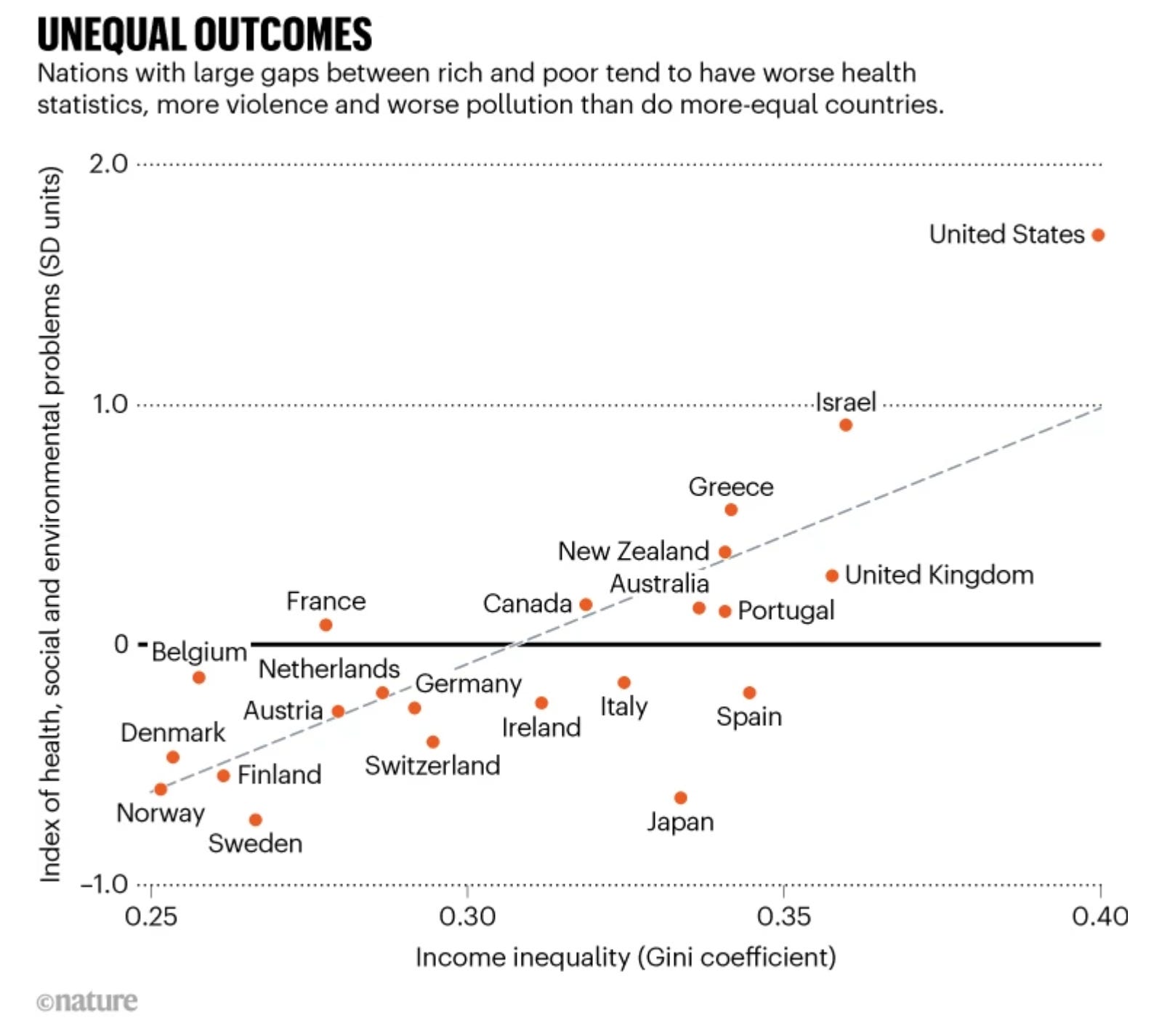
I tend to think there are confounding factors here - is it possible that rich countries that care more about inequity (ie the Scandinavians) also tend to have higher social trust and care more about their nation’s health and environmental outcomes in general?
More Garbage Day!
The one on the Chinese chemical manufacturer is something:
A Chinese glycine manufacturer called Donghua Jinlong has blown up on TikTok over the last few weeks. Louise Matsakis, the reporter behind the excellent You May Also Like newsletter, went deep on this trend. Matsakis called the meme a “great microcosm of what’s actually happening on TikTok when it comes to content from China.” Which is to say, it’s nonsense.
One thing I haven’t seen mentioned anywhere, though, is that I’m fairly certain fans of the Red Scare podcast and adjacent Downtown Scene/Dimes Square microcelebrities started the meme. A lot of the more popular videos feature the Red Scare hosts and comedians like Nick Mullen, oftentimes edited by an AI to read facts about the factory’s glycine. (Glycine is an amino acid used in food production btw.)
Digging into the substack mentioned:
One of these manufacturers is a company called Donghua Jinlong, which is headquartered in Hebei province about 200 miles from Beijing. It sells “high quality industrial grade glycine,” a type of nutritional additive that evidently sounds silly and abstract to people who never need to think about how processed food is made. Donghua Jinglong and its glycine have become a relatively big meme on TikTok, Instagram, and X over the last few days, and some of the company’s videos are getting over 100,000 views (even though its official account only has roughly 4,400 followers).
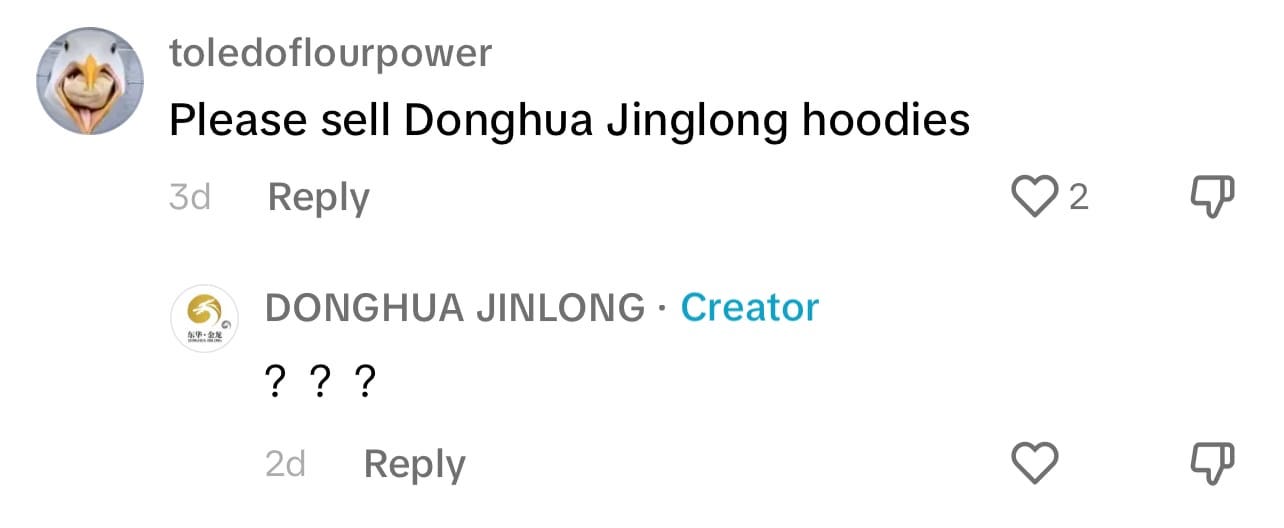
The Donghua Jinlong meme is a great microcosm of what’s actually happening on TikTok when it comes to content from China. Some people might argue that Chinese manufacturers are choosing to post on the app because its parent company, ByteDance, is also from China. In other words, these factories could be held up as an example of TikTok allowing Chinese influence to grow in the US (albeit a bizarre one).
But Donghua Jinlong also has a Facebook page with even more followers, it’s just that no one is engaging with its posts there. That’s because there are likely very few people searching social media for a new glycine supplier at any given time. TikTok, however, doesn’t rely on users to actively seek out content, it serves videos to them via an algorithm. So now tons of random people are coming across glycine manufacturers and Tide Pod machines by accident, and they’re happily turning the whole thing into a joke.
Supreme is still big in China
Chengdu seems really cool - way more laidback than Beijing/Shanghai and LGBTQ-friendly, and actually has great coffee
since COVID, China has turned more inward, but social media has let “lower tier” cities identify and adapt to commercial trends faster
Cool to read in contrast to Ray Dalio’s piece above. This is from Liu Chenru, the managing partner of 清泉石资本 Brookstone Capital, a China-based venture capital fund.
. . . At that time, China's path of economic development could be "copied", or more accurately, it copied the homework of the Four Asian Tigers in East Asia - developing foreign trade and urbanization. Investing was also simple at that time. Just look at what happened in those developed countries, and China would follow suit. China's choice was to copy the homework in the economy and hide its capabilities and bide its time in politics. Chinese people's choices were also simple: doing foreign trade along the coast, exploiting resources in the inland areas, and developing real estate and engineering projects where there were no resources; investing in buying houses, or depositing money in the bank. Therefore, against the backdrop of this unanimous focus on "money", China went through a glorious and simple thirty years. These thirty years were also the golden age of the people born in the 60s and 70s. They went from their twenties to their fifties or sixties, and wealth and political resources were accumulated during this process. That generation was the first generation of people who became generally wealthy in China in several hundred years. It is also not difficult to understand why many elitists in that generation had a heartfelt recognition for the Western culture.
. . .
Some people believe that America's hostility towards China comes from politics or culture. But I believe that this is often a rational economic behavior. If we go back two hundred and fifty years ago, the United States and Britain had a war of independence. If we talk about politics and culture, the United States inherited many of Europe's ideas. However, it still chose to declare independence through war. Under the capitalist Protestant ethic, economic interests are the entry ticket to heaven. In the past, the relationship between the United States and China was similar to that between Nike, Adidas, and Shenzhou International. If one day Shenzhou International wants to stand on its own, it will inevitably collide with Nike and Adidas. [BAiGUAN: Shenzhou is a Chinese garment manufacturer and a main supplier to western brand, listed in Hong Kong as 2313.HK]
This is a deeply Chinese observation, in the spirit of the oft-quoted saying “China is not a country, but a civilization”:
History has proven that among politics, economy, and culture, culture is the most resilient.
On East vs West culture:
Western civilization is an expansive oceanic civilization. Whether it is England, surrounded by the sea on all sides, or Greece, a union of city-states, where the local economy is difficult to support a large economic entity. Respect for trade and commerce has cultivated the spirit of contract and the concept of the rule of law; the emergence of Christianity and the Protestant Reformation have also nurtured the idea of equality for all and become the spiritual aspirations of Western people's pursuit of freedom. Individual heroism is what Western civilization values. This is not difficult to understand. In the history of Western civilization, many of the people who had foundational significance, such as Columbus or Newton, changed an era with their genius and extraordinary courage. However, oceanic civilization also has its natural shortcomings. A country that relies on commerce, trade, and finance means that some of the wealth is not self-created but need to be plundered from other countries' resources or cheap labor. This makes the profit-driven expansion of Western civilization accompanied by the export of war (or inflation). The Americas of 300 years ago and the Middle East of today are examples [of the targets of such export].
For China, the Yellow River Basin in the Central Plains is the birthplace of Chinese civilization. Over thousands of years, several important nodes have constructed the core of Chinese civilization. The first node is the Spring and Autumn Period, the Warring States Period, and the Han Dynasty that followed. Hundreds of years of war and ensuing peace established the status of Legalism and Confucianism in China's governance. The subsequent thousands of years were more of the unfolding and continuation of this order. The second node is more than a hundred years after 1840. Western culture, on the basis of absolute strength, entered China in a dominant way, causing a “change unseen in thousands of years." Although Chinese civilization has integrated northern nomadic ethnic groups, overall, the mainstream civilization in China's past was based on inland agriculture. Agricultural economy takes the family as the basic organizational unit, and culture advocates diligence, frugality, introversion, conservatism, and collectivism, promoting production (manufacturing), love of peace, not trade and wars. Thus, heavy agriculture and manufacturing have their cultural origins in China.
. . .
Some people think that in 2018, why couldn't China simply choose to bow its head like Japan or continue to hide its capabilities and bide its time when facing US technology sanctions. I think this is like two people, one with an independent personality and the other without. Since its founding, Japan has been surviving under the strong influence of other countries' cultures and civilizations. The bottom color of Japanese culture is "空 emptiness." The meaning of emptiness is not that there is no culture, but an attitude of acceptance and inclusiveness. Therefore, when the US fleet arrived, the Japanese emperor quickly abandoned the set of practices learned from China in the past and turned completely to the West. But it is difficult for Chinese civilization [to do that]. Chinese civilization has [more] colors, just like Iran [/Persia]. Colors mean independence, and independence means that change requires stronger birth pains and longer time. It also means that after the change, it is not losing one's personality but reconstructing this operating system in a new way. China is not Japan, Australia, or Canada. Cultural power is very strong, which makes China choose its own path to integrate into the world - not arrogant closure or blindly identifying with the West and losing oneself.
This was linked by the previous substack. It’s a 2021 piece and some parts do seem a bit outdated now in light of China’s post-Covid economic problems. But
The truth, then, is that China is not an authoritarian state seeking to become more liberal but an authoritarian state seeking to become more successful—politically as well as economically.
. . . In much Western analysis the verb most commonly attached to China’s reforms is “stalled.” The truth is that political reform in China hasn’t stalled. It continues apace. It’s just not liberal reform.
. . .
Seventy years on, many Chinese believe that their political system is now actually more legitimate and effective than the West’s. This is a belief alien to many Western business executives, especially if they’ve had experience with other authoritarian regimes. The critical distinction is that the Chinese system is not only Marxist, it’s Marxist-Leninist. In our experience, many Westerners don’t understand what that means or why it matters. A Marxist system is concerned primarily with economic outcomes. That has political implications, of course—for example, that the public ownership of assets is necessary to ensure an equal distribution of wealth—but the economic outcomes are the focus. Leninism, however, is essentially a political doctrine; its primary aim is control. So a Marxist-Leninist system is concerned not only with economic outcomes but also with gaining and maintaining control over the system itself.
That has huge implications for people seeking to do business in China. If China were concerned only with economic outcomes, it would welcome foreign businesses and investors and, provided they helped deliver economic growth, would treat them as equal partners, agnostic as to who owned the IP or the majority stake in a joint venture. But because this is also a Leninist system, those issues are of critical importance to Chinese leaders, who won’t change their minds about them, however effective or helpful their foreign partners are economically.
TIL about Kimi:
Emotions run high, swinging between fear and complacency. Take Kimi, a Chinese AI platform; its text processing prowess, claimed ten times that of GPT 4.5, has sent its valuation soaring to $2.5 billion, igniting a surge in related stocks this March.
More from Baiguan, some little tidbits:
China has its own slang for “quiet quitting”, or “mo yu” (touching fish)
the youth unemployment rate is pretty bad, even excluding students - about 15% in 2024 for 16-24 year olds, and 6.1% for 25-29 year olds
the youth are moving back to the “lower tier” cities for the lower cost of living
What would you do if you suddenly had a billion dollars?
The way you answer that question will tell you something about how likely you are to become a billionaire in the first place.
Pretty great hook.
Some billionaires are smart. All have been extremely lucky.
But there’s something else going with the Secret Geniuses. Venture capital is a world where the most effective way to get investors is to convince them you’re different—a one in a million visionary. This phenomenon is amplified because many investors are assuming that most of their bets will fail, but that every so often, one of their bets will produce a fat tail that leads to vast riches, as was the case with Facebook. When that happens, all the previous failures become meaningless, because the billions produced by the one success dwarfs the millions poured into the businesses that collapsed.
Everyone in venture capital is looking for their Secret Genius.
For some reason I missed this earlier! Good summary from Zvi:
(30:00) The market as the thing that finds a solution that gets us to the next day is a great way to think about it. And the idea that doing that, rather than solving for the equilibrium, is the secret of its success, seems important. It turns out that, partly because humans anticipate the future and plan for it, this changes what they are willing to do at what price today, and that this getting to tomorrow to fight another day will also do great things in the longer term. That seems exactly right, and also helps us point to the places this system might fail, while keeping in mind that it tends to succeed more than you would expect. A key question regarding AI is whether this will continue to work.
(40:30) Tyler made an excellent point here, that market participants notice a lot more than the price level. They care about size, about reaction speed and more, and take in the whole picture. The details teach you so much more. This is also another way of illustrating that the efficient market hypothesis is false.
How do some firms improve over time? It is a challenge for my model of Moral Mazes that there are large centuries old Japanese or Dutch companies. It means there is at least some chance to reinvigorate such companies, or methods that can establish succession and retain leadership that can contain the associated problems. I would love to see more attention paid to this. The fact that Israel and the United States only have young firms and have done very well on economic growth suggests the obvious counterargument.
(48:00) Tyler says we should treat children better and says we have taken quite a few steps in that direction. I would say that we are instead treating children vastly worse. Children used to have copious free time and extensive freedom of movement, and now they lack both. If they do not adhere to the programs we increasingly put them on medication and under tremendous pressure. The impacts of smartphones and social media are also ‘our fault.’ There are other ways in which we treat them better, in particular not tolerating using corporal punishment or other forms of what we now consider abuse. Child labor is a special case, where we have gone from forcing children to do productive labor in often terrible ways to instead forcing children to do unproductive labor in often terrible ways, and also banning children from doing productive labor for far too long, which is also its own form of horrific. But of course most people will say that today’s abuses are fine and yesterday’s are horrific.
Transcript of the Dwarkesh podcast here.
Tyler Cowen getting crushed on his own blog 😅 I feel pretty similarly to the comments section on not buying AI digests decreasing users’ “addiction” to social media - the cooking analogy feels especially pretty bad, considering the average person is nowhere nearly as enticed by cooking as they are Tiktok and Insta (if anything, it’s considered an annoying chore).
Comments
Nothing yet. Say the first thing.
Sign in to join the conversation.