
But my own thesis is that it goes the other way. Nerdom ascended because it was the nerds themselves who got rich. Really rich. Like Bill Gates rich. Because all the kids playing D&D in 1985 were doing dot com startups in 1995. The dot-com bubble burst, but a lot of them still got rich. These people, mostly men, had grown up mop-haired and spindly, the geek side of Freaks and Geeks. Then tech companies outperformed the S&P 500 for the last thirty years. We had the personal computing revolution, the internet and associated dot-com bubble, the crypto craze, and now the AI explosion. The end result is that Jeff Bezos is now buying yachts that somehow require other yachts, like some sort of marsupial yacht-ception.
. . . Despite this being a massive victory for my teenage self, and generally enjoying nerdom at a personal level (I admit I too would be intrigued by Silmarillion references in a pitch) my concern is that nerdom, in an unintentional way, is strangling high culture. For while most intellectuals are nerds, not all nerds are intellectuals. In fact, the majority of nerds aren’t intellectuals. And it’s problematic that the taste of the majority is swamping out the minority, leading to the nostalgia porn of Stanger Things, the CGI paste that is the latest Marvel movie, the unending Star Wars re-runs where Palpatine comes back yet again. Who is left to read literature, to make art-house cinema, to write weird burning-with-an-inner-fire poetry? That’s what some segment of nerds should be doing, metamorphosing from nerd into that more delicate but potent creature, the intellectual, but instead they are drawn to the easy honeypot of modern middlebrow culture because it is too nerdy, too attractive, too omnipresent, to ever leave. A key portion of nerds are supposed to complete a lifecycle and pupate into fancy-pants intellectuals, yet this natural process has been stymied by the very success of nerds in the first place.
This is actually how I think of NYC vs SF - my circles in NYC have a ton of Marvel/Star Wars/GoT/scifi fans but few “intellectual” types, whereas SF has a bunch of intellectual types but fewer of these pop culture geeks. Maybe nerd vs geek is a useful distinction here - nerds for the intellectual variant and geek for the culture-obsessive type.
We think of a discussion as one thing, but actually every discussion contains multiple conversations, many different kinds of conversations. And in general, those different kinds of conversations fall into one of three buckets. There’s these practical conversations, which is when we want to solve a problem, or perhaps we want to make a plan. But then there’s other conversations, as you pointed out, where I come in and I talk about a problem I’m having — like my boss, I think, is a jerk — and I don’t want the other person to solve my problem. I just want them to understand me, to tell me that my emotions are valid. Those are emotional conversations. And then there’s another basket, which are conversations about how we relate to each other, and how do we see ourselves in the context of society? And those are social conversations. And so these three big buckets of conversation — practical, emotional, and social — they’re really useful because they tell us what the goal is. And if we’re having a different kind of conversation than someone else, then we’re probably failing to connect.
Some great ideas for dinner convos here, like:
LEVITT: Okay, so I have a permission giving example. I was at a conference with a set of incredibly high achieving people. These were all folks who had received funding from an organization called Schmidt Futures, which is the most innovative philanthropic organization that I’ve ever seen. So shortly before dinner, one of the organizers pulls me aside and asks me if I could be responsible for facilitating the dinner conversation at my table. Okay, anyone who knows me knows that this is roughly the last thing that I would ever do, but I didn’t really feel like I have a choice because they gave me money, and so I thought I had to say yes. So then she hands me a piece of paper that lays out some kind of team-building exercise I was supposed to lead. It involved role play and, oh my God, I thought, “This is going to be torture.” So, without asking permission, I decided I would just do something completely different. And when the eight of us sat down at the table, I didn’t want people to make their standard introduction. I wanted each of us to tell our life story with one simple rule: that you couldn’t show any modesty.
Ethan Mollick is the every.to guy! This episode’s about how to use ChatGPT in your daily work. Some of his tips:
“Give me 30 versions of this sentence in radically different styles.”
have the AI read through the papers, write notes on them, organize them, write citations
suggest analogies that might be useful
have the AI act as readers, and in different persons, give the perspective of whether there might be better examples
He suggests it’s about 10 hours to really learn a model.
Interesting take:
But if you think about it like programming, then you end up in trouble. In fact, there’s some early evidence that programmers are the worst people at using A.I. because it doesn’t work like software. It doesn’t do the things you would expect a tool to do. Tools shouldn’t occasionally give you the wrong answer, shouldn’t give you different answers every time, shouldn’t insult you or try to convince you they love you.
And A.I.s do all of these things. And I find that teachers, managers, even parents, editors, are often better at using these systems, because they’re used to treating this as a person. And they interact with it like a person would, giving feedback. And that helps you. And I think the second piece of that “not tool” piece is that when I talk to OpenAI or Anthropic, they don’t have a hidden instruction manual. There is no list of how you should use this as a writer, or as a marketer, or as an educator.
They don’t even know what the capabilities of these systems are. They’re all sort of being discovered together. And that is also not like a tool. It’s more like a person with capabilities that we don’t fully know yet.
A fun little read on male archetypes in fairy tales:
It’s well known among fairy-tale scholars that there are hardly any studies of the masculine, or of male archetypes, in fairy tales. This is in good part because feminist fairy-tale studies (quite a significant field) developed in opposition to the belief (back in the day) that masculine experience was the norm, or was the only experience that was important. You know: the Hero’s Journey and all that blah. Well, it turned out that women wanted to find themselves in fairy tales, and they wanted to find themselves, themselves. It’s also the case that men seem not to be quite as addicted to fairy tales as women are – or at least, if they are, they don’t admit it because fairy tales sound sissy. I’m not entirely sure what the truth of it is.
Interestingly there are some differences between male and female shapeshifters and tricksters:
I’ve noted before that whereas shapeshifting in female characters in fairy tales is usually seen as something quite natural to them, a man who shapeshifts is pretty much always doing so as a consequence of a curse: he’ll be the victim of a spell, usually cast by a woman, and it’s usually the fairy tale’s heroine who saves him from it. If they’re not cursed, they’re evil, like werewolves and vampires, and the Scottish each-uisge (water horse).. How can we transform this archetype into something more positive? Because where women shapeshift it’s usually natural, and mostly (though of course not always) benign, whereas the male shapeshifter tends to do it to kill or to have power over someone else. I’m thinking now of a couple of great characters in Irish myth – though they’re not quite shapeshifters, it’s just that they took animal forms in previous incarnations.
As I wrote in Hagitude, female tricksters are, more often than not, truthtellers; this is how they disrupt (and remember that disruption – by whatever means – is at the heart of the Trickster archetype). Male tricksters usually disrupt in other ways – through malicious pranks and other forms of classic trickery, for example – and are more likely to be malign (such as Loki in Norse myth, who caused the end of the world). Hermes is often considered to be a Trickster: he’s the inventor of lying and the patron of thieves. In Irish folklore the leprechaun was a Trickster, and several characters in English folklore, such as Robin Goodfellow.
This is about reading books, but this rings true for me about the question “what are you working on” as well:
. . . But in the basement of a bookstore, a friend’s friend asked, an intense gleam in their eye, “So, Molly, what have you read lately?”
It sounds like an innocent question, but it came with a pile of expectations. This person kept up with everything. This person wanted to know what they could tick off the list with me. Had I read Big Book X? Had I gotten my hands on an advance copy of Massive Novel Y? Did I have opinions about the books a person in my job “ought” to have opinions on?
I did not, and what’s more, in that moment, I didn’t want to. I didn’t want to talk about what I’d been reading in the way this person wanted me to respond. I suddenly wanted to hold my cards, and my books, extremely close to the chest. Reading felt gamified, like a thing where you went down a list of titles and got points for which ones you’d read. This was no longer gold stars inside a folder. This was something else entirely.
This vibe has crept into so much online book discourse. People stress about not having time to read—a fair complaint, but one that has a different tone when the subtext (or text!) is “I’m getting behind.” Behind on what, and to whom? Who is served by all this stress, by reading challenges and goals and lists and shelfies and book hauls? What is it for? What are we getting out of it? What difference does it make if you read a book that came out last week or one that came out last century?
Take intelligence. I’m talking about book intelligence, the kind that shows up in SAT scores and GPAs.
How could someone possibly be too intelligent? How do you get to a point where you realize you could have been more successful if you had been a little dumber?
Tldr; smart people are better rationalizers, makes you less likely to listen to people who are less credentialed than you, and makes you more stubborn about changing your opinions if you overvalue your intellectual reputation.
Indeed, in many U.S. cities, elected officials are overwhelmed by debt obligations, and as a result have precious little money to spend on parks, museums, and other public services. The givers have no such constraints. In Boston, the Barr Foundation has done much to shape the city’s arts, culture, and political milieu. In Houston, Richard Kinder is helping to forge a massive network of urban trails. In Detroit, the Kresge Foundation is contributing funds for a new light-rail system. In New York, the Leon Levy Foundation has helped to revitalize a pair of Brooklyn landmarks, the Brooklyn Public Library and the Brooklyn Botanic Garden. These are worthy endeavors, but Callahan is right to express concern about a fundamental shift of power from a “hollowed-out public sector” to elite private givers who are not fully accountable and operate in dark corners. In 2008 Stephen A. Schwarzman, another cofounder of Blackstone, gave $100 million to the New York Public Library at a moment when the Library was secretly undertaking a dubious real estate and construction scheme. For nearly a decade, the NYPL refused to reveal how Schwarzman’s money was being utilized. Only in recent months did the Library account for the gift’s use: the $100 million formed part of the endowment and will soon be used for new renovation projects.
To a significant degree, the superwealthy have used their checkbooks to influence the political realm. Callahan found that Eli Broad has “pulled multiple levers of power”—and spent millions of dollars—in Los Angeles to create a climate in which charter schools can flourish. Under an initiative backed by Broad and like-minded funders, L.A. could add hundreds of new charter schools in a decade. Broad is quick to refute allegations that he is overreaching: “I think everyone is getting heard,” he informed Callahan. “We’re getting heard, the philanthropists. The unions and administrators are getting heard. Overall, we’re creating debate.”
A review of a surprisingly-little covered nonprofit sector, where the new superrich have “deployed their immense wealth for public purposes in the realms of politics, ideas, infrastructure, digital technology, and science". One of the most striking findings for me was that this space constitutes over 5 percent of GDP and 10 percent of private-sector employment!
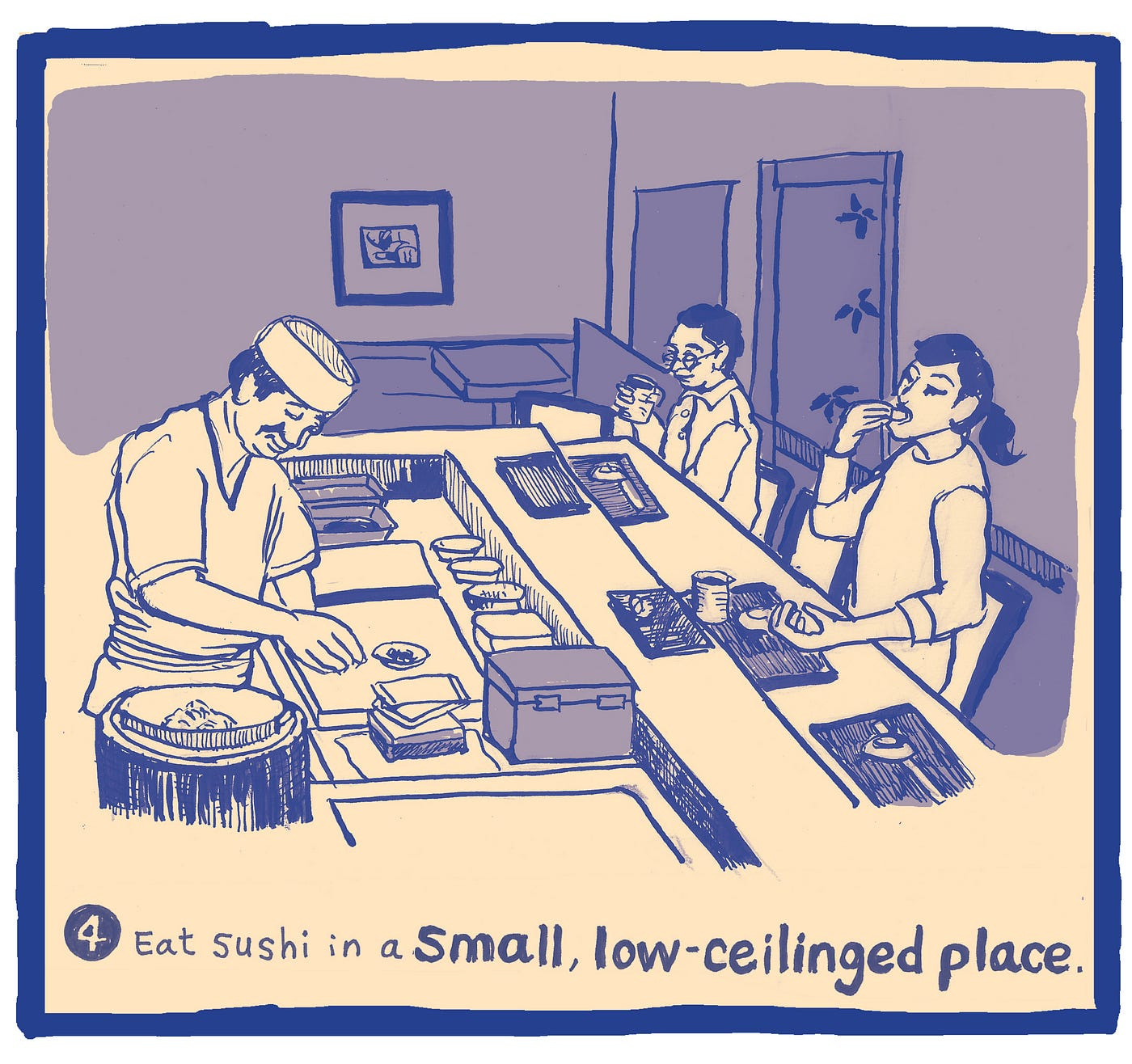
Fun deep dive into how the Japanese really eat sushi. The parts that really get me are:
eat it for lunch, not dinner
eat it with your hands, not chopsticks
sushi about the smell, not just the taste
you really should NOT be adding soy sauce or wasabi yourself, just eat what the chef gives you.
Some wild stories from a waiter at Bouley’s:
One shift, a party of seventeen buzzed Wall-Street guys (there were a lot of buzzed Wall Street guys) got into a pissing match over their wine knowledge. They collectively expressed disdain for the wine selection chosen for the meal, a corporate meeting. Refusing to drink below his station, one guest pulled me aside and ordered a more expensive bottle. It then became a game of drunken one-upmanship, with increasingly expensive bottles ordered for each subsequent course. Dessert was paired with bottles of Château d’Yquem (at the time, a dessert wine marked up to $1,200). When I presented the bill, the host asked why I had included a $2,700 gratuity. After I explained this was house policy for parties larger than six, he shrugged, said “Good job,” and added another $2,000.
Love this bit:
At Bouley, the customer was not always right: the Chef believed he was. In many restaurants, complaints about the quality of diver sea scallops might garner a discount. At Bouley, such complaints could lead to a message from the chef that your meal was over, and that you and your party might prefer to dine elsewhere. Requesting well-done meat or sauce on the side might be interpreted as a personal affront. Your request might be denied, and you might face a degradation ceremony. If your picky eight-year-old didn’t like the celery sauce accompanying the rare Kobe beef (at the time, about $115 for 10 oz), too bad. You should have hired a sitter.
Eating at elite fine dining restaurants like Bouley often means subsuming one’s personal preferences to the chef’s superior taste. Understanding this was a marker of class distinction as sharp as having the money for dinner in the first place.

This culture is only becoming more pervasive. The last few years have seen the biggest spike in ADHD prescriptions since Adderall first passed FDA approval in 1996. If Adderall were not considered a productivity drug—economically beneficial, on balance—we would almost certainly be talking about an amphetamine epidemic. And maybe we should be. Adderall’s efficacy for treating ADHD, and its popularity among the Professional Managerial Class, has helped obscure what a strange and deleterious drug it can be. Adderall is highly addictive, the returns it delivers are steadily diminishing, and the risks of heart disease and psychosis increase by the year. In the meantime, it just makes you kind of annoying.
The drastic increase in Adderall use hasn’t raised nearly as much uproar as the national shortage it helped cause. The consternation at the peak of the drought was understandable: our country was suddenly lacking one of its key ingredients. Productivity declined by 3%. Twitter started to suck. People raised on Adderall started unwittingly dabbling in meth. At Broadcast, we took this as an opportunity—a kind of pause—to reflect on the impact this pervasive drug has had on our culture. While Adderall use is widespread and normalized among a certain class of Americans, almost no one talks about it publicly. We were curious: What cultural shifts have come out of this incredibly upbeat epidemic? What are the short- and long-term consequences of millions of people getting hooked on speed?
Engrossing long read about the effects of Adderall via interviews with a bunch of different users. This part really strikes me - if the internet was architected by people on amphetamines, if all those doomscrolling dopamine sites like Insta were dreamed up by PMs and engineers on amphetamines, how can you take amphetamines to unhook yourself?
When people say “disaster capitalism,” they are referring to the dynamic by which capital creates crises for which it then sells solutions. In some cases, the logic hews so closely to its ligaments that it cries out for dissection. By now everyone save for the most orange-pilled #mentalhealthwarriors finds the late-90s child addy prescription boom shady at best. Yet even for those who consider themselves critics of the psychiatric establishment, the idea remains that the crisis of the attention economy was medicalized. In other words, first came the attention crisis, then came the diagnosis that described it as a medical problem, and last came the Adderall boom that was supposed to fix it. By these lights, if Adderall isn’t fixing the attention crisis, it’s because we are trying to cure a non-medical problem (e.g. the natural exuberance of children, or the infrastructural fact of smartphones) with a drug. This analysis fails to grasp the full extent of the problem. It’s not just that we are drugging something that can’t be solved with drugs. It’s that the particular drugs we are using to do so—amphetamines—are making the attention crisis worse.
. . . There is a growing consensus that the attention crisis is, at bottom, caused by the Internet, which has in turn caused the rise of Adderall usage and prescriptions. But what if this story has things the wrong way around? Working backward from the neurochemical effects of the drug, it begins to seem plausible that, in fact, Adderall’s prevalence was the sine qua non of the Internetified attention economy and its perpetual crises.
. . .
It’s not just that the technical architecture of the modern Internet was created by people on stimulants, although that’s also true. (There’s hardly a part of the country more Adderall-sodden than Silicon Valley. A recent study by the University of Michigan documented the prevalence of amphetamine use among programmers and coders.) It’s that Adderall was the living currency of being online, the elevated heart rate that set the culture’s BPM. Can one envision, for instance, a form as essentially millennial as the listicle without the army of twenty-something media writers intently foraging across the Internet, tweaking out of their minds? “Because Adderall is the drug most responsible for getting Gawker editors working at 7:30 AM,” the ill-fated site announced in 2006, “we recommend it without hesitation. Lord knows our loyalty is lifelong.”
. . .
The further you went downstream from literature toward the blogs, the more the linguistic euphoria thinned out into a pure content production grind. “Performance enhancers are necessary to the level of production the blog economy requires,” one industry veteran explained. “In a given week I may be called upon to produce, on short notice and in fair copy, essays, features, blog posts, Facebook posts, tweets, interviews, how to pieces, listicles, confessionals, city guides, recipes, memoirs, and whatever else will pay enough to cover my scrapple tab.” This flotsam was the phenomenological grist of being online, a loop running in a perpetual present. The Adderall that kept the 2010s VICE blogger churning out content was the same Adderall that made us open the article in yet another tab.
And this is the point: first came Adderall, then came the Internet. We didn’t get on Adderall because the Internet was too good. The Internet was good in the particular way that it was good because we were on Adderall.
173-page google doc on geographical features of Mongolia for geoguessrs - I love this as a peek into how they train.
Caffeine appears helpful for everything except relaxation (and it makes me hornier, which I'm neutral about). I'd call this experiment a success and will be running more in the future, while in the meantime taking caffeine before morning meditations.
Nothing surprising here but fun to see someone really dig into this, gwern-style.
Comments
Nothing yet. Say the first thing.
Sign in to join the conversation.