
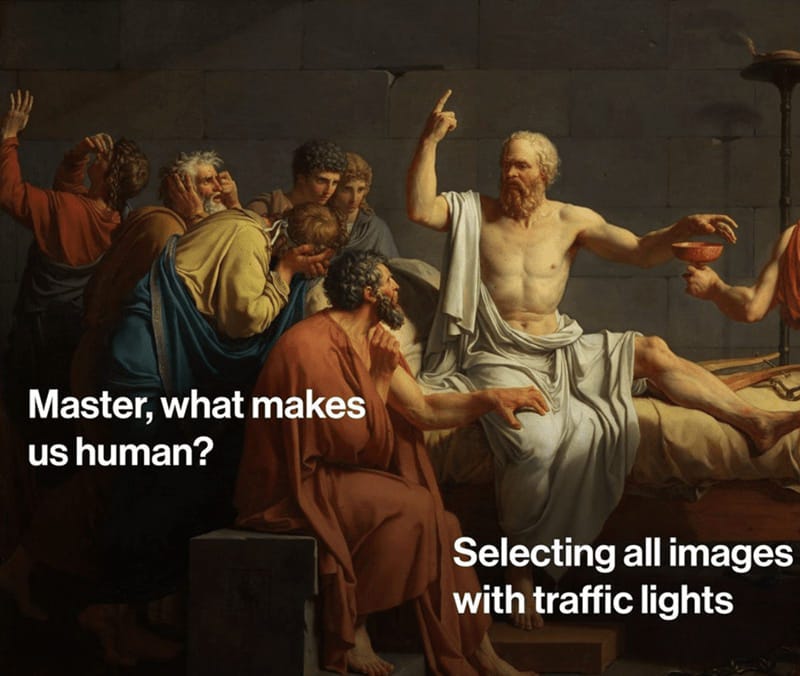
First off, a meme:
Avabear on frames:
For years, my goal was to find a way to coexist with my sensitivity without detaching from it. My current manner of interacting with other people and with the world around me was born out of that: a set of mannerisms and behaviors that allowed me to be authentic without causing undue damage. We each have a “frame” like this, informed by personality, social contracts and feedback from others: how do you make eye contact? How do you make small talk? What questions do you ask on a date? How do you leave a party? How do you give feedback to a friend? How do you ask someone to hang out? How do you gossip? How do you deescalate a fight? The rules and regulations you internally set for yourself, consciously and subconsciously, are your “frame.” I think of it as a series of agreements with yourself and other people.
I know that there is extant usage of the word “frame.” I’m using it a little differently: I think a frame is not your worldview, but how you functionally act. I find that this makes it easier for me to understand situations where, for instance, someone is extremely harsh and unpleasant at work, but very patient and loving with their friends and family. It’s not that one is their “real” self and one is their “fake self.” They have different frames for each, because they simply want to show up differently in different situations.
A series of posts on “female neediness”, ie whether there is a fundamental, biologically-driven gap between women’s desperation for commitment vs men willing to fulfill it, in the same way there is a casual sex gap for men. I come closest to Ruxandra’s position that we shouldn’t glamorize the past even if fewer women ended up broken-hearted by fuckbois - what they had instead was being raped by husbands, without even being able to call it that. If more women are broken-hearted today, it is because our standards are higher, it is because we think of love with a man who loves us back is even possible. (I also know of far more guys who are pining after a girl who doesn’t love them back than vice versa, which might be a function of my social circles but surely if friendzone is a thing, there is plenty of male neediness to go around too? Might it just be part of the human condition?)
I’ve been reading a lot more female writers on Substack. In particular, there’s this new genre of substack I’ve gotten really into - the gen z female writer, who writes in long, evocative confessional prose about stuff that just really sucks for them. Getting to see what the kids are up to makes me feel like a bewildered mom trying to poke into her teenage daughter’s love life. It’s quite the brave new world - there are so many new ways of jockeying for status now, like Steph’s piece on the rich kid memes that, in skewering the rich, signal they are also in fact rich.
The same writer has a piece on gen z’s military-dating complex which is fascinating and really highlights the growing arms race between young men and women today:
call her daddy’s messaging cast straight men as both a unified enemy and the ultimate prize, making the rules of the dating them anything but intuitive. to “win” this game, you had to watch their moves carefully, mirror their bad behavior, and often retreat before they got the chance to hurt you. the objective wasn’t to find love — it was to seize control by any means necessary.
. . .
today’s young women are approaching relationships armed with an arsenal of tactics to level out the playing field with their less-attached male counterparts. take the ick — a trend intended for women to chronicle the petty offenses that have caused them to lose attraction to a man, like running in flip flops or mispronouncing “gnocchi.” once a naturally occurring fate, the ick has now been repurposed as a tool to help women control their emotional attachment to a new partner.
This part in particular highlights my worry that we are really just Not Doing Okay, and while the apps are bad it’s not really about the apps themselves but about the way they give us the easy out-path from the more painful, but ultimately more rewarding, messiness of real life:
this brand of scrutiny reflects a broader cultural trend in discomfort aversion, one which is prompting young people retreat to digital spaces to assess and mitigate the risks associated with unpredictable circumstances — such as those that inevitably arise when navigating a new relationship. to borrow from myself: “in these isolated and controlled environments, our mistakes can be made in private, our public images can be meticulously managed, and our personal boundaries stay comfortably in tact.”
We are now both terminally connected and yet terminally alone. Consider internetprincess on the internet’s obsession with retreating inwards:
Somewhere between hyper-capitalist motivation videos, pseudo-spiritual tweets, and Instagram therapy infographics, a predominant mental-health narrative has emerged on the internet. It takes many forms, but is perhaps best defined by its penchant for isolation: it begs you to “focus on yourself,” to “protect your peace,” to sever relationships that don’t serve you and invest your newfound time and energy into self-improvement. Seductively, it whispers that you “don’t owe anyone anything.” It glamourizes — and moralizes — a life spent alone.
. . .
The social standard this culture offers is one of controlled, placated solitude. Its narrative often insists that you’re surrounded by toxic people who are trying to hurt you, and the only way to ever become the person you’re meant to be is to cut them all off, retreat into a high-gloss cocoon of talk therapy and Notion templates, and emerge a non-emotive butterfly who will surely attract the relationships you’ve always deserved — relationships with other “healed” people, who don’t hurt you or depend on you or force you to feel difficult, taxing emotions. And finally, your life will be as frictionless and shiny as you, alone, have always deserved for it to be. (A frictionless life is your reward for hard work, by the way, and people who don’t work hard don’t deserve good things. DO NOT google Protestantism.)
This makes me recall to mind Freddie DeBoer’s creed against therapy culture. I resonated deeply with this part in particular:
It is a cruel and fundamentally inhuman tragedy that the culture has convinced so many of us that we must be healed in isolation, because being surrounded by people — people who love us, or care for us, or are willing to sit in the same room with us while we clean up our messes — is about the only way that I, for one, have ever been able to get better. I am lucky enough to have been changed again and again and again by the people who have loved me or challenged me; I look back at the person I was at eighteen and I hardly recognize her, which feels like a miracle and a tragedy all at once. Standing between me and my younger self are a thousand different individual experiences of failure and growth and redemption, each a moment of excruciating vulnerability being witnessed by the very people I wish could only see me at my best. It’s driven me to isolate myself, convinced that ritualistic self-punishment and pathetic martyrdom were the only ways I could ever make myself worthy of other people. I realized, though, that I was being a coward. Being alone is hard, to be sure, but it’s also deceptively easy — it requires nothing of us.
As a Millennial I’m grateful I got to touch some grass in my youth before the first iPhone came out (I would’ve been casualty ground zero). It wasn’t just social media though, the pandemic took off more than a year of socialization right in the prime social-skills-learning era for Gen Z and I wonder if we are still looking at the ramifications today. I’m thinking about this piece on WFH ruined my 20s - as an introvert WFH would’ve felt SO good and yet have been SO bad for me when I was getting started in my career.
Moratiums were inevitable:
Economist Kyla Scanlon with a succinct explainer of the causes of Trump’s victory - voter unity, economic dissatisfaction, and broad desire for change - with an especial emphasis on the role of inflation, the rising unaffordability of the most basic goods, and the broad misinformation in the electorate:
80% of Republicans favored Kamala Harris policies over Trumps in a blind polling. Paid sick leave just passed with 74% of the vote in the GOP stronghold of Nebraska, which was a giant part of the Harris campaign as Walz highlighted.
. . . The problem wasn't Democratic policy or messaging. It's ignorance. As Heather "Digby" Parton wrote at Salon Wednesday, people backed Trump's "aesthetics and attitudes" but knew nothing about his policies. Before the election, Catherine Rampell and Youyou Zhou at the Washington Post polled voters about policies without revealing which candidate proposed them. Harris' were far more popular — even Trump voters generally liked her ideas more, as long as they knew they weren't hers.
https://www.nytimes.com/2024/11/07/opinion/ezra-klein-podcast-election.html
Ezra Klein on the culture side that Dems have ceded ground on:
And Harris was burdened by all that had come before her. The Democratic Party had spent years kicking people out of its tent. I went and listened to the appearance Elon Musk made on Joe Rogan’s podcast on Monday. It was strikingly right wing and conspiratorial. It wasn’t that many years ago that Rogan had Bernie Sanders on for a friendly interview. And then Rogan kinda sorta endorsed him. Rather than celebrate, online liberals were furious at Sanders for going on “Rogan” in the first place. I was still on Twitter then, and I wrote about how of course Sanders was right to be there and this was one of the best arguments for Sanders’s campaign. If you wanted to beat Trump, you wanted to win over people like Rogan.
. . .
Democrats have to go places they have not been going and take seriously opinions they have not been taking seriously. And I’m talking about not just a woke-unwoke divide, though I do think a lot of Democrats have alienated themselves from the culture that many people, and particularly many men, now consume. I think they lost people like Rogan by rejecting them, and it was a terrible mistake. But I’m also talking about day-to-day Democratic governance. When voters are this unhappy with the way you’ve wielded power, you have to want to know why. That work has begun in the Democratic Party — you saw it in the Biden administration’s eventual pivot to border enforcement — but it was clearly too little and too late.
A Democrat postmortem on their failures to get things working on the ground, even if the economy looks good from the broad numbers:
I write this to you from New York City, where we are governed by Democrats and we pay the highest taxes in the country, but that doesn’t mean we receive the best government services. Our transportation agencies are black holes for money, unable to deliver on their capital plans despite repeated increases in the dedicated taxes that fund them, because it costs four times as much per mile to build a subway line here as it does in France, and because union rules force the agency to overstaff itself, inflating operating costs. Half of bus riders don’t pay the fare, and MTA employees don’t try to make them. Emotionally-disturbed homeless people camp out on the transit system — the other day, I was on an M34 bus where one shouted repeatedly at another passenger that he was a “faggot” — and even though police are all over the place (at great taxpayer expense) they don’t do much about it, and I can’t entirely blame them since our government lacks the legal authority to keep these people either in jail or in treatment. The city cannot stop people from shoplifting, so most of the merchandise at Duane Reade is in locked cabinets. A judge recently said the city can’t even padlock the illegal cannabis stores that have popped up all over the place — that’s apparently unconstitutional, and so years into what was supposed to be the wokest legal cannabis regime in the country, our government still can’t figure out how to make sure people who sell weed have a license to do so, even though they’ve done that with regard to alcohol forever.
https://ericneyman.wordpress.com/2024/11/14/seven-lessons-i-didnt-learn-from-election-day/
Some (perhaps) contrarian observations. I appreciated this post’s explanation of why the French whale’s “neighbor method” was actually a pretty bad polling method.
A soul-searching piece, perhaps my favorite eulogy of the historical moment that has long been in the reckoning for the 21st century:
. . . Amid the tumult of the Iraq War came the global financial crisis, where again the institutions and experts meant to promote stability and prosperity—the World Bank, the Federal Reserve, large banks—failed to protect the everyday person, with nary an entity facing repercussions for the collapse.
Concomitant to these global shocks emerged three massively disruptive technological forces: social media, Silicon Valley and Bitcoin. The social Web—Wikipedia, Facebook, YouTube, Twitter, etc.—seized communicative power away from experts and the legacy press, while simultaneously flooding our information ecosystem with new media forms. The infinite scroll may go down in history as the most consequential invention of our time, which when integrated into the mobile phone and connected to the Internet meant that we could each consume user-generated media ad infinitum: never a beginning, never an end, never in a straight line. We would always enter in the middle of the feed and leave before the feed had completed, hopping around from destination to destination through a dizzying maze of content and hyperlinks on devices designed to addict us and surveil us. Other media replicated the model: Netflix, Amazon Prime, and Apple TV became repositories of never-ending content serving up movie franchises such as Marvel or Star Wars that, themselves, never ended, an infinite scroll of interconnected stories, all powered by algorithms designed to keep us inextricably tethered to our screens.
. . . The technology that powered this new ecosystem was small, as opposed to large: small chips, small phones, small circuit boards, small batteries, laptops instead of desktops, wearable, disposable, portable and mobile. As always, our behaviors and tastes became more like the technologies we used: nimble and agile became preferred to static and durable. Why be tied to a permanent home, partner or career, when one could be portable, mobile, work remotely, and hop from job to job? Why be limited to a national currency when users could create their own virtual currencies that operated outside the confines of the existing financial system? Why allow the institutions of the past to set the boundaries of possibility when so many possibilities existed beyond those boundaries?
This sounds like a renaissance of freedom and liberty. But it’s important to remember that this was occurring amid other structural changes, namely the displacement of jobs and the hollowing out of manufacturing communities. While the previous technologies created jobs, the new technologies were displacing them. That displacement was felt acutely among the working classes, and meant that the rapid proliferation of new technologies was inextricably intertwined with an anger towards the institutions that had failed to intervene. The expert-centric institutions had become over-burdened with bureaucracy, unconcerned with the plights of working people, and arrogantly tone-deaf, it was argued. (Billionaires flying on private jets to Davos for the World Economic Forum while the Swiss Alps melted in the background became, perhaps, the most iconic juxtaposition.) On both the Left and the Right, a belief grew that these institutions principally existed to perpetuate their own privilege, and that liberation lay in user-centric technology, radical activism, and strident self-reliance: I am my own brand, my own retirement plan, and my own media ecosystem. As Elon Musk recently posted on X, “You, the individual, are the media now.” No institution can be more trustworthy than what I am able to know myself.
More on the algo-driven post-truthiness of our times, called here by Sam Kahn the “epistemological crisis”. The allegory of the Center vs the Border feels especially evocative to me - it’s no longer a left-right divide so much as disagreement over where we get our info and where we place our trust: the institutions or the outsiders? CNN or Youtube? The NYT or renegade Substack blogger? One man’s conspiracy theorist is another’s daring truth-sayer. The internet has allowed outside voices (and outside funding) to infiltrate our hearts and minds as never before:
The point is that our political discourse no longer operates — if it ever really did — along a left-right axis, in which the parties agree on the basic terms of discourse but disagree on a variety of issues and affinities. The more fundamental division is understood to be inner/outer, with those in the different camps having strikingly different epistemological bases for their perspectives.
. . .
What’s obvious is that this divide goes well beyond political parties and speaks to something fundamental in outlook. As usual, Barton Surry gets to the heart of it. “Another way to characterize the collision of the two worlds is as an episode in the primordial contest between the Center and the Border,” he writes.
The key word here is primordial. The divisions are always there — between those who get to the organizational center of the society and those who are grouped on the outside. (Membership in the two groups can be fluid — a politician losing an election might suddenly find themselves dispatched to the outside, and the reverse is true for a guerrilla leader taking power — but the critical point is that the two have distinctly different modes of organization and, with them, different outlooks.)
I’m obsessed with the psmiths, and this review of The Art of Not Being Governed is the perfect follow-up to the vision of the Border and the Center:
There’s a clichéd history of civilization which goes something like: once upon a time all human beings lived in wandering hunter-gatherer bands where everybody was directly involved in food production. Then while sojourning through a fertile river valley, some of these groups discovered agriculture. The relative predictability and reliability of farming, coupled with the much higher caloric yield per hour of labor,1 made it possible to support a denser population, and for only a portion of it to be directly involved in food production. The rest of them could become soldiers, artisans, priests, and scribes. They could develop technology, pass on their knowledge through writing, and develop complex systems of taxation, bureaucracy, and forced labour. Along the way, they made picturesque little walled farming villages like the one below.
This is not their story. Instead it’s the story of the people who live in the hills behind that village. Without knowing anything at all about the place that picture depicts, you can probably tell me a lot about the people in those hills. Hill people are hill people, the world over. What are the odds that they’re clannish? Xenophobic? Backwards! Unusual family structures. Economically immiserated (probably due to their own paranoia and indolence). Deviant in their religious, commercial, and sexual practices. Illiterate, or at best poorly-read. They also probably talk funny. Basically they’re barbarians, but not the impressive kind who ride out of the steppe to massacre and enslave the soft city-dwellers. No, something more like living fossils — our ancestors were once like that, but then they got with the program. Well if they could do it, why don’t those hill dwellers move down here too, like normal people?2 They’re up to no good up there.
Scott Alexander musing on the game theory of Quakers and early Christians. Tit-for-tat is the best strategy again and again in standard game theory tournaments, yet somehow the early Christians pulled it off by being super cooperative instead of vengeful?
Talk is cheap, but The Rise Of Christianity suggests the early Christians pulled it off. For example, even though pagan institutions would not help indigent Christians, Christians tried to give charity to Christian and pagan alike, even going so far as to help nurse pagans during the plague (when nursing a victim conferred a high risk of contagion and death).
. . .
If the Christians had merely been TIT-FOR-TAT, it would be easy to tell a story of their victory. The Roman Empire was corrupt and decadent to the core. People were looking for a community they could trust. Christianity offered access to a better class of friends who wouldn’t immediately rob or betray you when your guard was down. By providing a superior alternative to the low-trust pagan world, it was irresistible on a purely rational economic basis.
But this story sounds more worthy of the mystery cults. Mystery cults are a great structure for mutual aid; we see this today in groups like the Freemasons (cf. Backscratcher Clubs). Everybody knows who’s on the inside (and needs to be mutually aided) and who’s on the outside (and can be ignored). The initiatory structure holds off freeloaders and makes sure the people on the inside are of approximately equal rank (so that you get as many benefits as you give) and can be held accountable if they don’t contribute.
Since Christianity did better than the mystery cults, there must have been some reason that COOPERATE-BOT beat TIT-FOR-TAT in the particular environment of Roman religion, defying all normal game theoretic logic.
Despite my own preferences for peace and love et al, I feel like there are plenty of counter-examples - was the United States’s conquest of the continent a COOPERATE-BOT victory? Would not-titting the tatters in WWII still have done away with the Nazis? Is it possible that there were plenty of kind, merciful peoples we know nothing of today because they were wiped out by more aggressive states? And isn’t “winning” in itself a temporary state? Because I think it is too early to say that the free speech Enlightenment thinkers have won when the largest economy today is a deeply censored authoritarian state.
Speaking of the Enlightenment, I also read this interesting Joseph Heath piece on John Rawls and the death of Western Marxism:
Why were Cohen’s American colleagues so quick to embrace egalitarianism? Because they were Rawlsians. What Rawls had provided, through his effort to “generalize and carry to a higher level of abstraction the familiar theory of the social contract,” was a natural way to derive the commitment to equality, as a normative principle governing the basic institutions of society. Rawlsianism therefore gave frustrated Marxists an opportunity to cut the Gordian knot, by providing them with a normative framework in which they could state directly their critique of capitalism, focusing on the parts that they found most objectionable, without requiring any entanglement in the complex apparatus of Marxist theory.
This led Cohen to the realization that, when push came to shove, he cared more about inequality than he did about exploitation, because how we relate to one another as human beings is fundamentally more important than our right to exercise ownership over every last bit of stuff that we make. So he switched foundations and became an egalitarian (and – though he would have hated the description – a liberal).
So nowadays, when kids like Freddie deBoer come along insisting that “Marxism is not an egalitarian philosophy,” I nod my head in agreement, but I want to respond “Yes! That’s why nobody is a Marxist any more.” Again, I want to emphasize that several of the greatest minds in political philosophy of the 20th century spent the better part of two decades working the salt mines of Marxist theory, trying to make the “exploitation” critique of capitalism work and every single one of them gave up and became an egalitarian. Surely that should count for something! Anyhow, there’s no need to take my word for it, the library is full of books.
Basically, the traditional moral critique in Marxism about the exploitation of workers falls apart if you are really arguing about massive inequality and the existence of extreme poverty in a society flush with billionaires, since nothing about less exploitation necessitates less inequality. Hence Rawls, who argued for protecting the least fortunate members of society (for we have no choice in our luck - in our native talents, our birth country, the richness of our parents etc), became the actual critique for most Marxists.
Fun little chart I found on countries with high inequality and the parenting style:

It’s interesting to see the US above Japan here, given national stereotypes. But it makes sense that if you have less of a safety net and high variance in outcomes (in China you only have a few top universities, which determine the rest of your life if you don’t have family connections), you’d become a Tiger parent.
A great Socratic dialogue arguing the pro and for case for whether scaling laws can take us to AGI, or if some inevitable pause is coming. This feels prescient given the current rumors about a slowdown.
An interview with gwern himself!! Vast ranging and self-recommending.
On writing:
Dwarkesh Patel
You wrote an interesting comment about getting your work into the LLM training corpus: "there has never been a more vital hinge-y time to write."
Do you mean that in the sense that you will be this drop in the bucket that’s steering the Shoggoth one way or the other? Or do you mean it in the sense of making sure your values and persona persist somewhere in latent space?
Gwern
I mean both. By writing, you are voting on the future of the Shoggoth using one of the few currencies it acknowledges: tokens it has to predict. If you aren't writing, you are abdicating the future or your role in it. If you think it's enough to just be a good citizen, to vote for your favorite politician, to pick up litter and recycle, the future doesn't care about you.
There are ways to influence the Shoggoth more, but not many. If you don't already occupy a handful of key roles or work at a frontier lab, your influence rounds off to 0, far more than ever before. If there are values you have which are not expressed yet in text, if there are things you like or want, if they aren't reflected online, then to the AI they don't exist. That is dangerously close to won't exist.
But yes, you are also creating a sort of immortality for yourself personally. You aren't just creating a persona, you are creating your future self too. What self are you showing the LLMs, and how will they treat you in the future?
On intelligence:
Dwarkesh Patel
Do people tend to underestimate or overestimate your intelligence?
Gwern
I would say they overestimate it. They mistake for intelligence the fact that I remember many things, that I have written many things over many years. They imagine that if they sat me down, I could do it all spontaneously at the moment that they’re talking to me. But with many things I have thought about, I have the advantage of having looked at things before. So I’m cheating. When I talk to people, I may just be quoting something I've already written, or at least thought about.
So I come off as a lot smarter than I actually am. I would say I'm not really all that smart, compared to many people I've known, who update very fast on the fly. But in the end, it's the output that matters, right?
. . .
One of my favorite quotes about this process is from the magicians Penn & Teller. Teller says “magic is putting in more effort than any reasonable person would expect you to.” He tells a story about how they make cockroaches appear from a top hat. The trick is that they researched and found special cockroaches, and then found special styrofoam to trap the cockroaches, and arranged all that, for just a single trick. No reasonable person would do that, but they did because they wanted the trick to really pay off. The result is cockroaches somehow appearing from an empty hat.
If you could see each step, it would make sense on its own, it would just look effortful. But when you see only the final trick, then that whole process and its output becomes magic.
On working:
Gwern
The workflow right now is more like: I wake up, I do normal morning things, and then I clean up the previous day's work on the website. I deal with various issues, like formatting or spelling errors. I review it and think if I properly collated everything and put it in the right places. Sometimes I might have an extra thought that I need to add in or make a comment that I realize was important. That's the first step.
After that, I often will shamelessly go to Twitter or my RSS feed and just read a large amount until perhaps I get distracted by a comment or a question from someone and maybe do some writing on that.
After that, I take a break for lunch or whatever, and then go back to that and just keep going at it. Somewhere around evening, I will often get exhausted from all that, and try to do a real project or contribution to something. I’ll actually sit down and work on whatever I'm supposed to be working on that day.
After that, I would typically go to the gym. By that point, I really am burned out from everything. Yes, I like going to the gym—not because I'm any kind of meathead or athlete or even really enjoy weightlifting—but because it's the most diametrically opposite thing I can do to sitting in front of a computer.
Dwarkesh Patel
This is your theory of burnout, right? That you have to do the exact opposite?
Gwern
Yes, when people experience burnout, you just feel a lack of reward for what you're doing or what you’re working on. You just need to do something different. Something as different as possible. Maybe you could do better than weightlifting, but it does feel very different from anything I do in front of a computer.
Comments
Nothing yet. Say the first thing.
Sign in to join the conversation.