
Part 1 of 3 — a series on how AI is reshaping open source
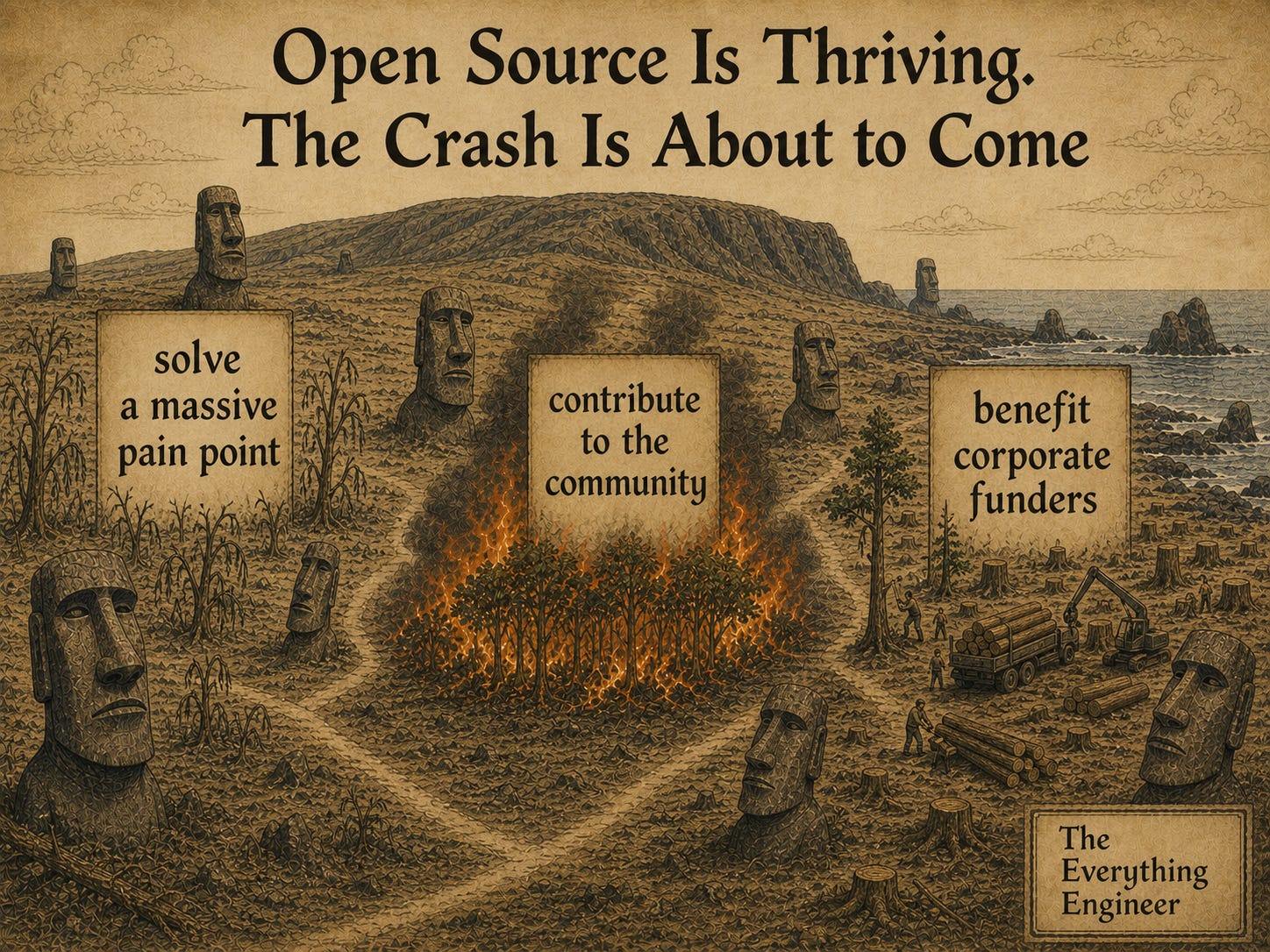
Lately, I’ve been thinking a lot about open source software and the Moai statues of Easter Island.
In Collapse, Jared Diamond describes how the impressive stature of the Moai belies a story of civilizational suicide: a society that kept competing for prestige, building more and bigger statues, stripping away the very resources that sustained them.
The open source ecosystem is doing something hauntingly similar.
From a distance — GitHub repos with 10k+ stars overnight, breathless LinkedIn posts about the new killer AI tool, people screenshotting their commit graphs — it looks like AI has led us into an open source golden age.
But look closely and the trees are disappearing fast. Each of the three pillars that sustain the open source economic model are under pressure:
Quality software that focuses on a massive pain point
A vibrant community of contributors
Corporate relationships that fund the best projects
In this essay, we go through these pillars and why, with the changed economics of AI coding, each of them is rapidly collapsing.
Scroll LinkedIn or Reddit on any given day and you’ll find the same template: someone built a tool over a weekend, open-sourced it to GitHub, and is sharing why you need to know about it. Polished readmes, eye-popping demo sites, active commit histories.
This matches what we’ve learned a thriving open source ecosystem should look like. But look closer, and it’s surprisingly hard to identify if there’s real value in these projects. Many of them are point solutions that claim to solve a problem of the moment (agent memory, token usage), but work inconsistently or only in narrow use cases. They are often one person’s problem solved for that one person, with no sense of design for broader or more durable use cases.
Despite this, these projects get lots of traction on social media, particularly when they are about “AI” — even though I suspect those posting about them never even bother to clone the repos. The lesson is clear: for many, open source is about promotion first and value second. The disconnect between the value a project actually creates and the amount of attention it garners grows bigger daily.
It’s more than a social media hype problem. A peer-reviewed study from Carnegie Mellon University identified 6 million suspected fake stars across nearly 19,000 repositories — and found that less than $200 worth of purchased stars is enough to meet the typical VC seed-round threshold. GitHub signals — once useful for knowing what was useful to others and worth knowing more about — are quickly degrading into commoditized social media assets.
The problem with losing signals like GitHub stars, contribution frequency (AI can push junk commits on whatever frequency you desire), and meaningful downloads is that it’s impossible to determine what’s better and more durable than vibe coding it yourself. Asking your AI agent to investigate won’t help: it will invariably reference the same signals.
And, while we are on the topic of agents, one thing AI coding agents don’t do is unstar repos, complain on Reddit about how a dependency broke its own interface, or vent to their friends about how the bad design of an OS tool increased the tech debt of their codebase. They are always going to prefer the option of a less-stable vibe coded version of a tool, rather than do the work of investing in a project and keeping it focused and honest.
The cost/benefit of hunting for the right open source project — versus just vibe-coding a solution yourself — has never looked worse.
A few years ago, I built and maintained an open source project called ResearchStack — an Android research framework developed to complement Apple’s ResearchKit and expand the breadth of populations that could be reached via mobile research studies.
I thought code & community adoption were going to be the hard part of the project, but quickly found that keeping the community together and aligned on the mission was the truly Sisyphean task. Even when we got the project to its most stable point — with hosted working sessions in NYC, participation from Apple and Google, and working group members at prestigious institutions such as Duke and Cornell — it still felt like everything was a few months out from falling apart.
And, eventually, it did. Members found the work of unifying everybody’s focus tiring. The corporate participants saw the energy peter out and stopped devoting resources. Any open source project eventually collapses under the organizational weight of keeping it relevant with the fast-moving pace of the software ecosystem unless the rewards of strong community, peer recognition, and mission can sustain it.
The economics of that problem have now completely inverted... in the worst possible way.
AI has made contribution essentially free. Filing an issue takes seconds; an agent can file dozens. Writing a pull request no longer requires understanding the codebase, or even the purpose of the project: the model produces something plausible-looking regardless of whether it’s right. The result is open source slacktivism: the feeling of contribution without the depth that made it valuable. More people are contributing than at any point in the history of open source. The average contribution has never been less meaningful, less useful, and the motivation to meaningfully contribute to an open source project’s community has never been smaller.
For maintainers — already doing largely volunteer work — this is brutal. The job of keeping a community focused and motivated was hard enough, but at least it meant something. Now more and more maintainer time is spent wading through meaningless waves of AI-generated noise instead: vague issues, worthless pull requests, social media hype cycles... all without ever talking to an actual human who cares. The Jazzband Python collective shut down entirely this year, citing AI spam as a primary driver. Curl’s creator ended the project’s long-running bug bounty program in January 2026 after submission quality collapsed. GitHub itself considered a kill switch for pull requests in direct response.
While the image of open source is of a group of scrappy developers building in their free time, any truly valuable project eventually finds money to sustain its community and key contributors. Serious open source projects are funded one of two ways. The first is the nonprofit model — foundations, grants, donations from companies that depend on the software. Unfortunately, if you aren’t building Linux, it’s hard to make this model work.
The second model — what I call “OS/SaaS symbiosis” — is what has really powered the explosion of open source over the past twenty years. Companies like Redis, Elastic, and HashiCorp built or adopted open source projects with traction and funded their development as a sales funnel for selling enterprise features added on top, such as single sign-on, SLAs, and support contracts. The model, essentially, is give away the core solution for free; come knocking for money when enterprises are already dependent on it and need to make it compliant.
The symbiosis model, more simply, is a SaaS business crouching inside an open source Trojan horse. Startups get moving fast with the free version, and when they grow into enterprises they pay for the privilege. But, as the stock market has noticed, the SaaS value prop gap is narrowing fast: what once required a six-figure enterprise contract is increasingly something an AI agent can wire together in an afternoon.
This isn’t entirely bad news. As anybody who has done tech procurement can tell you, the model has become overly focused on value extraction instead of value production. “Building for enterprise” often means that these projects get saddled with tons of features that most users don’t want or need, but that everybody pays for with endless configuration hell. In the current AI coding renaissance, it’s more tractable than ever to take an open source core and adapt it for your own environment, or reverse-engineer the specific functionality you need without all the accumulated complexity. Good riddance to paying hundreds of billable hours for “configuration.”
But when the funding spigot starts to sputter, so does support for the valuable open source core project. As a result, myself and others I’ve talked to have begun to notice a disturbing trend with newer “open source” projects: they are more complex to operate, have a heavier dependency matrix, and are less likely to have any contributors who aren’t paid by the companies backing them. As these economics continue to invert, at what point will these companies decide that maintaining an open source project that is useful outside their core enterprise use cases isn’t worth the cost — and what happens when they do?
The tragedy of Easter Island isn’t that the Rapa Nui built the Moai. It’s that the monuments outlasted the civilization. They kept raising the next one as the forests that made everything possible disappeared.
The open source ecosystem is approaching the same precipice, but instead of an ending — could this be a transformation? Next week, in Part 2 of this series, I will make the case that the AI tools and patterns breaking open source as we’ve known it are also clearing ground for something that can fill the gaps being left behind, at least in part.
Next: Part 2 — From packages to skills: the new currency of open source thinking.
Michael Carroll is the founder of Coolhand Labs, which helps engineering teams improve AI outputs using human feedback. He is still recovering from maintaining his last open source project.
No posts
Comments
Nothing yet. Say the first thing.
Sign in to join the conversation.