
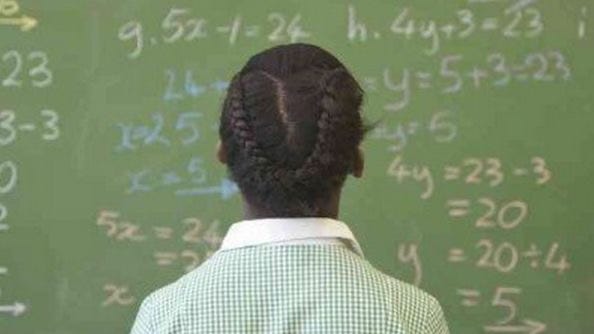
“I’m not a math person.”
I have heard it at parent-teacher conferences, at family cookouts, in barbershops, and in staff meetings.
This is not harmless. It is an inheritance.
Math phobia gets passed down in our community the way a language gets passed down: at the kitchen table, in the offhand comment, in the way a parent winces at a homework page. A child who hears “I was never good at math either” learns something before they ever learn fractions. They learn that math does not belong to them.
I grew up on the South Side of Chicago and in the South Suburbs. Having spent over a decade teaching mathematics to Black and Brown students in Milwaukee and Chicagoland, I can tell you the problem was never our children. It was never you. The problem is what we have allowed mathematics to become: a gate instead of a language.
The Gatekeeper
On April 11, 2006, I was a high school junior watching Oprah Winfrey hand America’s school funding system a failing grade. Her cameras followed a school swap. Students from Harper High School in Chicago’s Englewood walked the halls of Neuqua Valley in Naperville, a $65 million campus 35 miles up the road, and students from Neuqua Valley walked into Harper and through a metal detector.
Neuqua Valley offered its students more than two dozen advanced placement courses, while Harper offered two. And on the state mathematics exam, 0.5% of Harper’s students met standards.
Guess which school was mine. Somebody had decided I was not worth the investment. I understood at sixteen that there was no such thing as fair but equal.
I decided then that I would not simply talk about that broken system. I would spend my life inside it, working to change it.
Algebra decides futures. It determines who reaches advanced coursework, who gets to college, and who enters the fields of science, technology, and finance, where wealth is being built right now.
Civil rights organizer Robert Moses saw this decades ago. Moses looked at the modern economy and concluded that math literacy had become the new front in the freedom struggle. He called algebra a civil right, and in 1982, he founded the Algebra Project to organize communities around it the way he had once organized them around the ballot.
Moses asked “what must change so that all of our students succeed in it?” That reframing shifts the burden from our children to the institutions that serve them.
Nineteen years after that Oprah episode, I went looking for the answer in the data myself. Across 296 Chicagoland high schools, the single strongest predictor of mathematics proficiency among Black and Latino students was not a student characteristic. It was whether their school offered advanced coursework at all. Two dozen courses, or two.
How the Fear Was Built
The phobia did not fall from the sky. It was constructed, generation by generation, by the very institutions that claimed to educate us.
Separate and Unequal: For most of the twentieth century, Black children attended schools that were deliberately unequal: buildings with outdated textbooks, overcrowded classrooms, and often no advanced mathematics courses to take at all. You cannot fall in love with algebra in a school that does not offer it.
The Trap of Tracking: As schools integrated, sorting systems emerged that routed Black students into remedial and vocational tracks regardless of their ability, while their white peers were placed in college-preparatory mathematics. A counselor’s assumption became a schedule. A schedule became a ceiling.
The Silent Catalog: Tracking never really ended; it simply moved into the course catalog. When a school offers two advanced courses instead of two dozen, it has tracked every student in the building before a single one of them walks through the door.
Add chronic underfunding, revolving-door teacher vacancies, and gatekeeping exams designed to sort rather than teach, and the inheritance explains itself. A grandmother who was tracked out of algebra raises a mother who was told to take “business math,” who raises a child who hears “we’re just not math people.”
Three generations, one manufactured fear. What looks like a family trait is actually a paper trail.
Math Is a Language
Mathematics is not a talent. It is not a gene. It is a language, and languages are meant to be passed on.
Nobody says, “I’m not a talking person.” Every community on earth passes its language to its children through daily use, through patience, through the assumption that of course, the child will learn to speak. Imagine if we treated mathematics the same way. Imagine if counting change, comparing prices, reading a lease, and questioning a statistic were as ordinary in our households as telling stories.
Like any language, mathematics can read and write the world. Marilyn Frankenstein named this critical mathematical literacy: using mathematics to see clearly the social arrangements around us, because even a word problem is never neutral. It carries assumptions about how the world works and who it works for. Chicago’s own Eric “Rico” Gutstein turned that idea into practice, teaching students to read and write the world with mathematics.
I watched this happen in my own classroom. One year, I built an algebra unit around Thanos, the Marvel villain who wipes out half of all life with a snap, and turned my students loose on the mathematics behind his plan. Nothing in the curriculum told me to teach it that way. But students who had spent years announcing that they were not math people were suddenly arguing about functions with their whole chests, because for the first time, the mathematics was attached to something they already cared about.
They had the ability all along. What they had never been given was an invitation.
Math With Its Sleeves Rolled Up
That is what my colleagues and I now try to recreate at our family Math Nights. We put mathematics where it actually lives: in a grocery budget, in a recipe doubled for company, in the arithmetic of a paycheck. Off the worksheet. Into the world.
Compare grocery prices in Chatham versus Lincoln Park. Pull the per-pupil funding numbers for your school district and the one or two towns over. Chart the property tax assessments on your block. When the Chicago Tribune did exactly that math in its “Tax Divide” investigation, it found that Cook County had for years overvalued lower-priced homes while undervaluing expensive ones. This shifted the burden onto the neighborhoods least able to carry it and handed quiet discounts to the wealthiest.
When our young people learn to check the numbers, mathematics stops being an alien subject imposed on them and becomes a tool in their hands. It becomes a language of resistance.
Break the Cycle
In November 2025, I defended my dissertation from a room inside the Prairie-Hills district office. Thirty-one years earlier, that space was my kindergarten classroom. I sat there as a doctoral candidate, presenting regression tables on who gets access to advanced mathematics, in the exact square footage where I first learned to count.
My kindergarten teacher, Mrs. Young, logged on to watch. Dr. Metro, the woman who taught me high school algebra, was on that same call. So was my father, a high school social studies teacher for twenty-eight years.
I want to be precise about what that room proves, because it is not a story about me. Nobody handed me a fear of mathematics. People who assumed I was brilliant handed me a language instead. That is the whole difference, and it is reproducible. It is what happens when adults decide, early and out loud, that a child belongs in the conversation.
Where Do We Start?
Our children are returning to classrooms right now, which makes this the exact moment to act.
Parents: Do not pass on math phobia. When your child brings home a math page, resist the urge to announce your own bad memories. Speak about mathematics the way you would speak about any inheritance you want them to have: This belongs to you. You come from people who counted, measured, and built, and you can learn this language.
Educators: Traditional instruction has too often reduced mathematics to memorization and speed drills. We break the cycle when we adopt a high-impact approach instead, one where scholars are consistently invited to engage with a problem, explore its real-world implications, explain their reasoning, and evaluate their findings. Emphasize reasoning over recall, questions over silence, and sense-making over fear.
Communities: The Algebra Project proved that when communities organize around mathematics education, institutions respond. Meet your child’s teacher before there is ever a problem. Ask how mathematics will be taught. Ask what you can do at the kitchen table to match it.
The Stakes
This is urgent. Artificial intelligence is reshaping work, wealth, and power as we speak. The technologies deciding who gets a loan, whose neighborhood gets surveilled, and whose resume gets seen are built on mathematics.
Chicago knows this firsthand. For years, ShotSpotter’s gunshot-detection sensors blanketed Black and Brown neighborhoods almost exclusively, meaning an algorithm decided which blocks got watched, until the city ended the contract in 2024. If our children cannot read that language, those systems will be built about us and without us. If they can, they will be in the rooms where the future is designed.
Mathematics is a gatekeeper or as a gateway. Our own kitchens and classrooms will decide whether the next generation inherits our fear or our fluency.
The first step is simple. Stop passing down the phobia. Start passing down the language. Our children deserve to speak it. Our children deserve to write it. Our children deserve to use it to transform the world.
Dr. David Mikel Etheridge is the principal of Prairie-Hills S.T.E.A.M. Academy in Markham, Illinois, a former high school mathematics teacher, and the author of the dissertation “Mathematics in Crisis: Predictors of Achievement for Black and Latino High School Students Post-COVID-19.”
For just $5 a month, you’re directly investing in Black writers, Black ideas, and the future of independent Black media. Every subscription helps us commission original stories, platform new voices, and continue building E.N.D. into a living hub for revolutionary thought, culture, education, and community.
Thank you for helping us build something that belongs to us.
No posts
Comments
Nothing yet. Say the first thing.
Sign in to join the conversation.