
Everybody becomes a genius after a Black child dies.
Before the family has received answers, before the investigation has settled, and sometimes before the body has even been properly laid to rest, strangers begin rewriting the final days.
Eighteen-year-old Nolan Wells disappeared during a July Fourth trip to Horn Island with three white friends. Two days later, his body was found. The circumstances of his death remain unresolved, and that uncertainty should’ve made the rest of us more careful with our mouths.
Instead, uncertainty opened a door through which everybody’s opinions have walked in wearing dusty shoes.
People who never packed Nolan’s lunch, waited for him after practice, learned the sound of his footsteps, argued with him, forgave him, worried over him, or loved him have appointed themselves experts on the decision that would’ve “kept him alive.” Strangers on the internet are explaining what his parents should’ve noticed, forbidden, questioned, predicted, and somehow known before there was anything concrete for them to know. They don’t have the truth, but they have instructions.
Every “they should’ve known” contains an “I would’ve known,” and that hidden sentence is the comfort they came for.
They can’t return Nolan to the people calling his name, but they can make sure the internet knows they believe their own children would still be alive.
The first act of violence after a Black child dies is sometimes the public’s decision to place the people who loved him on trial.
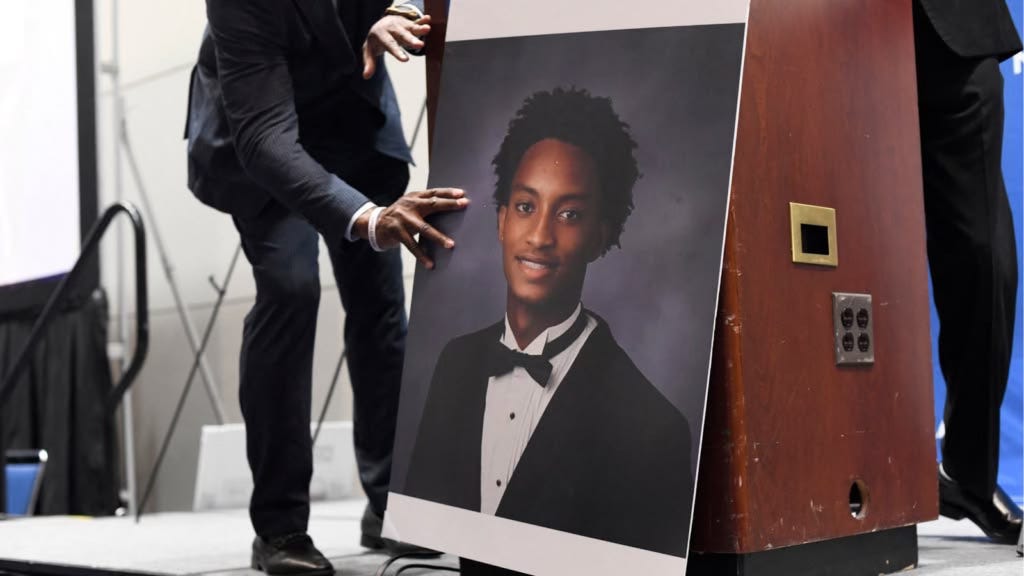
One of the loudest verdicts has been that Nolan’s parents shouldn’t have allowed him to be socialized around so many white people.That assumes danger announces itself. I understand the fear because Black folks have centuries of evidence that proximity to whiteness can become dangerous without warning, witnesses, accountability, or consequence. I also understand the desperate urge to travel backward, move one choice, erase one friendship, close one door, and create an ending where a family gets its child back. But even we know that harm and violence don’t work that way. Nolan’s death is no one’s fault but the people who murdered him.
There’s something merciless about the way the Wells are being treated.
People have said Nolan’s parents “should’ve known better” than to let him travel with white friends. Others insist Black parents shouldn’t teach their children to fear white people. They say eighteen is old enough to make his own choices, while still holding his parents responsible for choices they could no longer control.
They all contradict one another.
Protect him without isolating him. Prepare him for racism without teaching him to expect it. Give him independence while somehow remaining responsible for every danger he encounters outside your sight.
What people are describing as parenting is actually prophecy.
Let’s travel back in time.
I grew up around a lot of white people, so whiteness wasn’t an abstract political category in my childhood; it was many rooms where I sometimes belonged until something reminded me that belonging had terms. I learned early that being welcomed and
being protected aren’t the same experience because the white children around me bullied me so thoroughly that entire parts of my childhood became something I had to survive.
They made my life a living hell while I was already experiencing hell at home. The impact didn’t disappear because I grew up, changed schools, found a career, or learned more socially acceptable language for what they had done.
I’m not one of those Black people who can say I grew up around white people and came away loving them; I came away carrying fear, humiliation, rage, and a hatred I didn’t develop from theory, headlines, or somebody else’s politics. A person can know our favourite food, sleep in our home, call our parents by their first names, and still reach for the oldest story about Blackness when fear, conflict, embarrassment, or self-preservation enters the room.
That’s why the conversation around Nolan feels so electrically familiar: racism can come through someone close enough to convince us they’re safe, someone who has laughed with us, played beside us, called us family, and never imagined themselves capable of abandoning us.
Freedom where?
Where can I lock a Black child in a race-free room? Proximity can get us invited into the photograph, welcomed into the house, and included in the memory while still leaving us undefended when the story changes.
My father, Paul Smithers, lived through what can happen when a Black boy enters a predominantly white world believing talent, familiarity, discipline, and participation might be enough to keep him safe there.
My father was sixteen on February 18, 1973, when hockey stopped being only a game and became the beginning of a legal story that would follow him for the rest of his life. At Cawthra Park Arena in Mississauga, Ontario, Canada, he was one of the only Black boys in that hockey world. An exceptional player with NHL aspirations, a teenager whose future seemed to be moving toward him before courts, casebooks, and legal summaries began carrying his name for another reason. Hewas a gifted Black boy in a white-dominated sport that promised discipline, teamwork, toughness, sacrifice, and belonging while asking him to tolerate the racism that kept testing whether any of that belonging was real.
Barrie Cobby was a white player from an opposing team whom my father had encountered repeatedly throughout his hockey career. He had taunted my father before, and during that game, the harassment escalated into racial insults directed at him and derogatory remarks about my grandmother.
People in the arena were shouting for opposing players to “get the n*****.”
Yeah, the hard “er.”
Racism was conduct that had been repeated, witnessed, and allowed to accumulate while the adults around them failed to interrupt it. After the game, Cobby came outside with his friends, and my father demanded an apology from him. He was a sixteen-year-old Black boy asking for acknowledgment that what had been said to him and about his mother was unacceptable, after being taught that his talent could be welcomed while his dignity remained negotiable. Cobby refused, the confrontation escalated, and several white players from the opposing team grabbed and held my father down as he struggled to free himself. While pinned beneath them, my father kicked out in an effort to get free. That kick later became the centre of the case.
Cobby died after a rare medical chain involving fear, shock, vomiting, aspiration, asphyxia, and a malfunctioning epiglottis. My father was convicted of manslaughter, and the Supreme Court of Canada later held that the Crown didn’t need to prove the kick was the sole or primary cause of death, only that it contributed beyond the trivial range. My father’s name became Canadian legal doctrine. R. v. Smithers is still taught as a foundational criminal-law case on causation, while the Black boy whose life produced that doctrine largely disappears from what students are taught to remember.
In legal terms, Canada gained a leading rule on criminal causation and the thin-skull principle. In human terms, it learned how to isolate an act from the racial and institutional conditions that preceded it, transforming a racially targeted Black teenager into a legal principle before asking what it meant for hockey to invite his talent, leave him unprotected, and then hand the aftermath to the courts.
I grew up as the daughter of a man whose adolescence had already been translated into courtroom language before I was born.
By the time I understood the case, I also understood that institutions can preserve every procedural detail while misplacing the person at the centre of the record. Law students have encountered my father’s name as a test for causation without ever knowing his laugh, his dreams, the shape of the future he thought hockey might give him, or what it costs a family when one terrible afternoon is allowed to become the longest description of a life.
I inherited more than the facts of what happened. I inherited an awareness that Black boys are often required to survive the original harm and then survive the official story told about how they responded to it.
I can’t read people’s instructions for Nolan’s parents without hearing all the things strangers could say my father should’ve done differently: he shouldn’t have waited for an apology, shouldn’t have confronted anybody, shouldn’t have expected decency from boys who had already shown him cruelty, shouldn’t have played hockey, shouldn’t have been there, shouldn’t have reacted, and should’ve known exactly when to leave the white world before it turned on him.
Every direction asks a sixteen-year-old Black boy to possess more foresight, restraint, emotional regulation, racial analysis, and strategic planning than the adults and institutions surrounding him, while moving responsibility away from the people who created the conditions he was expected to navigate perfectly. Knowing white people didn’t grant my father immunity from racism, and being known by white people didn’t guarantee they would tell the whole truth about him once telling it became costly. Some days, I wonder how much of my life’s instinct to flip every table began with knowing nobody flipped enough of them for him.
And when the world refuses to reckon with what it did to a Black boy, it almost always turns around and asks what a Black woman failed to do.
If the mother failed, then tragedy has a rule—and everybody else can believe they know how to follow it. Black mothers are expected to function like emergency-management systems inside conditions they didn’t create. The public imagines that a good Black mother should know where her child is, who he’s with, what everybody around him secretly believes, which danger is approaching, and what decision must be made before the threat reveals itself:
If she watches closely, she’s controlling; if she gives him room to grow, she’s careless; if she warns him about white people, she’s teaching division; if she allows white friendships, she should’ve known better. Even when a Black father is present and loving, the mother is often treated as the final checkpoint through which tragedy should never have been permitted to pass.
Black women are expected to raise a confident son while filling his pockets with enough fear to keep him alive. That’s an impossible assignment disguised as parenting advice. Black parents already teach names to avoid, tones to soften, hands to keep visible, exits to notice, calls to make, instincts to trust, and rules many white families get to dismiss as excessive.. No parent should have to prove they performed vigilance at a supernatural level before the public agrees their child deserved to come home.
The verdict, if there is one, circling Nolan’s family isn’t new. Karmelo Anthony. Cesar Vernaza Vinces. Jabari Peoples. Different circumstances, different facts, but the same public appetite for deciding what Black families should’ve known, prevented, taught, noticed, or done differently. Google the names. Read the comments. The circumstances change; the audit of Black families doesn’t.
There’s a reason people rush toward parenting audits before the facts have settled. If Nolan’s parents made the wrong choice, then other parents can make the right one; if his death was preventable through perfect vigilance, then the world hasn’t become as uncontrollable as it feels. Blame lets frightened people mistake explanation for protection.
Black families are especially useful containers for this fantasy because the public has always treated their parenting as public property. The family must mourn and defend itself at once, answering strangers’ theories while trying to understand an absence that has rearranged every room in their home. They must say their child’s name with love while the internet says it like a debate topic. The comments arrive disguised as concern, racial awareness, caution, common sense, and hard truth, but many are cruelty trying to earn intellectual credibility. The arrogance is believing another family’s devastation proves your superior instincts rather than how little any of us controls.
Nolan Wells isn’t a warning against allowing Black children to have white friends, and he isn’t an empty page for strangers to fill with racial fears while his family fights for answers. His life held more than the final days the public is dissecting, and his family deserves room to grieve without proving they loved him correctly.
My father’s story reminds me that this instinct is older than the internet. More than fifty years ago, people could explain everything a sixteen-year-old Black boy should’ve done differently while giving far less attention to what had already been done to him. The details change, but hindsight still has a way of making everyone feel smarter than the people who actually lived through the harm.
Everybody becomes a genius after a Black child dies, but some things don’t require your “genius.” They require you to shut up.
For just $5 a month, you’re directly investing in Black writers, Black ideas, and the future of independent Black media. Every subscription helps us commission original stories, platform new voices, and continue building E.N.D. into a living hub for revolutionary thought, culture, education, and community.
Thank you for helping us build something that belongs to us.
No posts
Comments
Nothing yet. Say the first thing.
Sign in to join the conversation.