
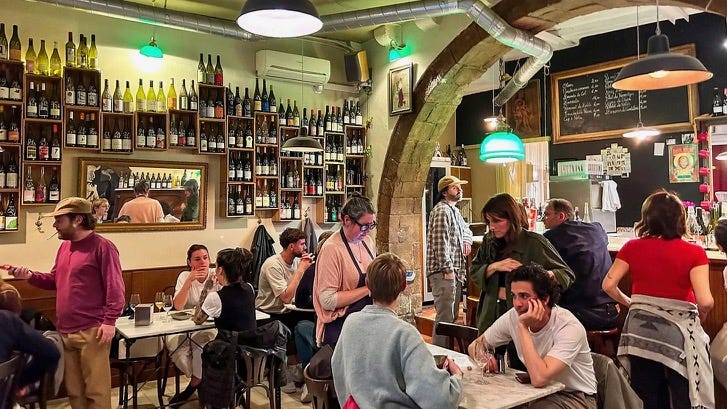
Sarah Sioli writes the newsletter Next Tasting and is one of our favorite Barcelona wine people. You may remember her appearance in “Am I a Verdejo Hater” back in February. This is the third piece in our Barcelona-themed series, starting with my travel guide to the city and continuing with Nika Shevela’s feature on its bodegas.
There’s a paradox anyone who cares about wine, gastronomic culture, and cities will recognize.
When I go out to eat and drink in Barcelona, I almost always have to choose between two things I love: the kind of bar that feels like home, and the kind of wine I actually want in my glass. In this city, those two things rarely live under the same roof. It’s happening in many cities where bars are still part of daily life, just as natural and low-intervention wines are gaining ground. Paris is the exception, but I’ll come back to that.
Let me back up.
I’m from Rio de Janeiro. I had lived there for 25 years, and I grew up inside the most democratic bar culture in the world. In places like Pavão Azul, Bracarense, Braseiro da Gávea, Adega Pérola, Nova Capela, Bar Urca, a famous soap opera actress can be eating next to a musician, next to a college kid (like me and my friends), next to a federal judge, next to a teacher, or a guy who fixes your car. Nobody looks twice. The classic bar wood or simple plastic chair, the bolinho de bacalhau, the price is the same for everyone. The bar in Rio is the great equalizer (as is the beach). In São Paulo, every bar has its tribe. Of dozens of cities I’ve visited, only Marseille has come close.
I arrived in Spain in 2008 already trained to love that kind of bar—bar as common space, as ritual, accessible, lively, crowded. And Spain didn’t disappoint. The counter, the racks of tapas behind glass or fresh from the kitchen, the wood walls stained by decades, the kitsch portraits, the catholic figures mixed with soccer stars, the absurd conversation. In Madrid especially, strangers start talking to your group within ten minutes. Through Andalucía, the Basque Country, Asturias, Castilla y León, Navarra, and Catalonia—where I’ve been living for ten years—I built my Spain through these bars. For a year, I commuted to Madrid weekly and sometimes planned my after-work around one specific taberna. The bar in Spain isn’t a hospitality category: It’s the operating system of social life.
In parallel, my relationship with wine was changing. And wine—more than beer or vermut, the other bar stars—is Spain’s deepest artisanal tradition on drinks. There are thousands of years of vines, families, and soils in a glass.
I’ve been drinking natural wine for eleven years, and almost exclusively for the last six. It’s a bit like Plato’s cave. For years I’d been drinking the shadows on the wall, thinking they were the thing itself. Then somebody showed me the actual tree under the actual sun, and I stopped being able to go back.
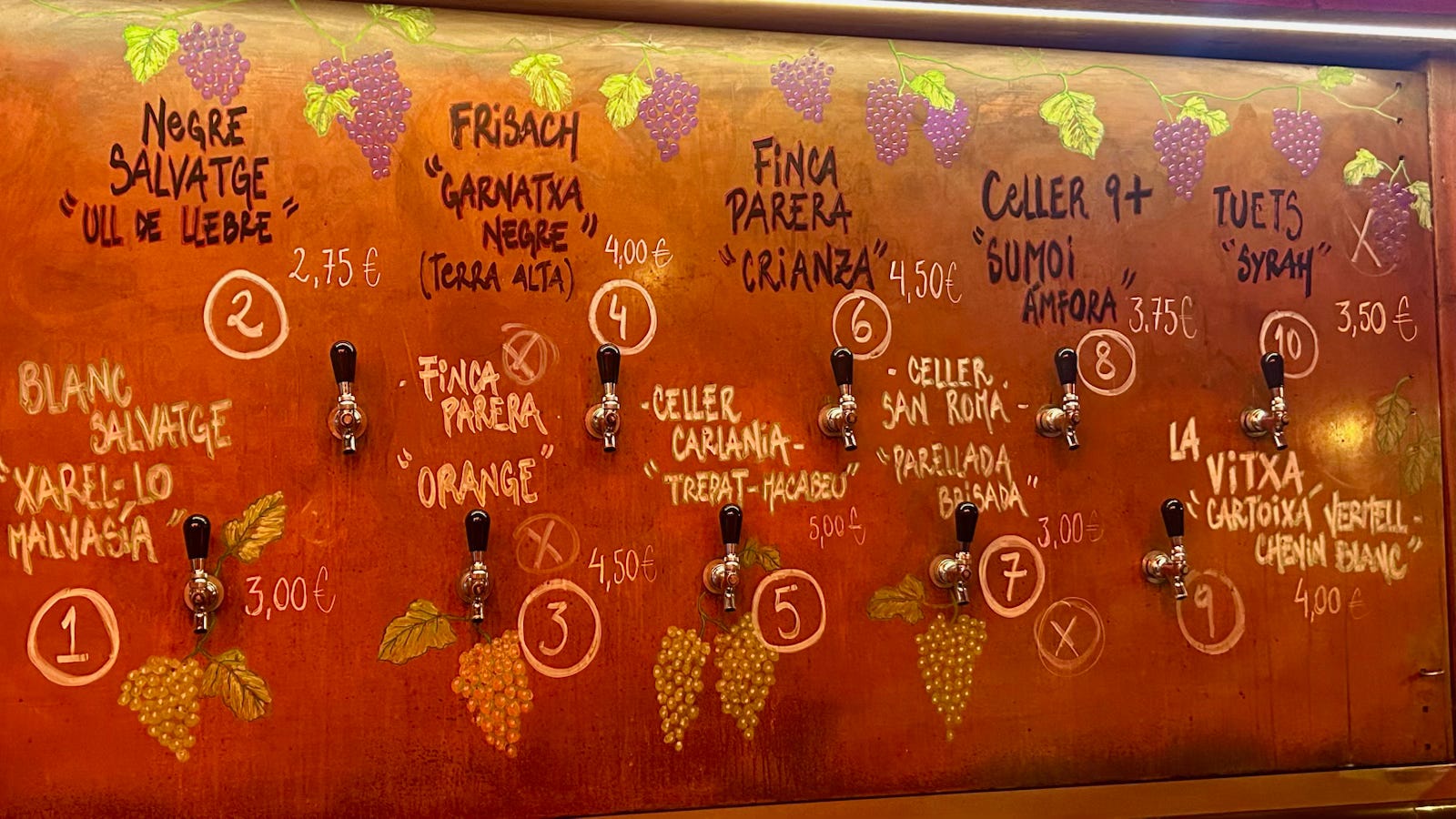
For many people, the shadows are fine—they don’t taste the makeup, the corrections, the industrial yeast, the residual sugar engineered to flatter the mass market. For me, once I saw the tree, the shadow stopped being acceptable. I had this insight with Verdejo: for years I always ordered Albariño because I couldn’t stand Verdejo — now I’m a huge fan of the natural versions from Esmeralda García, Microbio, Cantalapiedra. And for the price of a respectable industrial wine, you can buy a beautiful, alive natural one. So I do.
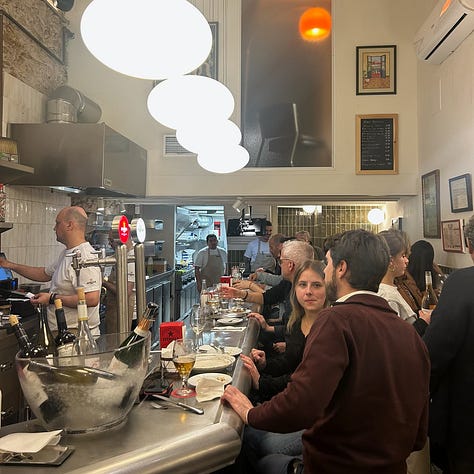
And here’s where the paradox lands. When I commit to natural wine, I’m almost automatically committing to leaving Spanish bar culture. The natural wine list lives in different kinds of rooms: a Michelin star restaurant or the bar where the tapa has become the platillo — smaller, minimalist, often pretentious, more expensive. The wood has become stainless steel. The kitsch portraits are gone, replaced by minimalist reproductions and photo prints. The crowd has become the modernillos—Spanish for the “cool kids.” The waiter speaks English first (myself included, when I’m speaking four languages in one room and my brain cracks). The music is the same playlist you’d hear in Copenhagen or Mexico City. The chairs are probably copies of a famous Nordic firm.
These places are what the anthropologist Marc Augé called non-places: Spaces designed to feel anywhere. I love a few of them, and the wine is genuinely beautiful. But when I walk in, I don’t feel like I’m in Spain.
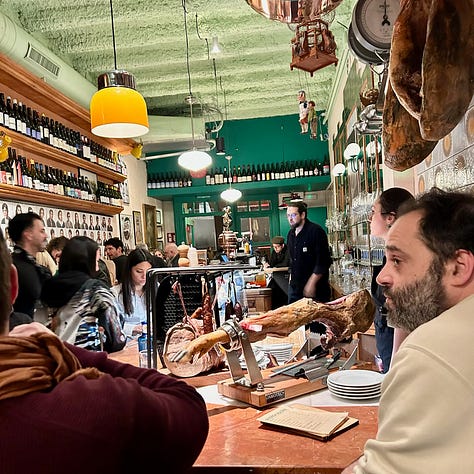
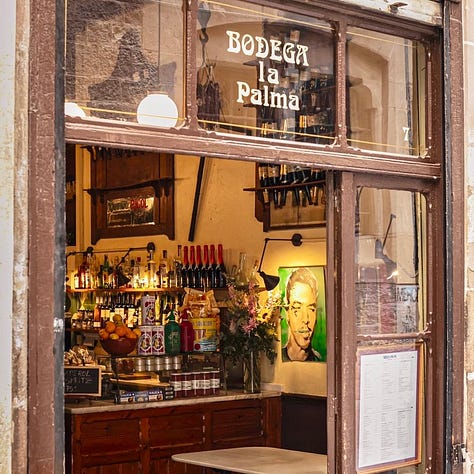
Meanwhile, the bars that do feel like Spain—the actual bodegas, the family-run tabernas, the spots where multi-generational people work at the counter—pour wine made for industrial scale. Big-volume supermarket Rioja, the fruity verdejo—wines from wineries that fix the acidity, correct the color, engineer a perfect “average” taste. The menu is filled with local recipes. The walls tell a story. The crowd is exactly the cross-section I love. But the wine is industrial.
So you choose. The bar that feels like home, or the wine that tells a story. Lately, choosing the wine, I’ve started feeling detached from Spanish culture — bars and restaurants are exactly where a foreigner like me feels connected to the place. But this isn’t just about wine. People who go only for the food feel the same shift. And it isn’t just foreigners: locals feel it too. This Spanish bar culture is changing—and vanishing. But this is a topic for another article!
Coming back to wines, the reasons are many. A traditional bodega can’t easily get four cases of a small natural producer when industrial reps deliver pallets. An entry-level natural feels risky for clients used to predictable taste. Even in France, natural is just one to two percent of the market—though inside that tiny world the variety is huge, and it increasingly features on Michelin-starred menus. And the new drinkers who care about natural wine also love the international design language that came with it.
Paris doesn’t have this paradox. There, natural wine entered the bistrot tradition back in the 1980s through people like Jean-Pierre Robinot (a bar owner before becoming an iconic Loire winemaker), and by the early 2000s it was at Le Baratin, Aux Deux Amis, and many more—bars and restaurants that look and feel like proper Paris, because the modern natural wine movement was born in France. Today, spots like Martin in the 11ᵉ are so low-key you’d never know you’re in a “nat wine bar.” The continuity was preserved. In most other big cities, it wasn’t.
Barcelona has exceptions: Maitea in the Eixample, Els Tres Porquets in Poblenou, El Cortijo in Tarragona. Bodega Solera is a new-version bodega: kitsch portraits on the wall, a leg of jamón ibérico over the marble counter, and the best natural wine by the glass selection in the city, imho. But they’re far from the rule. L’Anima del Vi, the city’s first natural wine bar and a place I worship, feels like a cozy French bar—something Barcelona oddly lacks, given how many French people live here. But Picasso’s Guernica over the old piano hints at where we actually are: Estamos en España, carajo!
It’s a cultural pairing crisis. And what I keep wanting is something so simple it almost sounds silly: a hearty tapa in a Spanish bodega with a cultural story, paired with a wine that tells about the culture of a place too.
That shouldn’t be a contradiction. But in Barcelona right now—and almost everywhere in the world—it is. I’m wishing for a movement that puts the Spanish bar with soul, and the Spanish wine with soul, in the same room.
No posts
Comments
Nothing yet. Say the first thing.
Sign in to join the conversation.