
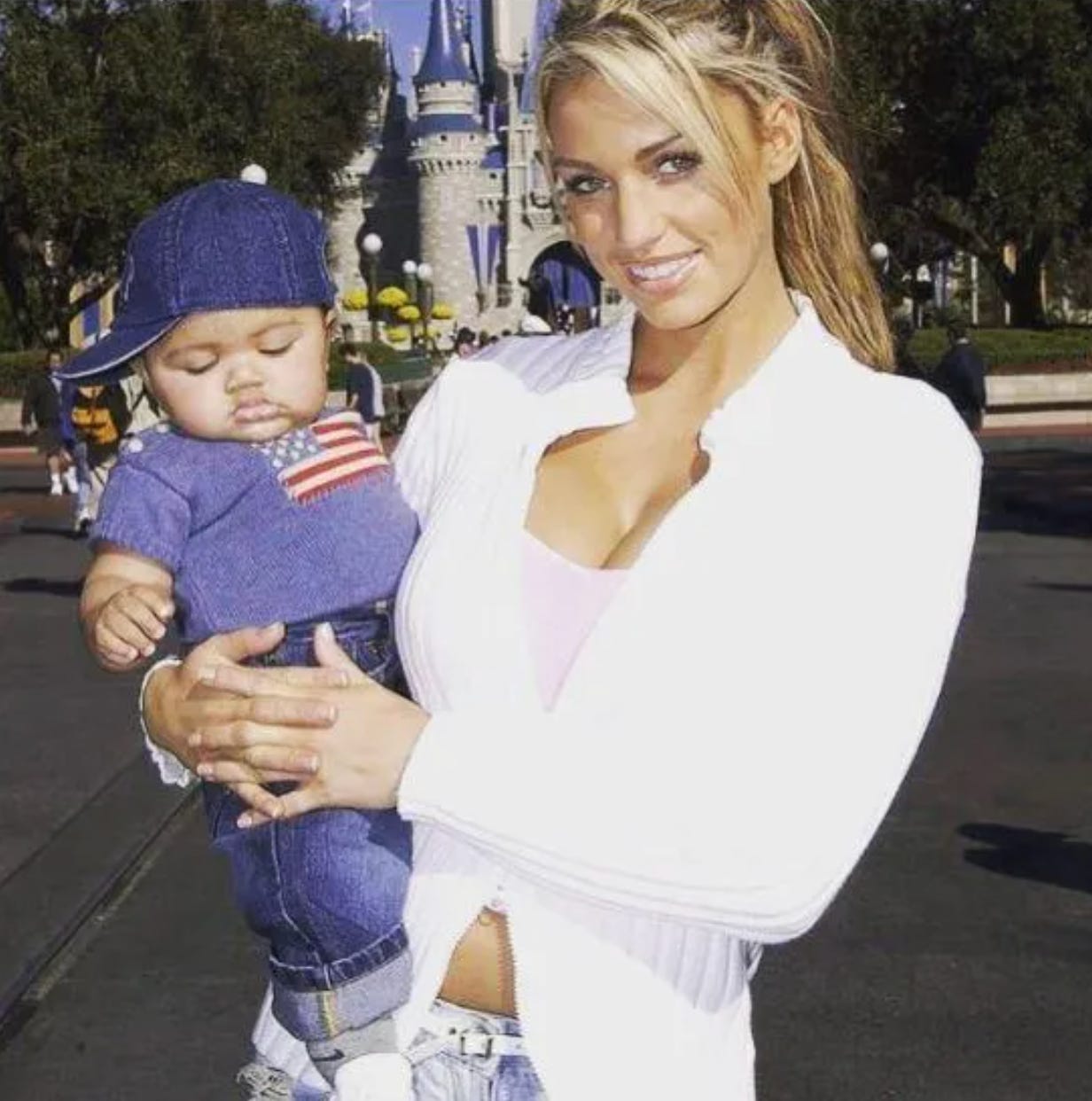
Has it ever been easier to be a bad mother? Watching the Katie Price documentary, where they pick through old headlines calling her, variously, a “bad mum” and the “mother from hell”, made me think about the moving goalposts of motherhood two decades later. I wondered what’s changed, what remains, and what these keen little shifts tell us about the way the world sees women today.
I’m typing this, you should know, from the floor of my son’s room where he’s acting out for me in Lego and light interpretive dance the plot of an imaginary addition to the Jurassic Park franchise. I’m offering regular gasps and sometimes a hmm, but the laptop is open of course and we can both tell my heart’s not in it. Everybody thinks they know what a bad mother is, until perhaps, they become one themselves. On paper it’s a woman who is neglectful and abusive to her child – maybe they are brutal, maybe simply absent. Off paper, however, online and in the tart and vigilant minds of those who frequently comment there, someone might see themselves labelled a bad mother for far less violent reasons – for working full-time for example, and enjoying it, or for sharing a picture of their child in a messy home, or for sharing a picture of their child at all.
The most disturbing one for me is when somebody becomes a bad mother for attempting to talk honestly about their life, by which I mean saying it is sometimes, occasionally, shit. This one’s jarring because it’s the one I’ve been personally accused of in comments beneath a column, other times in emails sent to my work address by a woman called, if I remember correctly, Sue. Yes, in the tabloid days in which Price reigned, the lines were more distinct – the mother was either a villain or saint (with race and class inevitably wound tightly through these labels), but now even the women who once were saints are sinful. Those who might previously have been venerated for maintaining, say, an appearance of glamour while raising children, are now just as quickly chastised for their horrible vanity. Mothers with concerns about their children’s health or education are less likely to be celebrated for advocating for them than judged for a smothering overreaction. Today we mother on black ice.
Ej Dickson, author of the new book One Bad Mother, says there has been a distinct rise in mother-shaming because, in this age of social media, “participating in our society is like living in a panopticon”. This was the philosopher Jeremy Bentham’s design for a prison where a central watchtower is surrounded by a circle of cells – because inmates can’t see the guard, they must assume they’re being constantly surveilled. And the result is that people, women, mothers, not only police their own behaviours but those of everyone around them too, with rules that are constantly changing yet infinitely punishable.
There are a number of political tweaks, like fully public-funded childcare provisions and the end of welfare cuts, and fair pay, and formalised social and community support, that could make it materially easier for women to be better mothers. But to be seen as a good mother requires an entirely different set of changes, many of which remain vaguely unthinkable as long as the internet stays switched on.
Dickson found that, for all its implied ancientness, the concept of the good or bad mother is relatively new. It was during the industrial revolution, when women found themselves recast as nurturing housewives, their husbands out working in the factory, that a moral fog settled upon their homes. And every time women have been allowed a flake of independence since, like after World War II, a conservative backlash has led to ever more impossible standards for mothers to meet. Says Dickson, we’re living through a moment like that right now.
While it feels increasingly hard to escape commentary about bad mothers, whether actors, pop stars, influencers or members, even, of your school PTA, it remains rare that either the tabloids or the algorithms will offer opinion on the iniquities of a dad. When Katie Price was being called “the mother from hell” for going to nightclubs while her son was a baby, his father, the footballer Dwight Yorke, was entirely absent. The bad dad goes unjudged, partly because misogyny refocuses the eye on mothers alone, but also because fathers are still held largely unaccountable for the rearing of their children. They’re allowed to continue as embodied human beings, containing conflict, ambition, responsibility and desire, rather than good or bad, dominated, domesticated, “dads”.
Is it really any wonder that women are having fewer children? Or that
Comments
Nothing yet. Say the first thing.
Sign in to join the conversation.