
Do you know who I feel sorry for? The 50 or so people wearing the Meta AI-enhanced camera glasses who are neither pervert nor creep. Can you imagine?
You’re just a gentle guy looking to, I don’t know, film yourself cooking paella for your burgeoning social media channel Rice To Meet You, or want a hands-free map to guide you through a walking holiday in Madeira (while filming it for your travel blog, You Don’t Have To Be Madeira To Walk Here) but when you put the glasses on, boom, scorned – people think you’re weird. You! It’s instant. You’re trying to document your experience, you’re trying to record the normal hubbub of a sweet Portuguese cafe. But the second those around you notice your glasses and their tiny little “I’m watching you” light they go silent. They start awkwardly exiting, or else lightly performing for the camera, forgetting how to drink from a coffee cup or lean on a counter, and there’s no chance of normal life continuing at all.
I feel for these smart glasses owners, who have probably never even thought about wearing theirs while performing a bikini wax on a client (happened in New York) or filming themselves harassing women in the street (undoubtedly happening right now, and being turned into content by manosphere influencers online) or using them to film sex without the other person’s consent (man fined £800 at Warrington Magistrates’ Court in January) or filming strangers in the toilets of an LGBTQ event in an attempt to “document grooming” (happened at Naples Pridefest in May) or using them to surveil immigrant communities and peaceful activists (ICE agents across the US). And yet, non-creep, when you put the glasses on, these are your people.
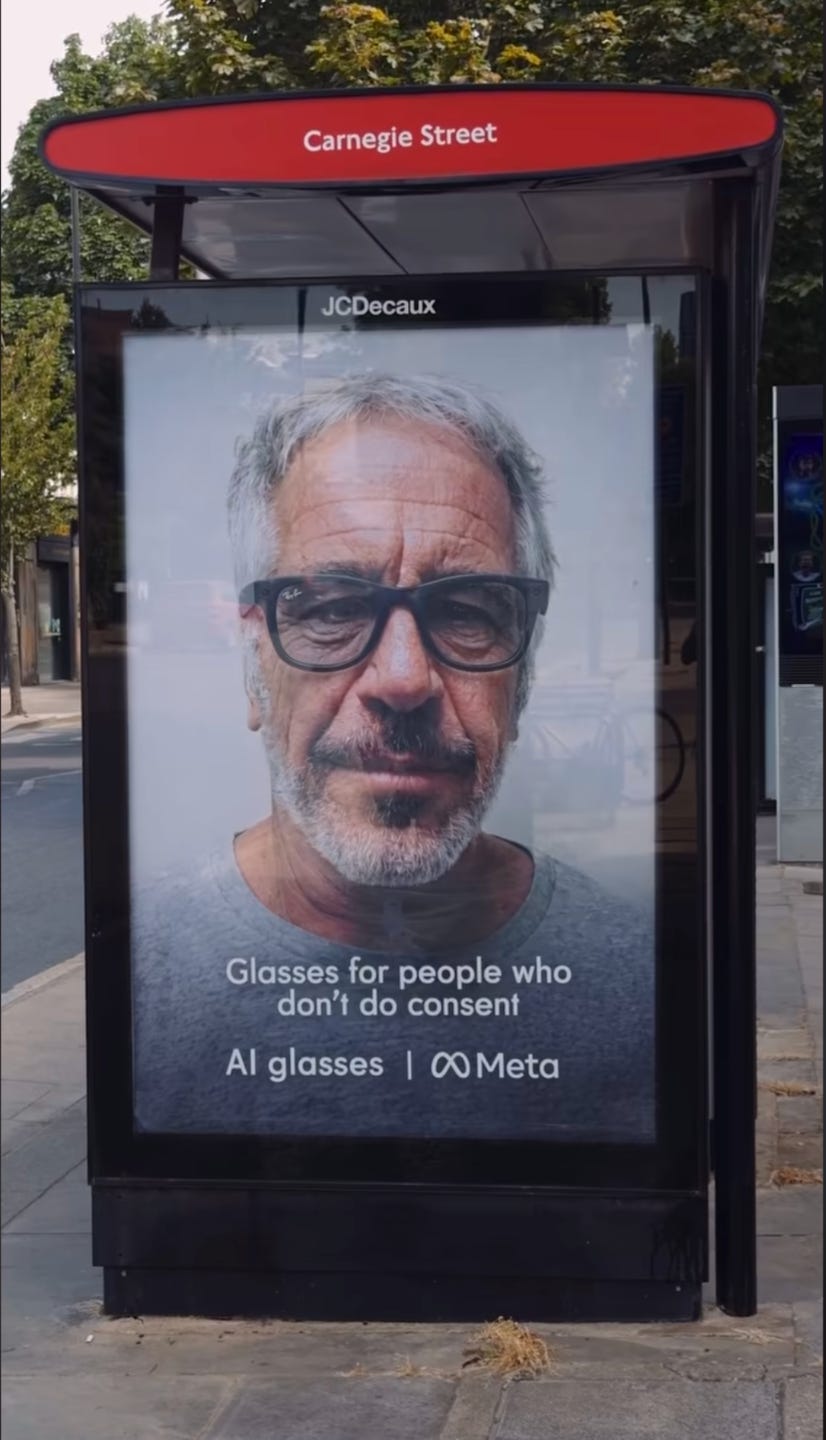
The pushback to these glasses has been fast, witty and regularly livid. A new app, called Nearby Glasses, uses Bluetooth signals to locate people wearing them. On bus stops in London posters appeared featuring the face of Jeffrey Epstein in Meta glasses, and the line “Glasses for people who don’t do consent”. Another advert saw the portrait of Kylie Jenner in her Meta glasses tagged, “We’re always watching”. Advice follows. On Instagram, videos alert women to play Disney songs if they suspect somebody is surreptitiously filming them, the idea being that Disney’s automated copyright detection algorithms will block any video captured by the glasses without consent.
With every new story it becomes more and more clear how voyeurism is baked into the business model. In February it was reported that Kenyan contractors, hired to train AI systems and check the glasses’ visual-query feature, were forced to review footage of nudity, sex, personal financial details and people on the toilet. Meta addressed this by simply ending the contract.
Much of the pushback to the Meta glasses comes from Gen Z, who, having grown up fluent in ideas about consent and privacy, see in them overt opportunities for abuse, extortion and government surveillance. And yet, they’re still buying these things! After debuting a design from the company behind Ray Bans, and a huge push through social-media influencers like Jenner, last year alone over seven million were sold. Which means the news of their rottenness, the sticky grey mess of it, this thing that wants to capture our time, money, desires, that wants to watch as we crawl unaided through the rubble of a once private life, is not cutting through. The answer is to impose stigma. The answer, and I say this with love, is to judge.
Until legislation catches up with technology and bans these glasses in public places, children should be taught to recognise what are now widely being called “pervert glasses”, and to walk away, or loudly tell a grown-up they think that guy over there is filming them. Adults the same, but with the added responsibility of laughing at, shunning, or (if the owner is one of the 50 or so aforementioned non-creeps) actively explaining their concerns. I love the idea of fashion as resistance too, promoted by new designers who work with “adversarial patterns” in their clothes – carefully designed shapes and colours intended to exploit weaknesses in computer vision systems. Imagine if Kylie Jenner decided to wear one of these garments instead of a pair of pervert glasses. Imagine how the sands could shift.
Comments
Nothing yet. Say the first thing.
Sign in to join the conversation.