
Hello valued subscribers and loyal readers. Thank you for your continued support of this newsletter!
We are moving in a new direction here, so over the course of the next few posts, I will be introducing my unified theory of problem solving.
Here at Problem Solving Incorporated, my goal has always been to explore and teach true mastery of this discipline. In the past, the focus of the articles have largely leaned toward the philosophy of problem solving, examining the fundamental nature of problems themselves, what they are, how they started, how to understand them, the WHY. In the problem solving equation, of course, you are the WHO, the problem solver.
But understanding the nature of a problem is only half the equation. To me, trying to solve problems without a clear methodology is like driving a car without knowing how the engine works. It functions perfectly until it breaks down. Then what?
No matter how well you may understand how your automobile functions, at some point when it breaks down, you (or somebody else like a mechanic, who, after all, is a professional problem solver) must fix it, or solve the problem. The HOW then becomes crucial to the solution, not just the WHAT.
PROBLEMOLOGY - THE SCIENCE OF SOLVING PROBLEMS is the method: It is the WHERE you can turn to find both the tools and techniques necessary to attack ANY PROBLEM.
Incorporating strategies from many distinct areas of problem solving, it offers a comprehensive toolkit that many current approaches lack, ignore, or overlook.
Utilizing a unique approach in symbolically visualizing problems as systems of interconnected nodes, it borrows from graph theory. Representing problems symbolically becomes the method of graphically understanding them more precisely, leading to insights that many problem solving systems cannot reveal.
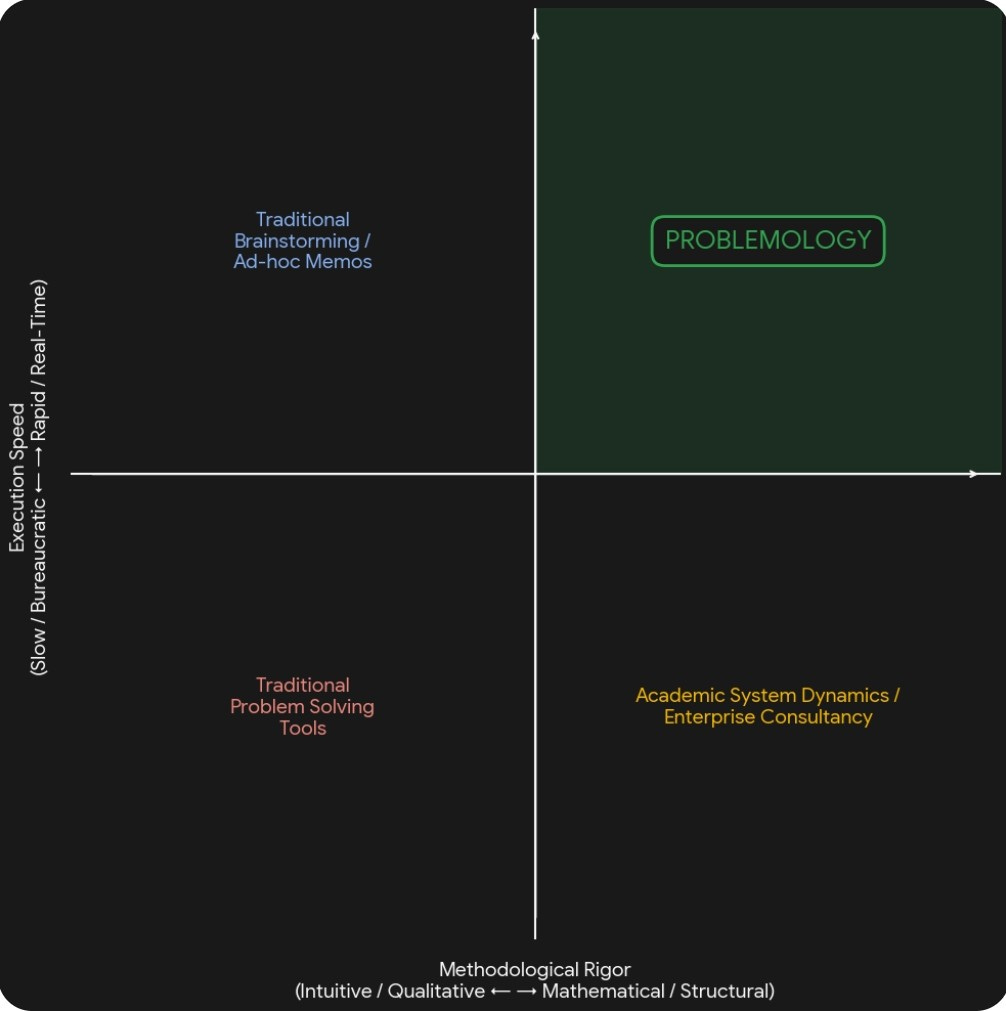
Problemology addresses many different avenues of attack on challenging problems that to date have been unexplored. This new way of representing problems brings a fuller vision of the landscape of potential solutions. Its utility has great practicality and usefulness from everyday problems all the way to complex business issues.
In the context of business or personal issues, problems are often approached with the unstated goal of subtracting “pain points.”
Problems are not isolated events; they are networks. When you attempt a superficial subtraction, you enter a dangerous loop. Without a "full expression" of the problem, your quick fix inadvertently triggers hidden variables, multiplying the mess across the rest of the system.
Rarely are such problems solved. Often, in attempting such subtraction, many parts of the problem system get multiplied unknowingly. Rather than creating a solution with zero or near zero side effects, certain popular methods can exacerbate, or make worse, other problem variables and conditions.
Without a “full expression" of the problem, with both visual and mathematical techniques, the solution is often sub-optimal.
Furthermore, representing problems symbolically allows us to graphically map them with clinical precision, revealing critical insights that traditional systems completely ignore.
Problemology steps in to a crowded marketplace of problem solving methodologies; however, its power of both visual and mathematical representation make it uniquely suited to furthering complex problem solving strategies, professional operations, and cognitive research. It also provides the tools and techniques necessary to attack any challenge.
Over the coming weeks, we will begin unveiling the official canon of this science, starting with the First Three Laws of Problemology.
Of note, there will be a new emphasis on graphical and symbolic representation of problems. Each future newsletter will have at least one graphic or equation exploring the ideas discussed, in order to solidify the concepts and suggest potential applications.
Remember: Always look for the hidden equation. Solve that.
Happy Problem Solving!
Evan J. Sillings
Thanks for reading Problem Solving Incorporated! This post is public so feel free to share it.
What do you think of this new applied scientific problem solving direction?
Reply in the comments with the a problem you feel might benefit from PROBLEMOLOGY, and I will choose one to break down symbolically in an upcoming edition.
Please encourage others who may be interested in becoming better problem solvers to subscribe to this newsletter. The bigger the community we can build together ensures that we can help one another tackle challenging problems. There are plenty out there…
No posts
Comments
Nothing yet. Say the first thing.
Sign in to join the conversation.