
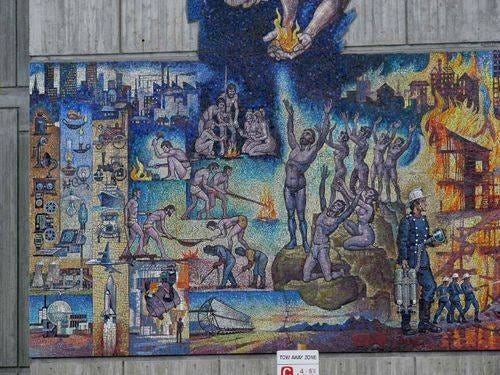
The following theses represent a summary of my current thoughts about AI, though just like last time, somewhat disorganised.
1) AI represents (among other things) a potential to affordably accomplish with computers many of the tasks which otherwise require significant amounts of human effort and most principally thought.
2) There are, however, valid reasons to doubt, at least in the short term, whether AI truly exists to the extent claimed and with the human-replacing capabilities often attributed to it. These doubts stem from concerns about: (1) the affordability of AI for businesses once companies such as Microsoft, OpenAI, and Anthropic begin charging prices that more accurately reflect the true cost of their services; (2) AI’s ability to continue obtaining genuinely high-quality information (the so-called “model collapse” problem); and (3) its harmful impact on the climate. For the purposes of the remainder of this text, however, I will assume that none of these factors will prove to be significant obstacles.
3) AI is trained on billions of inputs: texts, books, videos, scientific studies, newspapers, the entire internet, and more. Based on these inputs, it learns which words statistically fit together best in different contexts. In the case of images, it learns which pixels and colors statistically fit together best based on the context of the user’s prompt.
Already at this stage, we encounter potential ethical concerns: the information on which AI “feeds” is created by human beings, which raises obvious questions about copyright and theft of intellectual property.
Imagine that an AI is trained on the work of 10,000 children’s book illustrators and thereby acquires the ability to produce children’s book illustrations itself. If these illustrators then lose their livelihoods because no one is willing to pay for their work anymore, given that AI can reproduce “something similar” at 1% of the cost, there is clearly a legal issue here - or at the very least, an ethical one.
4) Some benefits which AI represents will be available to regular people: help with taxes, advising on bureaucratic issues, enhanced learning, consulting about practical questions, etc. This is, as far as it goes, a great good. Personally I have benefited greatly from AI in my studies and from soliciting critiques of my writing.
5) In the workplace, the benefit structure seems to be inverted. Employees will suffer more than they will benefit even if on the face of it the prospect seems good. Significantly increased abilities (in theory) make for significantly increased expectations from employers. The time which using AI theoretically frees up must now be used for more work - anyone who expects a shorter workweek will be disappointed.
Employees are expected to spend far more time managing and prompting AI, maintaining responsibility and mental context for an increased number of projects, under increasing pressure to use more AI faster or be laid off like their fellow employees who are losing their jobs because AI has made them redundant. Having AI bots to cover the material work of a project (communication, data presentation, time management, etc.) does not remove the formal responsibility and accountability for being the human responsible for the project. This will likely lead to increased stress, decreased job satisfaction, and employee burnout at work.
Because of the heightened expectation of efficiency and speed, employees will be deprived of the ability to take time to understand matters which require deeper thought and deliberation (this being now too costly). Instead they ought to delegate the problem to AI. Therewith, an era of de-skilling, lost mental depth, and knowledge context will begin, which makes a willingness to actively promote the decay of one’s own social, cognitive, motor, and practical skills the precondition of maintaining one’s job.
6) AI however also has the ability to be deployed as a looped process which, when connected to specific APIs and filesystem on a computer, can accomplish tasks in many ways which modulate a human: writing emails, composing Whatsapp messages, writing code features, filing taxes, researching and writing news stories, managing calendars, etc. This is called Agentic AI. It is no more complex than giving “hands and feet” to LLM Chatbots and running them in a repeated feedback loop until their task is finished, but it is powerful.1
7) Once again, in the workplace and societally, humans stand to suffer greatly due to agentic AI. Many employers who do not see their business as having a responsibility to humanity, but rather as a private method of extracting money from the market in which one may freely enter into contracts with other free individuals to pursue the same goal (neo-liberal), will take this opportunity to let their employees go and replace them as far as possible with agentic bots. Thus, insofar as agentic bots can be “set loose” and managed by a few “AI manager” employees, we stand to see a tremendous loss of workplace opportunities in the coming years, and it is doubtful that AI will create anywhere near as many jobs as it makes redundant.
8) The discussion about AI tends heavily one-sided. Critical stances towards AI are not often appreciated, especially if this criticism leads to employees refusing to implement AI in the ways employers wish.
The benefits of AI are real: technically, medically, scholarly, engineering-wise. They are incredible. But presenting one side of the story makes for a false picture and could lead to tragic mistakes. AI presents tremendous risks for humanity. Unfortunately, it seems that we are currently in a period of mild psychosis in which business Leaders are either under great pressure to adopt AI from their investors or themselves find the dream of replacing employee labor so attractive that they are psychologically not capable of seeing the damage this can do to society in general.
9) In this respect one thing that it seems isn’t being discussed enough is practices and their necessary role in human life.2 Facing challenges at work (preparing the presentation, repairing a server, researching specific statistics, maintaining a running application, debugging an impossible bug, etc..) are what push me to learn self-discipline, studiousness, personal maturity, and responsibility. Dealing with personal challenges from colleagues helps me to learn to develop a thick skin and patience. Having to manually think through hard things and do hard things makes me a strong, wise, and resilient person. This is the normal way to develop virtue and character as a person.3
The challenges which my workplace presents me with help me become who I am. My deeper knowledge of the world is often produced by necessity from work. To remove these challenges, whether by removing the need for working at all, or by making human work entirely frictionless, is to remove the natural processes by which I become a flourishing human being.
So also is education the means by which humanity develops deeper knowledge of the world and personal maturity. But if the smiling AI chatbot is omnipresent, omniscient and ever available, the need to internalize information and *reasons* in one’s thoughts is extinguished. Why study, why learn when it’s far more efficient to ask a chatbot? Even if the fruits of learning are some of the highest of human joys, it is very hard and comes at great cost. The incentive structure for learning will fail us.
We are draining knowledge from human individuals and society by laying the axe to the root of the very process by which we gain it.
Now imagine this systemically, at the scale of society and not just for individuals who actively choose it, like TikTok addicts who chose to make a habit of using the app. It’s hard to see how we are not preparing ourselves for a future which looks scarily like the film WALL-E.
10) Some argue that with time freed up from work, we will have time to focus on the important things. That we (may) have more free time may be true, but the assumption that we will use it to do the very hard things which build human maturity runs up against our general experience. We don’t do the hard things which tend to make us strong, mature people unless we are highly motivated or unless it is out of necessity. Remove the necessity, and you remove the precondition for much human knowledge and virtue.
Virtue emerges as a response to a call from a real, demanding circumstance of necessity. Courage arises when needing to conquer our fears of real, scary things. Responsibility arises when things are really demanded of us. Consistency is only needed when there is something to be consistent with. To remove the necessity is also to remove what for most people is the very reason for developing the virtue.
Consider: the mere presence of someone in a room who knows an answer to a question we are struggling to solve is enough to make us less willing to figure it out. What are the implications of having an omniscient, personable, sycophantic bot ever-present in our pockets?
11) However much AI bots are capable of emulating humans, they remain unconscious and only a mimicry of human behavior, even if very fast. They also tend towards errors and hallucinations this likely will not change. Removing true, deep conscious human knowledge from sectors of our systems, whether in airlines, medical systems, military, business, government, etc. represents critical risks for our society, both for knowledge, accountability, and infrastructure safety. AI might “know” how, but it doesn’t understand why, and that makes a transcending difference.
12) So also does culture, society, and, yes in fact also democracy face lethal threats in response to AI’s pervasive drain on human consciousness and mental resources. Democracy is predicated upon citizens who are wise, studied, and virtuous enough to deliberate about elected political leaders. A humanity deprived of the work opportunity to sharpen thought, knowledge, and maturity is being prepared for a feudal age and the tyranny of unaccountable rulers.
13) It is the responsibility of the state to protect human *good* not just human *freedom*. In this respect, insisting on a blind “free market” in light of what AI has the capability (and the exceedingly wealthy tech CEOs who own it) to do is merely to insist on the unchecked embodification of the general principle “might makes right”. The complete penetration of society by AI is not inevitable; decisions being made are being made by humans who have a choice.
For the sake of human culture and society the state ought to act with wisdom and consider how we can protect human knowledge and practices. This does not mean that we cannot develop AI. In fact, for the sake of national security, AI ought to be developed. But developing AI on a state level does not imply the necessity of permitting its indiscriminate use in private markets.
14) On an individual level, we must better learn to understand the trade-off that comes with technology instead of thinking one-sidedly about its benefits. While AI represents a threat unparalleled by other technologies because of its ability to replace our cognitive functioning, all technology involves a trade-off. To get something easily instead of the hard way is to avoid a challenge through which I might have come closer to the truth and virtue. These exchanges are not insignificant: they make up the very nature of our lives.
Thinking through a problem instead of just asking ChatGPT for the answer trains your mind and sharpens your thinking. Asking for the answer dulls and makes your mind dependent, and therefore less free as an individual. Do not run away from challenges; run towards them! They are the best way to find the truth and stay in it.
Take "OpenClaw" for example - it writes your emails and WhatsApp chats to family and friends. Soon, you might not even have to call your parents anymore! - yes, AI can relieve you of that oppressive burden too. Progress, my friend, progress - that’s what it’s all about. Think of all the possibilities. Can someone opposed to this really be pitied when they’re left behind as we strive on to new horizons of human. ehm, technological potential?
This is largely inspired by Alisdair MacIntyre’s philosophy of Virtue and Internal Goods of practices, spelled out in his book After Virtue among other books which followed it.
By this, I want to emphasize that necessity is not the only path by which virtue and spiritual maturity can be realized. As a Christian, I believe that supernatural grace is made available to us through the Holy Spirit for the perfection of our human nature. Yet this grace often works in us through challenges that are faithfully endured in good faith, and trust in Jesus Christ. Therefore, challenges which draw us out of ourselves are the natural way to develop virtue according to the natural order, whereas the supernatural, a divine grace and gift, elevates and perfects the natural order of human life so that it can participate in the divine.
Comments
Nothing yet. Say the first thing.
Sign in to join the conversation.