
For writing links and resources, scroll down!
Any typos simply prove this was not written by AI.
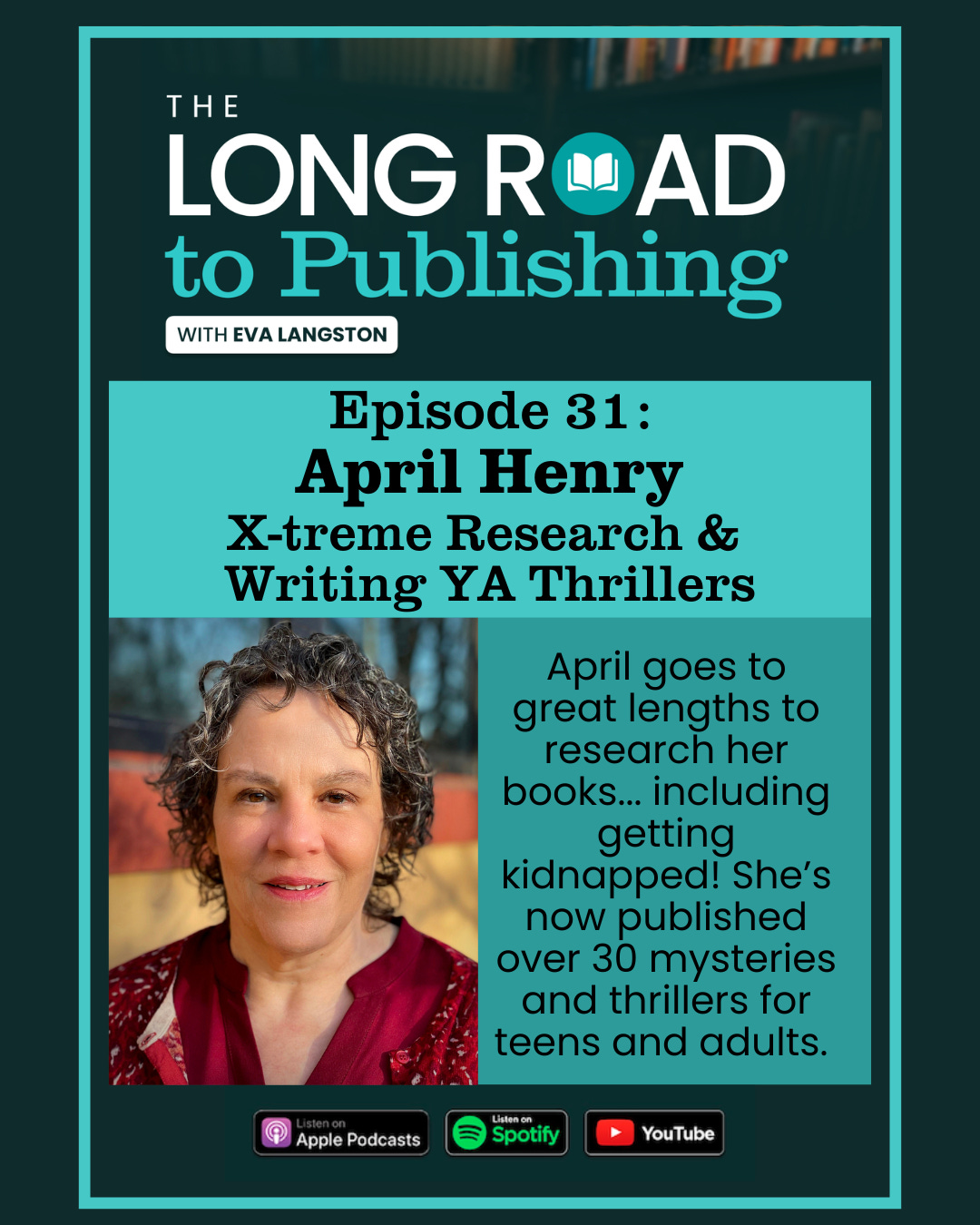
April Henry didn’t get serious about writing and publishing until the age of 30… and now she’s a bestselling author with over 30 mystery and thriller titles for teens and adults.
April goes to extreme lengths to research her novels. For example: getting fake-kidnapped. 😮 (Seriously, you have to hear her talk about the “urban escape and evasion” class she took--it’s next level.)
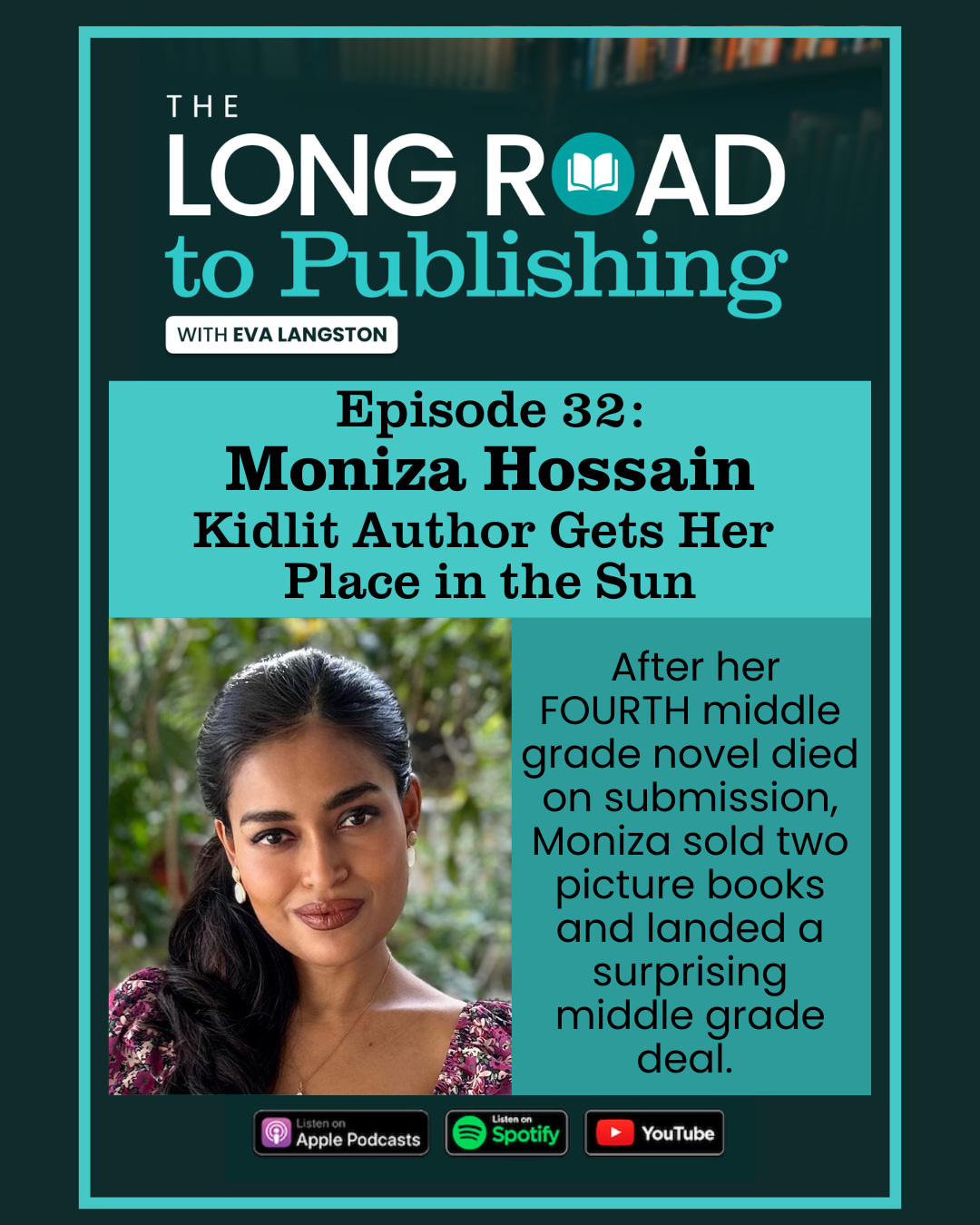
Moniza Hossain had FOUR novels die on submission before landing two picture book deals. Her latest picture book, Ritu in the Sun, came out in April, and she now has a middle grade horror novel coming out in September. After a brutal 10-year journey, it’s finally her time to shine!
Even if you don’t write kidlit, you cannot miss this episode. It’s SO cathartic to hear about such success after so much rejection!
I know there are plenty of resources out there with loooong lists of question to ask on “the call,” and that’s great, but there’s no way you can or should ask them all.
So I’ll simplify it for you. IMO, there are really only 6 important questions to ask a potential agent:
Does the agent think the manuscript needs a major revision, or just some polishing? Do they think it’s ready to go out to editors now (and if so, do you think it is, too?). If they want revisions, what changes are they imagining?
Where do they see this book fitting into the marketplace, and how are they planning to pitch it? What genre do they think it is? (This might sound like a silly question, but if you think you’ve written a family drama, and they’re hoping you’ll dial up the suspense and make it a thriller… that’s something you should discuss.)
If an agent thinks you should make certain changes, but you have questions/concerns… that’s a conversation to have before you sign with them. Be open to their suggestions— take some time to think and come back with questions— but also, be wary of signing with an agent who wants your book to be something you don’t want it to be.
Also, an agent should have some thoughts about which editors or publishers would be a good fit for your book. They shouldn’t promise to sell it, but they should have some ideas of how they will try.
Does the agent prefer phone, email, text, Zoom? When you reach out with a question, when can you expect to hear back? Do they have an assistant who reaches out on their behalf or helps with feedback?
This is also a place where you should communicate your own needs. When I had “the call” with my current agent, I told her I’d been ghosted by my previous agent, and so it was really important to me that my new agent try to always email me back within a few days.
Many agents are editorial these days, but not all. Some agents want to spend a lot of time revising, especially with new clients, while others might want to go on submission right away. Some agents will actually get someone else—in-house, or not—to give you notes, either in addition to or instead of their own.
If the agent is editorial, what’s their editing style? Will they give you a detailed editorial letter? Will they make comments or track-changes in the manuscript itself? Will they just talk to you about their revision ideas?
It can be hard to know if you will work well together until you actually work together, but it’s helpful to get a sense ahead of time about what to expect.
Recently I talked to an author friend who said her previous agent regularly took six months to get back to clients with feedback on new manuscripts. SIX MONTHS!? I had a hard time when it took my agent a measly two months to get me feedback on my latest manuscript (although, in hindsight, I needed those eight weeks to get some distance and perspective).
Clearly, my friend’s former agent would not have been a good fit for me, but maybe a six month wait wouldn’t be a huge issue for someone else.
I’ve talked to several authors about this, and the 8-week turnaround on a new manuscript seems pretty standard. (Then you might turn in a revised version, and it might take them another 4 to 8 weeks to get back to you on that.)
Every agent is different. Some are faster, some are slower and, for some, it will depend on what else they have going on at the moment. But good to discuss this up front.
Of course you don’t have to ask permission to do this, but it’s a courtesy. Either way I recommend doing it. It could be helpful to talk to a client who has sold at least one book with the agent and a client who has yet to land a book deal.
(I was only the second client my agent signed, so I talked to her one and only other client before signing!)
“Unfortunately, that’s always a possibility, although I have high hopes for this manuscript. That being said, let’s talk about some of your other ideas or works-in-progress. If this book doesn’t sell, we’ll try to sell something else.”
Ideally you already know which genres the agent represents because you did your research before you queried, but it’s still good to have a conversation about other books you might want to write. If you also want to write in a genre the agent doesn’t represent… maybe they’re not a good fit. OR, you’ll want to ask how they’d feel about you getting a second agent if you end up writing in a genre they don’t handle
(There was a brief period of time when I thought I might try to write and sell picture books. My agent said go for it, but I would need to find a second agent to rep those. Spoiler: I abandoned this idea pretty quickly and stuck to writing novels.)
“Oh, I can sell this book, don’t you worry about that.”
(My first agent promised me he could sell my book, no problem, and that should have been a major red flag, but I didn’t realize it at the time. Spoiler: He did not sell my book.)
“Oh, if this book doesn’t sell, I’ll probably drop you or ghost you.”
(Okay, I doubt anyone would say this, but it certainly happens.)
I’ve had several guests on The Long Road to Publishing ( Lindsey Goldstein, Marisa Walz, Darlene Campos) who parted ways with an agent because, though the agent liked their first manuscript, they didn’t like subsequent ones. Which is heartbreaking and frustrating, and we authors want to prevent this from happening to us, but I’m not sure it makes sense to ask this question of a potential agent because I don’t think there’s a clear answer.
If you listen to The Shit No One Tells You About Writing or have read Middlemen: Literary Agents and the Making of American Fiction by Laura B. McGrath, you know that so much of agenting is about the agent’s reputation and their personal “taste.” They don’t want to try to sell something to colleagues unless they themselves truly love it. Agents don’t want to misrepresent themselves by repping books they don’t really like.
So what should an agent do if a client starts writing manuscripts that are no longer the agent’s cup of tea? Literary agent Cecilia Lyra addresses this in a recent Shooting the Shit episode of TSNOTYAW: “it’s a conversation,” she said. The author and agent need to have an honest chat about it. Can the agent articulate why the book isn’t to their taste? Is it something a revision could fix? If so, does the author want to make those changes? Or is it time for the agent and author to part ways so the author can find an agent who loves the new manuscript?
As much as I want a straight answer to the original question, it probably doesn’t make sense to ask it of a potential agent. Because, like so many things in this business, “it depends.”
Sign up for Bianca Marais’s Beta Reader Match-Up! Extended deadline: June 8.
StorySnobs Pitch Contest: online June 10!
FREE Writing Residency in Pawling, NY this November for emerging writers of fiction, memoir, poetry, and nonfiction. Application deadline June 30.
The First Chapters contest from CRAFT is open now until June 28.
Follow Angelique Fawns for short story submission suggestions!
If you are an author with a polished manuscript that’s ready for publication, check out the annual contests for novels and short stories from Dzanc Books. Winners will be published by Dzanc Books and receive $. Deadline Sept. 30.
Find a writers group (online or in person) using the Poets&Writers searchable database!
The Writer’s Center website is a GREAT resource for finding grants, fellowships, residencies & retreats, publishers, and literary journal opportunities.
Writing Workshops offers lots of online classes in fiction, nonfiction, poetry, picture books, and the business of writing.
Writing Irresistible Picture Books: Free online workshop from Good Story Company on July 9.
Do you write for ages 2-6? HIGH FIVE Magazine (from Highlight’s) is open for submissions until June 30!
NorthSouth Books is currently accepting both agented and un-agented submissions from writers and illustrators around the world.
The Boyds Mill (formerly the Highlights Foundation) offers tons of programs, workshops, and events for children’s writers and illustrators.
Literary Rambles has information on kidlit agents and agent interviews. Plus contests and giveaways.
Here’s an incredible list of upcoming events for KidLit writers!
Check out SCBWI (The Society for Children’s Book Writers and Illustrators) for events, conferences, critique partners and more. (Picture book through YA.)
Incredibly helpful article from Devon Halliday for anyone in the query trenches
12 top literary agents who rep current NYT bestsellers & are open to NEW CLIENTS! (From Caroline Madden)
Follow Writing Day Workshops on BlueSky for New Agent Alerts with new agents actively seeking submissions!
Here’s a list of small publishers that do not require agents. And here’s another such list.
Andrea Bartz has a list of successful query letters (including mine!).
The Writer’s Retreat at Good Contrivance Farm north of Baltimore is open year-round as an affordable writer’s retreat. Only requirement: that you use the time to work on writing. Spaces normally book about two months in advance.
Thinking about going to a conference or applying for a residency? Check out the free searchable database on Poets & Writers.
The Writing Day Workshop “How to Get Published” Conferences are affordable and helpful. Plus, sign up for pitch sessions with agents. For online conferences, attend from anywhere in the world! Check out the upcoming conferences:
Writing Workshop of Chicago: June 20, 2026 (in person)
Writers Digest offers virtual conferences on a variety of publishing and writing craft topics.
For more writing conferences, check out this list or the free searchable database on Poets & Writers.
Comments
Nothing yet. Say the first thing.
Sign in to join the conversation.