
I recently returned from a journey to Amsterdam and Antwerp giving lectures for the Cal Alumni Association travel program. It was great to visit a few friends in the Rijksmuseum to which I’ve already introduced you, like Peter Claez’s Still Life with Turkey Pie and Judith Leyster’s The Serenade. My trip means that I will bring you many more close readings soon!
One of my favorite moments on this trip was a serendipitous one, where I was in the great Gothic Cathedral of Our Lady (Onze-Lieve-Vrouwekathedraal) in Antwerp when one of my fellow travelers saw me there and came up to ask me about Peter Paul Rubens’ Descent from the Cross. I’ll give you, my dear readers, the short impromptu discussion we had in front of that enormous triptych.
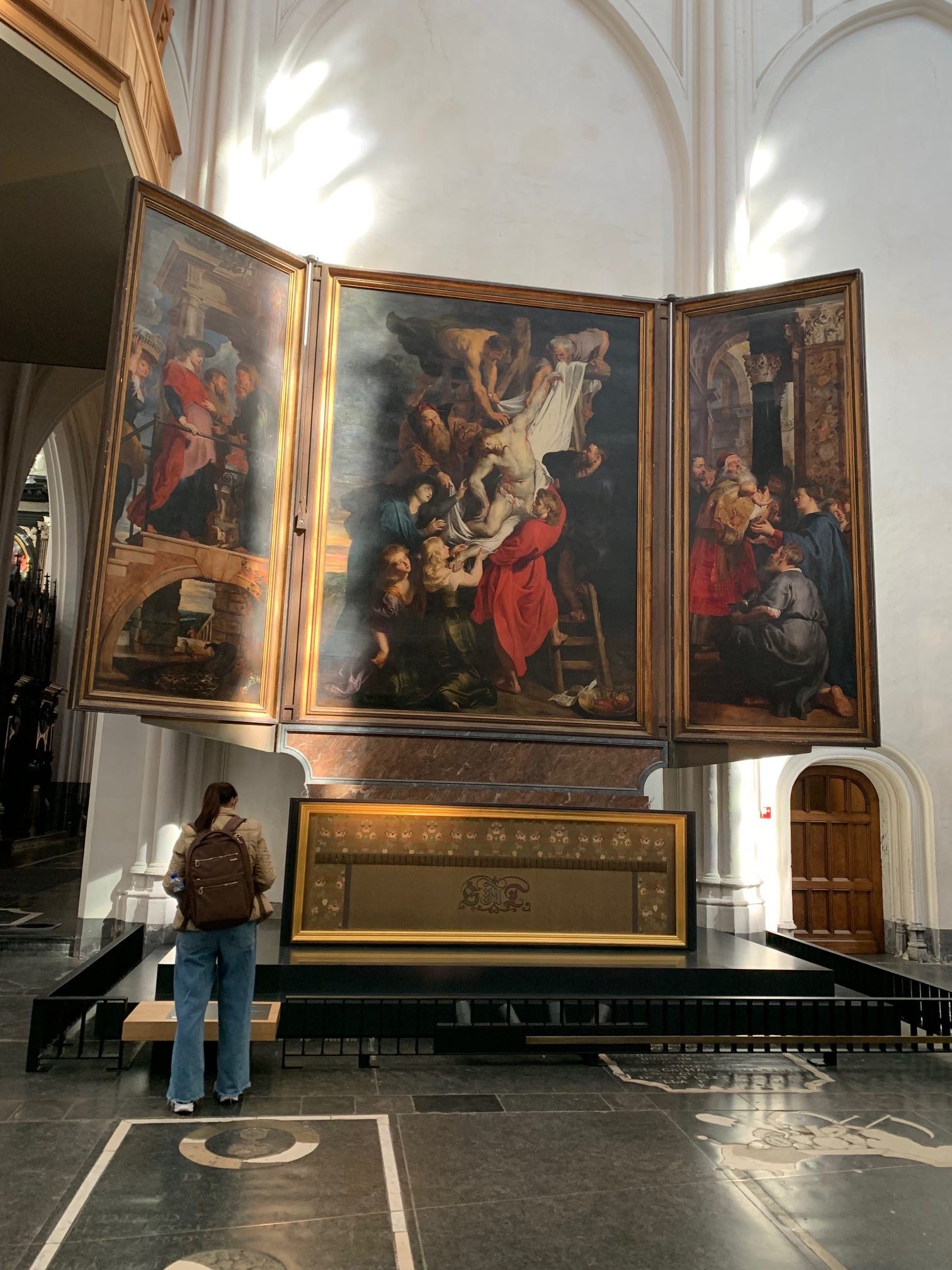
The triptych’s central panel shows the titular action as Christ’s followers lower his lifeless body from the cross. The left wing of the triptych shows the Visitation, the scene when Mary (miraculously pregnant with Christ) meets her cousin Elizabeth (miraculously pregnant with John the Baptist). On the right wing, Rubens shows the Presentation in the Temple, where the priest Simeon holds the baby Christ, in a culmination of the prophecy that he would live to meet the savior of the world. Thus the open triptych shows the end of Christ’s life bookended by events from his life’s beginning.
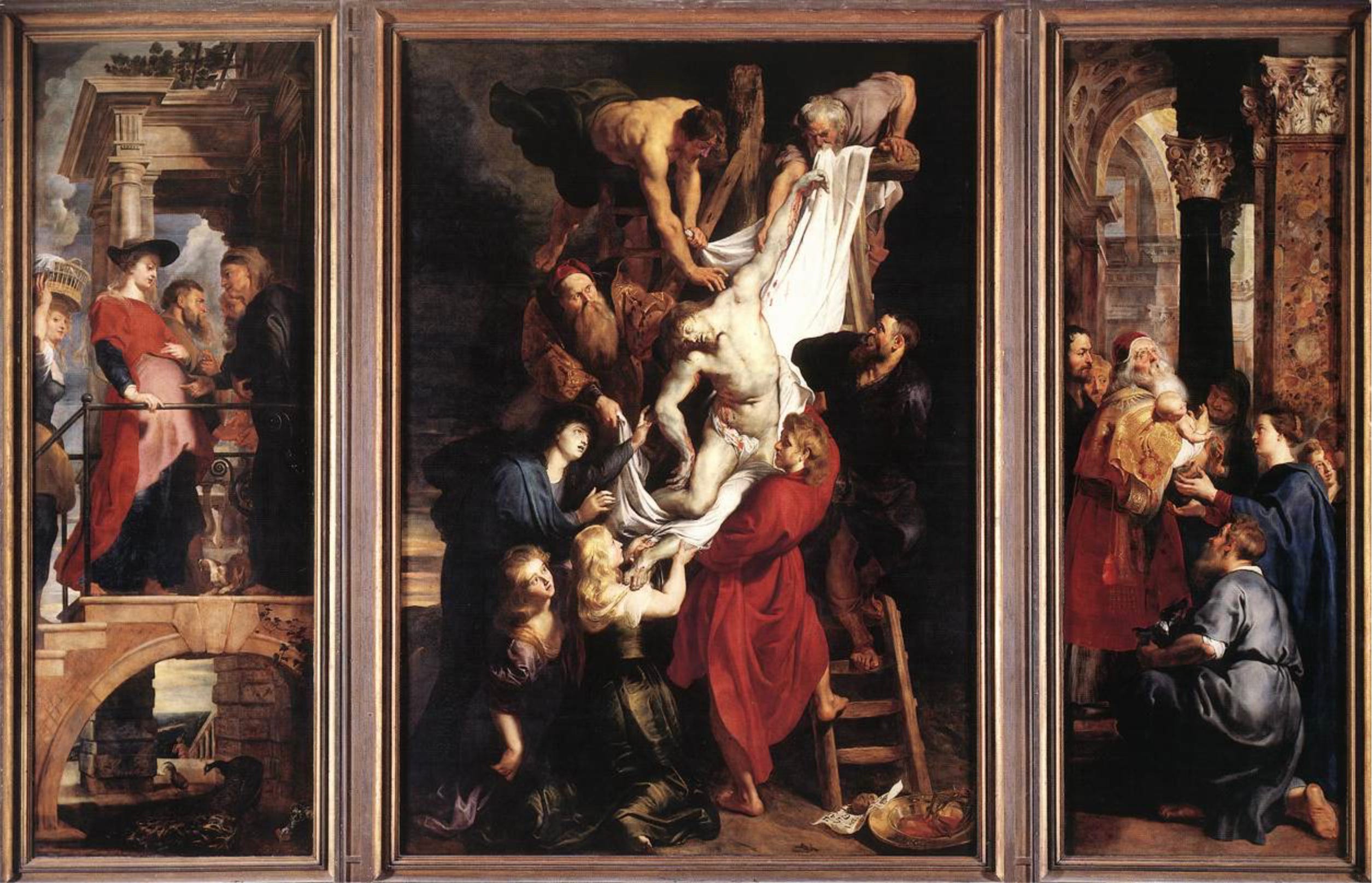
Triptychs are moveable objects of church furniture. The wings or side panels are painted on both front and back, sometimes with independent paintings, but sometimes (as here) closing the wings can bring together two halves of a scene. The paintings on the backs of these side panels were difficult to see on that sunny April afternoon in Antwerp, yet I still wish I had taken a picture to show you that lived experience of peeking around the back. I could barely make out the nighttime scene with the hermit carrying a lantern, but it was easy to identify Saint Christopher carrying the baby Christ on the left: and his story is the key to the whole iconographic scheme of the triptych!
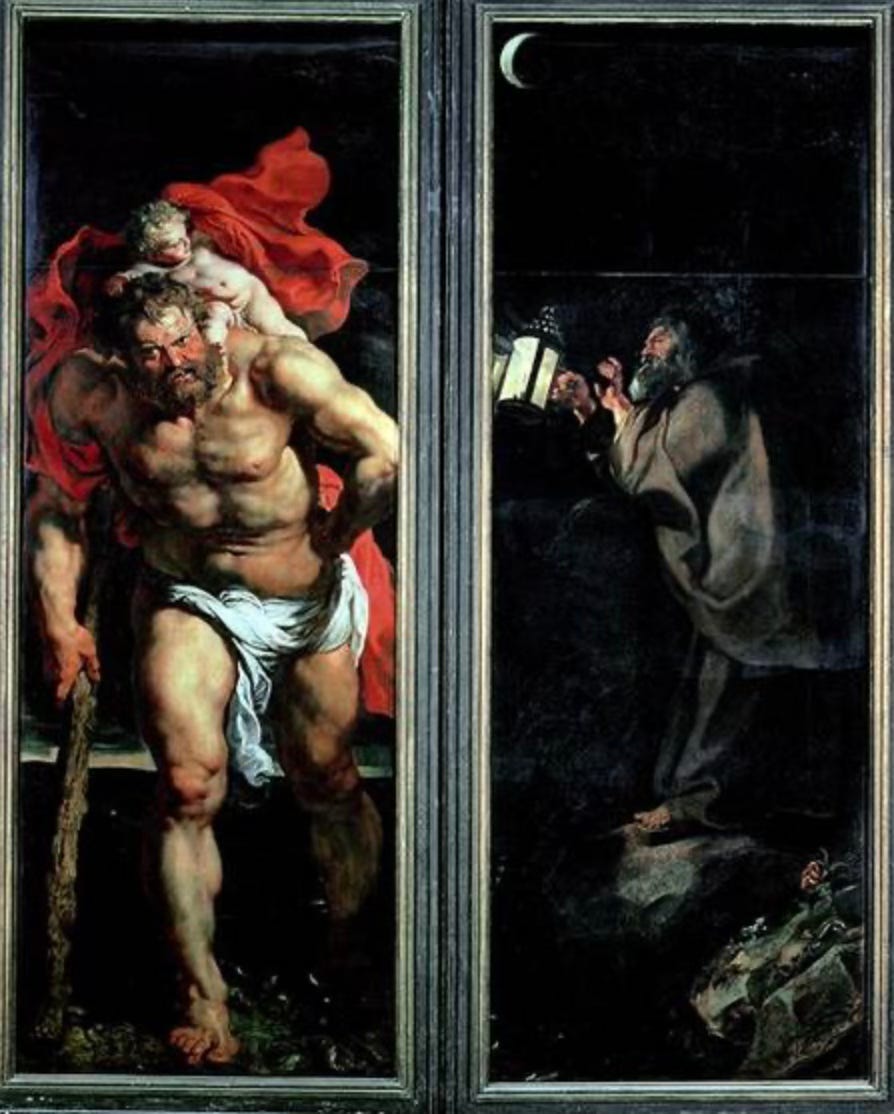
Christopher, as I explained when he appeared as the giant in Titian’s Triumph of Christ woodcut, is a saint name that enacts its own legend: Christopher means “bearer of Christ.” The story goes that Christopher was a very tall man who ferried people across a river. The best-known version of his story in the Golden Legend by Jacobus de Voragine, includes a hermit who had introduced him to Christianity and suggested this occupation as a way to serve people. One day he helped carry a baby over the river. The baby seemed to get heavier and heavier with every step through the water. After they had crossed the river, Christopher asked the baby why he was getting to be so heavy, and the baby replied, I am Christ, and I have taken upon myself the sins of all the world.
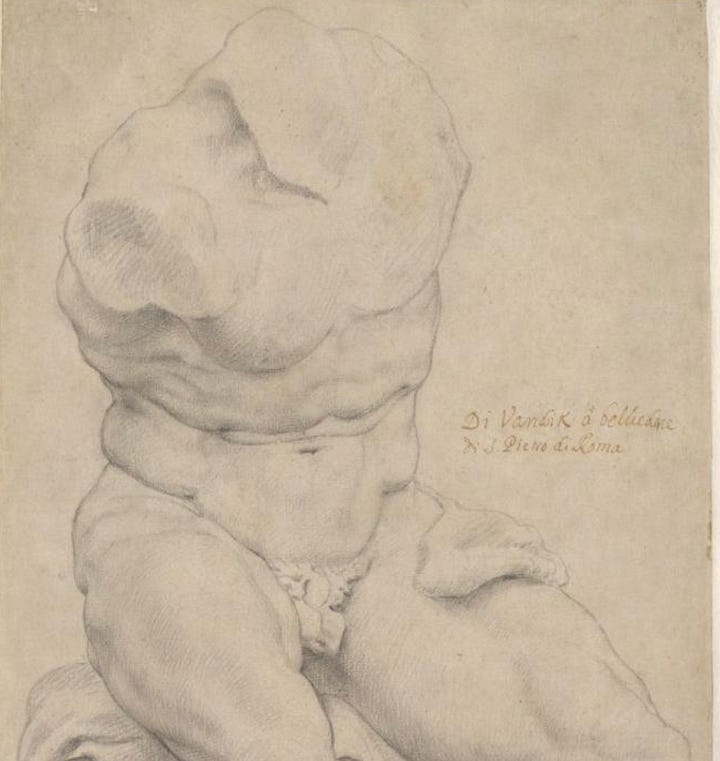
Rubens has made Christopher a muscular figure, probably envisioning Atlas holding the world on his shoulders. The baby Christ is straddling his shoulder with the same stride that Christopher makes, grasping his hair as though to move him forward (reminding me of the way Remi the rat makes Linguini cook in Pixar’s Ratatouille). Rubens painted the altarpiece for the guild of the arquebusiers (or Civic Guards) of Antwerp, and Christopher was their patron saint. I imagine these long-gun-toting military men would have relished the representation of their giant saint with his fully ripped Michelangelesque physique. Do I also detect a hint of the Belvedere Torso as well? (See my post on the Triumph of Love for more on that famous sculpture from antiquity.) Rubens excelled at suggesting sources without quoting them too directly. Below is a comparison of Christopher’s torso with Rubens’ own drawn study (in the Rubenshuis collection) of the classical sculpture, which he had seen during his time in Rome around 1601-3.
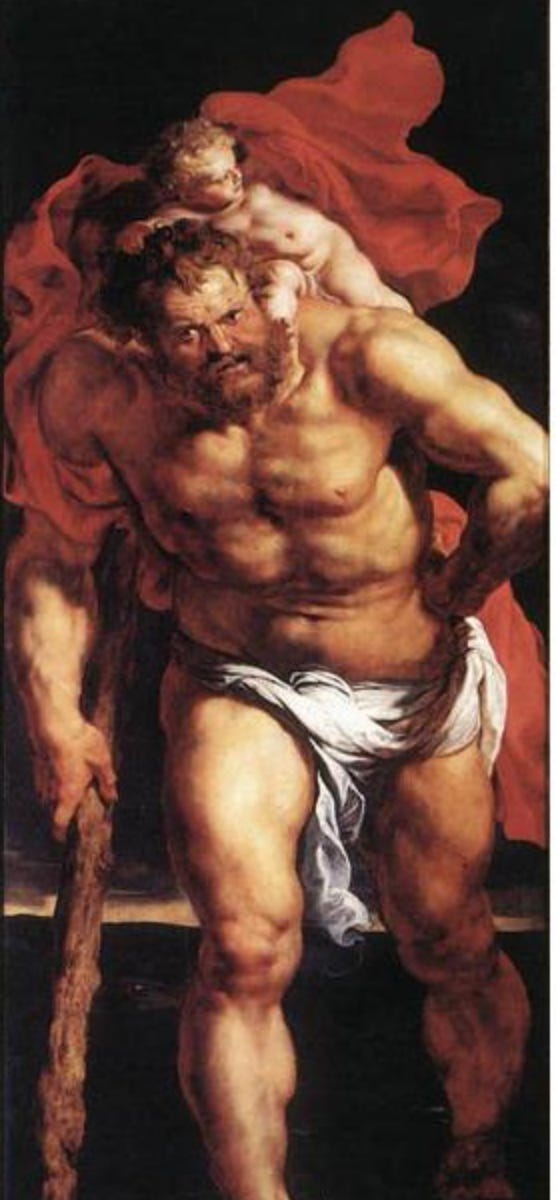
Christopher’s presence makes obvious that the theme of Rubens’ entire altarpiece is the bearing of the body of Christ. However, the altarpiece was intended for the arquebusiers’ chapel in this very cathedral, dedicated to the Virgin Mary. She was the OG bearer of the body of Christ, the theological necessity (in Christianity) for making God corporeal.
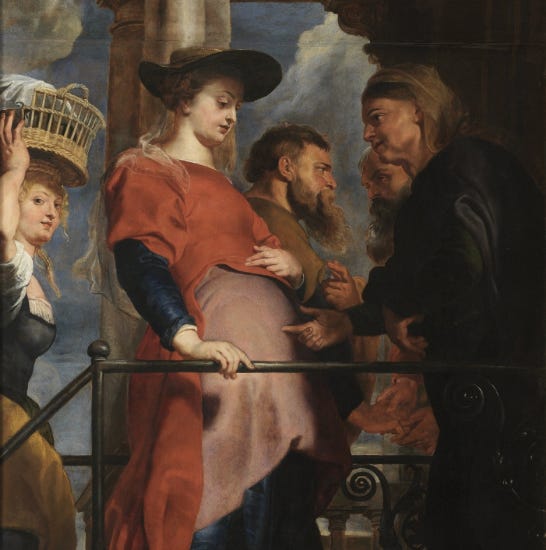
In the Visitation, Mary’s belly is enormous, the most heavily pregnant representation of Mary that I have ever seen. Drawing attention to Mary’s very pregnant body underscores that she bears within her own body the mortal baby Christ. She, or rather her belly (so baby Christ), is centrally located in the panel, with Elizabeth off to the side and her pregnancy barely represented at all. Rubens chose to ignore that Mary was at the most only three months pregnant with Christ—Elizabeth was to have been six months further along. The narrative has stepped aside in order to foreground the symbolic. Behind Mary, a servant girl (but obviously painted from the same model as Mary) holds a basket on her head, a nice tie-in to the carrying theme and Saint Christopher painted on this panel’s reverse. Also, does anyone know of another instance of Mary wearing a brown wide-brimmed hat? Keep an eye out and let me know. Rubens, you cowboy, you.
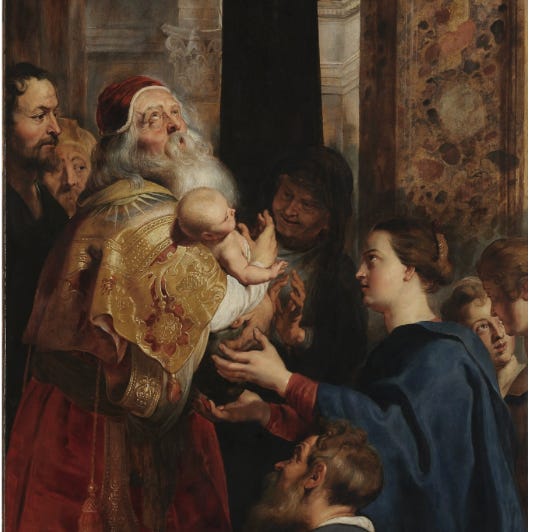
On the right wing, Saint Simeon holds the baby Christ in his arms, bearing Christ’s body with teary heaven-ward eyes and a silky beard. This baby seems a few months old, a heavy little guy, and Mary is ready to take him back—she holds out her hands for the transfer. Rubens’ own first child was born in 1611 and his second arrived in 1614, by which he had finished working on this altarpiece. Rubens conveys with understanding the weight of the child in Saint Simeon’s arms and the way the baby turns towards his mother.
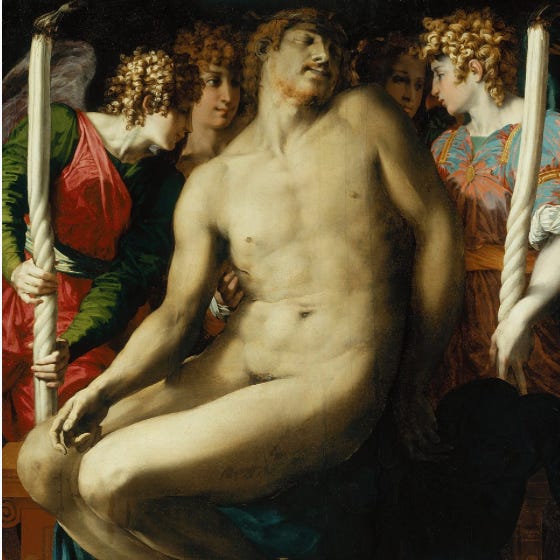
The transfer of baby Christ from Simeon to Mary foreshadows and sadly contrasts with the moment in the Christian story in the triptych’s center scene. Christ’s followers all collectively bear his body as they precariously transfer him lifeless from the cross to the ground, with St. John about to take most of the weight. Central to Christian theology—and specifically for the artwork of the Counter-Reformation—is the corporeality of Christ. Rubens presents Christ’s body frontally, sliding down, with head in an extreme tilt and scruffy facial hair and haircut, in what reminded me obliquely of Rosso Fiorentino’s Dead Christ with Angels from 1525-26. (Are both artists looking at the Torso Belvedere? Have you internalized yet that this is the most famous torso in history?)
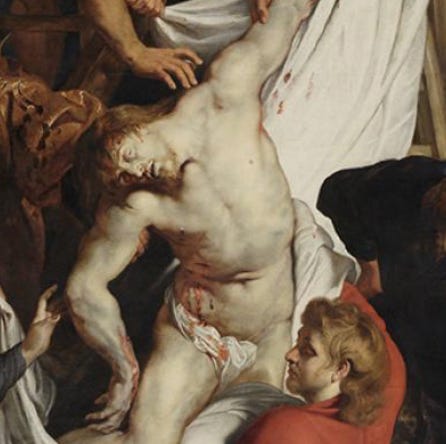
Rubens, famous for dialing up color and emotion, uses color to underscore the theme by having all the main bearers of Christ wear the same red as Christopher: Mary wears a red garment that reveals her belly; John wears all red (as he often does) as he supports Christ’s body; and Simeon wears red and gold priestly garments as he holds baby Christ. Mary’s clothes are mostly blue with only red sleeves in this right panel, since she’s not actively a bearer of Christ’s body just then. The red fabric swaths tie each panel of the triptych together and link Christopher to the front of the altarpiece.
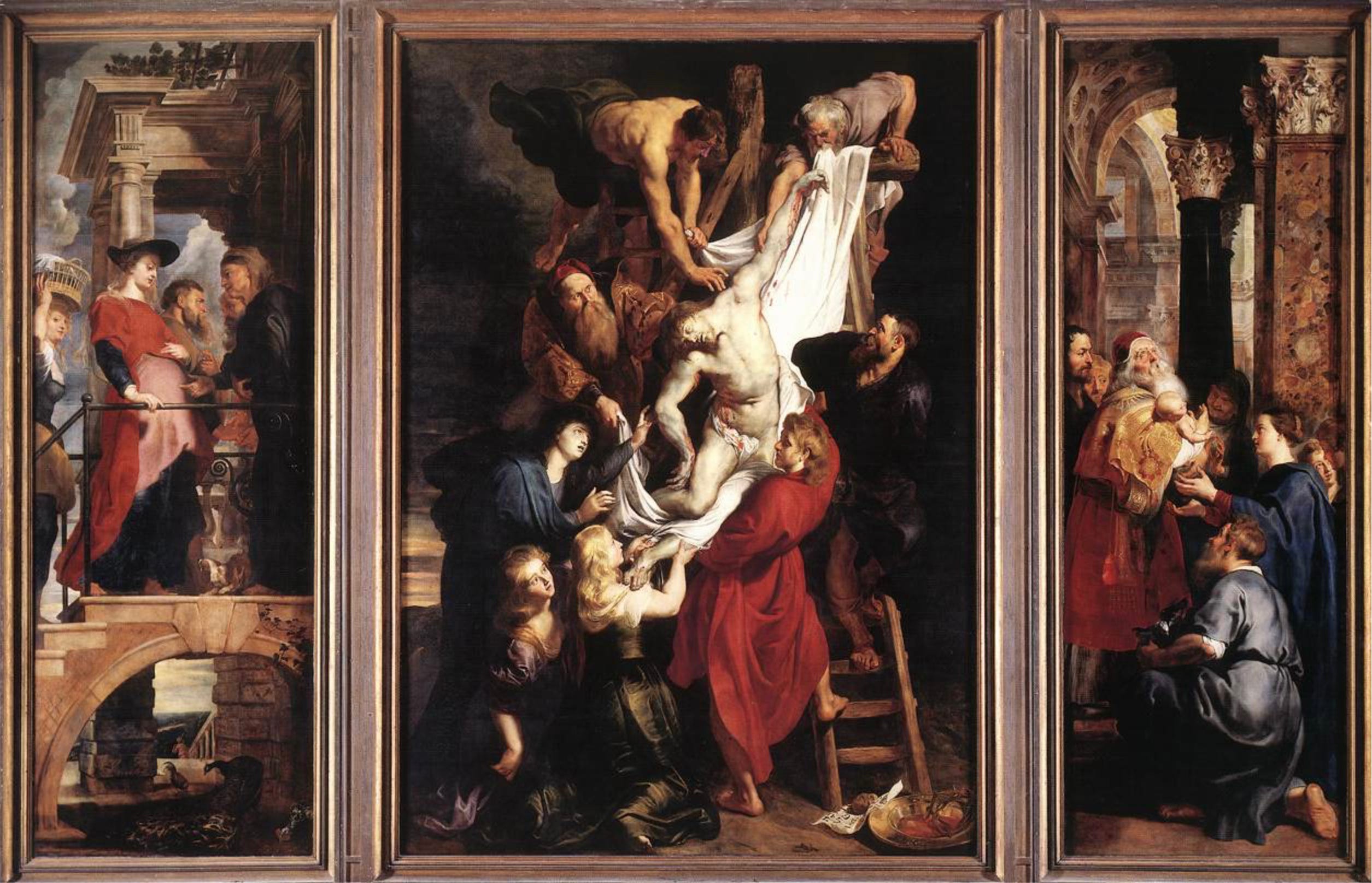
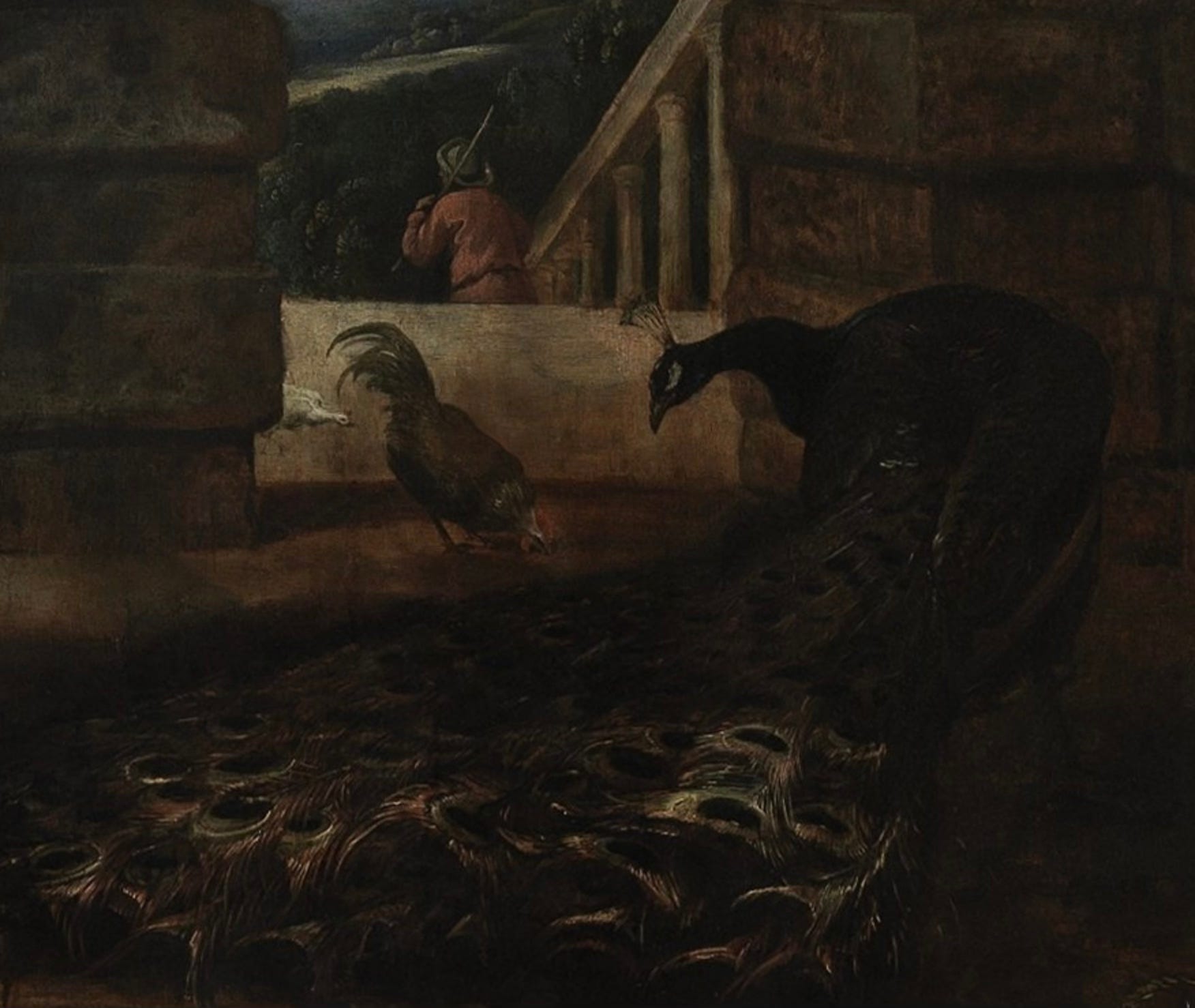
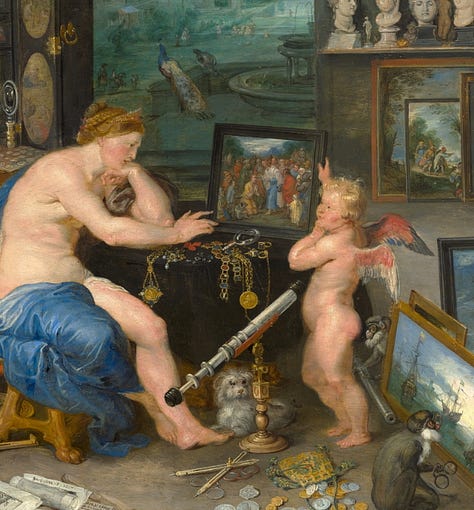
In the left panel, Rubens also added a peacock underneath Mary and Elizabeth. I had just featured Rubens’ peacocks in my lectures, where they show up as symbols of royalty; as an allegory for vision (because of the many eyes on the peacock’s tail); and as an attribute of the Roman goddess Juno and therefore symbolizing conjugal love. You can review my post on Rubens and Helena Fourment in the Garden for more background there.
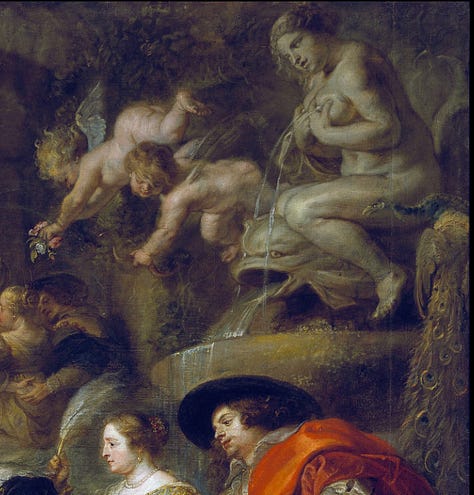
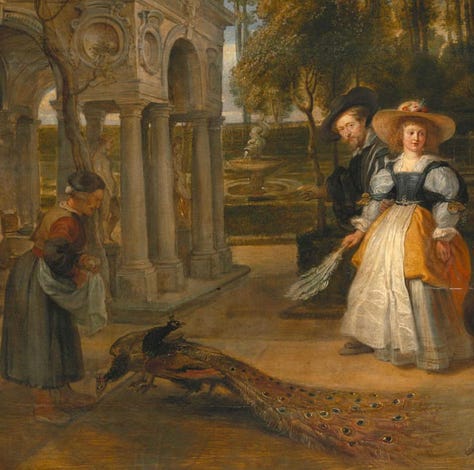
I think he added a peacock below Mary and Elizabeth in order to underscore the legitimacy of both of their pregnancies. In Mary’s case it was questionable because Christ’s father was not her betrothed husband, Joseph. (One might also suggest that Rubens included the rooster by the peacock to represent Joseph as cuckold.) Because the peacock was associated with Juno, wife of Jupiter, the King of the Gods in classical mythology, it also points to Mary’s future role as the Queen of Heaven, crowned by Christ. I think this is why he put the peacock in shadow under the arch, as foreshadowing. Rubens would have had no trouble including a symbol with double meanings, something he did on the regular. Remember Mantegna’s boating party where they aligned Jupiter with Christ? Eliding Christian and classical mythology was completely normal by Humanists since the Renaissance, and Rubens was fully steeped in this history.
No posts
Comments
Nothing yet. Say the first thing.
Sign in to join the conversation.