
This quick post remembers Betye Saar, who died last month, just shy of her hundredth birthday. An artist working in assemblage, or a combining of found and modified imagery with both two and three dimensional motifs, Saar challenged and reclaimed demeaning stereotypes of African-American women. She subverted those harmful ideas by turning the imagery into powerful refusals: refusals to being coopted, patronized, and objectified.
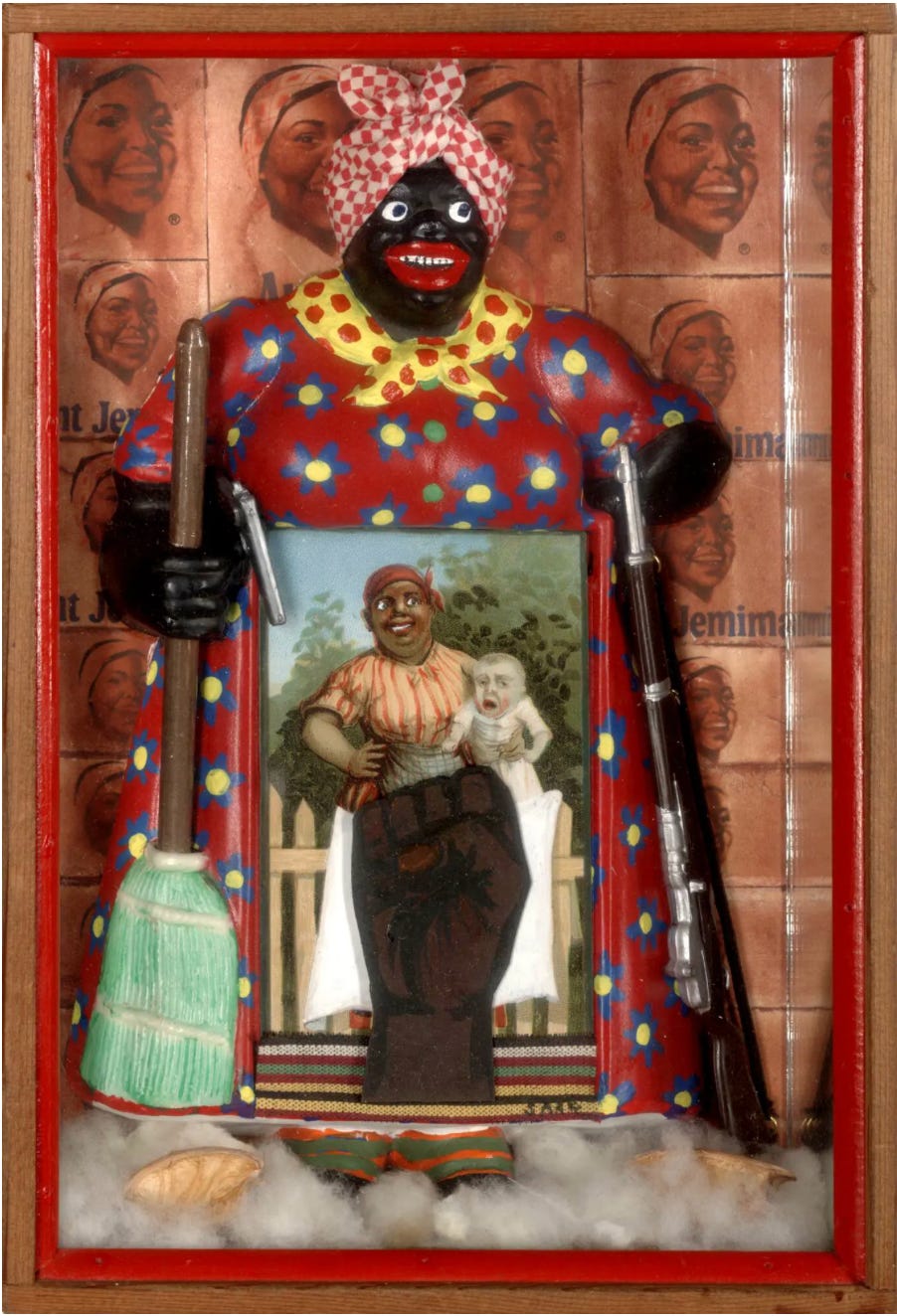
I must have first learned about her Liberation of Aunt Jemima in my college class survey of 20th century art. This work made an outsized impact on me from the lecture hall screen. It features a caricatured figurine of a “mammy” carrying a broom with a hand grenade under her arm, and with a rifle over the other arm. This figure envelopes a 2-D image of another smiling kerchief-wearing caricature holding a squalling and fearful white child. This one forms the background to a strong raised fist—the symbol of the Black Power movement. As in, we are forcefully interrupting this imagery, and no more will we stand for Black suppression.
Looking at this artwork now I recognize the influence of Andy Warhol, such as his Marilyn Diptych, within Saar’s repeated face behind the “mammy” figure.
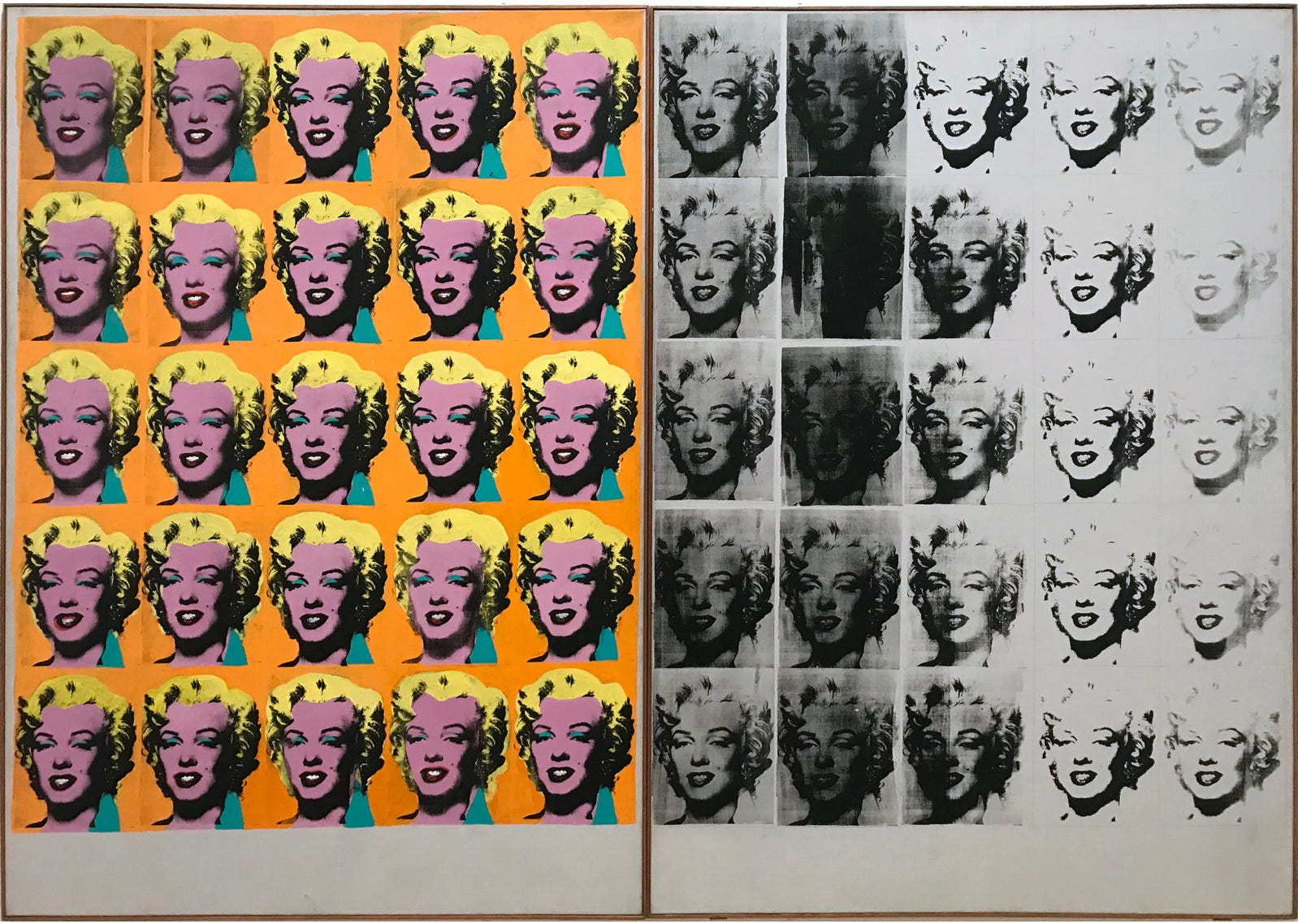
Unlike Warhol, Saar implicates the company behind Aunt Jemima pancake mix, and the viewer/buyer, by showing repeated Aunt Jemima images looking out with a co-opted smile. Saar subverted the advertising image into high art, reclaiming those stolen images and flattened identities of Black women by corporations and American society at large, turning them towards Black women’s power. That smiling “mammy” is actually pretty angry behind the façade. You don’t have to know much about the suppression of Black Americans during Jim Crow to understand why. Unfortunately, we are still grappling with the injustices left over from slavery and the Jim Crow era today, including the mythology of the happily subservient Black woman. Indeed, the Aunt Jemima pancake mix company only retired the branding of that image in 2020 (!).*
Decades after learning about The Liberation of Aunt Jemima, I unexpectedly encountered it in the original, in my own town—it is part of the collection of the Berkeley Art Museum and Pacific Film Archive! I had had no idea BAMPFA had such an important work—possibly the only artwork canonical enough to be included in that survey class long ago. Because of its forceful impact, I had imagined it to be the size of a large easel painting, but it’s actually closer to the size of a child’s shoebox, or a standard-sized printer paper. I had had no idea that this powerful work is so small. Some people have this experience when they visit the Mona Lisa for the first time, as we have talked about before —this artwork had a similar effect on me, except I was fascinated rather than disappointed.
I might have recognized its size had I noticed (at the artwork’s base) the actual cotton pods, included with cotton, an obvious reference to slave labor in the cotton fields. Additionally, the larger “mammy” figure was apparently a note-pad holder, a clue to its size—but also to the mundane way these harmfully racist images inhabited daily life in mid-20th century America. The small size of the boxy frame allows you to approach closer and peer into it. In this assemblage medium and style it takes a precedent set by Joseph Cornell, combining found objects, images on paper, and sculpture into a box that you peer into. However, it grapples with difficult history and uses the formal whimsy of assemblage as a vehicle, not an end. This is hardly your fourth grade diorama.
Encountering it living in my local art museum, The Liberation of Aunt Jemima was another reminder that seeing artworks in the original can pack a wallop. This may be an artwork on a small scale, but it crystallizes decades of Black Americans being co-opted and suppressed, the righteous anger that would not be silent, and eventually has and will come to the fore. Betye Saar exposed racist myths as complex and hardy lies. She continued to make bold and multidimensional artwork exploring racism, gender, and the Black experience, paving the way for later artists such as Faith Ringgold and Kara Walker.
*Aunt Jemima, Wikipedia gives more of the history of the brand, including naming the actual women who were hired to represent Aunt Jemima.
For more on Betye Saar and The Liberation of Aunt Jemima:
Listen to a 50th anniversary conversation put out in 2022 by the BAMPFA here.
Find more background at Smarthistory on the Liberation of Aunt Jemima (this site includes essays on many famous canonical works).
Here is Betye Saar’s Obituary.
No posts
Comments
Nothing yet. Say the first thing.
Sign in to join the conversation.