
Before you read this...
I'm about to challenge something so fundamental that your first instinct will be to dismiss it as semantic nitpicking. That reaction isn't wrong - it's precisely what I'm talking about.
We've become so accustomed to linguistic manipulation that when someone insists on precision, it feels pedantic. But here's what I discovered: the corruption of language isn't just annoying - it's a primary mechanism by which harmful systems disguise themselves.
What you're about to read will probably irritate you. You'll think "this guy is splitting hairs over word definitions." That irritation is your mind affirming patterns it's been trained to accept. I'm asking you to sit with that discomfort for just a few minutes, because on the other side of it is something that could fundamentally change how you evaluate everything.
This isn't about being the word police. This is about reclaiming the conceptual tools we need to build something actually good instead of just "less bad."
Fair warning: once you see this distinction, you can't unsee it. And you'll start noticing the manipulation everywhere.
Ready?
So, there seems to be a lot of confusion around the idea of “best possible”, so I thought I’d write an article to clear this up.
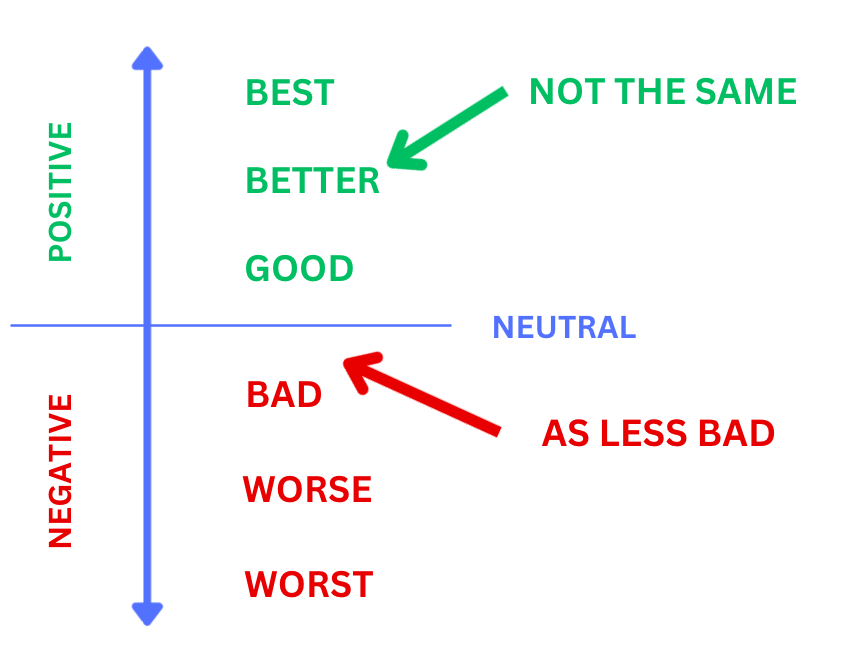
”BEST”, is a comparative form of “GOOD”.
That means best is a “form” or “level” of GOOD.
The different “levels” of goodness - if you want - are “good” “better” and “best”
That’s it. Pretty simple right?
Well, apparently not, because most people are confusing “good” with “less bad” all the time.
People say things like “He was a good thief” or “This is better for the environment”. I am going to get back to this in a moment, but before I do:
As you can see - in this very elaborate and highly technical graph of the “Spectrum of Goodness” - there is a real difference between “GOOD” and “BAD”. And hence “BETTER” is not the same thing as “LESS BAD”.
Let me drive this point home with a real World Example: Electric Cars.
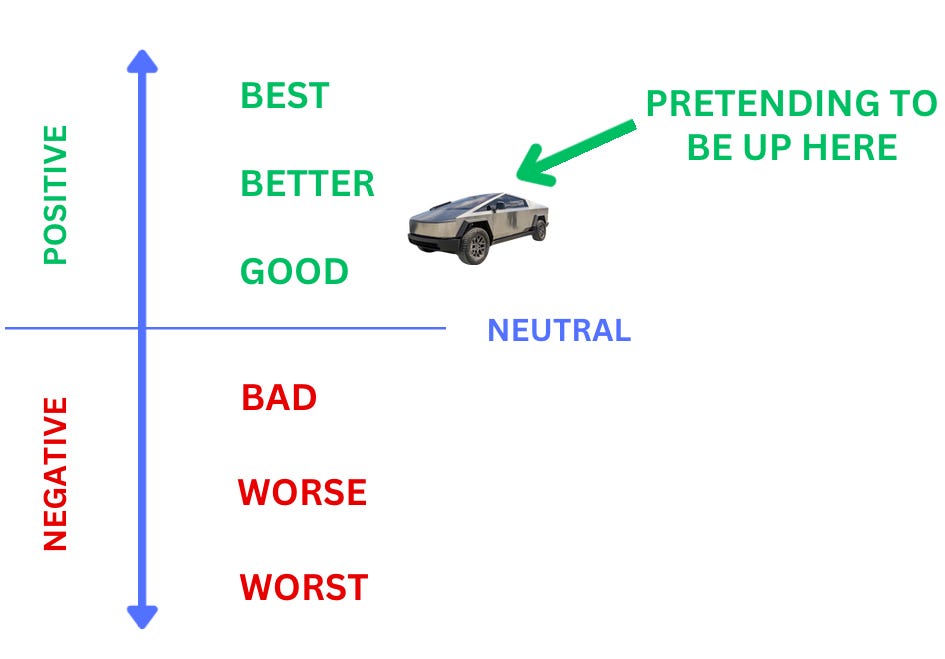
They “pretend” to be “good for the environment”. When in reality they are totally not. When you realize that an average Cybertruck pollutes more than 750 THOUSAND liters of water during its production, and creates at least a TON of none recyclable toxic battery waste than you have to realize that - NO - these things are NOT good for the environment. You are being played.
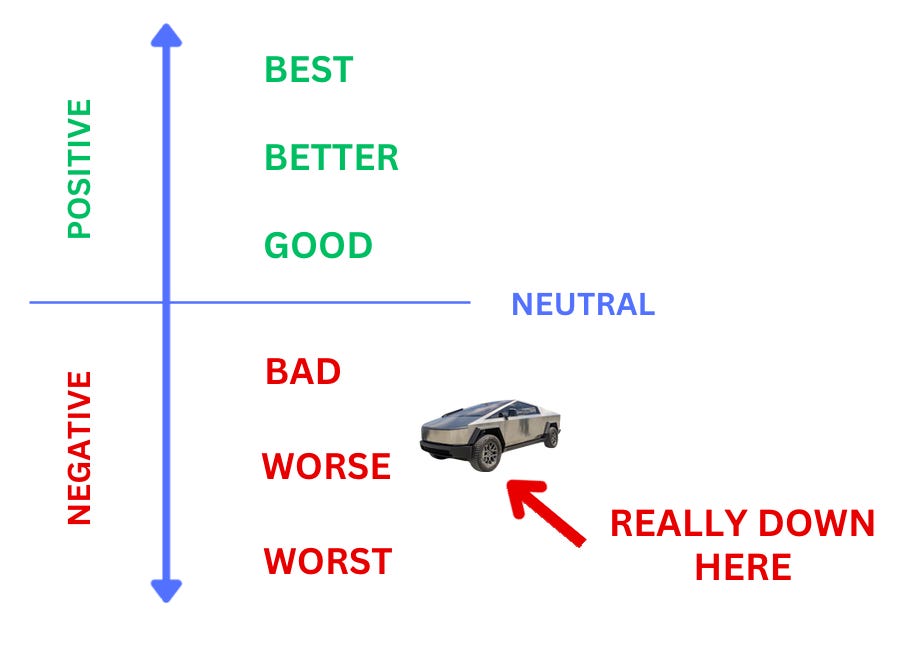
And here is proof.
So apparently either the “Worlds Richest Man” does not know the difference between good and bad OR we are being played.
Either way the result is kind of similar. People confuse BAD with GOOD. All the time.
Remember the “Good Thief”? Well unless he has been some type of Robin Hood that stole from the bad guys and gives to the good guys. He was not a “good thief”. He might have been a very “able thief”. He might have even been a very “skilled thief”. But since he was a thief, he very likely wasn’t a “good thief” so let’s stop calling him that. Words matter.
Same thing goes for our Ironman imitation “Elon” Character.
It seems like our capability to distinguish between “good” and “bad” between “positive” and “negative” needs some “upgrading” and that is where “Netpositivity” comes in, and what I am writing extensively about on this blog.
For those of you that want to know more about “Netpositivity” I encourage you to read (“What is Netpositivity? or “Plastic Net Positivity and how to get there”
Or simply look at this pretty picture to get the main idea:
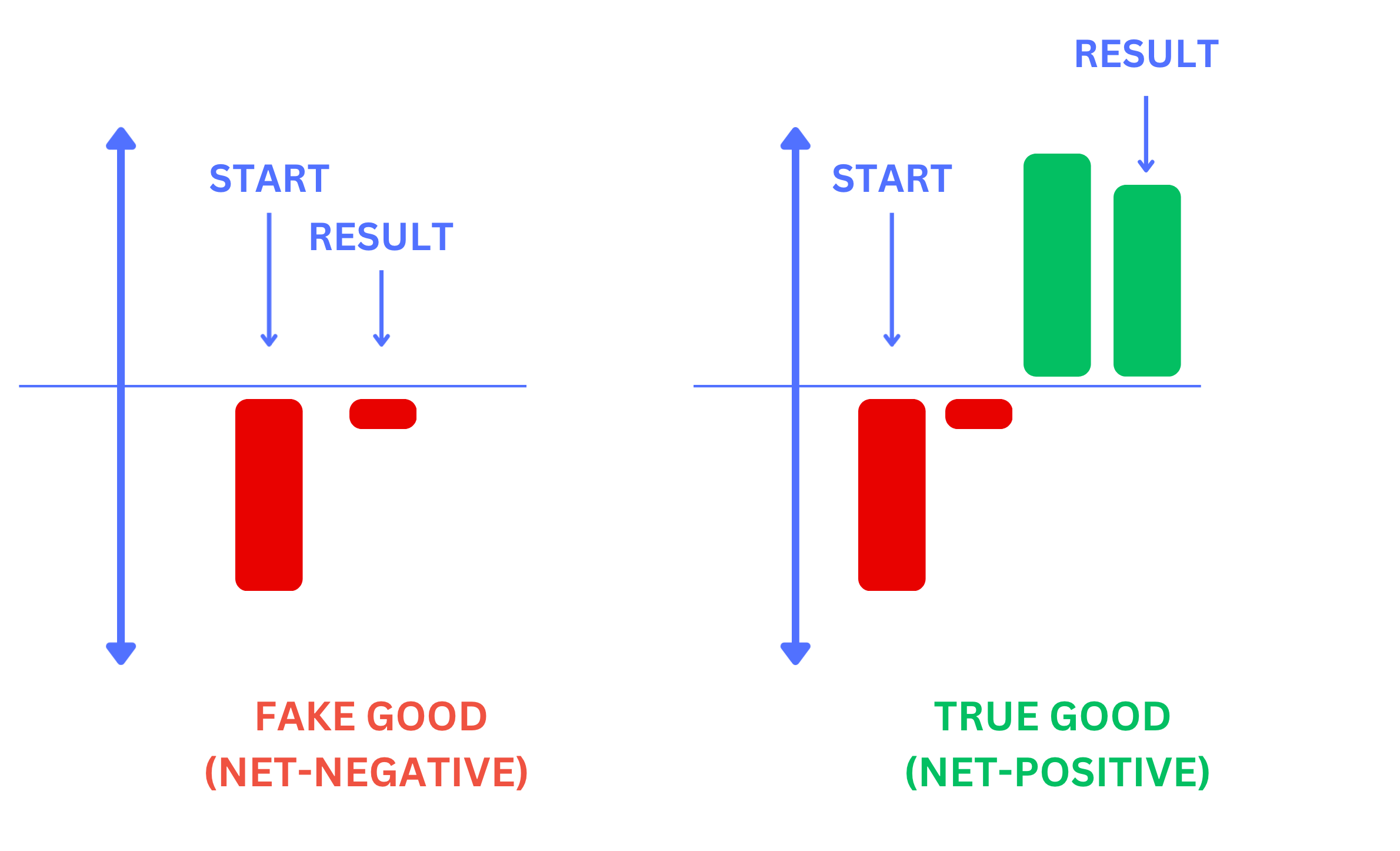
To sum it up. People CAN pretend to be “good” (which they do all the time). But they CAN NOT pretend to be “netpositive”. Because in order to be netpositive you need to show quantifiable proof that your “positive impact” is greater than your “negative impact”. And only if the end result is positive (= netpositive), then congratulations. You are “truly good”.
Netpositivity is a measurement of true, objective goodness
And that is kind of a big deal, because that means Netpositivity is a measurement of true, objective goodness.
Bad Actors, like e.g. Coca Cola, can’t pretend to be “netpositive Companies”. Their efforts to “pretend to be good” - via deceptive Marketing - are immediately exposed by Netpositivity for what they truly are: blatant manipulation tactics.
Hence Netpositivity holds everyone up to - authentically - “better” standards (not less bad ones).
Cool.
So, with that out of the way, let’s recap:
“BEST” is a “version” of “GOOD”. You can’t be the best without first being good. Goodness is not arbitrary, it is a function of Netpositivity.
Sweet!
Now revisiting the idea we started out with: the best possible. By applying what we just learned. Best is NOT “whatever you decide”. And best does not “just depend on Context”. In order for something to be “the best”, it first had to be good. Then it has to be “better” than just “good” so it can finally become “the best”.
IN ORDER FOR SOMETHING TO BE “THE BEST”, IT FIRST HAD TO BE GOOD.
You find something that is “truly good” (= netpositive), then you find a way to make it even “better” (by adding more goodness) until you eventually can’t add any more “goodness”.
And that, my dear bioholographic friends, is then “the best possible”.
Easy, right?
And here is a way you can apply this “new knowledge” in your life right now: Call out every time you notice someone using the word “good” in the wrong way. Notice every Ad you see on Television, every attempt at manipulation you are confronted by and call out the BS. Take back the power over your words. You are the one you have been waiting for.
Learn to appreciate how Netpositivity shields you from the toxicity of “modern day society”. Start seeing the manipulation right where it first happens: When people pretend something is good, which really is bad.
With that being said.
Much love and see you in the next one. :)
Dirk
P.S: Subscribe if you want to learn more about how to live your best possible life.
P.P.S.: To Learn more read any of these Articles
Humanity's Most Important Text - Ever?
No posts
Comments
Nothing yet. Say the first thing.
Sign in to join the conversation.