
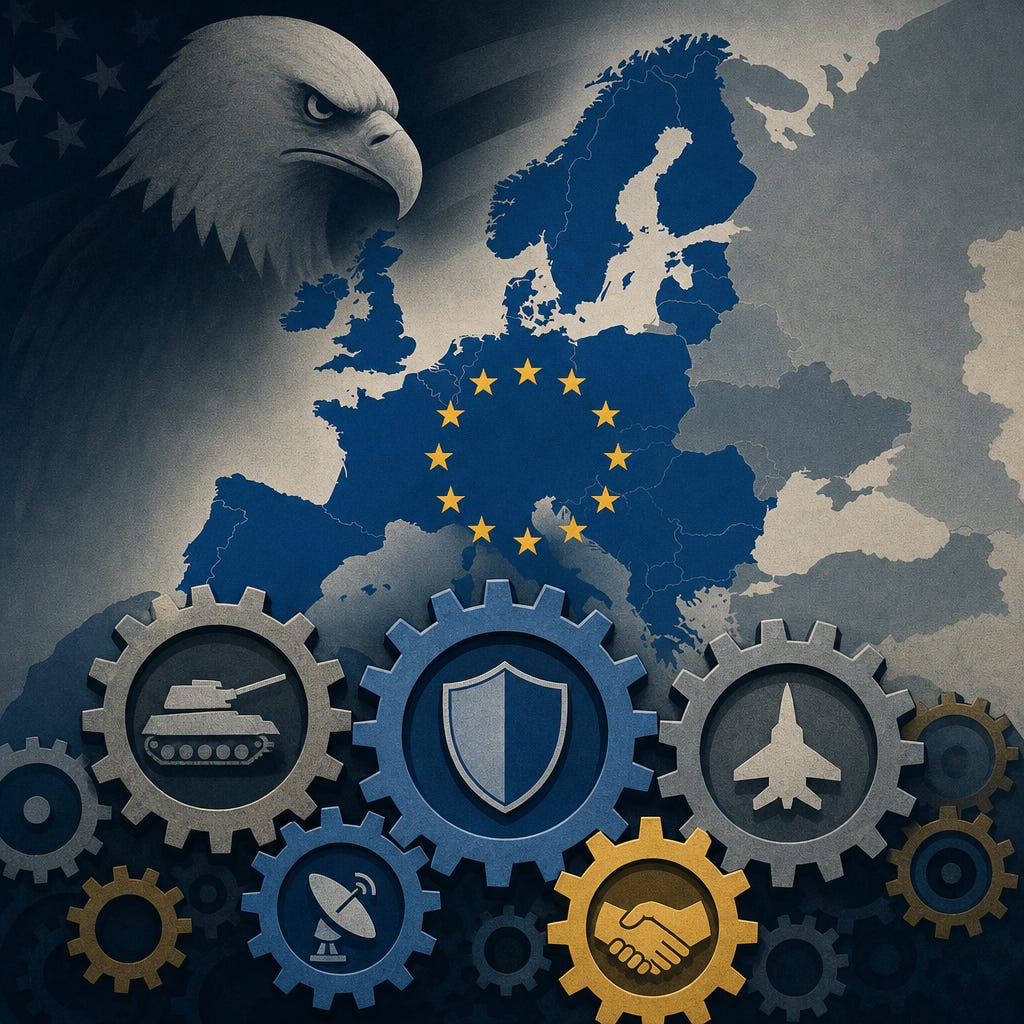
Editorial illustration generated by gpt-image-2.
The European Commission published on Friday a Eurobarometer in which 74% of EU citizens declare a negative opinion of the United States, fourteen points higher than in autumn 2025. In the same survey, conducted across the 27 member states between mid-March and early April with more than 26,000 respondents, 81% support a common European defence and security policy — the highest level recorded in twenty years. Negative views of Russia stand at 83%, China at 61%, India at 41%.
🤝
My articles are available for licensing. I can write columns on pre-agreed topics. Email me at mafalda@estriga.com.
🤝
The Commission declined to read the figures politically. Spokesperson Arianna Podesta limited herself to stating that the United States "remains an important partner" and that Brussels continues to work with Washington "de manière constructive" on shared interests, as reported by L'essentiel. There was no accompanying initiative, no proposal, no convened Council. The poll was published, framed in cautious institutional language, and released into a debate the executive does not control.
The figures do not arrive in a vacuum. They follow tariff threats from the Trump administration on European cars and trucks, recent remarks on Greenland, and the wider transatlantic friction running through trade and defence files since the start of the year. They also follow a separate move in Brussels: in late April, EU leaders meeting in Cyprus asked the Commission to prepare a detailed plan on how Article 42.7 — the mutual-assistance clause — would be operationalised if a member state were attacked. The treaty contains the obligation. It does not contain the procedures.
That is the second register, and it sits underneath the polling. The Eurobarometer measures what citizens want. The Treaties define what the Union can do. Article 42 of the Treaty on European Union keeps the core of defence policy in intergovernmental territory: unanimity in the Council, national control over procurement, opt-outs preserved. The Commission can propose, coordinate and support funding at the margins through instruments such as the European Defence Fund, PESCO or the more recent EDIRPA and ASAP procurement schemes. It cannot compel a single member state to buy a single shell.
The distance between the two registers is measurable. Three years after Russia's full-scale invasion of Ukraine, the Versailles Declaration and the Strategic Compass produced rhetoric and modest joint procurement instruments where billions were promised and tens were delivered. Ammunition production targets set in 2023 were missed. The defence-industrial base remains organised along national champions, with duplication of platforms and limited interoperability — a structural problem the Swedish Institute for European Policy Studies and others have documented for years. Even a hot war on the Union's eastern border did not dissolve the veto logic that runs through Article 42.
Against that backdrop, the polling data is striking on a second figure: 76% of respondents see Russia's war as a threat to EU security, 76% want Brussels to keep supporting Kyiv until a "just and lasting peace," and 56% support EU financing of military equipment. The ceiling on public consent for defence integration, long invoked as the binding constraint, has clearly moved. The constraint that has not moved sits in the Council.
France has held an autonomy doctrine since the 1960s and now finds it generalised across capitals that long resisted the vocabulary. Berlin's Zeitenwende rhetoric, the recalibration of northern and central European governments under tariff pressure, and the quiet erosion of the Atlanticist firewall in elite discourse mark a real shift from earlier autonomy waves — Iraq 2003, the first Trump term — when public anxiety existed but elite consensus contained it. The novelty in 2026 is the synchronisation of public and elite distrust.
This does not produce capacity. Poland, the Baltic states and the Nordic frontline governments support European burden-sharing while remaining acutely aware that the United States still provides the strategic enablers — intelligence, lift, missile defence, nuclear deterrence — that no European combination currently replaces. Their position is not anti-autonomy; it is anti-illusion. The same caution runs through the warning issued in The New York Times by David French, who argued that there is "an immense difference between allies who step up to contribute their fair share to a cooperative alliance and nations that engage in a military buildup to replace American power." The distinction is not rhetorical. It is operational.
The Eurobarometer also records a quieter figure: trust in EU institutions at 51%, support for the euro at 74%, identification with EU citizenship at 75%. The Union is, in the public mind, a place of stability. It is not yet, in its own legal architecture, a place of decision on the matter the public most wants it to act upon.
Commissioner Andrius Kubilius holds the Defence and Space portfolio. The portfolio exists. The competence does not.
Friday's survey gives the Commission a mandate it cannot legally execute and gives the Council a legitimacy it has not yet chosen to use. Citizens are ready. The Treaties are not.
Sources of truth consulted: 28
No posts
Comments
Nothing yet. Say the first thing.
Sign in to join the conversation.