
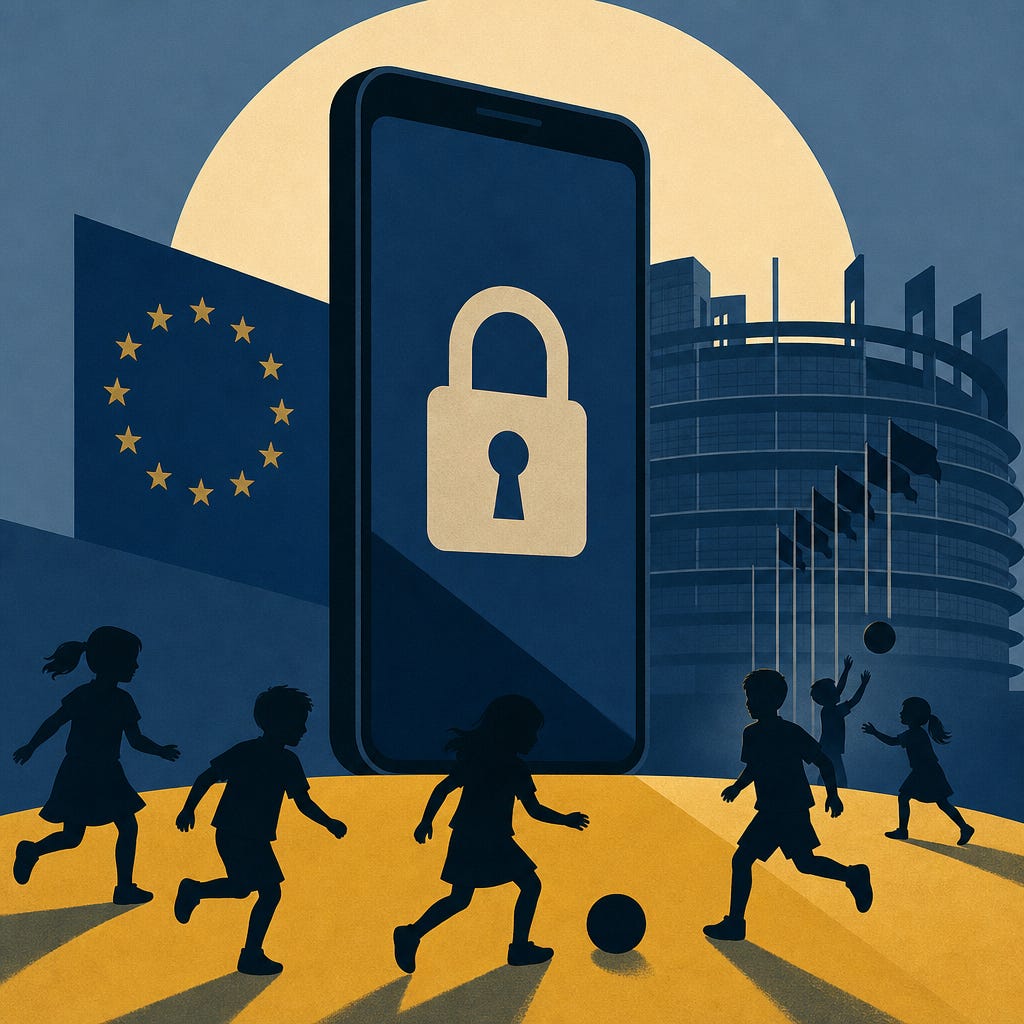
There is a number missing from Ursula von der Leyen's Copenhagen speech, and the absence is the whole story. The President of the European Commission told the European Summit on Artificial Intelligence and Children, on 12 May, that Brussels may table a legislative proposal this summer to delay children's access to social media. She did not say at what age. She did not say under which Treaty article. She did not say who would check.
What she said, in the formulation reported by Euronews, was that "discussions about a minimum age for social media can no longer be ignored" and that, "without pre-empting the panel's findings, I believe we must consider a social media delay". The panel — the Commission's expert group on child safety online — reports in July. The proposal, if it comes, would arrive in the weeks immediately after.
France has notified Brussels of a national law that, from September, will require Instagram and TikTok to block users under fifteen and close existing accounts. Spain, Greece and Denmark are pressing in the same direction. On the same day von der Leyen spoke in Copenhagen, as Politico's Brussels Playbook noted, Emmanuel Macron was convening a parallel videoconference with several national leaders on the same file. Two competing forums, on the same morning, on the same subject, with no agreed instrument behind either of them.
This is the moment at which the announcement is doing more political work than the policy. Australia, cited by von der Leyen as a "pioneer", legislates as a single jurisdiction through one regulator, the eSafety Commissioner. The Union does not have that. It has twenty-seven legal orders, Digital Services Coordinators of very uneven capacity, and a recent history — Article 8 of the GDPR — of letting member states pick any digital age of consent between thirteen and sixteen. That fragmentation is the reason a harmonised rule is now being demanded. It is also the reason a harmonised rule is hard to write.
The technical hinge is age verification. The Commission's app is being tested in France, Greece, Spain, Italy, Denmark and Cyprus; one EU official told Politico that "the EU has been testing this for a while — now it's ready", while cybersecurity researchers say the system is not yet robust enough to support a universal rule. And a verification system designed to keep thirteen-year-olds off Instagram is, by construction, a system that asks every adult user to prove who they are. The child-protection frame and the universal-identification frame are the same infrastructure seen from two angles.
The Digital Services Act already obliges very large platforms to mitigate systemic risks to minors. In February, the Commission ruled that TikTok's addictive design breached that obligation. Enforcement has been slow, contested, and dependent on data the platforms resist handing over. Moving from risk mitigation to access control multiplies every one of those problems.
What exists today is a Commission President, an expert panel, an app under test, a French statute about to enter into force, and a summer legislative window. What does not exist is a legal basis, a threshold, a verification standard that survives a privacy challenge, or an enforcement authority that does not collapse back into the DSA Coordinators. The objective is defensible. The architecture is not yet there.
The summer will say which of the two the Commission was building.
https://www.politico.eu/article/eu-social-media-ban-could-come-this-summer-ursula-von-der-leyen-says
Sources of truth consulted: 27
No posts
Comments
Nothing yet. Say the first thing.
Sign in to join the conversation.