
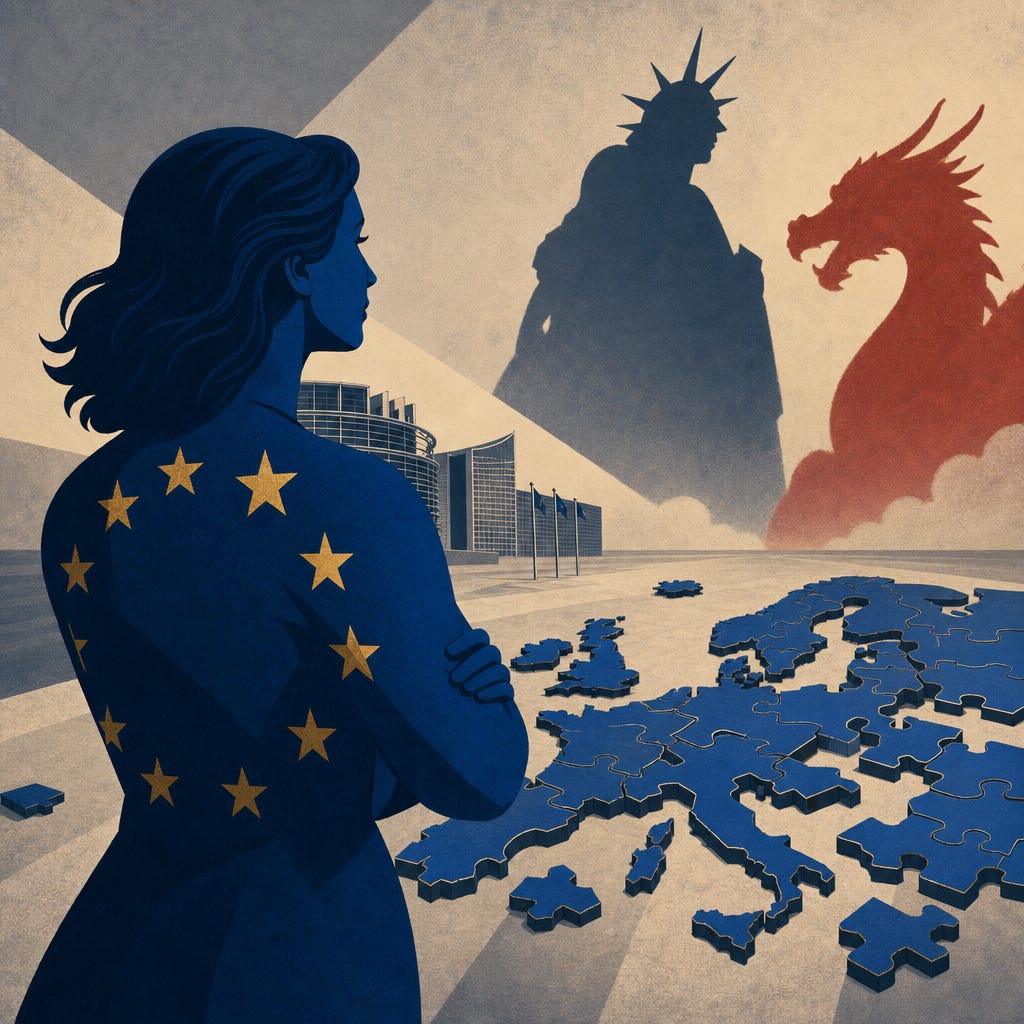
The Coronation Hall in Aachen is a venue calibrated for canonisation. On Thursday morning, with Friedrich Merz delivering the laudatio and Christine Lagarde in the audience, Mario Draghi used the Charlemagne Prize ceremony to say what European technical documents have been saying, in increasingly elaborate prose, for a decade. "For the first time in living memory, we are truly alone together," he told the hall, according to Politico's account of the speech. The United States, he argued, has become "more adversarial and unpredictable" and "may no longer guarantee our security"; China, "directly supporting our adversary, Russia," offers no alternative. Kyriakos Mitsotakis, speaking at the same ceremony, called for "true strategic autonomy," describing it, per Kathimerini, as "an act of responsibility, self-respect and long-term resilience." The diagnosis is now the consensus. The diagnosis was never the problem.
What Aachen confirms is that Europe has finally caught up with itself rhetorically. The Tindemans Report named the gap in 1975. The Five Presidents' Report named it in 2015. Macron named it at the Sorbonne in 2017. Versailles named it in 2022. Letta and Draghi himself named it in 2024. Each iteration narrowed the distance between diagnosis and instrument; the instrument never arrived. Aachen is the latest sediment in a deposit of European self-warnings, and its significance lies precisely in what it does not produce: no Council decision, no legislative proposal, no procedural breakthrough. A ceremony.
The figure Draghi attached to the warning — a provisional estimate of nearly €1.2 trillion in additional annual strategic spending, up from the €800 billion of his 2024 report — names the order of magnitude without naming the source. Common borrowing remains opposed by Berlin and the frugal northern capitals. National budgets are constrained by fiscal rules that the same governments wrote. The Multiannual Financial Framework, whose envelope sits at 1.26 per cent of EU gross national income, accommodates cohesion and the Common Agricultural Policy and little else; Merz used his laudatio, per FAZ, to call for redirection of EU spending toward defence and competitiveness, which is to say toward the priorities that net contributors prefer and net recipients resist. The June European Council will be the first place this argument lands. None of the available exits are yet acceptable to those who would have to walk through them.
The institutional bottleneck is precisely identifiable. The domains where Europe needs to act fastest — defence procurement, foreign policy, fiscal capacity — are governed by unanimity under Title V TEU. The domains where Europe has built genuine integrated power — internal market, trade, competition, regulation — operate under qualified majority. This asymmetry was designed into Maastricht as the price of monetary union without political union. Constitutional lawyers will correctly point out that the treaties already provide pathways around it: Article 20 TEU's enhanced cooperation, Article 44 TEU's delegation of CFSP tasks to coalitions, the Article 31(3) passerelle permitting the European Council to shift specific CFSP decisions to QMV without treaty revision. The instruments exist. PESCO has existed since 2017, with 25 participating states and 60 projects, and produced modest deliverables and no operational consolidation. The constraint is not the absence of legal architecture but the absence of political activation. Which is, on Draghi's own logic, the harder problem.
The industrial gap is more tractable, and that is the better news the speech did not emphasise. The ammunition support regulation (ASAP) mobilised €500 million and lifted projected EU 155mm shell capacity from roughly 300,000 to close to 2 million rounds per year by end-2025. The European Defence Industry Programme proposes a permanent legal basis under Articles 173 and 322 TFEU. Capacity is being built. It is being built incrementally, in a continent where the threat horizon is not incremental, and where, as Dave Keating noted in his newsletter, "too many national leaders are sitting in their nationalist trenches" while the language of acceleration outpaces the deliveries. The Bruegel framing by Buti, Corsetti and Peychev is the right one: the challenge is "reducing Europe's systemic vulnerability to external coercion and shocks," and that vulnerability sits upstream of speeches, in supply chains, command structures and fiscal instruments that cannot be conjured by acceptance addresses.
The optimistic reply is that NextGenerationEU went from inconceivable to adopted in five months, that Schengen began as an intergovernmental agreement among five states, that European leaps tend to follow exactly this kind of elite rhetorical convergence. The reply has weight, and it has a flaw. Every prior leap was triggered by an acute, datable shock and occurred in a QMV domain. The current shock is diffuse and chronic, and the integration required sits in the unanimity core. The analogy underdetermines what it is asked to support.
Draghi knows this. His phrase — federalismo pragmatico — is the Italian doctrinal lineage of Spinelli and Padoa-Schioppa, translated into the language of differentiated integration. It is a proposal to let those who feel the urgency move ahead. It is also a recognition that the 27 will not. The Charlemagne Prize was awarded for clarity. Clarity is what Europe has now achieved. The instruments to act on it remain on the agenda of a Council that has not yet decided who pays, who commands, and who is willing to lose.
Sources of truth consulted: 27
No posts
Comments
Nothing yet. Say the first thing.
Sign in to join the conversation.